ABM Tech Stack 2026: Build a High-ROI Stack
What an ABM tech stack actually needs in 2026 — the seven layers, the tools that matter, and how to wire them together without overspending.
TL;DR#
- A modern ABM tech stack has seven layers: account data, intent, enrichment, orchestration, advertising, engagement, and measurement.
- You do not need one mega-platform. Most teams ship better pipeline by stitching a focused stack together for under $4,000/month than by paying $60K+ for a single suite.
- The biggest waste in 2026 is buying intent before you can act on it. Get account data and enrichment right first.
- Email finders and verifiers (the unglamorous middle of the stack) are what actually convert "matched account" into "booked meeting."
- This guide compares the real options at each layer, shows where they overlap, and gives you a build-vs-buy decision tree.
Account-based marketing stopped being a category and became an operating model. The companies winning in 2026 are not the ones with the longest tool list — they are the ones whose stack can answer a single question on demand: which 50 accounts should we engage this week, with what message, on which channel, and how do we know it worked?
This post breaks down the seven layers of an ABM tech stack, what each one is actually for, the tools worth evaluating, and the most common ways teams overbuild. If you are a RevOps leader or demand-gen marketer planning your 2026 stack, start here.
What is an ABM tech stack?#
An ABM tech stack is the connected set of tools that lets a go-to-market team identify target accounts, understand their buying intent, engage the right people inside them, and measure account-level pipeline. It is not a single product — it is a system of record (your CRM), a system of intelligence (intent + enrichment), and a system of engagement (ads, email, sales sequences), all wired together.
The mistake most teams make: they shop for "an ABM platform" and end up with a $75K/year tool that does one layer well and three layers poorly. The platforms that market themselves as all-in-one (6sense, Demandbase, Terminus) are strong on intent and orchestration but rarely best-in-class at enrichment or engagement. You almost always end up bolting on other tools anyway.
A leaner 2026 stack looks like this:
Each layer feeds the next. Skip one and the layers downstream get noisier.
What are the seven layers of a modern ABM stack?#
Here is the canonical breakdown. You should be able to name the tool you use at each layer — or know why you do not need that layer yet.
| Layer | What it does | Example tools | Typical cost/mo |
|---|---|---|---|
| 1. CRM (system of record) | Stores accounts, contacts, opportunities | Salesforce, HubSpot, Pipedrive | $50–$300/user |
| 2. Account data | Firmographics, technographics, org charts | ZoomInfo, Apollo, Clearbit | $1,000–$8,000 |
| 3. Intent | Third-party signals + first-party visitor data | Bombora, G2 Buyer Intent, 6sense | $1,500–$6,000 |
| 4. Enrichment | Email/phone/LinkedIn for contacts | Tomba, Apollo, RocketReach | $49–$1,500 |
| 5. Orchestration | Routes accounts/leads, triggers plays | LeanData, Default, HubSpot workflows | $0–$2,500 |
| 6. Engagement | Sends ads, emails, sequences | LinkedIn Ads, Instantly, Outreach | $500–$5,000 |
| 7. Measurement | Account-level reporting + attribution | Dreamdata, HubSpot, custom dashboards | $0–$3,000 |
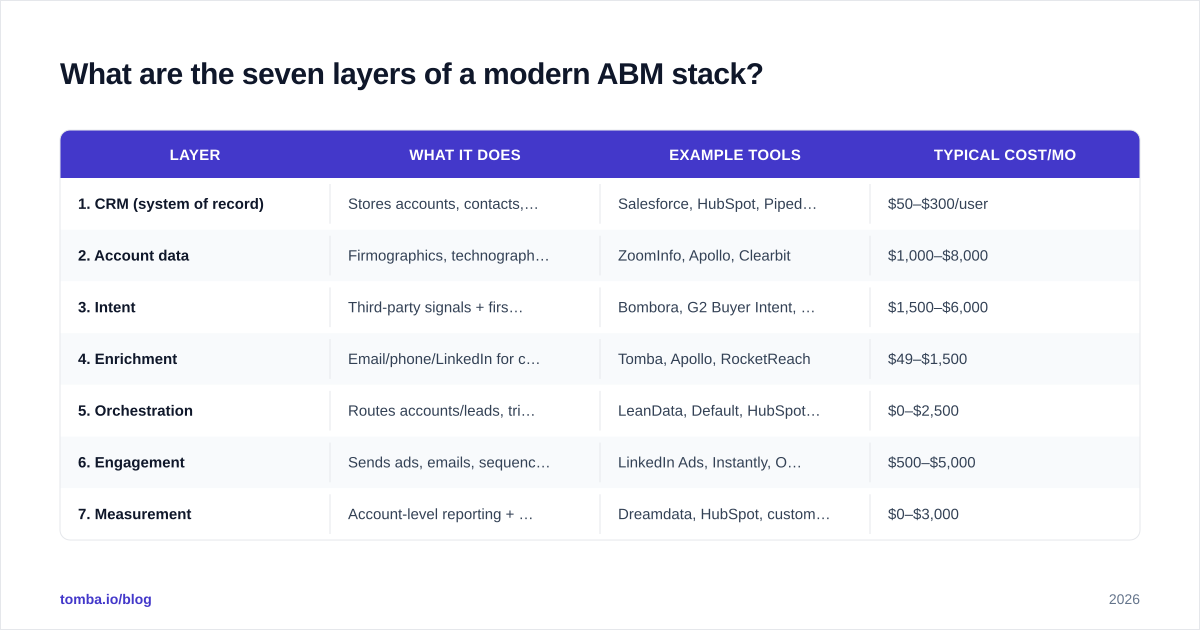
A solid mid-market stack hits all seven layers for under $4,000/month. An enterprise stack with 6sense or Demandbase at the center will easily clear $15K/month — and you should be honest about whether the extra spend pays back.
What sits in the CRM layer?#
Your CRM is the spine. Every other tool either writes to it or reads from it. If your account and contact data is messy in the CRM, no ABM tool downstream can save you.
The choice in 2026 is still mostly between Salesforce and HubSpot. Salesforce wins on customization and enterprise scale. HubSpot wins on out-of-the-box reporting and time-to-value. Pipedrive remains a fine fit for sub-50-person teams. For a deeper definition of how the CRM underpins everything downstream, see the glossary.
What the CRM layer needs to do for ABM specifically:
- Distinct account and contact objects (not just contacts)
- Custom fields for ICP fit score, intent score, and account tier (1/2/3)
- Account hierarchies for parent/child relationships
- Activity logging from email, calendar, and call tools
If your CRM cannot do those four things cleanly, fix that before buying anything else.
What does the account data layer actually do?#
This layer answers: of all the companies in the world, which ones match our ICP, and who works there?
The big three are ZoomInfo, Apollo, and Clearbit (now part of HubSpot). In practice:
- ZoomInfo has the deepest firmographic and technographic coverage, but pricing starts around $15K/year and contracts are notoriously rigid.
- Apollo bundles data + sequencing + dialer in one tool. Cheaper and faster, but its email accuracy in EMEA and APAC lags.
- Clearbit / HubSpot Breeze Intelligence is best if you are already a HubSpot shop and want enrichment to happen automatically on form fill.
Most teams underestimate how much of "ABM" is just having clean account data. If your sales team is still copy-pasting from LinkedIn into Salesforce, no amount of intent data will help.
How important is the intent data layer?#
Intent data is the most over-hyped and under-operationalized layer in the stack. Vendors will quote you research showing buyers do 70% of the journey before talking to sales — true — and then sell you a tool that flags "surging accounts" you cannot actually act on.
Intent breaks into two flavors:
- Third-party intent — what accounts are reading across the web (Bombora, G2, TrustRadius)
- First-party intent — what accounts do on your properties (visitor reveal tools, form data)
First-party is more actionable. A tool like Tomba's website visitor reveal tells you which companies are on your pricing page right now. That is a signal you can act on this afternoon — not next quarter.
Buy third-party intent only if you have:
- A defined ICP with at least 500 target accounts
- A play designed for surging accounts (specific email, ad creative, SDR script)
- Capacity to actually run that play within 72 hours of the signal
If you fail any of those three, intent data becomes an expensive dashboard nobody opens.
What goes in the enrichment layer?#
This is where ABM stops being theoretical. You have a target account list. You have intent signals. Now you need to find and contact specific humans inside those accounts — and that means email, phone, and LinkedIn data per contact.
Enrichment tools fill that gap. The honest comparison:
| Tool | Strength | Weakness | Starter price |
|---|---|---|---|
| Tomba | Highest verified-email accuracy in 2026 benchmarks; clean API | Smaller phone database than Apollo | $49/mo |
| Apollo | Bundled sequencing + dialer | Email deliverability declining; quality varies by region | $59/mo |
| RocketReach | Strong personal email coverage | Slow bulk processing | $80/mo |
| ZoomInfo Engage | Tight CRM sync | Steep contract minimums | Custom |
| Clearbit | Auto-enrichment on form fill | No standalone search workflow | Bundled with HubSpot |
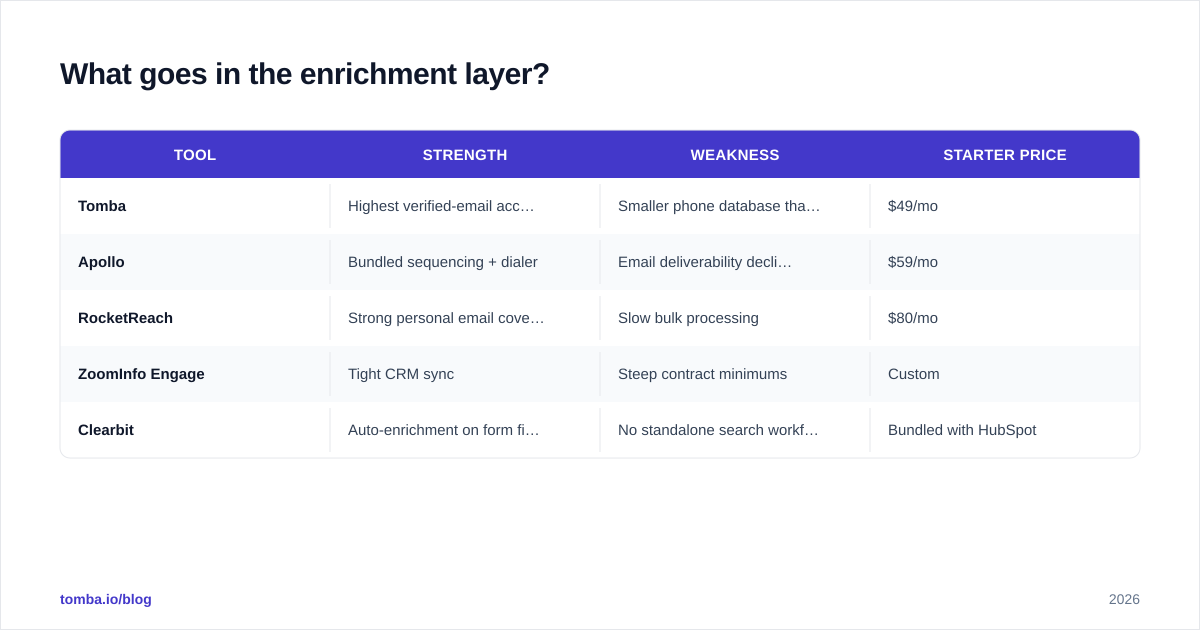

If you are running outbound at any scale, you need an email finder plus an email verifier in the stack. The finder gives you the addresses; the verifier keeps your sender reputation alive. Skipping verification is the single fastest way to torch a domain — and a torched domain takes weeks to recover.
For bigger teams, the bulk email finder workflow turns a list of 5,000 target accounts into a verified contact file in an afternoon. That used to take an SDR team a full week.

What does the orchestration layer do?#
Orchestration is the unsexy plumbing that decides what happens when a signal fires. An account just hit the pricing page — does it get routed to AE, SDR, or marketing? An MQL just downloaded the buyer's guide — what's the next touch?
The options:
- LeanData — the enterprise default for lead-to-account matching and routing
- Default — newer entrant, faster setup, friendlier pricing
- HubSpot workflows / Salesforce flows — free with your CRM, fine for simpler routing
- Zapier / Make — duct tape that works at smaller scale; see the Zapier integration for connecting enrichment to your CRM
You probably do not need a dedicated orchestration tool until you have at least 10 reps and three named plays running in parallel. Before that, native CRM workflows are enough.
How do the engagement and advertising layers fit together?#
Engagement is where the message reaches the buyer. It splits into three sub-channels — and ABM done well uses all three in concert, not in isolation.
Ads. LinkedIn Matched Audiences is still the workhorse for B2B account-based advertising. Upload your target account list, run sponsored content + message ads, retarget pricing-page visitors. Display ABM via 6sense or Demandbase adds reach but rarely beats LinkedIn on intent-quality.
Email. This is where most pipeline actually gets created. Tools split into:
- Sales engagement platforms — Outreach, Salesloft, Apollo, Saleshandy
- Cold email infrastructure — Instantly, Smartlead, Lemlist (focused on deliverability)
If you are doing high-volume outbound, the deliverability-focused tools beat the SEPs. If you are running named-account, low-volume, high-touch, the SEPs win because of CRM logging.
Sales touches. Calls, LinkedIn messages, video. The data and routing layers feed these, but the channel itself is a human one.
A practical rule: pair each ad campaign with an outbound email sequence and an SDR call cadence targeting the same account list, in the same week. Single-channel ABM is just regular marketing with extra steps.
What about measurement and attribution?#
Account-level reporting is where most ABM programs collapse. The CMO asks "did ABM work?" and nobody can answer cleanly because:
- Sales credits all closed-won to the rep, not the program
- Marketing credits everything to first-touch
- The CRM does not track account-level engagement history
You need three views minimum:
- Account engagement score — composite of web visits, email opens, ad impressions, content downloads
- Pipeline by account tier — how many tier-1 accounts moved from Aware → Engaged → Opportunity this quarter
- Influenced revenue — closed-won deals where any ABM touch happened in the 90 days before opp creation
Dreamdata and HubSpot's revenue reporting are the most common picks. Custom dashboards in Looker or Hex work too if you have a data team. Whatever you choose, define the metrics before you launch the program — retrofitting attribution is brutal.
How do I decide what to actually buy?#
A simple decision tree for 2026:
| If your company is... | Buy this stack |
|---|---|
| <50 employees, finding PMF | HubSpot Starter + Tomba + LinkedIn Ads + manual lists. Total: ~$500/mo |
| 50–200 employees, scaling outbound | HubSpot Pro + Tomba + Apollo (data) + Instantly + Bombora. Total: ~$3,500/mo |
| 200–1000, formal ABM program | Salesforce +ZoomInfo + Tomba (verification) + 6sense + Outreach + Dreamdata. Total: ~$18K/mo |
| Enterprise, 1000+ | Salesforce + Demandbase or 6sense full suite + dedicated RevOps team |
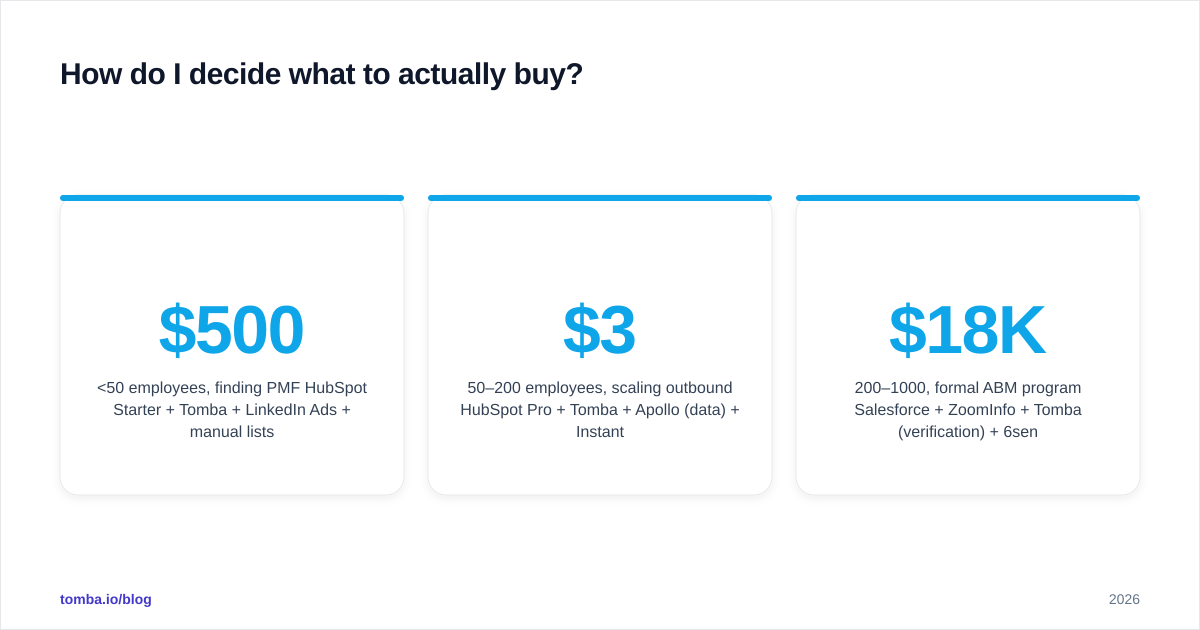
Notice the middle two tiers both include Tomba. The reason is mundane: even when you have ZoomInfo or Apollo for data, a dedicated finder + verifier (and the Tomba API for programmatic enrichment) keeps your contact data cleaner and your sender reputation healthier. It is the bicycle wheel under the truck.
What are the most common ABM stack mistakes in 2026?#
After watching dozens of teams build and rebuild ABM stacks, the same five mistakes show up:
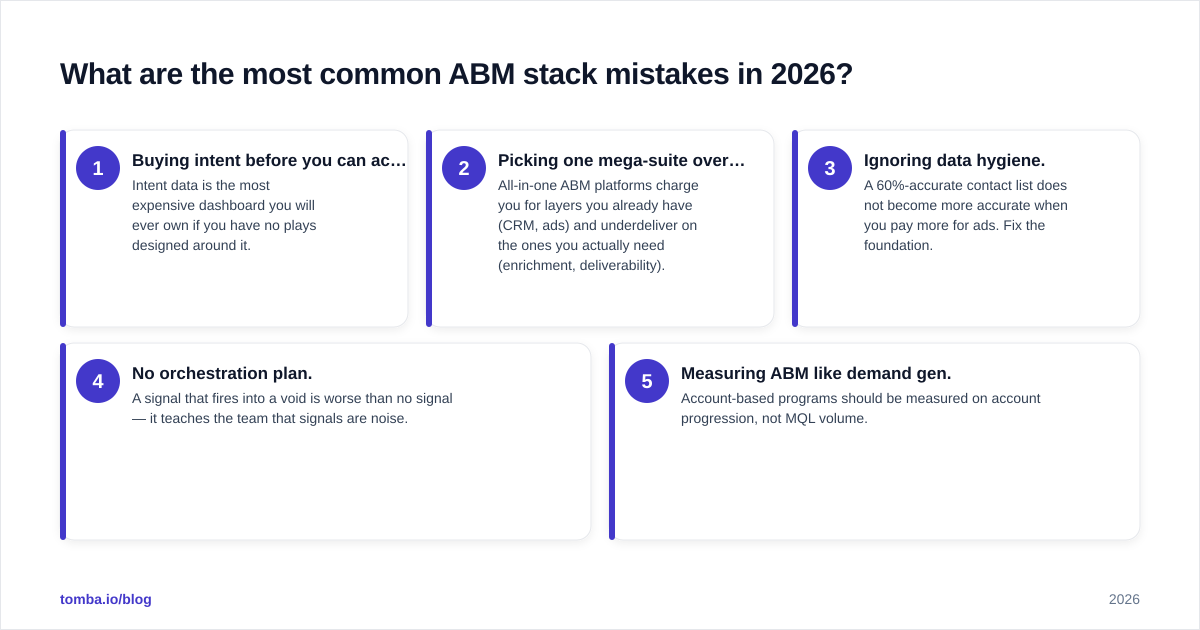
- Buying intent before you can act on it. Intent data is the most expensive dashboard you will ever own if you have no plays designed around it.
- Picking one mega-suite over best-of-breed. All-in-one ABM platforms charge you for layers you already have (CRM, ads) and underdeliver on the ones you actually need (enrichment, deliverability).
- Ignoring data hygiene. A 60%-accurate contact list does not become more accurate when you pay more for ads. Fix the foundation.
- No orchestration plan. A signal that fires into a void is worse than no signal — it teaches the team that signals are noise.
- Measuring ABM like demand gen. Account-based programs should be measured on account progression, not MQL volume.
For more on the foundations of revenue operations, the glossary lays out the underlying RevOps stack patterns that ABM sits on top of.
How does Tomba fit into an ABM stack?#
Tomba sits in the enrichment layer — the bridge between "we identified the account" and "we contacted the right human." The job is unglamorous and essential:
- Find verified work emails for the contacts you identified via ZoomInfo, Apollo, or LinkedIn
- Verify and clean lists before any outbound campaign to protect deliverability
- Enrich CRM records automatically through the API or native HubSpot and Salesforce integrations
- Power bulk workflows when you need to action a 5,000-account list inside 24 hours
Starter is $49/mo, Growth is $99/mo, and the free tier (25 searches/mo) is enough to test the workflow end-to-end. See full Tomba pricing for team-tier breakdowns.
Where should you start?#
If you are building or rebuilding your ABM stack in 2026, do this in order:
- Clean up your CRM (one week)
- Define your ICP and target account list (one week)
- Wire up data + enrichment with the Tomba Email Finder so every account on the list has at least three verified contacts (two weeks)
- Launch one engagement play across LinkedIn Ads + email + SDR calls (one month)
- Then layer in intent and orchestration
Start narrow, ship fast, measure account progression weekly. The teams that win at ABM are not the ones with the most tools — they are the ones whose stack can move a tier-1 account from "never heard of you" to "in active sales conversation" in 90 days. Build for that, and the layers fall into place.
Ready to plug the enrichment layer into your stack? Try the Tomba Email Finder free — 25 searches a month, no card required, full API access on every plan.
// get started
Find, verify and enrich your first contacts today
Start on the free plan with 25 searches a month, then scale when your team is ready.
Free plan · No credit card required · GDPR & CCPA
// about the author