ABM vs ABX in 2026: What Actually Changed and Why It Matters
ABM targets accounts. ABX orchestrates experiences across the buying committee. Here is the honest 2026 breakdown — what works, what is hype, and which model fits your GTM motion.
TL;DR
- ABM (Account-Based Marketing) targets a named list of accounts with coordinated marketing campaigns. ABX (Account-Based Experience) extends that idea across the entire buying group and the full lifecycle — pre-sale, sale, and post-sale.
- ABX is not a new acronym for the same playbook. The shift is real: from MQLs and one-off plays to signal-driven, multi-threaded experiences that include CS, product, and RevOps.
- ABM still wins for small target lists with high-touch sales. ABX wins when you have buying committees of 6+, intent data, and a CS motion that can expand revenue.
- The stack is converging: intent platforms (6sense, Demandbase), data and email finders (Tomba, Apollo), orchestration (HubSpot, Salesforce), and ad targeting (LinkedIn, RollWorks).
- You do not have to choose one. Most successful 2026 teams run ABM for tier-1 accounts and ABX patterns across tier-2 and tier-3.
What is ABM and how did it get here?#
Account-Based Marketing (ABM) is the practice of treating individual accounts as their own market. Instead of casting a wide net for inbound leads, you pick a finite list of companies that match your ideal customer profile and run coordinated marketing and sales plays against them.
ITSMA coined the term in 2004, but the model went mainstream around 2016 when Engagio, Demandbase, and Terminus turned it into a software category. The classic ABM motion looked like this:
- Marketing and sales agree on a target account list (TAL).
- Marketing runs display ads, direct mail, and personalized content against the list.
- SDRs prospect into named contacts at those accounts.
- AEs close the deals marketing warms up.
It worked. ABM-focused teams reported higher deal sizes and shorter cycles in ITSMA benchmark data for years. But the model had cracks. It was front-loaded toward acquisition, ignored the post-sale lifecycle, and treated buying as a marketing-to-sales handoff when modern B2B purchases involve 6 to 10 people making decisions together.
What is ABX and how is it different from ABM?#
ABX (Account-Based Experience) is the term Demandbase popularized around 2021 to describe what ABM became once intent data, AI scoring, and post-sale revenue motions matured. The core shift: from "campaigns targeting accounts" to "orchestrated experiences across the full buying group and lifecycle."
The ABX model has four practical differences from classic ABM:
- Signal-first, not list-first. You still have target accounts, but the trigger to act is a buying signal (intent surge, job change, funding round, product usage spike), not a quarterly campaign calendar.
- Buying-group, not lead-based. You map the committee — economic buyer, champion, technical evaluator, end users — and engage each role with content tuned to their job-to-be-done.
- Full lifecycle, not just acquisition. ABX governs pre-sale demand, sales execution, onboarding, expansion, and renewal as one continuous experience.
- Orchestrated channels, not parallel ones. Email, ads, sales touches, and product experiences fire in sequence based on engagement, not on independent campaign schedules.
Forrester now uses "buyer engagement" and Gartner uses "buying group orientation" to describe the same shift. The acronym is less important than the underlying change.
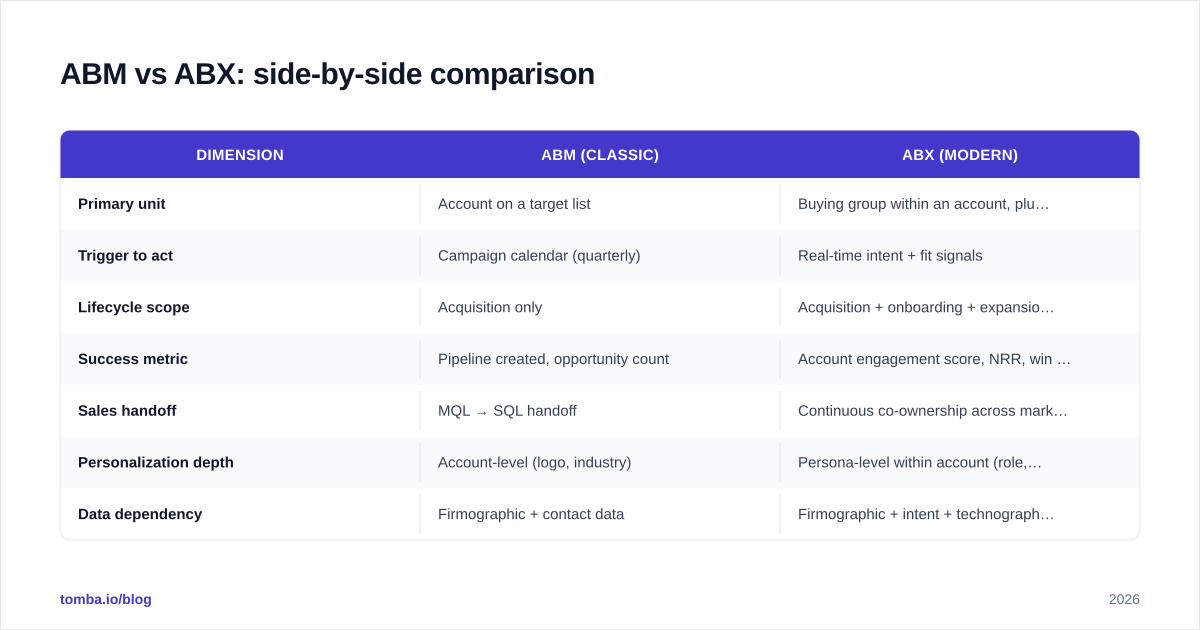
ABM vs ABX: side-by-side comparison#
| Dimension | ABM (classic) | ABX (modern) |
|---|---|---|
| Primary unit | Account on a target list | Buying group within an account, plus signals |
| Trigger to act | Campaign calendar (quarterly) | Real-time intent + fit signals |
| Lifecycle scope | Acquisition only | Acquisition + onboarding + expansion + renewal |
| Success metric | Pipeline created, opportunity count | Account engagement score, NRR, win rate per tier |
| Sales handoff | MQL → SQL handoff | Continuous co-ownership across marketing, sales, CS |
| Personalization depth | Account-level (logo, industry) | Persona-level within account (role, pain, stage) |
| Data dependency | Firmographic + contact data | Firmographic + intent + technographic + product usage |
| Typical channels | Display, direct mail, SDR outbound | Above + LinkedIn ABM ads, podcast targeting, in-product nudges, CS-led plays |
| Tech maturity needed | CRM + marketing automation | CRM + MAP + intent + reverse ETL + product analytics |
| Org alignment | Marketing + sales | Marketing + sales + CS + product + RevOps |
| Best for | <100 tier-1 accounts | 100–10,000 accounts across multiple tiers |
Is ABX just a rebrand of ABM?#
Partly, yes. The cynical read is that Demandbase and a few analysts needed a fresh acronym to sell software upgrades, and the underlying principles — target named accounts, personalize at the account level, align marketing and sales — were already in ABM.
The honest read is that the playbook actually changed. Three forces forced the upgrade:
- Buying committees grew. Gartner's 2023 B2B buying research found the average enterprise software purchase involves 6 to 10 stakeholders. Single-threaded ABM plays lose to multi-threaded ABX motions when 8 people have to agree.
- Intent data became reliable. Bombora, G2, 6sense, and Demandbase now publish signals accurate enough to trigger action. ABM did not have this in 2016.
- NRR became the metric that matters. SaaS valuations now hinge on net revenue retention. A model that only optimizes acquisition leaves money on the table when 70% of revenue comes from existing customers.
So ABX is partly a rebrand, partly a real evolution. If your team already does signal-based outreach, multi-threaded engagement, and CS-led expansion, you are doing ABX even if your slide deck says ABM.
When should you choose ABM over ABX?#
ABM (the classic, list-driven version) still wins in specific situations:
- Very small TALs. If you sell to 25 named accounts globally, you do not need intent data — you need an SDR who knows every contact by name. ABX overhead is wasted.
- Long, relationship-driven cycles. Government contracting, defense, and some healthcare verticals where deals close on personal trust over 18 months. The signal-based ABX motion does not fit a procurement-driven buyer.
- Early-stage GTM without data infrastructure. If you do not yet have a CRM populated with clean firmographics, jumping to ABX is a tech-stack project, not a GTM project. Start with manual ABM and earn the right to automate.
- High-ASP, low-volume motions. When one deal is worth $2M+ ARR and you close 6 per year, you can afford white-glove, hand-built campaigns per account.
For these cases, an email finder and a clean spreadsheet beat a six-figure ABX stack. Build the list, find the buying committee with a tool like Tomba's domain search, enrich with contact data, and run hand-built plays.
When should you choose ABX over ABM?#
ABX is the better model when any of the following are true:
- Your TAL is 200+ accounts. Manual personalization breaks down. You need orchestration software and signal triggers to know which 20 of 500 deserve attention this week.
- Buying committees are large (6+ stakeholders). Multi-threading is non-negotiable. You need persona-level content and engagement tracking, not just account-level.
- You have a CS-led expansion motion. If 60%+ of revenue comes from upsell, cross-sell, or renewal, ABM (which stops at the close) is too narrow.
- You have intent and product-usage data. ABX without signals is just ABM with extra steps. If you already pay for Bombora, 6sense, or Snowplow, you have the raw material.
- Your sales cycles are 60–180 days with multiple touch types. ABX shines at sequencing email + ads + content + sales touches over a 4-month window.
What does the ABX tech stack look like in 2026?#
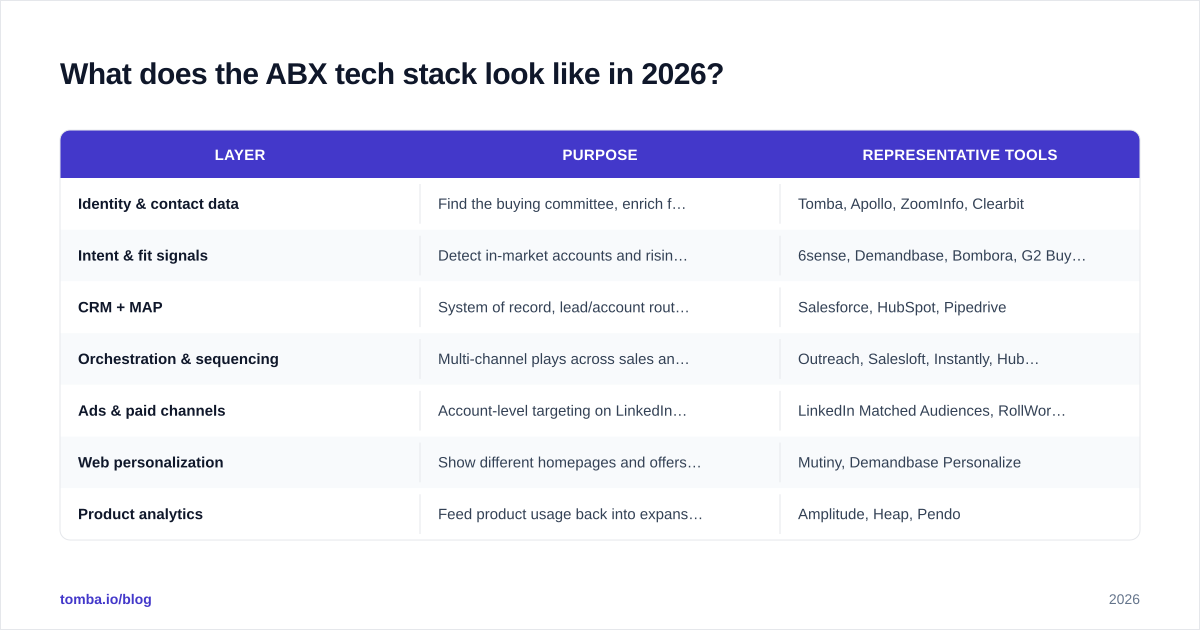
ABX is more stack-dependent than ABM. You need data, orchestration, channels, and analytics working together. Here is the realistic shape of a mid-market ABX stack:
| Layer | Purpose | Representative tools |
|---|---|---|
| Identity & contact data | Find the buying committee, enrich firmographics, verify emails | Tomba, Apollo,ZoomInfo, Clearbit |
| Intent & fit signals | Detect in-market accounts and rising priorities | 6sense, Demandbase, Bombora, G2 Buyer Intent |
| CRM + MAP | System of record, lead/account routing, lifecycle workflows | Salesforce, HubSpot, Pipedrive |
| Orchestration & sequencing | Multi-channel plays across sales and marketing | Outreach, Salesloft, Instantly, HubSpot Sequences |
| Ads & paid channels | Account-level targeting on LinkedIn, display, CTV | LinkedIn Matched Audiences, RollWorks, Metadata |
| Web personalization | Show different homepages and offers per account | Mutiny, Demandbase Personalize |
| Product analytics | Feed product usage back into expansion plays | Amplitude, Heap, Pendo |
| RevOps & attribution | Stitch signals, measure influenced revenue | Cube, dbt, Hightouch, BigQuery |
You do not need all of it on day one. The minimum viable ABX stack is: a CRM, a verified contact source like Tomba's email verifier, an intent provider, a sequencer, and LinkedIn ads. Everything else gets added when the simpler stack hits a ceiling.
How do the metrics differ between ABM and ABX?#
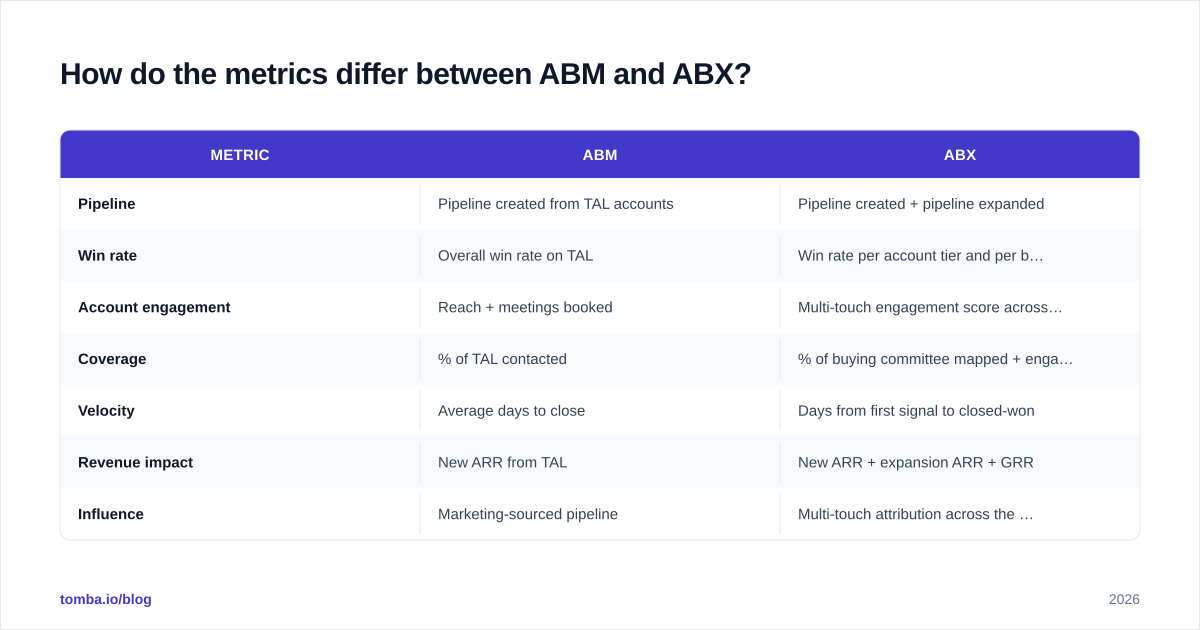
ABM and ABX use different scoreboards. If you switch motions without switching metrics, the numbers will lie to you.
| Metric | ABM | ABX |
|---|---|---|
| Pipeline | Pipeline created from TAL accounts | Pipeline created + pipeline expanded |
| Win rate | Overall win rate on TAL | Win rate per account tier and per buying-group coverage |
| Account engagement | Reach + meetings booked | Multi-touch engagement score across personas |
| Coverage | % of TAL contacted | % of buying committee mapped + engaged |
| Velocity | Average days to close | Days from first signal to closed-won |
| Revenue impact | New ARR from TAL | New ARR + expansion ARR + GRR |
| Influence | Marketing-sourced pipeline | Multi-touch attribution across the lifecycle |
The ABX metric that matters most is buying-group coverage. If you have engaged the economic buyer, champion, and one technical evaluator at an account, your win rate jumps materially compared to single-threaded deals.
What does an ABX play actually look like?#
Concrete example. You sell a sales automation tool at $30K ACV. An ABX play might fire when:
- Signal: Account hits an intent surge on "sales engagement platform" (Bombora) AND a new VP of Sales joined LinkedIn at the company in the last 30 days.
- Buying-group map: Use a LinkedIn finder to find the new VP, the existing CRO, the sales ops lead, and two AEs. Verify emails with Tomba's email verifier before any outbound.
- Channel orchestration:
- Day 0: LinkedIn ad campaign targeted at the five-person buying group launches.
- Day 2: Personalized email to the VP referencing the recent role change.
- Day 5: Connection request + value-add comment from your AE on the VP's LinkedIn post.
- Day 7: Email to the sales ops lead with a technical 1-pager.
- Day 10: Direct mail to the VP — a printed teardown of their current stack.
- Day 14: Re-engagement email to anyone who clicked but did not reply.
- CS handoff (already mapped): If the deal closes, the CSM already knows who the champion is and what they cared about, because the engagement data flowed into the account record.
That is the difference. ABM might have run the LinkedIn ads and an SDR email cadence. ABX wires the whole sequence together, fires only when signals warrant, and hands off cleanly to CS.
How do pricing and effort compare?#
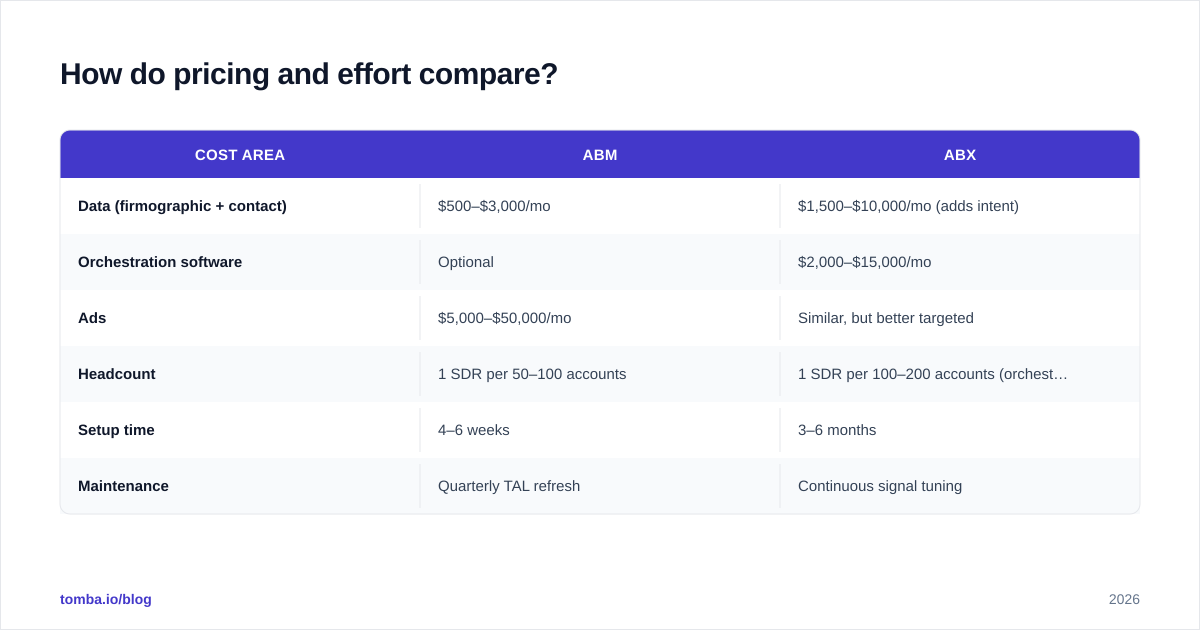
ABM and ABX both require investment. The shape of the investment differs.
| Cost area | ABM | ABX |
|---|---|---|
| Data (firmographic + contact) | $500–$3,000/mo | $1,500–$10,000/mo (adds intent) |
| Orchestration software | Optional | $2,000–$15,000/mo |
| Ads | $5,000–$50,000/mo | Similar, but better targeted |
| Headcount | 1 SDR per 50–100 accounts | 1 SDR per 100–200 accounts (orchestration leverage) |
| Setup time | 4–6 weeks | 3–6 months |
| Maintenance | Quarterly TAL refresh | Continuous signal tuning |
ABX has a higher floor, but the unit economics improve at scale. ABM stays manual; ABX automates the boring parts and lets humans focus on the high-judgment moments.
For pricing transparency on the data layer, Tomba pricing starts at a free tier with 25 searches per month, and the Starter plan is $49/mo — meaningfully lower than the enterprise data providers if your needs are contact discovery and verification rather than full intent.
Common mistakes when moving from ABM to ABX#
- Buying tools before fixing data. Intent data is worthless if your CRM is full of duplicates and outdated emails. Clean and verify first.
- Killing inbound. ABX is not anti-inbound. Inbound is one signal among many. Treat a demo request as the strongest possible intent signal and route it into your ABX motion.
- Over-engineering scoring. A 14-factor weighted score that nobody trusts is worse than a 3-factor model the team actually acts on.
- Skipping CS alignment. If CS is not in the buying-group map and the post-sale plays, you are still doing ABM with extra software.
- Measuring acquisition only. You will conclude ABX is not worth it because you ignored the expansion lift, which is where ABX usually wins.
How do you transition from ABM to ABX without breaking pipeline?#
A staged approach beats a big-bang rebrand:
- Quarter 1: Keep ABM running. Add one intent signal (a free Bombora trial or G2 Buyer Intent on your category) and route one weekly play off it.
- Quarter 2: Map buying groups for your top 50 accounts. Use a tool like Tomba's bulk email finder to enrich contacts at scale, then verify them before sequencing.
- Quarter 3: Bring CS into the account review. Add expansion plays for existing customers showing intent on adjacent products.
- Quarter 4: Move scoring from MQL-based to account-engagement-based. Retire MQL goals and replace with sourced + influenced pipeline per tier.
By quarter 4 you are running ABX without ever turning off the lights on ABM.
What is the verdict: ABM or ABX in 2026?#
If you are running a small, high-ASP, relationship-driven motion: stay with ABM. The overhead of ABX is not worth it for 25 accounts.
If you sell to mid-market or enterprise with buying committees, multiple tiers of accounts, and a CS expansion motion: ABX is the better model. The "X" is the part that matters — the experience that spans acquisition, onboarding, expansion, and renewal as one continuous motion.
For most teams, the realistic answer is both. Use ABM for tier-1 (top 50 strategic accounts, fully manual, white-glove). Use ABX patterns for tier-2 and tier-3 (orchestrated, signal-driven, automated where possible). Let the metrics tell you when to graduate an account between tiers.
Where does Tomba fit in?#
ABM and ABX both depend on knowing who is in the buying group and reaching them at verified email addresses. That is the layer Tomba sits in.
Use Tomba Email Finder to build accurate buying-group contact lists from a target account list, domain search to map every team at a target account, email verifier to keep your sender reputation safe before any cold sequence, and the Tomba API to wire contact discovery into your ABX orchestration stack. Free tier covers 25 searches per month if you want to test it against your TAL before committing.
Pick the right model for your motion. Build the data layer that lets either one work. The acronym matters less than the discipline behind it.
// get started
Find, verify and enrich your first contacts today
Start on the free plan with 25 searches a month, then scale when your team is ready.
Free plan · No credit card required · GDPR & CCPA
// about the author