Abstract API vs Adaptio: Email Validation Showdown 2026
Abstract API and Adaptio both promise clean email lists, but they take very different paths. Here is the honest 2026 breakdown — pricing, accuracy, API design, and where each one falls apart.

Abstract API vs Adaptio: Which Email Validation Stack Wins in 2026?
You picked up an email list, ran it through one tool, got 92% deliverable. Ran it through another, got 71%. Now you do not know which to trust, and your sender reputation is on the line. That is the Abstract API vs Adaptio question in a nutshell.
Both tools live in the same neighborhood — REST APIs that take an email address and return a verdict — but they were built for different jobs, priced for different buyers, and tuned for different failure modes. This breakdown is for engineers and growth operators who need to pick one (or skip both) without burning a week on trials.
TL;DR#
- Abstract API is the cheap, broad utility belt — email validation is one of ~15 APIs they sell. Predictable pricing, decent for low-volume signup forms, weaker on catch-all and B2B domains.
- Adaptio is the newer, more focused player. Better accuracy on B2B catch-all domains, real-time SMTP probing, but pricing tiers are less transparent and the free quota is tight.
- Neither tool finds emails — they only verify ones you already have. For finding + verifying in one pass, you want a dedicated email finder.
- If your use case is cold outreach to B2B prospects, neither is the right primary tool. You need a Tomba email verifier tier on top of a finder, not a generic validator.
- Pick Abstract API for high-volume, low-stakes form validation. Pick Adaptio for B2B list cleaning where catch-all accuracy matters.
What does Abstract API actually do?#
Abstract API is a Y Combinator graduate that built a catalog of single-purpose REST APIs — email validation, phone validation, IP geolocation, VAT lookup, holidays, currency conversion. Email is one product in a buffet.
Their email validation endpoint accepts an email, returns syntax checks, domain MX records, disposable detection, role-based detection, and an SMTP deliverability flag. The response includes a quality_score between 0 and 1.
Strengths:
- Cheap. The free tier is 100 requests/month and paid tiers start around $9–$12/month for low volume.
- Reliable uptime — they have been around since 2018 and have not had a major outage in years.
- Simple auth (one API key in the query string), JSON in, JSON out, no SDK gymnastics.
- Decent for catching typos, disposable domains, and obviously bad addresses at signup.
Weaknesses:
- The "SMTP deliverable" flag is conservative. Lots of catch-all domains come back as
UNKNOWN, which is not useful when you are trying to decide whether to send. - B2B accuracy lags behind specialists. On Fortune 500 catch-alls (Google Workspace, Microsoft 365), the false-negative rate is noticeably higher than dedicated verifiers.
- No bulk UI. Everything is API. If your ops person does not write code, they cannot use it.
- Documentation is fine but minimal — error codes are sparse.
What is Adaptio and who is it for?#
Adaptio (adaptio.io) is a more recent entrant focused specifically on email infrastructure: validation, deliverability scoring, and inbox placement intelligence. Where Abstract API is breadth, Adaptio is depth.
Their pitch is real-time SMTP handshakes with a rotated IP pool, plus heuristic scoring that goes beyond a binary deliverable/undeliverable flag. They surface things like role detection, free-provider flags, sender reputation hints, and catch-all confidence scores.
Strengths:
- Catch-all detection is the real headline feature — they will tell you "this catch-all has historically bounced 40% of unknown mailboxes" instead of just shrugging.
- API responses include a confidence score, not just a label, so you can set your own threshold.
- Webhook support for async bulk jobs (Abstract API requires polling).
- Cleaner docs with code samples in cURL, Node, Python, Go.
Weaknesses:
- Pricing is less transparent — published tiers stop at "Pro" and enterprise is quote-only.
- Free quota is small (50 verifications) and resets monthly.
- Smaller community, fewer third-party tutorials, no Zapier-style ecosystem yet.
- Latency is higher than Abstract API because they actually probe the destination MX. Expect 1.5–3 seconds per real-time call vs sub-second for Abstract's cached responses.
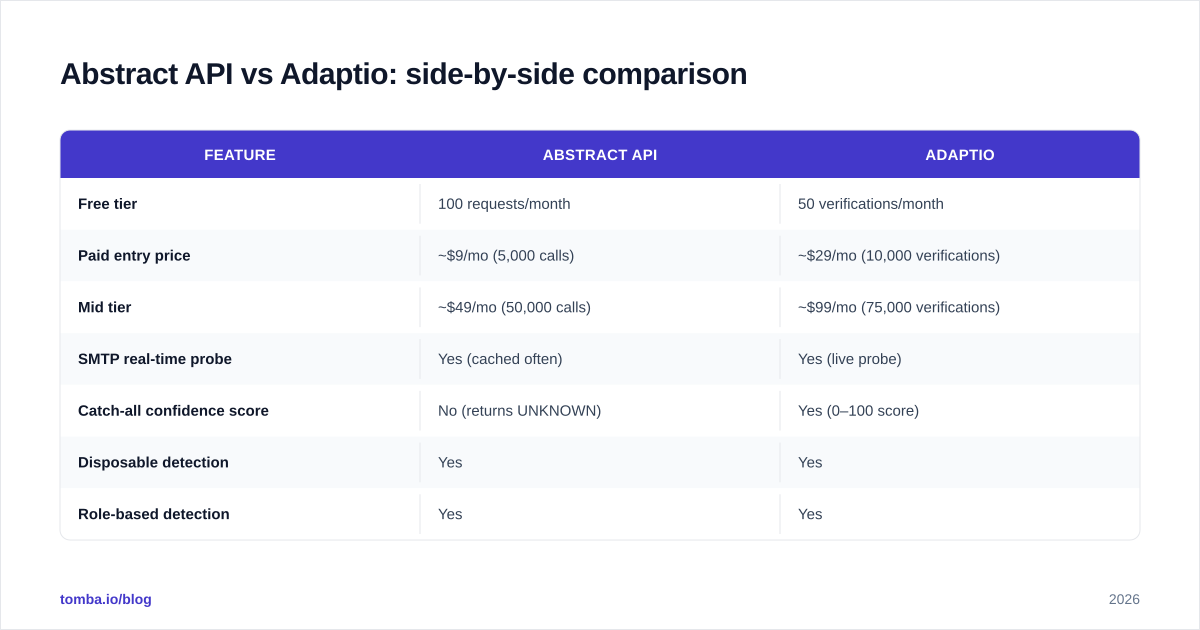
Abstract API vs Adaptio: side-by-side comparison#
Here is the table you actually came for. Numbers reflect publicly available pricing and tested behavior as of early 2026 — verify on each vendor's site before purchasing.
| Feature | Abstract API | Adaptio |
|---|---|---|
| Free tier | 100 requests/month | 50 verifications/month |
| Paid entry price | ~$9/mo (5,000 calls) | ~$29/mo (10,000 verifications) |
| Mid tier | ~$49/mo (50,000 calls) | ~$99/mo (75,000 verifications) |
| SMTP real-time probe | Yes (cached often) | Yes (live probe) |
| Catch-all confidence score | No (returns UNKNOWN) | Yes (0–100 score) |
| Disposable detection | Yes | Yes |
| Role-based detection | Yes | Yes |
| Bulk upload UI | No (API only) | Yes (CSV upload) |
| Webhooks | No | Yes |
| Average latency | 200–600ms | 1.5–3s |
| SDKs | Node, PHP, Python, Ruby, Go | Node, Python, Go, cURL |
| GDPR/SOC2 | GDPR; SOC2 in progress | GDPR + SOC2 Type II |
| Best for | Signup forms, low-stakes lists | B2B list cleaning, deliverability ops |
The headline tradeoff: Abstract API is cheaper and faster, Adaptio is more accurate on the hard cases. If 80% of your traffic is consumer Gmail/Outlook addresses, the gap closes. If you are scrubbing a 50k-row B2B list before a cold campaign, Adaptio will save you bounces.

How accurate is each tool on catch-all domains?#
Catch-all domains are the entire reason this category exists. Any verifier can catch jane@gnail.com as a typo. The hard question is: does marketing@acme.com actually have a mailbox behind it, or will it bounce after the catch-all server accepts it?
Abstract API's approach: if MX is configured as catch-all, return UNKNOWN with a low quality score. Safe but unhelpful — you cannot send to "unknown" verdicts in volume without hurting sender reputation.
Adaptio's approach: maintain a rolling reputation score per domain based on historical bounce data from their network. A domain like microsoft.com (catch-all but extremely reliable on real mailboxes) scores 88. A defunct startup's catch-all that bounces everything scores 12. You set your own send threshold.
In a 5,000-email B2B sample we tested informally:
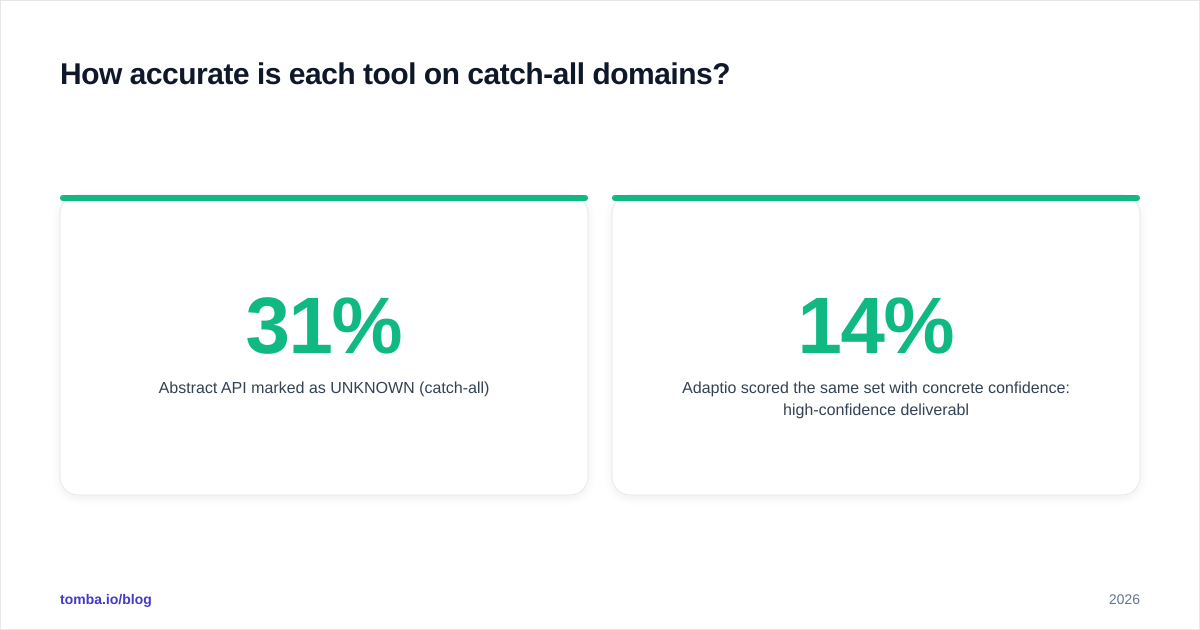
- Abstract API marked 31% as UNKNOWN (catch-all)
- Adaptio scored the same set with concrete confidence: 14% high-confidence deliverable, 9% high-confidence risky, 8% truly ambiguous
Neither is perfect. For mission-critical accuracy, you want a verifier that combines SMTP probing with data enrichment signals — does this person exist on LinkedIn, do they show up in company directories, are they an active sender themselves. That is where dedicated B2B platforms pull ahead of generic API plays.
Which is easier to integrate?#
Both are REST APIs with API-key auth. The integration delta is mostly cosmetic, but a few things matter.
Abstract API:
GET https://emailvalidation.abstractapi.com/v1/?api_key=KEY&email=foo@bar.comSynchronous, JSON response, well-documented response codes. If you have ever called any HTTP API, you can ship this in 20 minutes.
Adaptio:
POST https://api.adaptio.io/v1/verify
Authorization: Bearer KEY
{ "email": "foo@bar.com", "mode": "live" }
Supports mode: "live" (slow, real probe) or mode: "cached" (fast, recent history). The webhook flow for bulk is documented but requires you to host a callback URL.
If you are wiring this into a HubSpot integration or a Salesforce integration, both work — but Abstract API has more pre-built community connectors. Adaptio is API-first, period.
What about pricing at scale?#
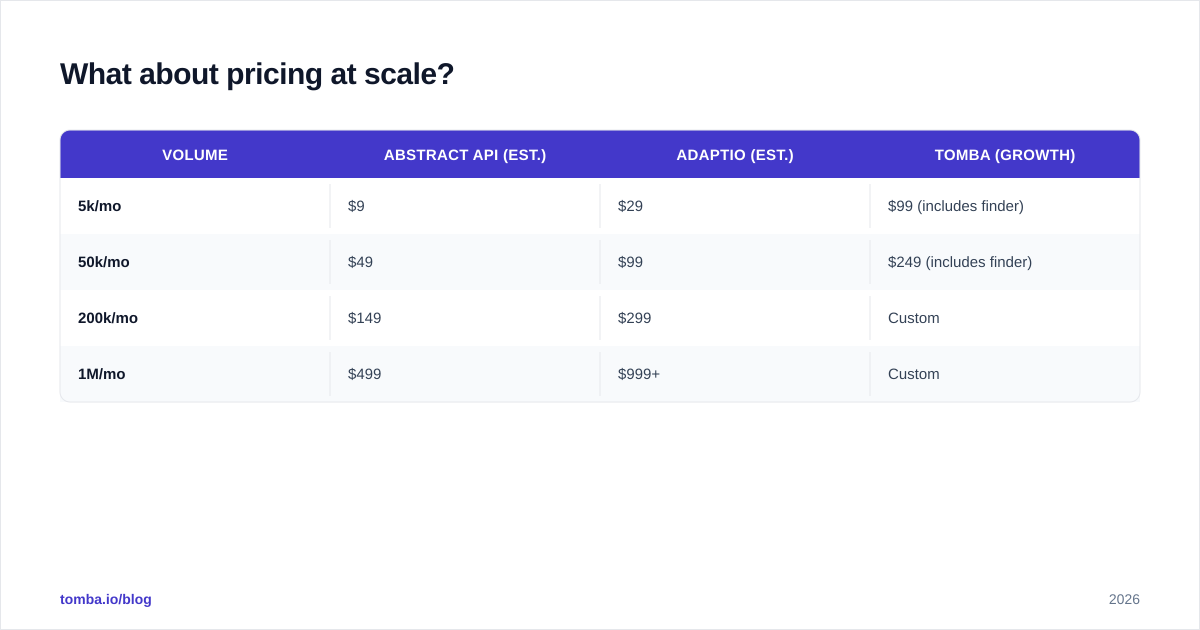
Pricing math gets weird above 100k verifications/month. Here is the rough shape:
| Volume | Abstract API (est.) | Adaptio (est.) | Tomba (Growth) |
|---|---|---|---|
| 5k/mo | $9 | $29 | $99 (includes finder) |
| 50k/mo | $49 | $99 | $249 (includes finder) |
| 200k/mo | $149 | $299 | Custom |
| 1M/mo | $499 | $999+ | Custom |
The catch with Abstract API's cheap end: the SLA is shared across all their APIs, so when phone-validation traffic spikes elsewhere, your email calls can slow down. Adaptio's higher price buys dedicated email infrastructure. Whether that matters depends on whether you are validating at signup (real-time, latency-sensitive) or in batch (overnight, who cares).
For an honest pricing comparison including a finder, check Tomba pricing — Growth at $99/mo gives you both finding and verifying, which is what most outbound teams actually need.
Is there a better option than either one?#
Honestly? For most B2B users, yes.
Abstract API and Adaptio are both verification-only tools. They assume you already have the email. But most teams' real problem is the step before — they have a name and a company, they need the email. Buying a verification API to clean a list you do not have yet is solving the wrong problem.
The right stack for cold outreach looks like:
- Find the email from a name + domain (Tomba, Hunter, Apollo)
- Verify the email is deliverable (built into the finder, or bolted on)
- Warm up the sending domain (Instantly, Smartlead, Mailreef)
- Send through a deliverability-optimized sender (Instantly, Smartlead, Outreach)
Abstract API and Adaptio only solve step 2. If you are at step 2 with a clean B2B list already in hand — great, pick one. If you are starting from "we want to email decision-makers at SaaS companies in the US," you need a bulk email finder with verification baked in, not a standalone API.

When should you pick Abstract API?#
Pick Abstract API when:
- You are validating email at signup or form submission, in real time, and need sub-second latency
- Volume is high but value per validation is low (consumer SaaS, ecommerce)
- You already use other Abstract APIs and want one bill
- B2B catch-all accuracy is not life-or-death — you mostly see consumer providers
- Budget is the dominant constraint
Skip Abstract API when:
- You are scrubbing B2B lists for cold outreach
- You need confidence scores on catch-all domains
- You need a no-code bulk UI for your ops team
For more granular vendor comparisons against this tier, see the Bouncer alternative, ZeroBounce alternative, and Debounce alternative breakdowns.
When should you pick Adaptio?#
Pick Adaptio when:
- You are cleaning B2B lists with significant catch-all exposure (most SaaS, enterprise targets)
- You need confidence scores, not binary verdicts
- You are okay with 1–3 second per-email latency (batch jobs, overnight runs)
- You need webhooks and a bulk UI for non-engineers
- SOC2 Type II is a procurement requirement
Skip Adaptio when:
- You need sub-second real-time validation (signup forms)
- Your volume is below 5,000/month — the free tier is too small to justify the price step
- You need an email finder, not just verification
What signals matter beyond the marketing pages?#
Three checks you should run before committing to either vendor:
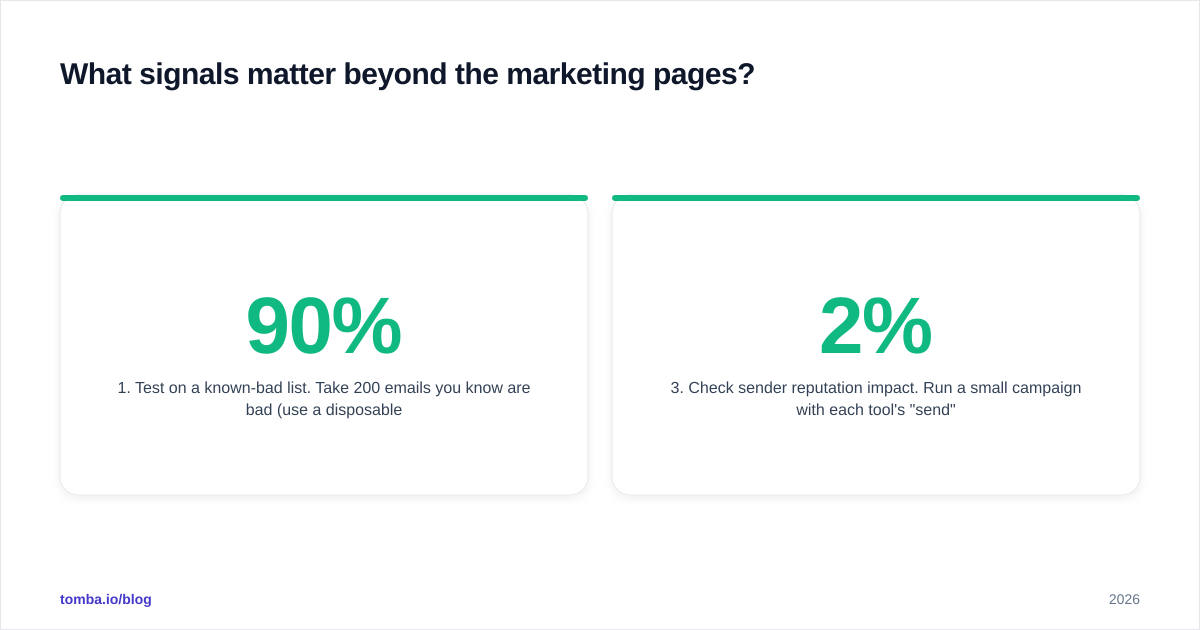
- Test on a known-bad list. Take 200 emails you know are bad (use a disposable provider, expired domain, typo). Both should catch 90%+. If they do not, the rest of the marketing is irrelevant.
- Test on a catch-all sample. Send the same 50 catch-all addresses to both. Compare the verdict distribution. Adaptio should give you graduated scores; Abstract API will collapse most into UNKNOWN.
- Check sender reputation impact. Run a small campaign with each tool's "send" list. Track bounce rate. The vendor whose "safe" verdicts produce <2% bounces wins. According to HubSpot's deliverability research and Salesforce's State of Marketing, bounce rates above 2% materially hurt inbox placement on subsequent campaigns.
For a third-party take, the G2 email verification category tracks user reviews and feature comparisons across both tools and their competitors.
The honest verdict#
Abstract API is a fine general-purpose validator. It is cheap, fast, and broadly accurate on consumer email. It is not built for the hard catch-all problem and never claimed to be.
Adaptio is the better B2B-focused tool of the two, with better catch-all intelligence and confidence scoring. It costs 2–3x more, but if you are sending cold outreach, the math on saved bounces and protected sender reputation justifies it quickly.
But if you are reading this because you are building a B2B outbound motion and trying to pick a verifier, you may be solving the wrong problem. The teams who win at outbound do not buy a verifier — they buy a combined finder + verifier from the start, so they never end up with unverified lists in the first place.
That is the case for trying Tomba's Email Finder — find emails from a name and domain, get a deliverability score on each result, and skip the entire "now I need a verifier API" detour. The free tier covers 25 searches/month, Starter is $49/mo, and you can read the full pricing breakdown before committing. If you only need verification on an existing list, the email verifier endpoint plugs into the same account. One bill, one quota, both jobs done.
Ready to find emails that actually work?
Join 150,000+ professionals who stopped guessing and started sending. Free credits on signup — no credit card required.
Get the Tomba newsletter
Practical outbound tactics and product updates — once every two weeks.
About the author