Abstract API vs Salesbot: B2B Data Tools Compared 2026
Abstract API and Salesbot solve different problems but get pitched against each other. Here's an honest 2026 breakdown of accuracy, pricing, and use cases.
Abstract API vs Salesbot: Which One Actually Fits Your Stack in 2026?
TL;DR
- Abstract API is a suite of developer-first REST endpoints for email validation, phone validation, IP geolocation, and company enrichment — billed per request.
- Salesbot is an outbound sales platform (best known as the AI SDR module inside Close CRM) that drafts emails, handles replies, and runs sequences.
- They are not direct competitors. One is a data utility you call from code; the other is a workflow that consumes data and sends messages.
- If you need clean records to feed a CRM or signup form, Abstract API wins. If you need an AI to actually book meetings, Salesbot wins.
- Most growth teams end up using both — plus a dedicated email finder like Tomba — because neither tool covers the full prospecting loop.
Why does the "Abstract API vs Salesbot" comparison even exist?#
The query shows up because both tools surface near the top of B2B tooling searches and because vendors love to label themselves as "all-in-one." They are not. Abstract API is a collection of stateless validation and enrichment endpoints aimed at engineers. Salesbot is an autonomous outbound agent aimed at SDR managers and founders who do not want to hire reps.
Lumping them together would be like comparing a kitchen knife to a delivery service. Both touch food. They do completely different things. This post will treat them as the separate products they actually are, then show you where each one fits — and where you still need a third tool to close the gap.
For an honest read on related categories, browse our take on revenue operations and how data quality drives every downstream play.
What is Abstract API?#
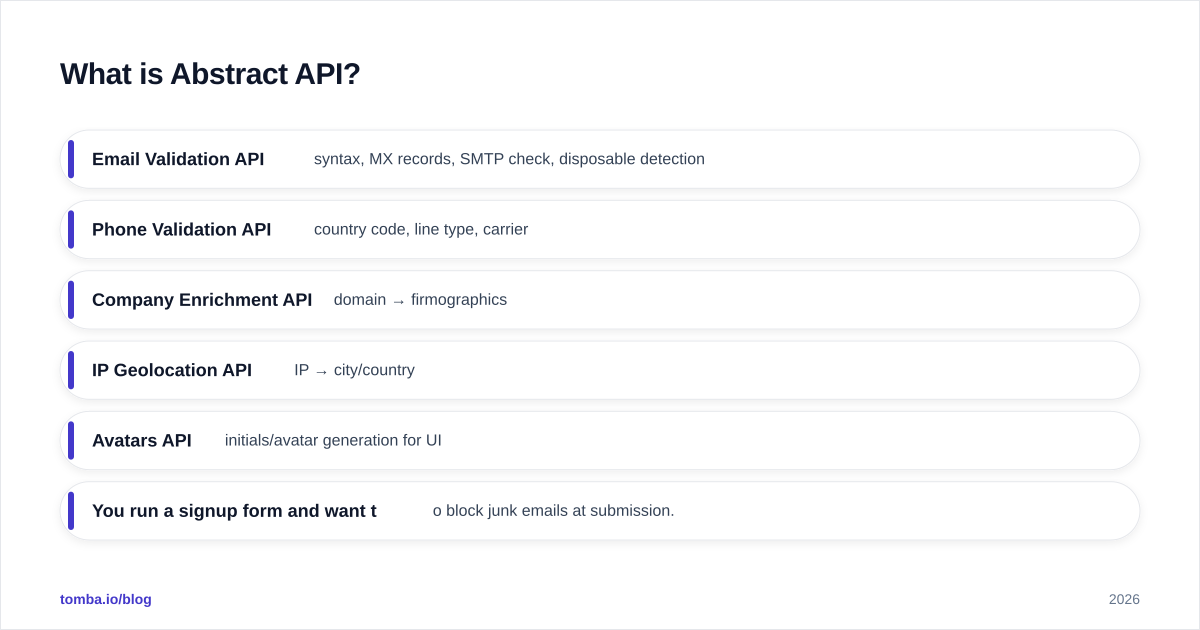
Abstract API (abstractapi.com) is a developer platform offering roughly a dozen independent REST APIs. The ones most relevant to sales and marketing teams are:
- Email Validation API — syntax, MX records, SMTP check, disposable detection
- Phone Validation API — country code, line type, carrier
- Company Enrichment API — domain → firmographics
- IP Geolocation API — IP → city/country
- Avatars API — initials/avatar generation for UI
Each endpoint is billed per call. You sign up, get an API key, and make HTTP requests. There is no UI for running a campaign, no contact list, no sequence builder. It is a layer your application calls.
This makes Abstract API a strong fit when:
- You run a signup form and want to block junk emails at submission.
- You import a list into a CRM and want to verify deliverability before sending.
- You build an internal tool that needs firmographic enrichment on the fly.
It is a poor fit if you want a packaged "find leads and email them" experience. There is no campaign layer.
What is Salesbot?#
Salesbot is the AI sales assistant built into Close CRM. It reads inbound replies, drafts personalized follow-ups, schedules sends, and routes hot replies to a human. Some teams use the Salesbot brand name to describe any AI SDR product, but for this comparison we mean the Close-native one — that is what most search traffic lands on.
Core capabilities:
- AI-drafted email sequences based on your ICP description
- Reply classification (interested / not interested / out of office)
- Auto-handoff to a rep when intent is detected
- Tied directly to Close's pipeline, calling, and SMS modules
Salesbot does not find email addresses on its own. It assumes you already have a contact list inside Close. It does not run heavy validation either — bounces still happen if your inputs are dirty. That is where pairing it with a finder like the Tomba Email Finder and a separate email verifier becomes important.
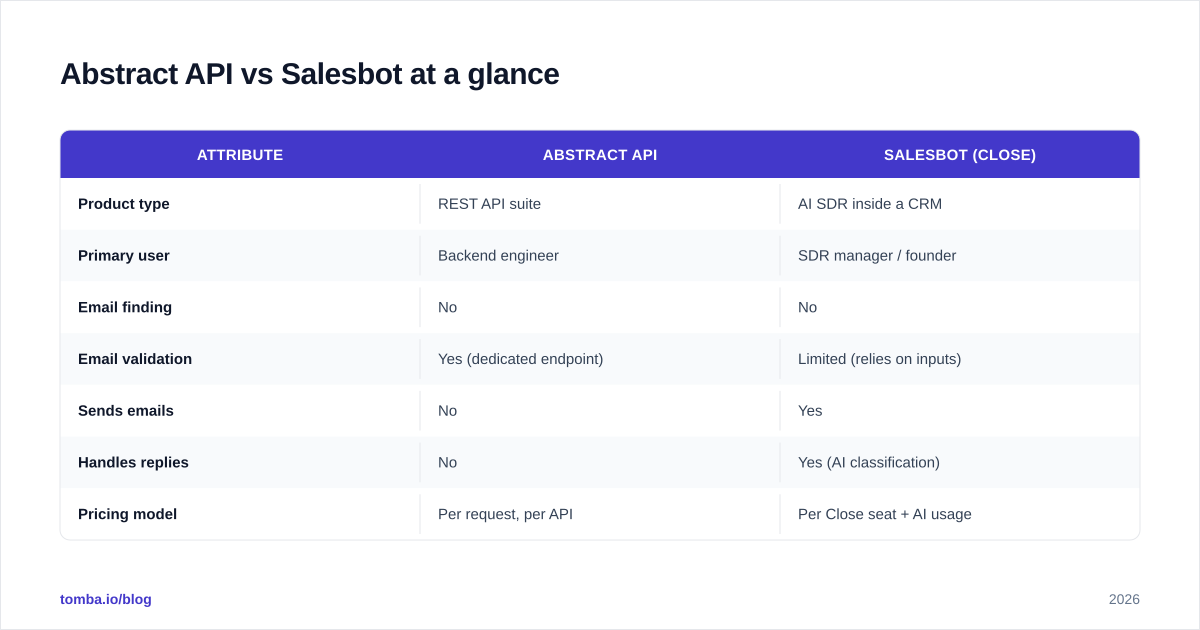
Abstract API vs Salesbot at a glance#
| Attribute | Abstract API | Salesbot (Close) |
|---|---|---|
| Product type | REST API suite | AI SDR inside a CRM |
| Primary user | Backend engineer | SDR manager / founder |
| Email finding | No | No |
| Email validation | Yes (dedicated endpoint) | Limited (relies on inputs) |
| Sends emails | No | Yes |
| Handles replies | No | Yes (AI classification) |
| Pricing model | Per request, per API | Per Close seat + AI usage |
| Free tier | 100 reqs/mo per API | Trial only |
| Starter price | ~$9/mo per API | Bundled with Close ($59+/seat) |
| Best for | Form validation, data hygiene | Outbound automation |
| Worst for | Running campaigns | Engineer-led pipelines |
How does pricing actually compare?#
Pricing is where the difference gets stark, because the two tools bill on entirely different units.
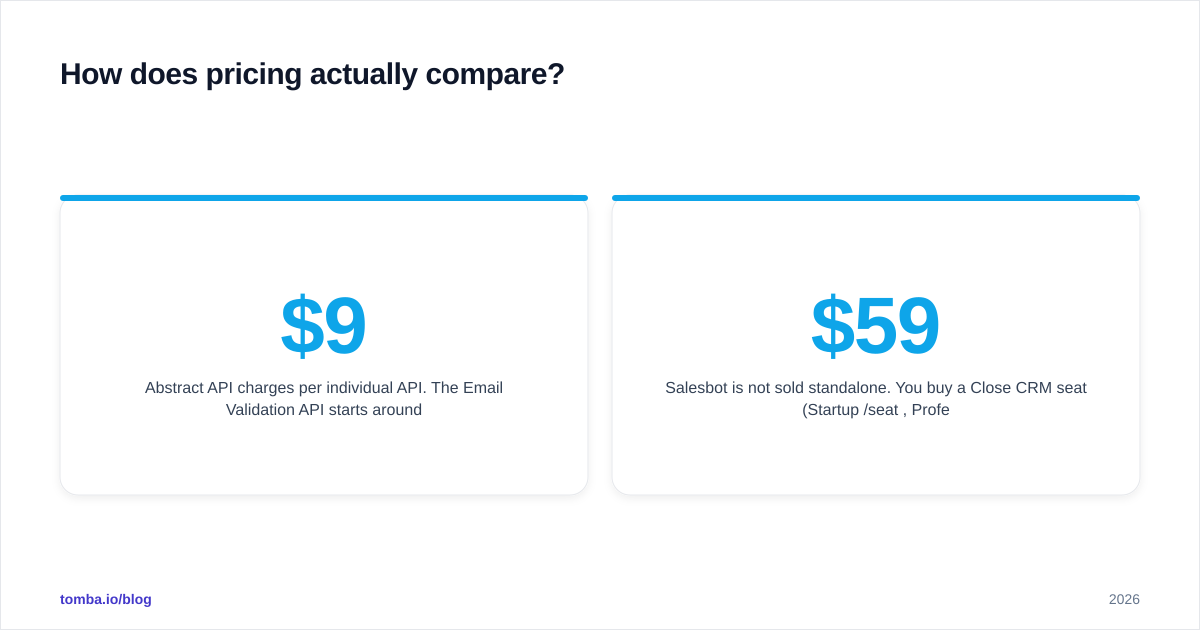
Abstract API charges per individual API. The Email Validation API starts around $9/month for 5,000 requests and scales to $499/month for 1,000,000 requests. Each other API (phone, company, IP) is billed separately. If you use four APIs you pay four subscriptions. The free tier is generous for testing — 100 requests per month per endpoint — but production traffic moves you to a paid plan fast.
Salesbot is not sold standalone. You buy a Close CRM seat (Startup $59/seat/month, Professional $109/seat/month, Enterprise $149/seat/month as of early 2026) and Salesbot capacity is metered on top. AI-generated emails and reply handling consume credits that vary by plan. For a 5-rep team, expect $500–$1,000/month all-in before AI add-ons.
If you only need email validation and have a flat 50,000-records-per-month workload, Abstract API is a fraction of the cost. If you need an AI to actually run a sequence, Salesbot is the only relevant option of the two — Abstract API simply does not do that work.
For a third reference point, check our breakdown of Tomba pricing, which sits in the middle of these two billing models.
Is Abstract API more accurate than Salesbot for email validation?#
Yes, because Salesbot does not really do validation. It assumes the addresses in your Close contact list are valid. If they are not, your sender reputation suffers.
Abstract API's Email Validation API runs the standard checks: syntax, domain MX records, SMTP probe, role-based detection (info@, sales@), free-provider detection, and disposable detection. Independent benchmarks put Abstract API at around 91–94% accuracy on mixed B2B lists — competitive but not category-leading. Dedicated verifiers like ZeroBounce, NeverBounce, and Tomba's own email verifier tend to score 95–98% on the same test sets because they invest heavily in catch-all detection and proprietary signal blending.
If you want maximum accuracy before sending through Salesbot or any other sender, a dedicated verifier in front of the pipeline is the right architecture. Abstract API works fine as a first-pass filter inside a signup form; for outbound lists, lean on a specialist.
When should you pick Abstract API?#
Pick Abstract API when:
- You are a developer adding validation to an existing app or form.
- You need a single endpoint to call, not a UI to learn.
- Your volume is predictable and you want per-API pricing transparency.
- You already have a sender (Salesbot, Outreach, Apollo, an in-house tool) and just need clean inputs.
- You also need adjacent validations — phone numbers, IP, VAT, currency conversion — under one vendor.
Skip Abstract API if you want a list of prospects, a campaign tool, or anything resembling a SaaS UI. It is intentionally headless.
When should you pick Salesbot?#
Pick Salesbot when:
- You already use or are willing to adopt Close CRM.
- You want an AI to handle the actual sending and replying, not just provide data.
- Your team is small (1–10 reps) and you want one tool, not a tech stack.
- You have a defined ICP and warm enough offers that AI-drafted copy will land.
- You care about phone, SMS, and email living under one pipeline view.
Skip Salesbot if you live outside Close, if you need granular per-step control over sequences, or if your sending volume justifies a dedicated cold email platform like Instantly or Smartlead.
How do they fit together in a real prospecting stack?#
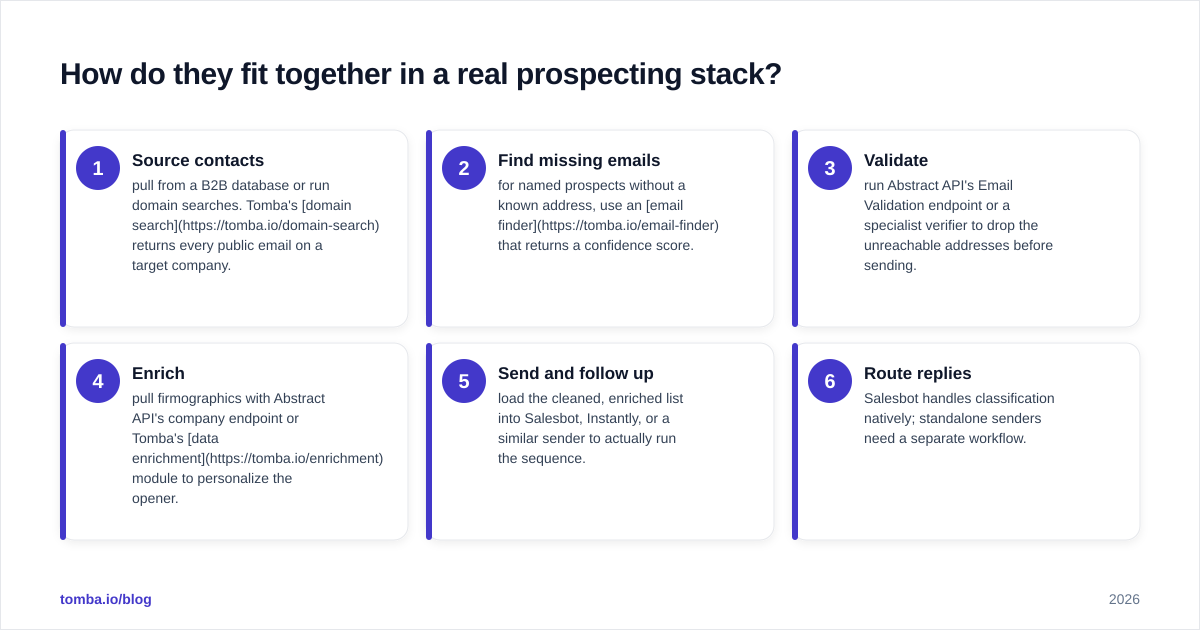
Neither tool gives you a complete outbound pipeline on its own. A realistic 2026 stack looks like this:
- Source contacts — pull from a B2B database or run domain searches. Tomba's domain search returns every public email on a target company.
- Find missing emails — for named prospects without a known address, use an email finder that returns a confidence score.
- Validate — run Abstract API's Email Validation endpoint or a specialist verifier to drop the unreachable addresses before sending.
- Enrich — pull firmographics with Abstract API's company endpoint or Tomba's data enrichment module to personalize the opener.
- Send and follow up — load the cleaned, enriched list into Salesbot, Instantly, or a similar sender to actually run the sequence.
- Route replies — Salesbot handles classification natively; standalone senders need a separate workflow.
Each step is a distinct job. Trying to make Abstract API send your emails or Salesbot find new contacts will create friction. Use each one where it is strongest.
For deeper background on the underlying mechanics, see the domain search glossary entry and the sender reputation primer.
What about deliverability?#
Salesbot inherits whatever sending infrastructure you connect — Gmail, Outlook, a dedicated SMTP. It does not warm domains, manage DNS, or rotate inboxes. You are still responsible for SPF, DKIM, DMARC, and warmup.
Abstract API helps deliverability indirectly: by catching bad addresses before they ever reach a mailbox provider, it keeps bounce rates low. A bounce rate above 2% is enough for Gmail and Outlook to start filtering you. Validating at intake — using Abstract API in your signup form, then again before sending in Salesbot — is the cheap insurance every team should buy.
Independent guidance from HubSpot and G2 reviewers consistently flags list hygiene as the highest-leverage deliverability fix, ahead of subject-line tweaks or send-time optimization.
Common alternatives worth knowing#
If the Abstract API vs Salesbot framing does not fit your situation, the closest substitutes are:
- For validation APIs — ZeroBounce, NeverBounce, Kickbox, Mailgun Validate, or Tomba's email verifier API.
- For AI SDRs — Artisan, 11x, Regie.ai, Jason AI, Reply.io's AI mode.
- For combined finder + sender — Apollo.io, Outreach, Salesloft (heavier, mid-market).
- For developer-first email finding — Tomba's email finder API returns verified addresses with a confidence score, billable on the same per-request logic Abstract API users are used to.
The right answer depends on whether you have engineers building the pipeline or operators clicking through a UI. Be honest about that before you sign a contract.
Frequently asked questions#
Is Abstract API a CRM? No. It is a set of REST endpoints. You still need a CRM (Close, HubSpot, Salesforce, Pipedrive) to store contacts and pipeline.
Does Salesbot find email addresses? No. It expects contacts already in your Close database. Use a dedicated finder upstream.
Can I call Abstract API from Salesbot directly? Not natively. You would need a middleware layer (Zapier, Make, or a custom script) to bridge the two.
Which is cheaper? For pure validation at moderate volume, Abstract API. For replacing an SDR seat, Salesbot — but only because hiring a human is expensive, not because the software is cheap.
Are there free tiers? Abstract API has 100 free requests per month per endpoint. Salesbot ships only as part of a Close CRM trial. Tomba offers a free tier of 25 searches per month if you want to test a finder + verifier combo without paying.
The bottom line#
Abstract API and Salesbot are not the same product, and treating the choice as either/or will leave gaps in your pipeline. Abstract API is the right call when you need a clean, fast validation or enrichment endpoint inside your own code. Salesbot is the right call when you want an AI to actually run outbound sequences from inside Close CRM. Most teams that take outbound seriously end up running both, plus a finder that bridges the contact-discovery gap neither tool addresses.
If that finder is your missing piece, start with the Tomba Email Finder. It returns verified work emails with a confidence score, plugs into the same per-request billing model Abstract API users already understand, and feeds clean records straight into whichever sender — Salesbot, Instantly, or anything else — you decide to run.
Ready to find emails that actually work?
Join 150,000+ professionals who stopped guessing and started sending. Free credits on signup — no credit card required.
Get the Tomba newsletter
Practical outbound tactics and product updates — once every two weeks.
About the author