ABX Explained: The 2026 Guide to Account-Based Experience
ABM treated accounts as targets to hit. ABX treats them as customers to win — across marketing, sales, and CS. Here's how the model actually works in 2026.
TL;DR#
- ABX (Account-Based Experience) is the buyer-centric evolution of ABM — every touch across marketing, sales, and customer success is orchestrated around what a target account actually needs next.
- It was popularized by Demandbase around 2020 and has become the default GTM model for B2B teams selling deals over $25k ACV in 2026.
- ABX wins because it kills the marketing-to-sales handoff: the same account-level intent data, signals, and journey state flow through every team.
- The stack usually includes an ABX platform (Demandbase, 6sense), a contact source (Tomba, Apollo), a CRM, an outreach tool, and an analytics layer.
- You don't need 200 logos to start. A focused list of 50-100 accounts, clean contact data, and three coordinated plays will beat a sprayed campaign every time.
What is ABX (Account-Based Experience)?#
ABX, short for Account-Based Experience, is a B2B go-to-market model where marketing, sales, and customer success teams orchestrate every interaction around the buying journey of a defined set of target accounts.
It is not a campaign type. It is not a tool. It is an operating model.
Think of it like running a Michelin-starred restaurant versus a fast-food chain. The chain serves whoever walks in with the same menu. The Michelin restaurant knows who is sitting at table seven, what they ordered last time, what allergies they have, and which sommelier should walk over. ABX is the Michelin approach applied to B2B revenue: every account gets a coordinated experience designed for them, not for an anonymous segment.
The term was coined by Demandbase around 2020 as a response to a real problem — ABM had hardened into "send personalized ads to a list and call it strategy." ABX broadened the lens to include sales sequences, SDR touches, website personalization, and post-sale expansion, all running off the same account-level data.
How is ABX different from ABM?#
The short version: ABM is a marketing tactic, ABX is a company operating model.
ABM was born in the late 2000s. Marketing picked target accounts, ran display ads at them, sent direct mail, and called it a day. Sales got a list. Customer success got nothing. The handoff between teams was a CRM stage change and a hope.
ABX rewires that. The same buyer journey is visible to every team, the same intent signals trigger plays for every team, and the same account scoring determines whether marketing runs an ad, sales sends a sequence, or CS books a strategic review.
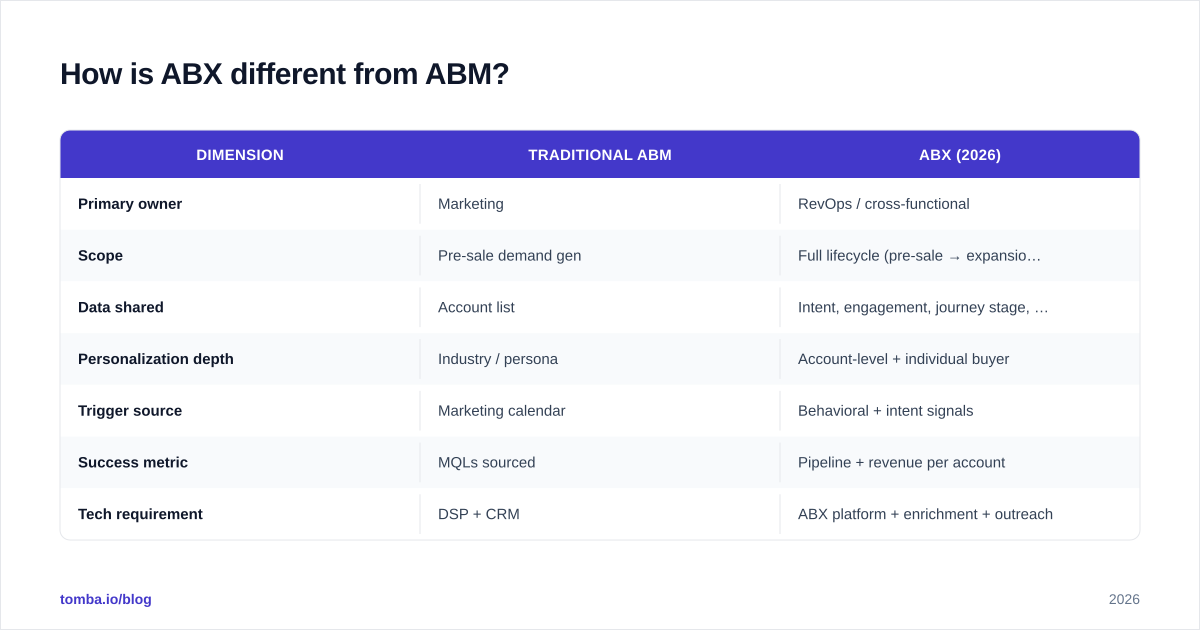
| Dimension | Traditional ABM | ABX (2026) |
|---|---|---|
| Primary owner | Marketing | RevOps / cross-functional |
| Scope | Pre-sale demand gen | Full lifecycle (pre-sale → expansion) |
| Data shared | Account list | Intent, engagement, journey stage, fit |
| Personalization depth | Industry / persona | Account-level + individual buyer |
| Trigger source | Marketing calendar | Behavioral + intent signals |
| Success metric | MQLs sourced | Pipeline + revenue per account |
| Tech requirement | DSP + CRM | ABX platform + enrichment + outreach |
The practical effect: in ABM, marketing spent budget on "awareness" and threw leads over the fence. In ABX, marketing spends budget on accounts the sales team is actively working, and CS knows the second a customer's expansion signal fires.
Why does ABX matter in 2026?#
Three structural shifts make ABX the default model this year.
1. Buying committees got bigger. Gartner puts the average B2B buying group at 6-10 stakeholders for considered purchases. Hitting one buyer with one ad doesn't move a deal. ABX coordinates 20-30 touches across the committee.
2. Intent data finally got good. First-party intent (your own website), second-party (review sites like G2), and third-party (publisher networks) now flow into one feed. ABX platforms turn that feed into "play this account now" alerts instead of monthly reports.
3. Budget compression killed spray-and-pray. Marketing leaders in 2026 are defending CAC payback to CFOs, not impressions to CMOs. ABX gives you per-account ROI, which is the only number that survives a budget review.
The data backs it up. Forrester's most recent B2B revenue waterfall benchmark shows companies running mature ABX programs convert account-level opportunities at roughly 2-3x the rate of companies running classic ABM, with deal sizes 30-40% larger on average.
What are the core pillars of ABX?#
Five pillars sit underneath every working ABX program. Miss one and the whole model stops compounding.
1. Account selection#
You can't deliver an experience to 5,000 accounts. Most successful ABX programs work a tiered list: 50-100 Tier 1 (1:1, white-glove), 200-500 Tier 2 (1:few, programmatic personalization), and 1,000-5,000 Tier 3 (1:many, account-aware nurture).
Selection should be data-driven, not gut-feel. Combine your ICP fit score with technographic data, recent funding events, hiring signals, and intent surges. Tools that do website visitor reveal will surface accounts already researching you that aren't on the list yet.
2. Signal capture#
Signals are the heartbeat of ABX. Three layers matter:
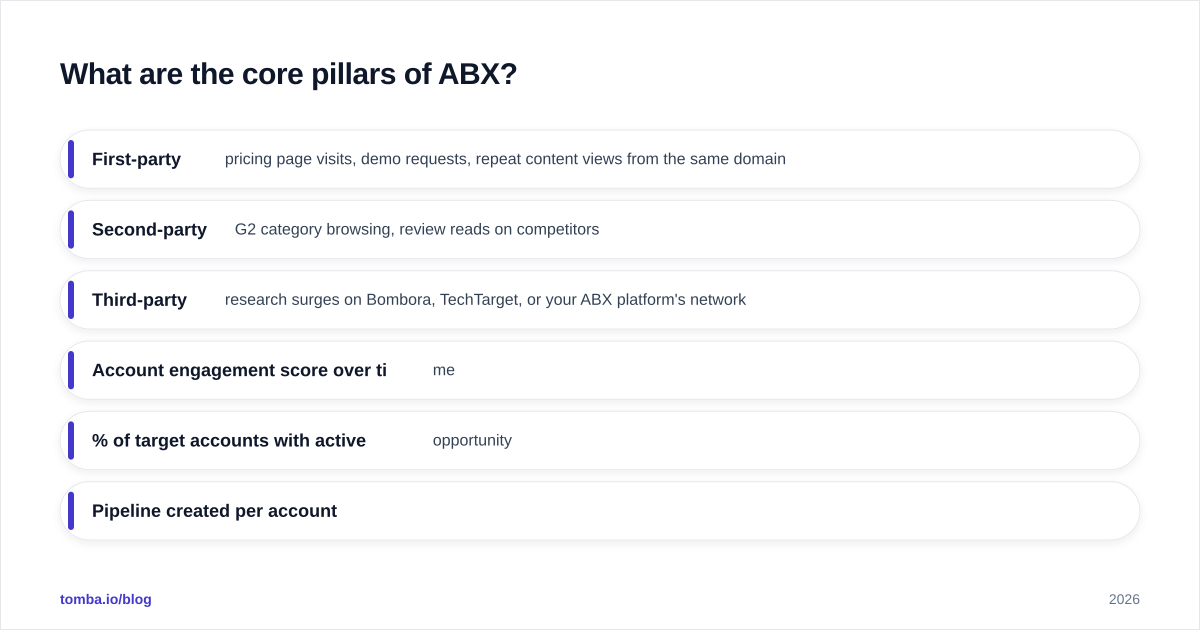
- First-party: pricing page visits, demo requests, repeat content views from the same domain
- Second-party: G2 category browsing, review reads on competitors
- Third-party: research surges on Bombora, TechTarget, or your ABX platform's network
The job isn't to collect every signal — it's to define which combinations trigger which plays. A pricing page visit alone is noise. A pricing page visit from a Tier 1 account where two new decision-makers were hired last month is a sales-ready alert.
3. Orchestration#
Orchestration is where ABX lives or dies. When a Tier 1 account hits a signal threshold, does anything actually happen? In mature programs, the answer is yes: an SDR is alerted, a one-to-one LinkedIn ad fires, marketing customizes the next email, and a direct-mail trigger queues. All from one signal, all in under 24 hours.
This is impossible without clean account-to-contact mapping, which is why most ABX implementations stall at the data layer. You need verified emails for the actual buying committee, not generic info@ addresses. Tools like Tomba's email finder and data enrichment close that gap by giving you direct contacts for every named account on your tier list.
4. Personalization at scale#
True personalization isn't {{first_name}}. It's a website that swaps the hero image to the prospect's industry, an email that references their CFO's recent earnings comment, and an ad that mentions the specific competitor they're evaluating.
The trick is templated variability — 80% of the message is reusable, 20% is account-specific, and the variable bit is pulled from enriched data, not hand-typed.
5. Measurement#
ABX measurement is account-centric, not lead-centric. The metrics that matter:
- Account engagement score over time
- % of target accounts with active opportunity
- Pipeline created per account
- Average deal size for ABX accounts vs non-ABX
- Time from first signal to opportunity creation
If you're still measuring MQLs in an ABX program, you're running ABM with a new name.
What does an ABX tech stack look like?#
There's no single right stack, but a working one usually has five layers. Here's how the dominant vendors compare in 2026:
| Layer | Purpose | Leading vendors | Typical cost |
|---|---|---|---|
| ABX platform | Account scoring, intent, orchestration | Demandbase, 6sense, RollWorks | $40k-$200k/yr |
| Contact data | Verified emails, phones, LinkedIn for buying committee | Tomba, Apollo,ZoomInfo | $49-$1,500/mo |
| CRM | System of record | Salesforce, HubSpot | $50-$300/seat/mo |
| Outreach | Sales sequences, multi-channel cadences | Salesloft, Outreach, Instantly | $100-$200/seat/mo |
| Analytics | Account journey + attribution | Native ABX + warehouse (Snowflake, BigQuery) | Variable |
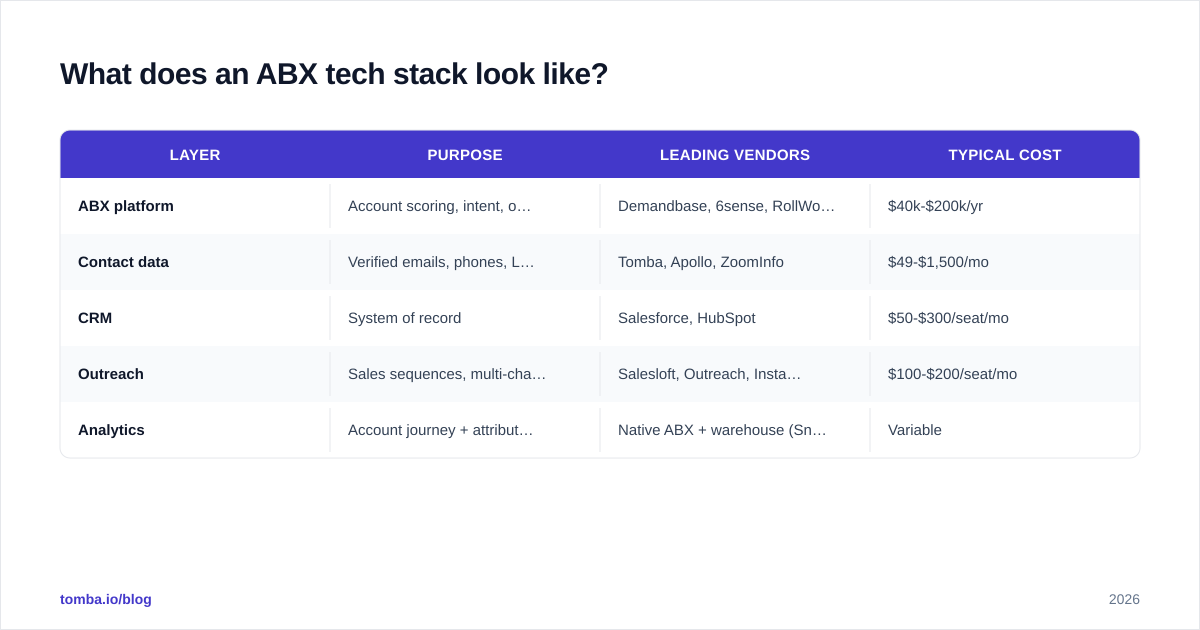
Picking the platform first is a common trap. The contact data layer matters more, because no platform can orchestrate against accounts you can't reach. If you're priced out of ZoomInfo, the Tomba pricing starts at $49/mo and gives you the same kind of verified contact data the enterprise platforms charge five figures for.
For teams using HubSpot or Salesforce as their CRM spine, the Salesforce integration and HubSpot integration push enriched contacts directly into the account record so ABX plays can fire without manual export-import gymnastics.
How do you implement ABX in 90 days?#
Most teams overscope ABX and stall. The 90-day path that actually ships:
Days 1-15: Foundation
- Define the ICP and tier the account list (start with 50 Tier 1)
- Audit existing contact data — for each Tier 1, do you have 4+ verified emails for the buying committee? If no, fill the gaps with an email finder
- Pick one signal to monitor first (pricing page visits is the easiest)
Days 16-45: First plays
- Build three coordinated plays: high-intent (account hits two signals), medium-intent (one signal + tier match), and dormant (no signal in 90 days)
- Wire each play across marketing email, SDR sequence, and LinkedIn ad
- Use a shared Slack channel for real-time account alerts
Days 46-75: Measurement
- Establish baselines: meetings booked per account, pipeline per account, win rate vs control segment
- Weekly review of engagement scores
- Identify the 10 accounts moving fastest and double down
Days 76-90: Expand
- Add Tier 2 (200 accounts, programmatic personalization)
- Add CS plays for closed-won accounts (expansion signals)
- Re-tier based on actual engagement, not original guesses
Mature ABX programs take 12-18 months. But you should see meeting-rate lift on your Tier 1 inside 60 days. If you don't, your contact data is wrong, your signals are noise, or your tiers are too broad — fix one at a time.
What metrics define ABX success?#
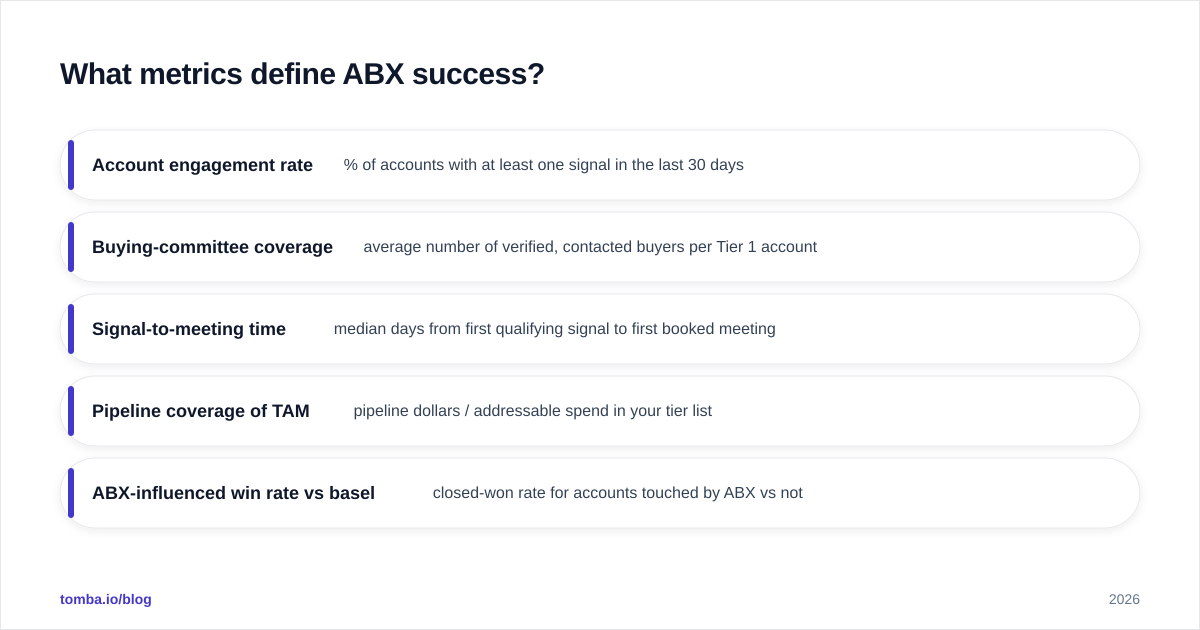
Drop MQLs. Track these instead:
- Account engagement rate: % of accounts with at least one signal in the last 30 days
- Buying-committee coverage: average number of verified, contacted buyers per Tier 1 account
- Signal-to-meeting time: median days from first qualifying signal to first booked meeting
- Pipeline coverage of TAM: pipeline dollars / addressable spend in your tier list
- ABX-influenced win rate vs baseline: closed-won rate for accounts touched by ABX vs not
The buying-committee coverage metric is the most underrated. ABX programs fail quietly when teams have one contact per account and assume that's enough. The benchmark to aim for: 5-7 verified contacts per Tier 1 account, refreshed quarterly. That's where the bulk email finder and ongoing data enrichment earn their keep — keeping the committee list fresh as people change jobs.
For more on aligning these metrics with broader GTM strategy, see the revenue operations primer.
What are the most common ABX mistakes?#
After watching dozens of programs launch, four mistakes show up over and over.
Mistake 1: Picking the platform before the list. Teams buy 6sense or Demandbase, then spend three months trying to figure out who to point it at. Build the tier list with a spreadsheet and verified contacts first. Layer the platform on once you know what good looks like.
Mistake 2: Over-relying on third-party intent. Third-party intent is directional, not deterministic. Some "surging" accounts are interns doing research. Combine with first-party signal before any sales action.
Mistake 3: One-channel ABX. If your "ABX program" is just LinkedIn ads at a list, it's not ABX. The whole point is multi-channel orchestration: email, ad, SDR touch, direct mail, event invite — same week, same message, different surfaces.
Mistake 4: Stale contact data. Buying committees turn over 20-25% per year. A Tier 1 list built in January is 8-10% stale by July. Set a quarterly refresh cadence using a bulk verify workflow, or your beautiful orchestration is hitting empty inboxes.
How does ABX work for smaller teams?#
The big platforms target enterprise budgets. Mid-market and SMB teams can run a functional ABX program on a fraction of the cost:
- Skip the $100k platform. Use a CRM + intent signal you already get (HubSpot has account-level scoring built in, Salesforce + Pardot/Account Engagement does this too)
- Use a B2B database and email finder for contact data instead of an enterprise contract
- Run plays manually for the first 25 accounts before automating
- Build dashboards in your CRM, not in a separate analytics tool
The methodology scales down better than the tools do. A two-person SDR + marketer team running coordinated plays against 25 Tier 1 accounts beats a 10-person team running spray-and-pray every time.
Where is ABX heading next?#
Three trends are reshaping ABX in 2026:
- AI-generated personalization at the message level. Models now write the variable 20% of an email — referencing the prospect's recent LinkedIn post, a press release, a hiring announcement — at scale. Quality varies, but the floor keeps rising.
- Predictive account scoring with explainability. Black-box "account fit scores" are out. Buyers want to know why an account scored 87, so they can debate it. Vendors are exposing the underlying signals.
- Post-sale ABX. The fastest-growing segment of ABX spend in 2026 is on existing customers — expansion plays, renewal-risk plays, advocacy plays. The same machinery that wins logos can grow them.
Ready to run ABX without an enterprise budget?#
ABX falls apart without verified contact data for the actual buying committee. If your Tier 1 list has one info@ address per account, you don't have an ABX program — you have a wish list. The Tomba Email Finder gives you direct, verified emails for every named account on your tier list, plus the bulk email finder handles list-wide enrichment in one upload. Free tier covers 25 searches, paid plans start at $49/mo, and it integrates with the CRM you already use. Stop running ABX on guesses — start with the data layer that makes the rest of the stack actually work.
// get started
Find, verify and enrich your first contacts today
Start on the free plan with 25 searches a month, then scale when your team is ready.
Free plan · No credit card required · GDPR & CCPA
// about the author