ABX Orchestration in 2026: The Complete Playbook for RevOps
ABX orchestration is what separates ABM theater from real account-based revenue. Here's how to design the data, signals, plays, and handoffs that actually move pipeline in 2026.
TL;DR
- ABX orchestration is the operating layer that turns account-based marketing strategy into coordinated plays across sales, marketing, CS, and product.
- Traditional ABM stops at "target list + ads." ABX (account-based experience) extends the same logic across the full lifecycle — pre-sale, sale, expansion, and renewal.
- The 2026 stack is signal-first: third-party intent, first-party engagement, product usage, and identity resolution feed a single decisioning layer that routes plays.
- Most teams fail on the handoff, not the targeting. Define triggers, owners, SLAs, and exit criteria for every play or your orchestration will collapse into spam.
- Pair a strong data foundation (verified emails, firmographics, intent) with disciplined play design — tools like Tomba, Demandbase, and Common Room sit underneath, not on top of, the strategy.
What is ABX orchestration?#
ABX orchestration is the practice of coordinating every customer-facing touch — ads, emails, sales calls, content, product nudges, CS check-ins — against a shared account-level plan and a shared set of signals. The "X" stands for experience: the goal is one coherent account journey, not five disconnected channel campaigns.
If account-based marketing was the strategy, ABX is the operations discipline that makes it ship. Think of it like an air-traffic control tower. The planes (your channels) all want to land at the same airport (the account). Without orchestration, they collide, circle, or get diverted. With orchestration, each one lands at the right gate at the right time.
In practical terms, ABX orchestration answers three questions, on every account, every day:
- What does this account need next?
- Who on our side owns the next move?
- What signal will tell us to escalate, pause, or change channel?
How is ABX different from ABM?#
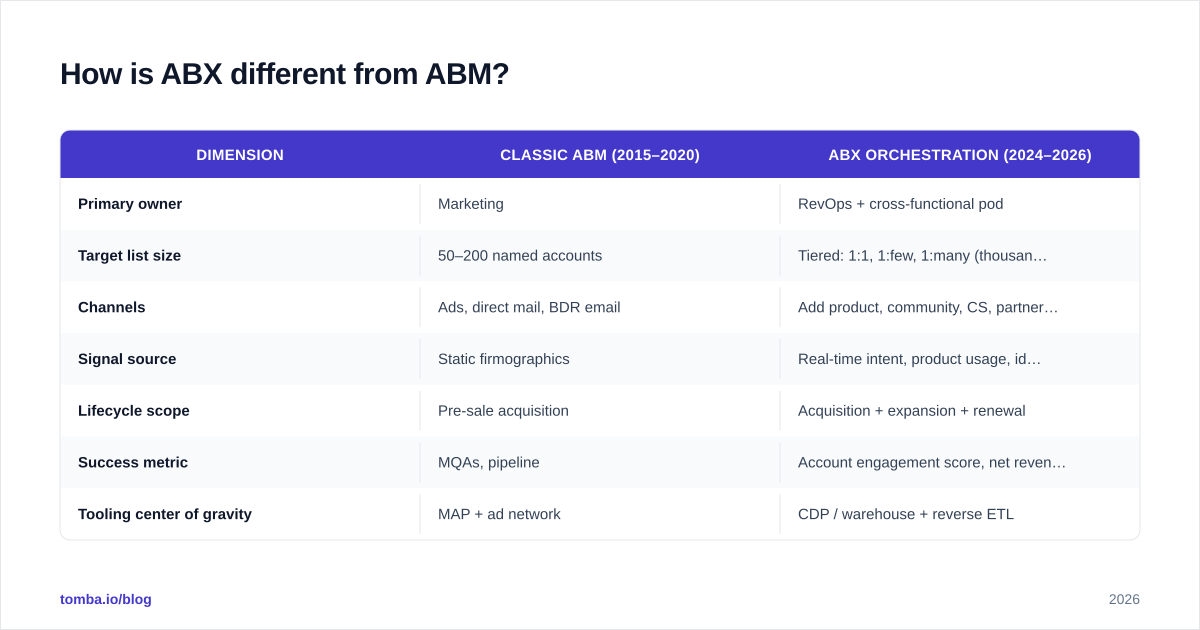
ABM and ABX share the same DNA — both treat the account, not the individual lead, as the unit of value. The difference is scope.
| Dimension | Classic ABM (2015–2020) | ABX Orchestration (2024–2026) |
|---|---|---|
| Primary owner | Marketing | RevOps + cross-functional pod |
| Target list size | 50–200 named accounts | Tiered: 1:1, 1:few, 1:many (thousands) |
| Channels | Ads, direct mail, BDR email | Add product, community, CS, partner, intent ads |
| Signal source | Static firmographics | Real-time intent, product usage, identity graph |
| Lifecycle scope | Pre-sale acquisition | Acquisition + expansion + renewal |
| Success metric | MQAs, pipeline | Account engagement score, net revenue retention |
| Tooling center of gravity | MAP + ad network | CDP / warehouse + reverse ETL |
ABM tried to push a static target list through a static funnel. ABX assumes the account state changes daily and the orchestration layer has to react.
What does an ABX orchestration stack look like in 2026?#
A modern stack has five layers. You can buy them as separate tools or as a bundled suite — what matters is that each layer exists and feeds the next.
1. Identity and data layer. Verified company and contact records, deduped against your CRM. This is where your B2B database and contact enrichment live. If the bottom layer is dirty, every layer above it lies.
2. Signal layer. Third-party intent (Bombora, G2, 6sense), first-party web/email engagement, product usage events, community signals (Common Room, Slack), and hiring/funding signals. Each signal needs a strength score and a freshness timestamp.
3. Decisioning layer. Rules and models that decide which account is "in market," which play to fire, and who owns it. This is where ABX actually happens — the rest is plumbing.
4. Activation layer. Channels that execute the play: ads, sequences, sales tasks, CS check-ins, in-product banners, direct mail.
5. Measurement layer. Account-level dashboards showing engagement, pipeline progression, and play attribution. Reverse-ETL'd back into the warehouse so the decisioning layer learns.
Most teams under-invest in layers 1 and 3 and over-invest in layer 4. You can't out-tactic a broken identity graph.
How do you build the signal stack?#
Signals are the fuel of orchestration. A useful signal has three properties: it's specific, it's fresh, and it's actionable.
Build the stack in this order:
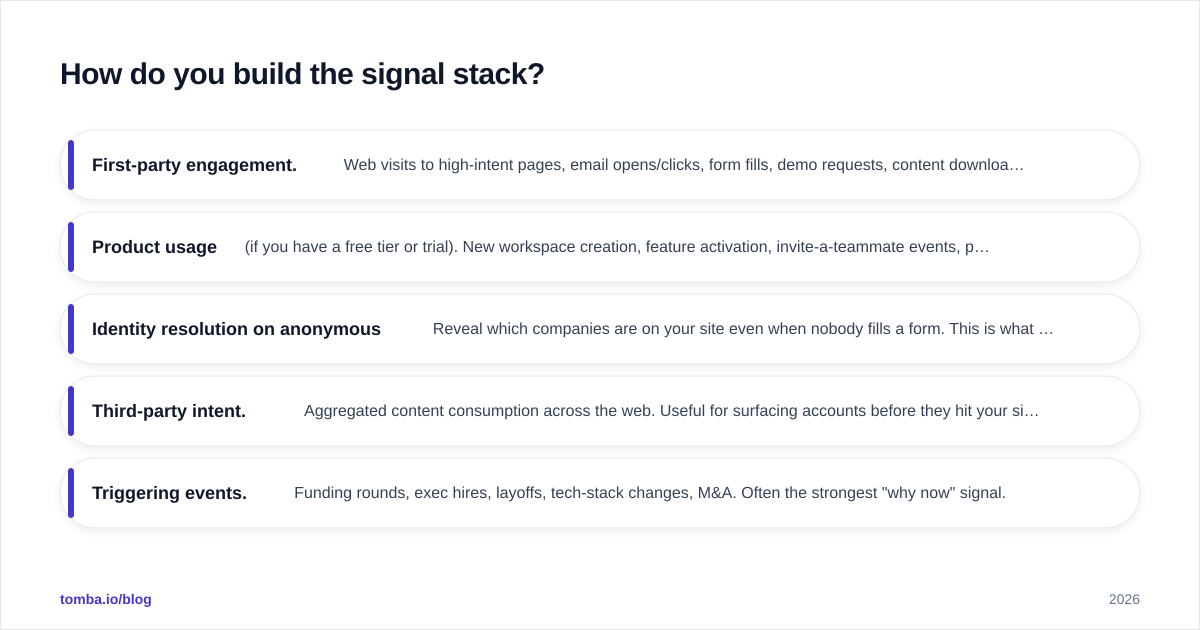
- First-party engagement. Web visits to high-intent pages, email opens/clicks, form fills, demo requests, content downloads. Cheapest to capture, highest fidelity.
- Product usage (if you have a free tier or trial). New workspace creation, feature activation, invite-a-teammate events, plan-limit warnings. PLG-style signals beat third-party intent by 5–10x in our experience.
- Identity resolution on anonymous traffic. Reveal which companies are on your site even when nobody fills a form. This is what website visitor reveal and tools like Albacross do.
- Third-party intent. Aggregated content consumption across the web. Useful for surfacing accounts before they hit your site, noisy on its own.
- Triggering events. Funding rounds, exec hires, layoffs, tech-stack changes, M&A. Often the strongest "why now" signal.
Don't ingest everything at once. Pick one signal per layer, prove a play with it, then expand. For deliverability terms behind the email signals, see Tomba's email deliverability glossary.
What plays should you orchestrate first?#
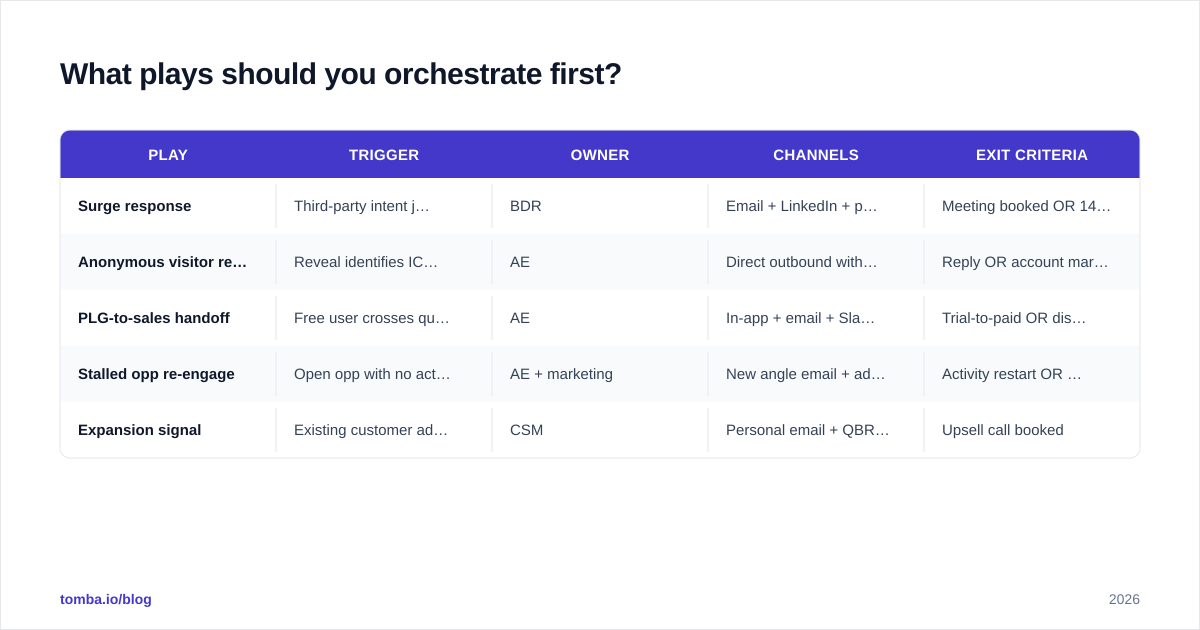
A "play" is a pre-defined sequence of actions tied to a trigger. ABX orchestration without plays is just dashboards. Start with these five — they cover 80% of the value most teams see in year one.
| Play | Trigger | Owner | Channels | Exit criteria |
|---|---|---|---|---|
| Surge response | Third-party intent jumps above threshold for ICP account | BDR | Email + LinkedIn + paid retargeting | Meeting booked OR 14 days no engagement |
| Anonymous visitor revival | Reveal identifies ICP account browsing pricing page | AE | Direct outbound within 24h | Reply OR account marked "not now" |
| PLG-to-sales handoff | Free user crosses qualification threshold | AE | In-app + email + Slack alert | Trial-to-paid OR disqualified |
| Stalled opp re-engage | Open opp with no activity for 21 days | AE + marketing | New angle email + ad sequence | Activity restart OR closed-lost |
| Expansion signal | Existing customer adds 5+ new users in 30 days | CSM | Personal email + QBR slot | Upsell call booked |
Every play needs the same five fields: trigger, owner, channels, SLA, exit criteria. Skip any of those and the play turns into noise.
How do you handle handoffs without dropping the ball?#
Handoffs are where ABX dies. Marketing fires a play, sales never sees it. Sales books a meeting, CS isn't told. Product flags churn risk, nobody acts.
Three rules fix most of this:
Rule 1: Single source of truth at the account level. Your CRM account record (or a synced warehouse view) shows every signal, every play, every owner, every status — in one timeline. Not five tabs.
Rule 2: Named owner with a time-bound SLA. "Marketing fires, sales follows up" is not an SLA. "AE owns within 2 business hours, BDR owns if AE doesn't claim" is. Use Slack integration or your routing tool to enforce it.
Rule 3: Closed-loop disposition. Every play ends with the owner choosing a disposition: engaged / not now / disqualified / wrong contact / no signal. Without disposition data, the decisioning layer can't learn.
A surprisingly large fraction of "ABX is broken" complaints turn out to be "we have no idea what happened after the alert fired." Wire up disposition first, optimize plays second.
Where does data quality fit in?#
Underneath everything. The ugly truth is that most ABX programs fail not because the strategy is wrong but because the contact data is wrong. You can't orchestrate against accounts whose decision-makers you can't reach.
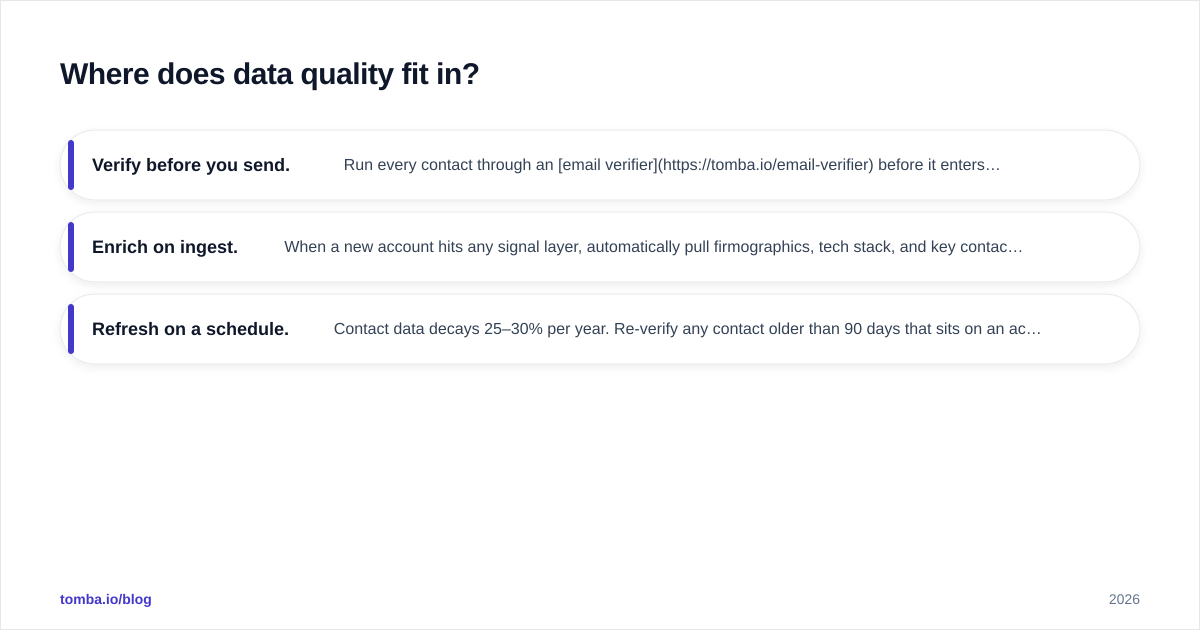
Three data hygiene practices that pay for themselves inside a quarter:
- Verify before you send. Run every contact through an email verifier before it enters a sequence. Bounce rates above 3% will tank your sender reputation and silently kill your orchestration.
- Enrich on ingest. When a new account hits any signal layer, automatically pull firmographics, tech stack, and key contacts. Use data enrichment to fill gaps before routing.
- Refresh on a schedule. Contact data decays 25–30% per year. Re-verify any contact older than 90 days that sits on an active account.
Verified data is the boring layer nobody brags about at the board meeting and the layer that determines whether anything else works. See G2's email verification category for vendor comparisons.
How do you measure ABX orchestration?#
Forget MQLs. The right metrics live at the account level and the play level.
Account-level metrics:
- Account engagement score (weighted sum of signals over rolling 30 days)
- Account stage progression rate (% moving from aware → engaged → opportunity → customer)
- Account pipeline velocity (days from first signal to closed-won)
- Net revenue retention on orchestrated vs. control accounts
Play-level metrics:
- Trigger volume (how often does the play fire?)
- Acceptance rate (% of triggers picked up within SLA)
- Disposition mix (% engaged / not now / disqualified)
- Conversion to next stage
- Cost per orchestrated account
A healthy program shows engagement scores rising faster than ungated benchmarks, and disposition mix moving toward "engaged" as the decisioning layer improves.
What are the common failure modes?#
After watching dozens of teams run ABX programs, the same patterns recur.
- Tool-first thinking. Buying Demandbase or 6sense before defining a single play. The tool doesn't build the play; the team does.
- Target list bloat. "Tier 1" with 800 accounts. Tier 1 should be small enough that an AE can name everyone on it.
- Channel monoculture. Running every play as an email sequence. ABX exists because no single channel converts on its own.
- No exit criteria. Plays that run forever. If an account hasn't responded to 12 touches in 30 days, the play needs to stop and the account needs to drop a tier.
- Marketing-only ownership. ABX is a RevOps function. If sales isn't in the design room, the handoffs will break.
- Vanity dashboards. Tracking "accounts engaged" without tracking "accounts moved to next stage." Engagement without progression is just noise.
The fix for almost all of these is the same: shrink the program. Fewer accounts, fewer plays, tighter SLAs, sharper exit criteria. Expand only after the small version works.
How does AI change ABX orchestration in 2026?#
AI shows up in three places in the modern stack, and only three places. Anywhere else and it's mostly marketing copy on a vendor's homepage.
Signal interpretation. LLMs reading account news, earnings calls, job listings, and product reviews to flag triggering events that rule-based systems miss. Useful, but needs grounding.
Message personalization at scale. Drafting account-specific outbound copy from the signal context. The honest version: AI gets you to a "good first draft" and a human edits. Sending raw AI-drafted outbound at scale will burn your domain reputation. Pair generated copy with a subject line tester and a spam checker before any send.
Next-best-action prediction. Models that recommend which play to fire on which account based on historical outcomes. Powerful when you have enough closed-loop disposition data — useless before then.
Skip AI features that promise "fully autonomous outbound." They generate volume, not pipeline, and they're the fastest way to land in spam folders and on RevOps blocklists. The HubSpot research on AI in sales is a reasonable temperature check before you commit to a vendor.
How do you roll out ABX orchestration without breaking the team?#
A 90-day rollout that consistently works:
Days 1–30: Foundation.
- Pick 50 Tier-1 accounts (no more)
- Audit and clean the contact data for those accounts
- Define one play with full trigger/owner/SLA/exit spec
- Wire one signal source into the CRM at the account level
Days 31–60: First play live.
- Run the play on the 50 accounts
- Daily standup: which triggers fired, who owned them, what happened
- Measure acceptance rate and disposition mix, not pipeline (too early)
- Fix the handoff before you scale
Days 61–90: Expand carefully.
- Add a second play and a second signal source
- Expand to 200 accounts
- Start measuring stage progression
- Decide what to industrialize and what to kill
If by day 90 you can't point to specific accounts where the orchestration changed the outcome, the program is broken — go back to day one and shrink, don't add tools.
Closing: where Tomba fits in your ABX stack#
ABX orchestration depends on knowing who's at the account and being able to reach them. That's a data problem before it's a strategy problem.
Tomba's Email Finder sits at the identity layer of an ABX stack: enrich target accounts with verified decision-maker emails, fill the gaps your reveal tool surfaces, and feed clean contacts into the plays you're orchestrating. Pair it with the email verifier for hygiene, the domain search for account-level discovery, and the API to plug verified contacts straight into your warehouse and decisioning layer. Free tier gives you 25 searches/month to test the workflow before you commit; paid plans start at $49/mo on Tomba pricing when you're ready to scale.
Get the data layer right and the rest of the orchestration starts to actually work.
// get started
Find, verify and enrich your first contacts today
Start on the free plan with 25 searches a month, then scale when your team is ready.
Free plan · No credit card required · GDPR & CCPA
// about the author