ABX Strategy in 2026: The B2B Playbook That Replaced ABM
ABM treated buyers like targets. ABX treats them like humans. Here's how account-based experience works in 2026 — and the stack, signals, and plays that make it convert.
TL;DR#
- ABX (Account-Based Experience) is the 2026 evolution of ABM — it adds experience design, buyer signals, and orchestration across every touchpoint, not just marketing.
- The shift matters because buying committees grew to 11+ people, 80% of the buying cycle happens before a sales call, and one-size-fits-all ABM stopped converting.
- A working abx strategy stacks three layers: target list (ICP + buying committee), signal layer (intent, web visits, hiring, funding), and experience layer (web personalization, ads, outbound, RevOps plays).
- The tools that matter in 2026: 6sense or Demandbase for intent, Tomba for verified contact data, HubSpot or Salesforce for orchestration, and Reveal-style identification for anonymous traffic.
- You don't need a six-figure budget to start. A 50-account pilot with intent data, verified emails, and three coordinated plays beats a 2,000-account "spray" every quarter.
What is an ABX strategy and why did it replace ABM?#
ABX stands for Account-Based Experience. It's a B2B go-to-market approach that coordinates marketing, sales, customer success, and product around a curated list of accounts — but unlike classic ABM, the unit of focus is the buyer experience, not the marketing campaign.
The simplest way to think about it: ABM asked "how do we hit this account with personalized content?" ABX asks "what does this account need to experience, in what order, across which channels, to move from problem-aware to closed-won?"
The shift happened because three things broke at once:
- Buying committees exploded. Gartner's research shows the average B2B purchase now involves 11 or more stakeholders. Targeting "the CMO" doesn't work when the CMO is one of fourteen voices.
- Self-serve research dominates. Buyers complete 70–80% of their decision before they ever talk to sales. By the time they fill out a form, your pitch is already calibrated against three competitors.
- ABM fatigue. Inboxes became unusable. Generic "personalized" templates ("Hey {{firstname}}, I noticed {{company}}…") stopped working around 2023, and by 2026 even the well-crafted ones get filtered.
ABX is the response: less volume, more orchestration; less interruption, more relevance; less marketing-only, more cross-functional.
How does ABX differ from ABM in practice?#
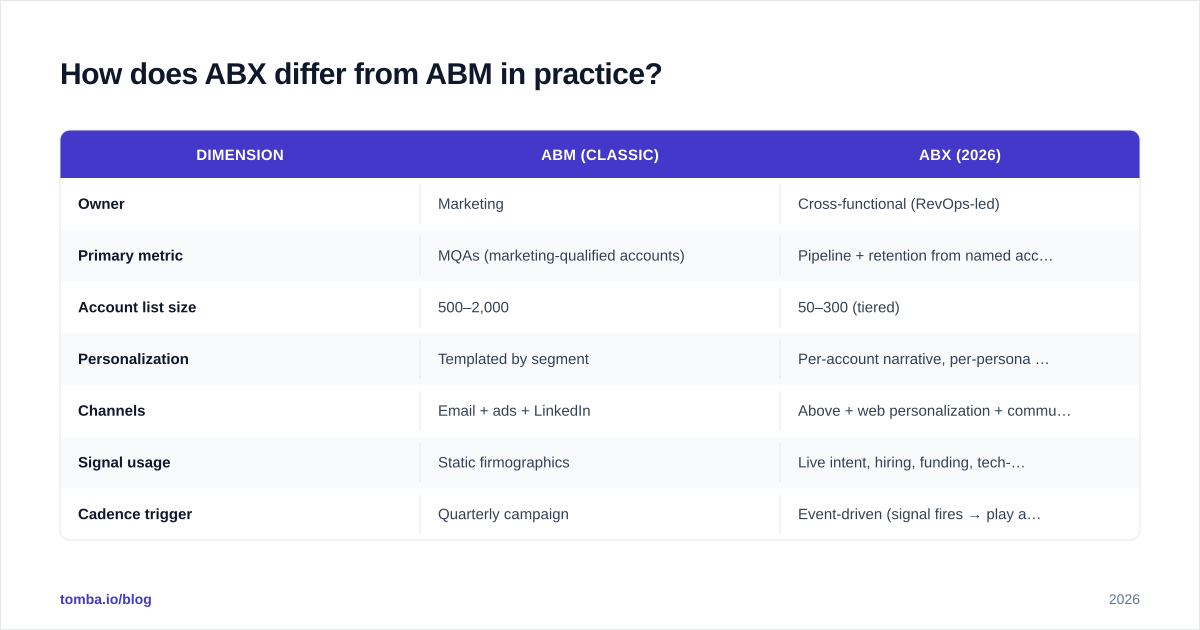
The labels overlap, and many vendors still use them interchangeably — but the operational differences are real.
| Dimension | ABM (classic) | ABX (2026) |
|---|---|---|
| Owner | Marketing | Cross-functional (RevOps-led) |
| Primary metric | MQAs (marketing-qualified accounts) | Pipeline + retention from named accounts |
| Account list size | 500–2,000 | 50–300 (tiered) |
| Personalization | Templated by segment | Per-account narrative, per-persona angle |
| Channels | Email + ads + LinkedIn | Above + web personalization + community + product-led + outbound calls |
| Signal usage | Static firmographics | Live intent, hiring, funding, tech-stack, web visits |
| Cadence trigger | Quarterly campaign | Event-driven (signal fires → play activates) |
| Sales involvement | After MQL hand-off | From list-build through close |
If your current "ABM" program is a list of 1,500 accounts getting the same three-touch ad sequence, you're doing ABM. If you have 80 accounts where every signal triggers a coordinated play that the AE, marketer, and CS lead all see in real time, that's ABX.
What does the ABX tech stack look like in 2026?#
The stack settled into four jobs. Some platforms cover multiple jobs; nobody covers all four well.
| Stack layer | What it does | Common tools |
|---|---|---|
| Identification | Reveal anonymous web visitors, match to accounts | 6sense, Demandbase, Albacross, Tomba Reveal |
| Signal & intent | Surface in-market accounts via third-party intent + first-party behavior | Bombora, G2 intent, 6sense, LinkedIn |
| Contact data | Find and verify the right humans inside the account | Tomba, Apollo, Cognism,ZoomInfo |
| Orchestration | Trigger plays, sync to CRM, track touches | HubSpot, Salesforce, Outreach, Default, Clay |
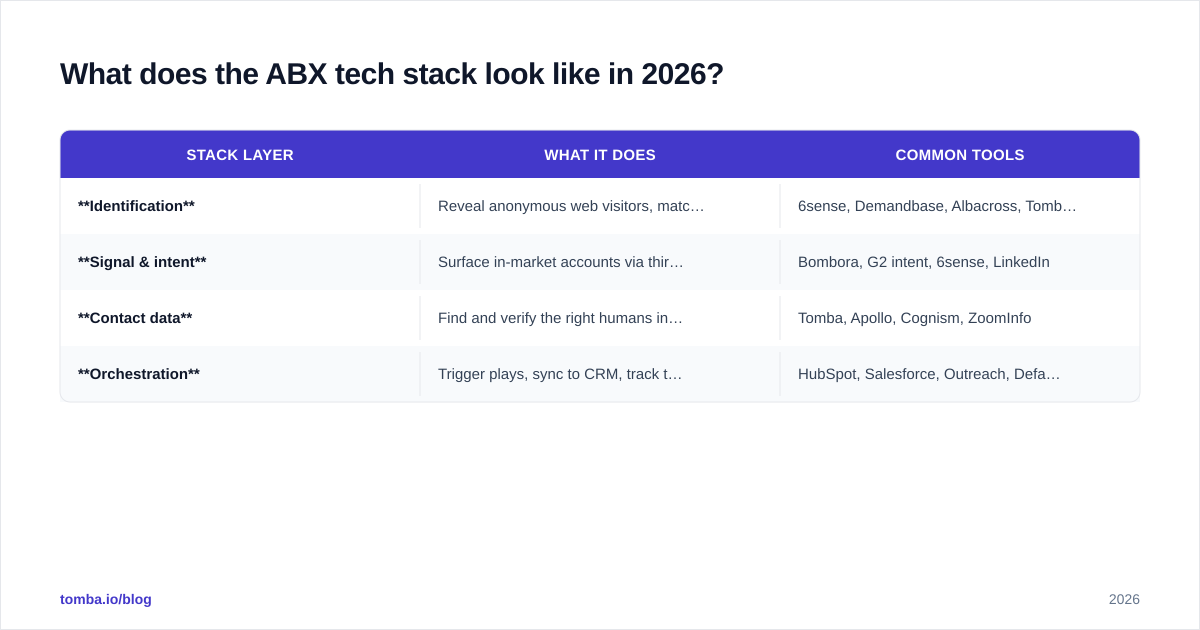
The honest version: most teams over-buy at the identification layer and under-invest in contact data. You can have perfect intent signals and still lose the deal because you emailed a generic info@ address or a contact who left 18 months ago. Verified, current contact data is where most ABX programs leak.
That's where tools like Tomba's email finder and domain search earn their place — once you've identified the account and surfaced intent, you still need to know who on the buying committee to reach, with a deliverable address.
What signals should an ABX strategy actually use?#
Signals are the heartbeat of ABX. Without them, you're back to broadcasting. With them, every play is event-driven.
The signals that consistently outperform in 2026:
Intent & research signals
- Third-party intent spikes (Bombora, G2 review reads, comparison-page visits)
- Repeat visits to your pricing or competitor-comparison pages
- Anonymous traffic resolved to a target account
- Searches for category keywords inside content syndication networks
Trigger & change signals
- Funding rounds (Series A → C is prime SaaS territory)
- Executive hires in your buyer persona (new VP Marketing, new CRO)
- Tech-stack changes (adopted Salesforce → CRM-integration angle)
- Job posts that imply pain (hiring "Head of Demand Gen" → growth problem)
First-party signals
- Webinar attendance with no follow-up form fill
- Multiple stakeholders from the same domain on your site in 14 days
- Demo request from a junior buyer (signal the senior hasn't engaged yet)
- Reply to a cold email — even a negative reply is a signal of attention
Negative signals (just as valuable)
- Recent funding for a competitor (they're entrenched)
- Layoffs at the account (deal timeline collapses)
- New CRO with a known stack preference that excludes you
The discipline isn't collecting more signals — it's deciding which combinations trigger which plays.
What does an ABX play actually look like?#
A play is a pre-defined response to a signal pattern. It has a trigger, an owner, a deadline, and a measurable outcome.
Here's a worked example. Trigger: an account on the Tier 1 list shows a 6sense intent spike on "data enrichment" AND has had three visits from different IPs to your pricing page in the last 7 days.
- Hour 0 — RevOps: Auto-assigns account to the named AE in Salesforce, flags as "hot signal", posts to a #abx-hot Slack channel.
- Hour 1 — Marketing: Pushes the account into a LinkedIn ad audience with creative tuned to data-enrichment ROI; web personalization swaps the homepage hero to a case study from a peer customer.
- Hour 4 — AE: Pulls the buying committee (5–8 names) using a contact-finding tool, sends a hand-written email referencing the specific pain pattern.
- Day 2 — SDR: Calls the two highest-priority personas, leaves a value voicemail that references the case study running in the ad audience.
- Day 5 — Content: A relevant teardown lands in their inbox via a sequence step, signed by the AE.
- Day 7 — Review: If no engagement, the account moves to a nurture track. If engagement, the AE owns the next step manually.
That's one play. A mature program runs 8–15 plays in parallel, each tied to a specific signal pattern.
How do you build the target account list?#
The list is the foundation. Get it wrong and every downstream investment compounds the mistake.
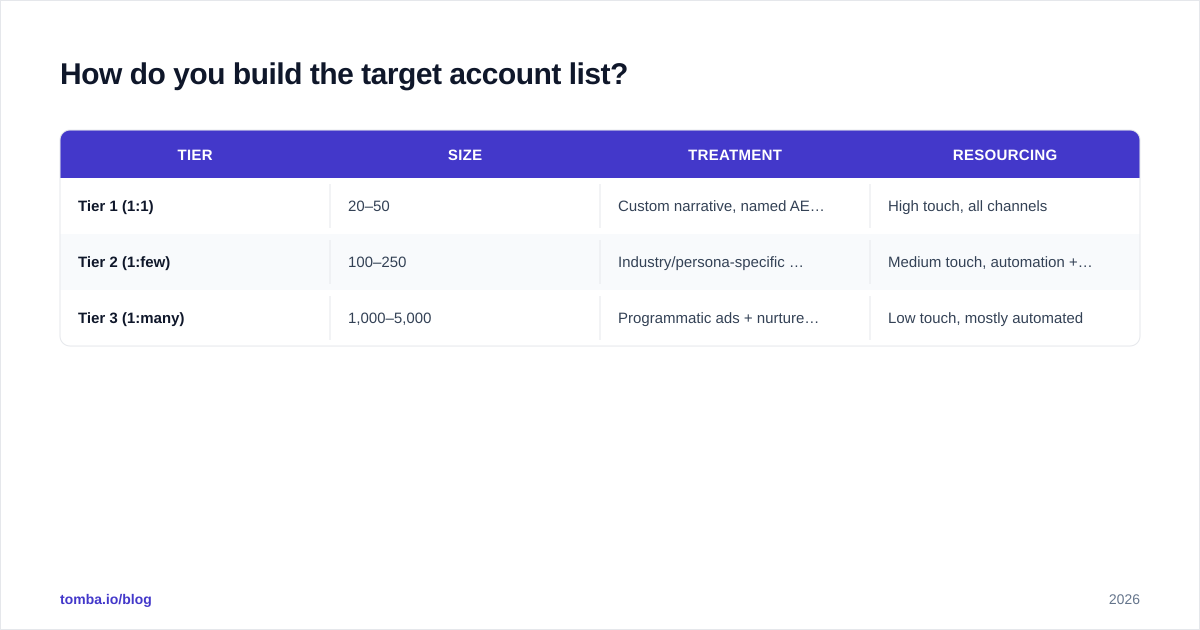
The 2026 best practice is tiered, not flat:
| Tier | Size | Treatment | Resourcing |
|---|---|---|---|
| Tier 1 (1:1) | 20–50 | Custom narrative, named AE, dedicated marketing support | High touch, all channels |
| Tier 2 (1:few) | 100–250 | Industry/persona-specific plays, shared SDR pool | Medium touch, automation + human |
| Tier 3 (1:many) | 1,000–5,000 | Programmatic ads + nurture, signal-triggered only | Low touch, mostly automated |
Build the list from three inputs: your ICP fit score, current pipeline gaps (which segments are under-represented?), and signal availability (you can't run ABX against accounts with zero observable signal).
Refresh quarterly. Move accounts up or down tiers based on engagement, not on hope.
How do you measure ABX without lying to yourself?#
ABM was famously hard to measure because the metrics (MQA, account engagement) didn't tie to revenue. ABX inherits some of that pain but resolves more of it.
The metrics that matter:
Leading indicators
- % of target accounts with >1 engaged contact in the last 30 days
- Buying committee coverage (how many of the ~6 key personas have you reached?)
- Multi-thread depth in pipeline accounts (3+ contacts engaged = healthy)
- Signal-to-play conversion rate (signal fires → play executed in SLA)
Pipeline indicators
- Pipeline created from named accounts (absolute and as % of total)
- Average deal size from ABX accounts vs. non-ABX
- Sales cycle length on ABX vs. non-ABX
Outcome indicators
- Closed-won revenue from target accounts
- Net revenue retention (ABX includes CS — expansion counts)
- Pipeline-to-closed-won conversion rate
The trap to avoid: judging ABX on lead volume. ABX intentionally trades volume for depth. If you measure it by MQL count, you'll kill the program before it has time to compound.
What are the most common ABX mistakes?#
After watching dozens of programs ship and stall, the same patterns recur.
Treating ABX as a marketing project. If sales isn't co-owning the target list, the plays, and the SLAs, it's not ABX. It's ABM with new branding. Cross-functional ownership lives or dies at kickoff.
Buying signals you can't act on. Intent data is worth zero if your SDR team can't process the resulting alerts. Match signal volume to operational capacity. Better to act on 20 signals/week well than 200 poorly.
Generic outreach to "personalized" lists. The whole point of a smaller list is per-account, per-persona narrative. If your top-20 accounts are getting the same email as your top-2,000, you've built ABM with extra steps.
Stale or unverified contact data. A 50-account pilot dies fast when half the emails bounce. Plug verified contact data into the workflow from day one — use an email verifier on every contact before it enters the play, and refresh quarterly.
No closed-loop on signals. Signals fire. Plays execute. Nobody reviews which signal patterns actually correlated with closed-won. Without the feedback loop, the program drifts toward whatever the loudest team member finds intuitive.
Confusing personalization with research. Mentioning that the prospect's company "just raised $40M Series B" isn't personalization — it's reading a press release. Personalization is connecting that raise to a specific operational pain your product solves.
Where does Tomba fit in an ABX stack?#
The contact-data layer is where most ABX programs underspend, and it's where Tomba is built to slot in.
- Buying committee mapping: when a signal fires on an account, you need the right 6–8 humans inside the company. Tomba's domain search returns role-mapped emails for an entire company in seconds, so the AE doesn't lose 40 minutes prospecting before they outreach.
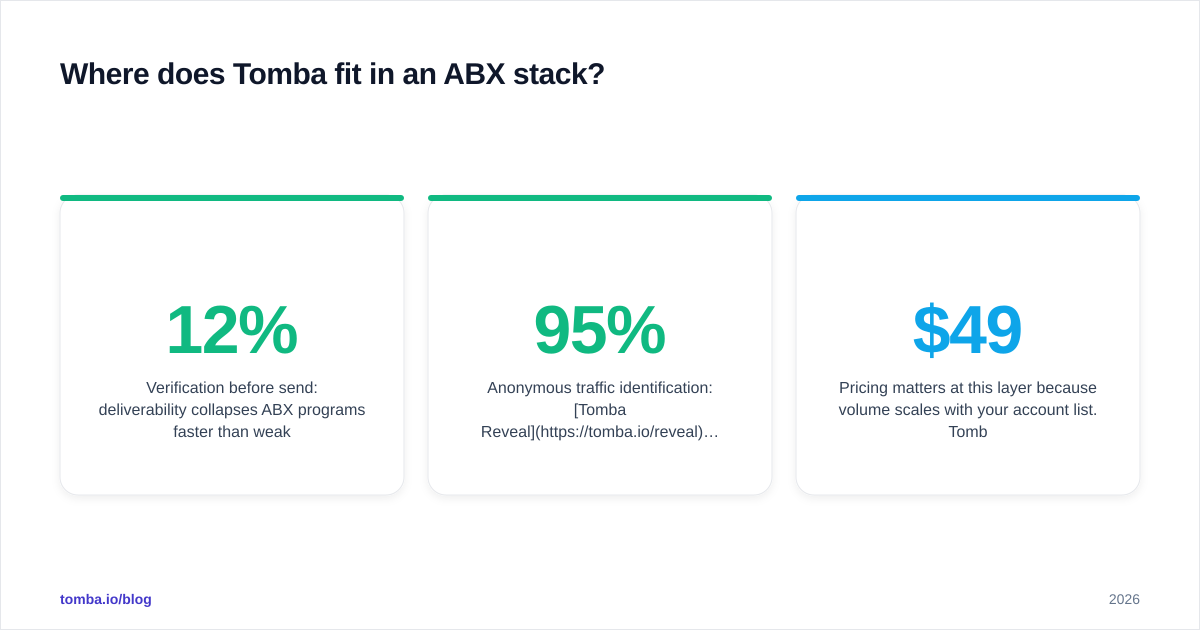
- Verification before send: deliverability collapses ABX programs faster than weak copy. Tomba's email verifier catches the 8–12% of stale or risky addresses before they enter a sequence.
- Anonymous traffic identification: Tomba Reveal resolves anonymous web visitors to the account level, which is a core ABX signal — without it, 95% of your in-market accounts stay invisible.
- CRM-native workflow: Tomba integrates with HubSpot, Salesforce, and
Zapier, so contact data lands in the system the AE actually works in.
Pricing matters at this layer because volume scales with your account list. Tomba's pricing starts with a free tier (25 searches/mo), Starter at $49/mo, Growth at $99/mo, and Pro at $249/mo — most ABX pilots fit inside Starter or Growth.
How do you start an ABX strategy in the next 30 days?#
You don't need to rebuild your GTM motion. You need a pilot.
Week 1 — Pick the list. 50 accounts. Tier 1. Real fit, recent signal, clear buying committee.
Week 2 — Wire the signals. Pick three signal sources you can actually act on (intent, web visits, hiring posts). Connect them to a Slack channel or CRM view.
Week 3 — Build two plays. One for high-intent accounts, one for trigger-event accounts. Document the trigger, owner, and SLA. Verify contact data for every account.
Week 4 — Run. Measure buying committee coverage, response rate, and meetings booked. Compare to your non-ABX baseline.
After 90 days you'll know if the program is working. If pipeline-from-named-accounts isn't materially up, fix the signal layer or the play execution — not the account count.
The bottom line#
ABX isn't a rebranding of ABM — it's a structural answer to bigger buying committees, longer self-serve research, and the death of generic personalization. The strategy is straightforward: small, tiered list; rich signal layer; coordinated cross-functional plays; verified contact data underneath it all.
The teams winning at ABX in 2026 are not the ones with the biggest tech stack. They're the ones who picked 50 accounts, instrumented three signals, ran two plays, and measured what closed.
Ready to put verified contacts into your ABX motion? Start with Tomba's Email Finder — find and verify the buying committee inside every target account, push it straight to your CRM, and stop losing deals to bounced emails. The free tier gives you 25 searches to test it against your top-tier list this week.
Ready to find emails that actually work?
Join 150,000+ professionals who stopped guessing and started sending. Free credits on signup — no credit card required.
Get the Tomba newsletter
Practical outbound tactics and product updates — once every two weeks.
About the author