How to Accelerate Sales Cycle in 2026: A Playbook
Stalled deals kill quotas. Here's the 2026 playbook to accelerate sales cycle length without sacrificing deal size or win rate.
The average B2B sales cycle has stretched 24% since 2022, according to Gartner. Buying committees now have eleven stakeholders. Deals stall in legal, in security review, in "we'll circle back next quarter." If you sell to mid-market or enterprise, you already feel it — pipeline looks healthy, forecast looks soft, commission checks look thin.
This guide shows you how to accelerate sales cycle length in 2026 without the usual sins: discounting to close, skipping discovery, or pressuring buyers into bad-fit deals. The tactics here come from operators running 30 to 90 day cycles in SaaS, services, and managed offerings — not theory.
TL;DR#
- The 2026 median B2B sales cycle is 84 days; top quartile teams close in under 50.
- Cycle time is a leading indicator of revenue. A 20% reduction lifts annual capacity by roughly 25% per rep.
- The four highest-leverage levers: pre-qualified pipeline, mutual action plans, multi-threading, and async deal acceleration tools.
- Don't confuse "fast" with "rushed." Speed comes from removing friction, not skipping steps.
- Tools matter, but process matters more. Audit your stages before you buy software.
Why does the sales cycle keep getting longer?#
Three structural shifts are responsible.
First, buying committees grew. Forrester's 2025 buyer research puts the average B2B committee at 10-12 people, up from 6-8 in 2019. Every added stakeholder adds an approval, a meeting, and a chance for the deal to die.
Second, procurement and security review became default. SOC 2, ISO 27001, vendor risk questionnaires, DPAs — the average enterprise deal now spends 18-22 days in legal alone.
Third, buyers self-educate before they talk to you. Gartner reports that B2B buyers complete 67% of the journey before contacting a vendor. By the time they reach you, they've already shortlisted competitors and built internal opinions you have to dismantle.
You cannot eliminate these. You can engineer around them.
What is sales cycle length and how do you measure it?#
Sales cycle length is the median number of days from first qualified meeting to closed-won. Use median, not mean — a single 400-day enterprise whale will distort the average and hide the real distribution.
Measure it three ways:
- Total cycle: first meeting to signed contract.
- Stage velocity: days each deal spends in each pipeline stage.
- Time-to-first-response: how long between buyer signals (demo request, pricing page visit) and your first human touch.
The third one is where most teams bleed days they don't know about. Drift's research shows that responding in under 5 minutes increases conversion 8x versus responding in an hour. If your SDRs reply the next morning, your cycle starts 14 hours late by default.
How long should a B2B sales cycle take in 2026?#
There is no universal answer, but here are the benchmarks worth measuring against.
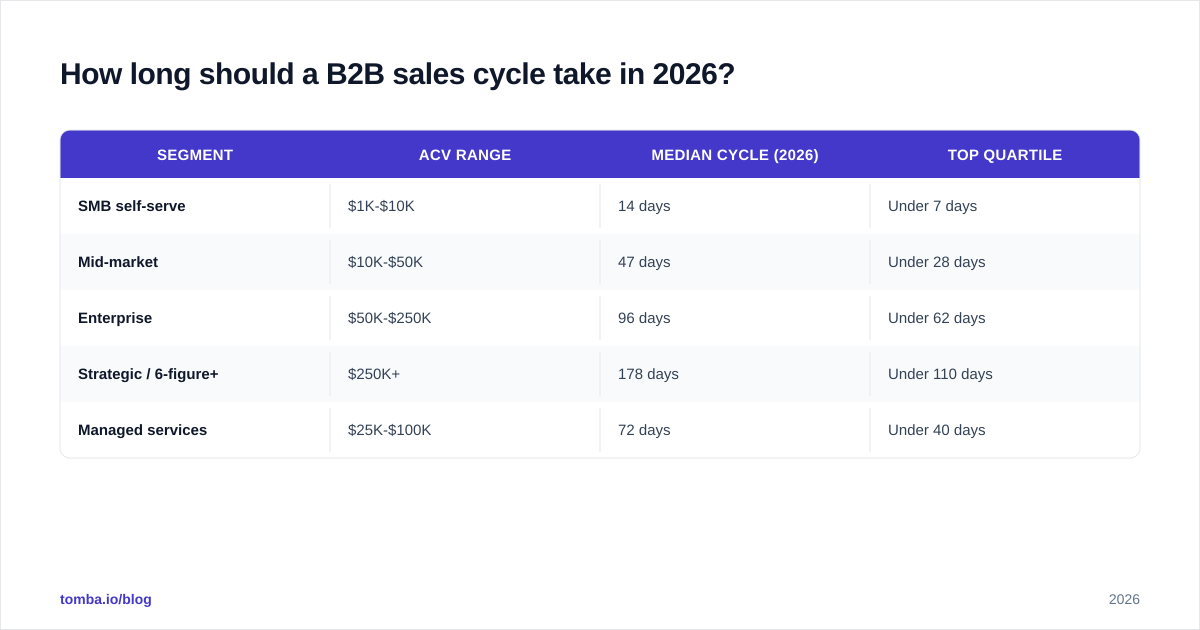
| Segment | ACV range | Median cycle (2026) | Top quartile |
|---|---|---|---|
| SMB self-serve | $1K-$10K | 14 days | Under 7 days |
| Mid-market | $10K-$50K | 47 days | Under 28 days |
| Enterprise | $50K-$250K | 96 days | Under 62 days |
| Strategic / 6-figure+ | $250K+ | 178 days | Under 110 days |
| Managed services | $25K-$100K | 72 days | Under 40 days |
Source: aggregated from HubSpot's 2025 State of Sales, RevOps Co-op community benchmarks, and OpenView SaaS metrics.
If you're in the median column, you have room. If you're above the median, something specific is broken — and it's usually one of the four levers below.
How do you accelerate sales cycle length without skipping discovery?#
The instinct is to skip steps. Don't. The fastest cycles come from teams that do more discovery, not less — they just do it in parallel instead of serial. Here are the four levers in order of impact.
Lever 1: Pre-qualify pipeline harder#
A deal that closes in 30 days was a great-fit deal on day one. Cycle time is largely set at qualification, not at close. If you fill the funnel with poor-fit logos, no playbook will save you.
Use a written ICP scorecard. Score every opportunity 1-5 on:
- Company size and segment match
- Trigger event present (funding, hire, M&A, tech change)
- Budget owner identified
- Use case maps to a flagship customer story
- Decision timeline under 90 days
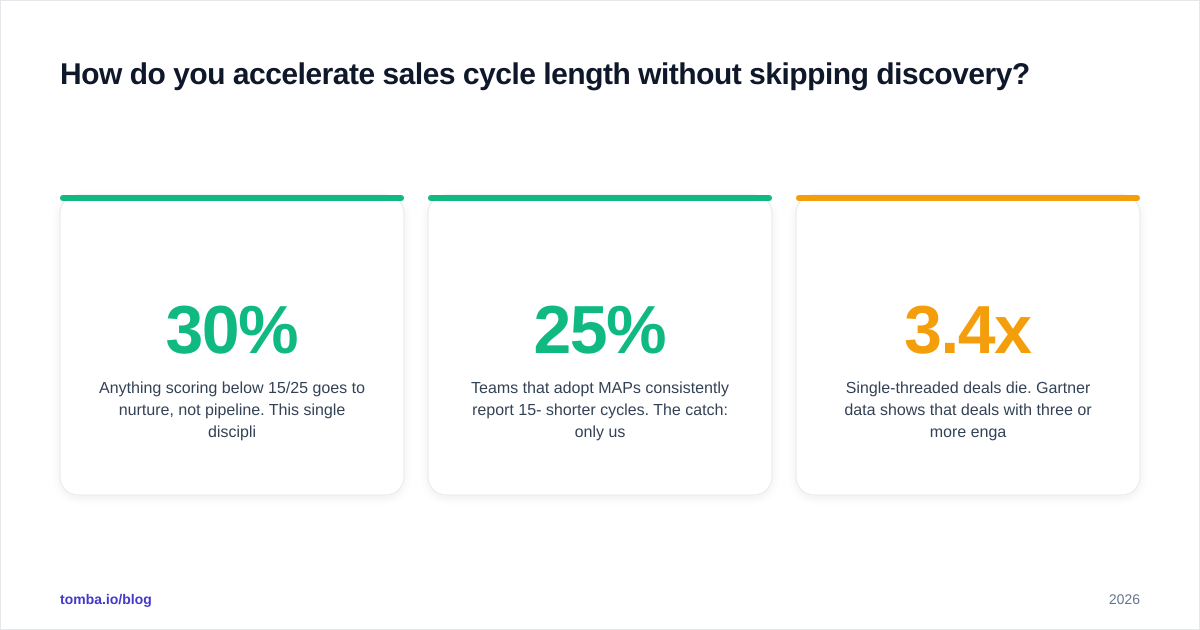
Anything scoring below 15/25 goes to nurture, not pipeline. This single discipline cuts cycle time by 20-30% in most organizations because it removes the deals that were never going to close in your fiscal year anyway.
To build that pipeline efficiently, you need accurate contact data and a way to verify it. A reliable email finder plus an email verifier at the top of funnel prevents you from spending three weeks chasing a job-changed buyer.
Lever 2: Run mutual action plans (MAPs)#
A mutual action plan is a shared document — typically a Google Doc or dedicated tool like Recapped or Dock — that lists every step from current call to signed contract, with named owners and dates on both sides.
MAPs accelerate cycles two ways:
- They surface objections early ("we'll need security review" in week one, not week six)
- They make slippage visible. When a buyer misses a date, you have a written reason to follow up.
Teams that adopt MAPs consistently report 15-25% shorter cycles. The catch: only use them with qualified deals. A MAP with a tire-kicker is wasted ceremony.
Lever 3: Multi-thread from day one#
Single-threaded deals die. Gartner data shows that deals with three or more engaged stakeholders close at 3.4x the rate of single-threaded ones and 27% faster.
Multi-threading is not "spam everyone at the company." It's strategic:
- Champion: your day-to-day advocate
- Economic buyer: signs the check
- User: lives in the product
- Blocker: usually IT, security, or finance
Map these four roles on every deal worth more than 3x ACV. If you can't name them by end of discovery, your cycle will stretch.
Lever 4: Compress async friction#
The hidden cycle killer is wait time between touches. A typical enterprise deal has 14-22 touch points; if each one waits 36 hours for a reply, that's three weeks of pure latency.
Async accelerators that move the needle:
- Video walkthroughs (Loom, Vidyard) instead of "let's schedule a follow-up call"
- Pre-recorded demos with live Q&A instead of generic live demos
- Shared deal rooms where buyers can self-serve documentation
- Calendar links that respect time zones and avoid the 9-email scheduling thread
What tools actually accelerate the sales cycle?#
The honest answer: most "sales acceleration" tools accelerate activity, not cycles. Be ruthless about what you adopt.
| Category | Best-in-class | What it accelerates | Risk |
|---|---|---|---|
| Lead data + verification | Tomba,ZoomInfo | Top-of-funnel quality, response rate | None when used with verification |
| Sequencing / cadence | Outreach, Salesloft, Smartlead | Activity volume, follow-up consistency | Spam if uncalibrated |
| Mutual action plans | Recapped, Dock, GetAccept | Mid-funnel velocity, deal hygiene | Adoption — reps must use them |
| Conversation intelligence | Gong, Chorus | Coaching cycle, objection handling | Surveillance optics with reps |
| E-signature + CPQ | DocuSign, PandaDoc, Salesforce CPQ | Closing friction | Over-engineering the quote |
| Deal rooms | Mindtickle, GetAccept | Buyer self-service | Becomes a junk drawer |
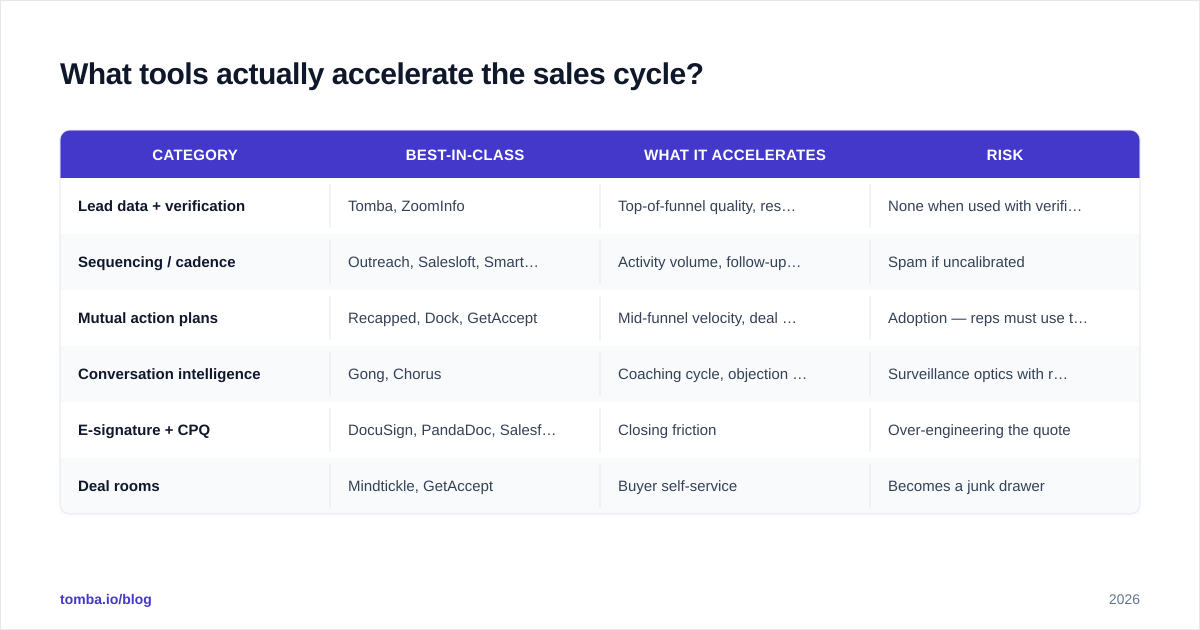
Pick one in each row that you'll actually deploy. Five tools used well beat fifteen used badly.
How do you reduce time-to-first-response?#
This is the cheapest cycle improvement available, and the most often ignored.
The ideal first-response SLA for inbound is 5 minutes during business hours and under 1 hour off-hours. Teams that hit this benchmark see 21% higher pipeline conversion than teams that respond in over 1 hour, per InsideSales/Xant research.
Three plays to get there:
- Inbound routing automation. Use Chili Piper, Default, or a custom Slack-based router. The instant a demo form fills, the right rep gets pinged.
- Real-time enrichment. When a form fills, you should see firmographics, tech stack, and the visitor's role within 30 seconds. Tools like Tomba's data enrichment and website visitor reveal cut research time before the first call.
- Pre-built first-touch messages. Personalization at scale is a myth; templated first touches with two-variable personalization (name + trigger) outperform generic templates and aren't much slower than copy-paste.
How do you accelerate enterprise deals without losing them?#
Enterprise cycles resist most SMB tactics. Here's what works specifically at the high end.
Get to the legal redline early. Send your MSA template in week two, not week six. Most teams hide it; the fast ones ship it the moment a deal scores high. You'll lose the deals that were never going to clear legal anyway — and you should lose those early, not after 80 days of effort.
Pre-empt the security questionnaire. Build a public trust center (Vanta, Drata, SafeBase). Buyers complete 60% of the questionnaire themselves. The remaining 40% — the custom questions — you'll knock out in a single session.
Run the procurement playbook. Identify the procurement lead by the end of stage 2, not stage 5. Procurement is not the enemy; they're a stakeholder. Treat them like the user persona they are: timeline, savings narrative, supplier comparison.
Sequence the close. A clean enterprise close has three signatures in a known order: technical, business, financial. Confirm the sequence with your champion in writing. Surprise approvers add weeks.
For prospecting into enterprise accounts, multi-channel coverage matters. Combine a verified phone finder, email outreach, and LinkedIn outreach to keep the deal warm across modalities while procurement does its work.
What about AI? Does it actually accelerate cycles?#
Mostly yes, in narrow ways. The hype is ahead of the reality, but three specific applications move cycle time today:
- Pre-call research summaries. AI tools that compile a one-page brief on every account before a call save 15-30 minutes per meeting. At 4-6 calls a day, that's a full hour of selling time.
- Email drafting at the bottom of funnel. Recap emails, follow-up templates, redline summaries — AI is good at this. It is bad at writing genuine first-touch outreach; don't use it there.
- Forecast hygiene. AI deal-inspection tools (Gong Forecast, Clari Copilot) flag stalled deals 2-3 weeks earlier than reps do. Earlier flag = earlier intervention = shorter aggregate cycle.
What AI does not accelerate: trust, executive sponsorship, security review, or the existence of a budget. Don't ask it to.
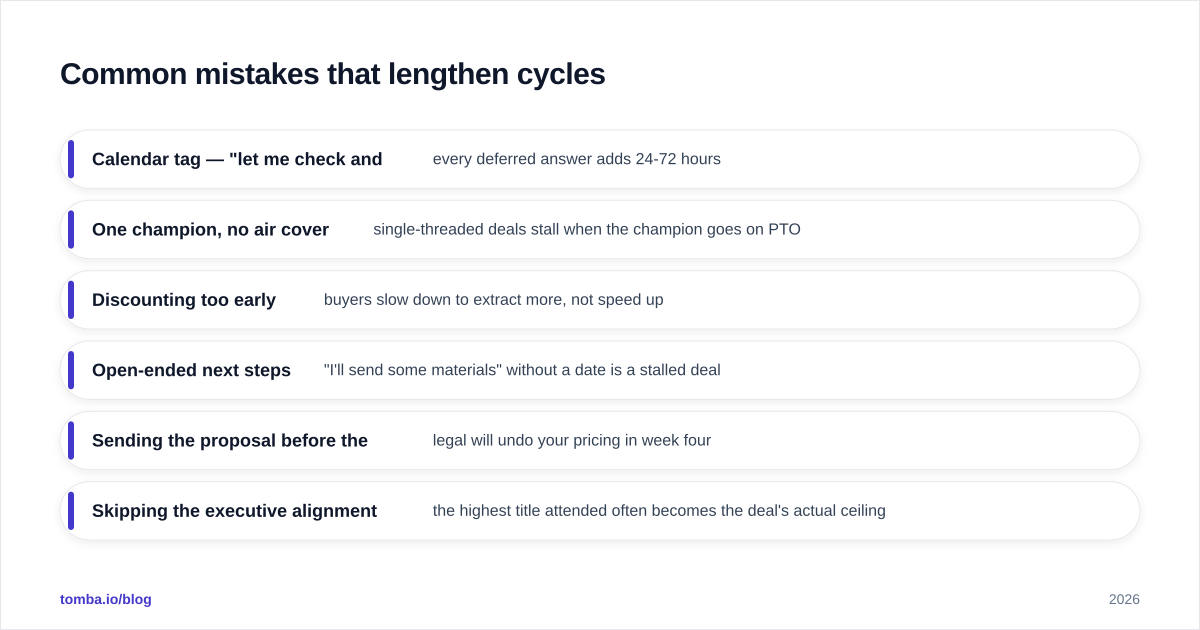
Common mistakes that lengthen cycles#
The opposite of acceleration. Audit your team against these:
- Calendar tag — "let me check and circle back" — every deferred answer adds 24-72 hours
- One champion, no air cover — single-threaded deals stall when the champion goes on PTO
- Discounting too early — buyers slow down to extract more, not speed up
- Open-ended next steps — "I'll send some materials" without a date is a stalled deal
- Sending the proposal before the redline conversation — legal will undo your pricing in week four
- Skipping the executive alignment call — the highest title attended often becomes the deal's actual ceiling
How do you build a culture of velocity?#
Tactics work for individuals. Velocity becomes durable when it becomes cultural. Three habits separate fast teams from slow ones:
- Weekly stage-aging review. Any deal aged 1.5x the stage median gets a written intervention plan or moves out of forecast. No exceptions.
- Reverse pipeline reviews. Instead of "walk me through your pipeline," ask "what's the single thing slowing each of your top 5 deals?" The answer reveals the real bottleneck.
- Win/loss interviews with closed deals. Talk to the buyer 30 days after close. Ask what slowed them down internally. You'll find the same three answers repeatedly — and they'll be different from what your reps reported.
Final word: speed is a system, not a stunt#
You can't accelerate sales cycle length by pushing harder on the close. You accelerate it by tightening every link in the chain — from how you build pipeline, to how you qualify, to how fast you respond, to how cleanly you handle legal and security.
The teams cutting their cycles in half in 2026 are not the ones with the best closers. They're the ones with the best operating discipline.
Start with one lever. Measure it for 30 days. Then add the next.
Ready to accelerate your top-of-funnel?#
Cycle acceleration starts before the first meeting. Bad data, bounced emails, and job-changed buyers waste days you'll never get back. The Tomba Email Finder gives you verified, deliverable contact data with built-in verification — so the deals that enter your pipeline are real, reachable, and ready to move. Start free with 25 searches a month, or scale up to Growth at $99/month when your pipeline does. See Tomba pricing for plan details.
// get started
Find, verify and enrich your first contacts today
Start on the free plan with 25 searches a month, then scale when your team is ready.
Free plan · No credit card required · GDPR & CCPA
// about the author