Account Based Engagement in 2026: The Complete Playbook
Account based engagement turns ABM theory into measurable revenue. Here's how to build orchestrated, multi-threaded plays that convert target accounts in 2026.
TL;DR#
- Account based engagement (ABE) is the operational evolution of ABM — it replaces one-shot campaigns with continuous, multi-threaded plays across email, LinkedIn, ads, and direct mail.
- Teams running ABE see 3x higher response rates than spray-and-pray outbound, but only when SDRs, AEs, and marketing share one account list and one orchestration layer.
- The 2026 ABE stack is intent data + enrichment + sequencing + signal-based triggers — not another platform purchase.
- Success metrics shift from MQLs to engaged accounts, buying group coverage, and air-cover-to-meeting ratio.
- Most ABE failures trace back to weak contact data. Fix the people-database before you fix the playbook.
What is account based engagement?#
Account based engagement is the practice of coordinating sales, marketing, and customer-success touches around a named list of target accounts — with the goal of building relationships across the entire buying committee, not just a single champion.
If ABM was the strategy ("focus on the 200 accounts that matter"), ABE is the operating system. It answers the harder question: what do we actually do on Tuesday morning to move account #47 from "aware" to "in pipeline"?
The shift matters because B2B buying committees ballooned to an average of 11 stakeholders per deal. A campaign that lands one VP no longer wins the deal. You need to engage finance, IT, legal, and the end-user team — concurrently — without sounding like a swarm.
How is ABE different from ABM and traditional demand gen?#
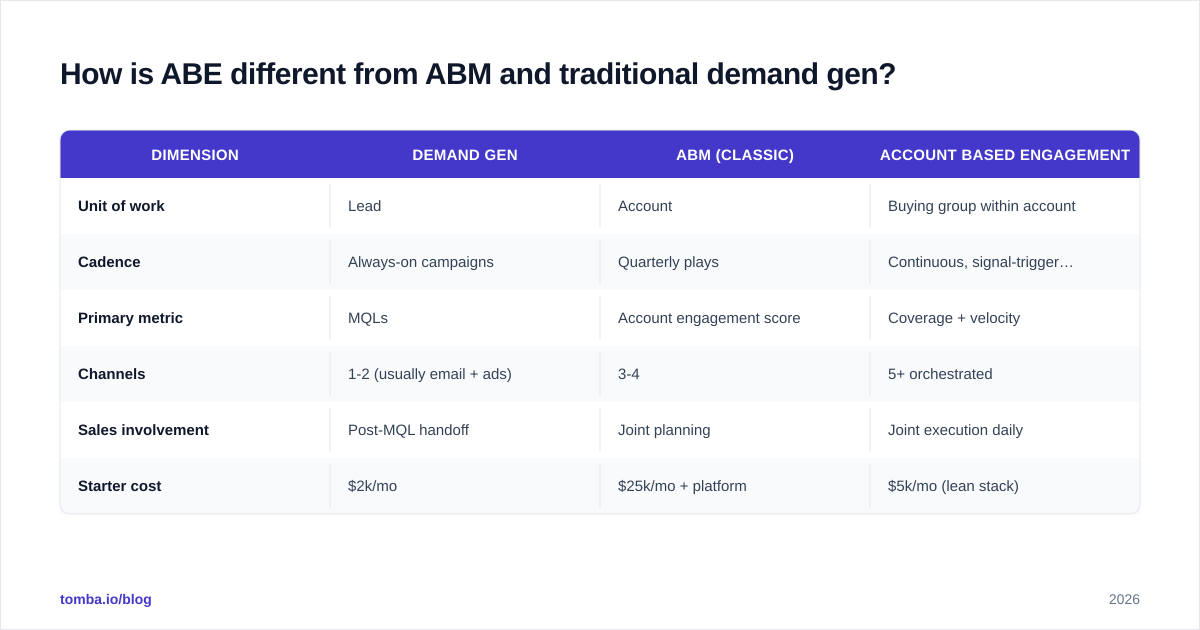
The three approaches sound similar but operate on completely different rhythms.
| Dimension | Demand Gen | ABM (classic) | Account Based Engagement |
|---|---|---|---|
| Unit of work | Lead | Account | Buying group within account |
| Cadence | Always-on campaigns | Quarterly plays | Continuous, signal-triggered |
| Primary metric | MQLs | Account engagement score | Coverage + velocity |
| Channels | 1-2 (usually email + ads) | 3-4 | 5+ orchestrated |
| Sales involvement | Post-MQL handoff | Joint planning | Joint execution daily |
| Starter cost | $2k/mo | $25k/mo + platform | $5k/mo (lean stack) |
The big unlock in 2026 is that ABE no longer requires a six-figure platform commitment. With cheaper contact enrichment, open intent feeds, and lightweight orchestration tools, a two-person team can run ABE on 150 accounts using a stack under $1,000/month.
Why does account based engagement work in 2026?#
Three structural changes made ABE the default GTM motion for serious B2B teams.
1. Buying committees got bigger and quieter. Forrester's latest B2B buyer research shows 75% of the buying journey happens before a vendor is contacted. If you wait for an MQL, the shortlist is already set.
2. Outbound deliverability got harder. Google and Yahoo's 2024 sender requirements raised the bar. Cold spray to 10,000 contacts now triggers spam filters that didn't exist 18 months ago. Smaller, higher-context sends to known accounts perform dramatically better.
3. Intent data finally got affordable. Tools like G2 Buyer Intent, Bombora, and 6sense surface real-time signals. When you know an account is researching your category this week, the cold pitch becomes a warm conversation.
The combination means precision beats volume — and ABE is the operational frame for executing precision at scale.
What are the core components of an account based engagement program?#
Six building blocks. Skip any one and the program stalls.
1. The target account list (TAL)#
Start with 100-300 named accounts that match your ideal customer profile. Resist the urge to start with 2,000. ABE depth beats reach every time.
Use firmographic + technographic filters first (employee count, industry, tech stack), then layer in fit-and-intent scoring. A solid B2B database plus website tech detection is enough to build a defensible TAL in a weekend.
2. Buying group mapping#
For each account, identify the 6-12 personas you need to engage:
- Economic buyer (signs the contract)
- Champion (advocates internally)
- Influencers (technical evaluators, end users)
- Blockers (security, procurement, legal)
Use a LinkedIn finder or org-chart tool to map these roles, then enrich with verified work emails and direct dials.
3. Account-level scoring#
Combine three signal types:
- Fit (ICP match, firmographics)
- Intent (research signals, content engagement, site visits)
- Engagement (your touches that landed — replies, meeting accepts, ad clicks)
Accounts that score high on all three move to "active" tier. Mid-tier gets nurture. Low-tier stays in the database.
4. The play library#
A "play" is a coordinated sequence of touches across channels, triggered by a specific signal. Example plays:
- Champion identified → personalized LinkedIn invite + value-first email + targeted display ad
- Pricing page visit → SDR calls within 5 minutes + AE drops a Loom
- Competitor mention in earnings call → custom one-pager + executive outreach
Most teams launch with 5-8 plays and expand from there.
5. Multi-channel execution#
LinkedIn, email, phone, direct mail, retargeting ads, and customer-success reach-outs all working off the same account state. The orchestration layer is what makes this hard — and what most teams underestimate.
6. Closed-loop measurement#
Engaged accounts → meetings → pipeline → closed-won. If you can't draw a line from a specific play to a closed deal, the program won't survive its first budget review.
How do you build the data foundation for ABE?#
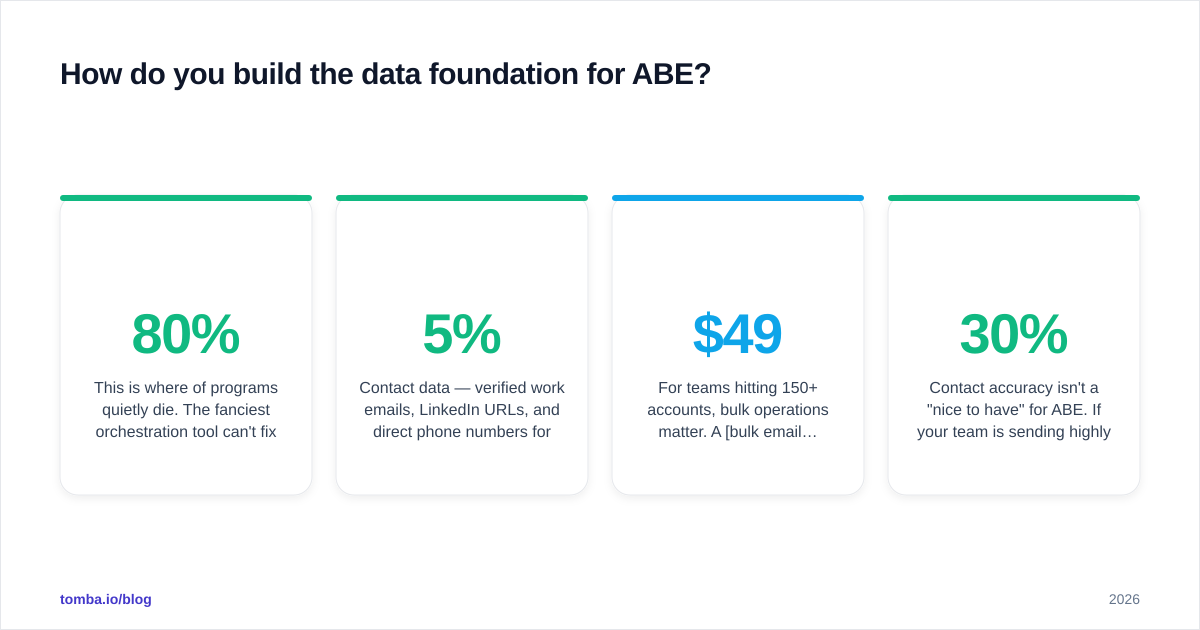
This is where 80% of programs quietly die. The fanciest orchestration tool can't fix bad data.
You need three data layers:
Account data — accurate firmographics, tech stack, recent funding, headcount trends. Refresh quarterly.
Contact data — verified work emails, LinkedIn URLs, and direct phone numbers for every persona in the buying group. This is where an email finder and email verifier earn their keep. Bounce rates over 5% will tank your domain reputation and kill the whole program.
Engagement data — every touch you and the prospect have exchanged, across every channel, tied back to the account. Without this, "orchestration" is just sales and marketing running parallel campaigns.
For teams hitting 150+ accounts, bulk operations matter. A bulk email finder and bulk verifier shave hours off list-building each week. Tomba's free tier (25 searches/month) is enough to sanity-check small lists; the Tomba pricing Starter plan at $49/mo handles most early-stage ABE programs without breaking budget.

Contact accuracy isn't a "nice to have" for ABE. If your team is sending highly personalized sequences and 30% of the addresses bounce, you've simultaneously wasted research time and damaged sender reputation. Get the data right first.
What does an account based engagement play look like?#
Here's a real-world play we've seen work for a mid-market data infrastructure vendor.
Trigger: Target account's CTO posts on LinkedIn about scaling challenges.
Day 0 (SDR): Sends a one-line LinkedIn comment, not a pitch. Just useful context.
Day 1 (AE): Records a 90-second Loom referencing the CTO's exact post and ties it to a customer story.
Day 2 (Marketing): Launches a custom display ad targeting that company's IP range, featuring the customer story.
Day 3 (SDR): Emails the CTO and two adjacent engineering leaders with a short note + Loom link.
Day 5 (AE): If no response, drops a hand-written postcard with a relevant industry report.
Day 8: Reassess. Engagement signals trigger the next play or move account to nurture.
Total touches in 8 days: 5-7, across 4 channels, all referencing the same anchor (the CTO's post). To the prospect it feels like one attentive vendor — not five teams spamming them.
Which tools belong in the 2026 ABE stack?#
You don't need every category. Pick one per row, ruthlessly.
| Category | Lean pick | Enterprise pick | Why it matters |
|---|---|---|---|
| Contact data | Tomba | ZoomInfo | Verified emails + phones for buying groups |
| Intent | G2 Buyer Intent | 6sense / Demandbase | Surface in-market accounts |
| CRM | HubSpot | Salesforce | Single source of account truth |
| Sequencing | Smartlead | Outreach | Multi-step, multi-channel cadences |
| Ads | LinkedIn Matched Audiences | RollWorks / Terminus | IP- and account-level targeting |
| Orchestration | Clay + Make | Demandbase One | Glues signals to plays |
| Personalization | Loom / Vidyard | Sendoso | Async video + direct mail |
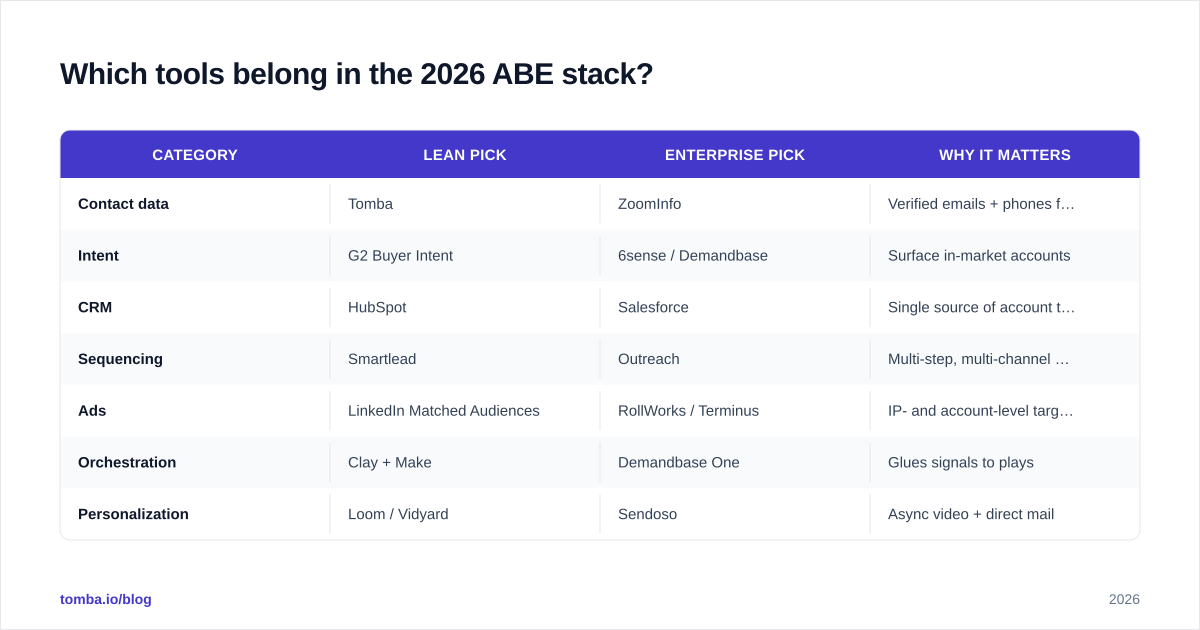
The shift in 2026: orchestration is now lightweight. With a workflow tool plus a good API stack — Tomba's API and HubSpot integration are common starting points — you can ship a workable ABE engine in two weeks instead of two quarters.
What metrics should you track for account based engagement?#
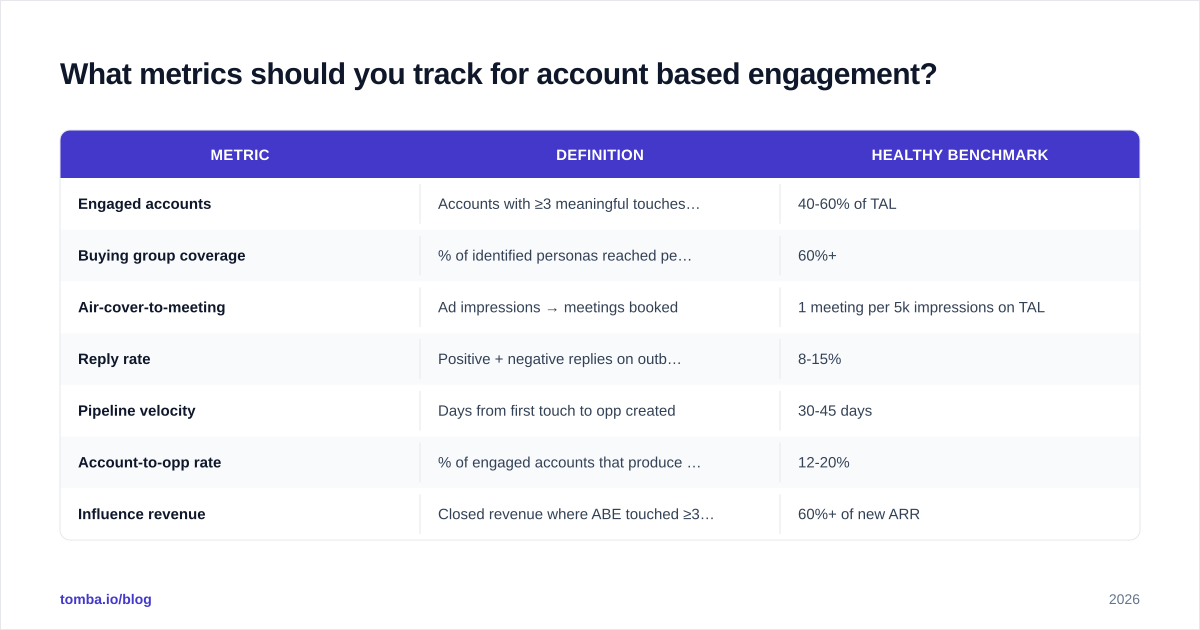
Stop reporting on MQLs. ABE has its own scoreboard.
| Metric | Definition | Healthy benchmark |
|---|---|---|
| Engaged accounts | Accounts with ≥3 meaningful touches in 30 days | 40-60% of TAL |
| Buying group coverage | % of identified personas reached per account | 60%+ |
| Air-cover-to-meeting | Ad impressions → meetings booked | 1 meeting per 5k impressions on TAL |
| Reply rate | Positive + negative replies on outbound | 8-15% |
| Pipeline velocity | Days from first touch to opp created | 30-45 days |
| Account-to-opp rate | % of engaged accounts that produce a qualified opp | 12-20% |
| Influence revenue | Closed revenue where ABE touched ≥3 buying group members | 60%+ of new ARR |
The two metrics most teams forget: buying group coverage and influence revenue. Without them, you'll over-credit the SDR who happened to email the signer last and under-credit the marketing team that warmed the entire committee for six weeks.
What are the most common ABE mistakes?#
After watching dozens of programs launch, the same mistakes repeat.
Starting too broad. 500-account TAL with a 4-person team = nobody gets real attention. Cut it to 100.
Sales and marketing running parallel lists. If the SDR's CRM list doesn't match the marketing ad audience, you don't have ABE. You have two campaigns with extra steps.
Treating ABE as a quarterly project. It's continuous. Plays trigger on signals year-round.
Ignoring data hygiene. Stale contact enrichment means you're emailing people who left the company 18 months ago. Run a quarterly refresh.
No CRM discipline. If account stage and buying-group contacts aren't updated weekly, the orchestration breaks.
Over-automating personalization. "Hi {{firstName}}, I noticed {{company}} is growing fast" was dead in 2022. In 2026 it actively damages your brand. If you can't personalize, send fewer messages.
Skipping the retro. Win/loss reviews on ABE deals teach you which plays land. Skip them and you'll run the same broken plays for a year.
How long until account based engagement shows ROI?#
Expect a 4-6 month ramp before pipeline reliably converts.
- Month 1-2: Build TAL, map buying groups, enrich contacts, write plays.
- Month 3: First coordinated plays go live. Engagement metrics start moving.
- Month 4-5: Pipeline starts forming. Early closed-won is rare but possible on shorter sales cycles.
- Month 6+: Steady-state. Plays optimized, signals tuned, repeatable pipeline.
The teams that quit at month 3 because "ABE doesn't work" almost always had a data problem they didn't diagnose. Validate every email, refresh contacts monthly, and the curve bends faster.
Is account based engagement right for your team?#
ABE pays off when:
- Average contract value > $25k (lower ACV economics favor demand gen)
- Sales cycles > 30 days (you need time to engage multiple personas)
- Buying committee > 3 people (otherwise demand gen works fine)
- You have or can build a real SDR-AE-marketing partnership
Skip ABE — or run a lighter version — when:
- You're product-led with self-serve conversions
- ACV is under $5k
- You have fewer than 50 logical target accounts
For everyone in between, ABE is the highest-leverage GTM motion available in 2026.
Build your ABE engine on data you can trust#
The single biggest predictor of ABE success isn't your platform choice — it's whether your team can reliably reach the right people at the right accounts. That starts with verified contact data.
Tomba's Email Finder gives you verified work emails for every persona in your buying group, with bulk lookups, native HubSpot integration, and a free tier to test before you commit. Pair it with the email verifier before any send, and you've solved the data layer that quietly kills most ABE programs. Start free at tomba.io — 25 searches a month, no card required.
// get started
Find, verify and enrich your first contacts today
Start on the free plan with 25 searches a month, then scale when your team is ready.
Free plan · No credit card required · GDPR & CCPA
// about the author