Account Based Everything in 2026: The Complete GTM Playbook
Account based everything moves past marketing-led ABM into a full GTM operating model. Here's how sales, marketing, CS, and RevOps run accounts together in 2026.
TL;DR#
- Account based everything (ABX) is the operating model that comes after ABM. Marketing, sales, customer success, and RevOps run a shared list of target accounts as one team, not three.
- The shift in 2026 is structural: lead-based funnels are losing to account-based revenue motions because buying committees now average 9-11 people and 70% of the journey happens before a rep is contacted.
- An ABX program has five pillars — account selection, unified data, coordinated plays, shared metrics, and one tech stack. Skip any one and it collapses back into ABM.
- The metrics that matter changed. Track account engagement score, pipeline coverage by tier, multi-threading depth, and account velocity — not MQLs.
- Tooling matters less than orchestration. You need a sharp ICP, clean contact data, intent signals, and a single source of truth. Tools like Tomba feed the contact and enrichment layer that ABX depends on.
What is account based everything?#
Account based everything is a go-to-market model where every revenue-facing team — marketing, sales development, account executives, customer success, and RevOps — works from one prioritized list of target accounts and one shared definition of success on each account.
The phrase was popularized by Engagio (later acquired by Demandbase) around 2017, but the model only became widely adopted in 2024-2026 as buying committees expanded and lead-based funnels broke down. ABM said "marketing should target accounts." ABX says "the whole company should."
The difference matters. ABM lives inside marketing's quarterly campaigns. ABX is how the entire revenue org plans, executes, and reports.
How is ABX different from ABM and traditional inbound?#
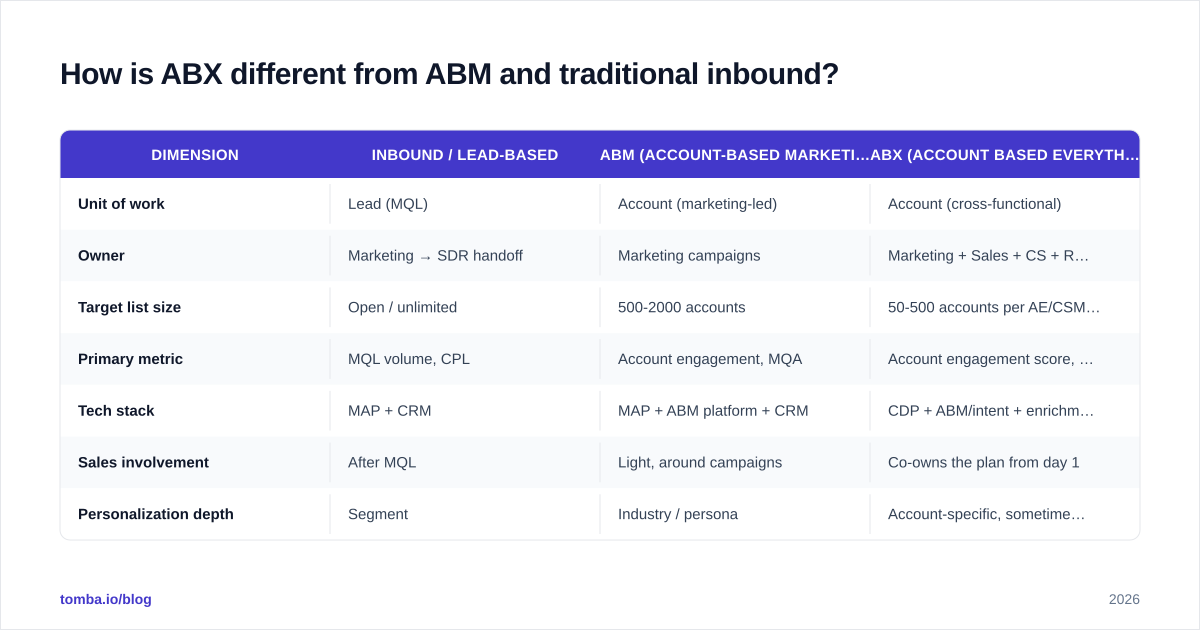
The three models are not interchangeable. Each has a different unit of work, a different success metric, and a different team owner.
| Dimension | Inbound / Lead-based | ABM (Account-Based Marketing) | ABX (Account Based Everything) |
|---|---|---|---|
| Unit of work | Lead (MQL) | Account (marketing-led) | Account (cross-functional) |
| Owner | Marketing → SDR handoff | Marketing campaigns | Marketing + Sales + CS + RevOps |
| Target list size | Open / unlimited | 500-2000 accounts | 50-500 accounts per AE/CSM pod |
| Primary metric | MQL volume, CPL | Account engagement, MQA | Account engagement score, pipeline by tier, NRR |
| Tech stack | MAP + CRM | MAP + ABM platform + CRM | CDP + ABM/intent + enrichment + sales engagement + CRM |
| Sales involvement | After MQL | Light, around campaigns | Co-owns the plan from day 1 |
| Personalization depth | Segment | Industry / persona | Account-specific, sometimes 1:1 |
| Typical cycle length | 30-90 days | 90-180 days | 90-270 days |
| Success looks like | Many leads, some convert | Tier-1 accounts engaged | Closed-won revenue + expansion on named accounts |
If you only changed the marketing tactics and kept the lead-based reporting, you have ABM with a new name. ABX is the operating model change.
Why is account based everything dominating 2026?#
Four structural shifts pushed B2B from leads to accounts. None of them are reversible.
1. Buying committees exploded. Gartner's latest B2B buying research puts the typical committee at 9-11 stakeholders for enterprise deals. A single MQL tells you almost nothing about whether the account is ready to buy.
2. Self-serve research dominates the journey. Forrester and Gartner both report that 65-75% of the buying journey happens before a vendor is contacted. The job is no longer to capture demand — it is to be visible inside the right accounts when committees form.
3. Lead forms collapsed. Privacy regulation (GDPR, CCPA, CPRA), browser tracking changes, and form fatigue dropped form-fill conversion 30-50% from 2020 levels. Buying signals had to move from form-fills to intent data, web visit identification, and contact enrichment.
4. CS owns expansion revenue. In 2026, the average SaaS company gets 40-60% of new ARR from expansion. That breaks the old "marketing → sales → CS" relay. CS now needs the same account intelligence sales has.
The companies that adapted are running account based everything. The ones still optimizing MQL volume are losing pipeline coverage to competitors who target the same accounts with five touchpoints from five different teams in the same week.
What are the five pillars of an account based everything program?#
You can replace tools. You cannot skip pillars. Each one feeds the next.
Pillar 1: Account selection (ICP + tiering)#
Start with a tight Ideal Customer Profile based on closed-won data, not aspiration. Tier accounts by fit + intent:
- Tier 1 (1:1) — 20-50 accounts per AE. Bespoke plays, executive sponsor, custom content.
- Tier 2 (1:few) — 100-300 accounts. Industry/persona plays, account-specific landing pages.
- Tier 3 (1:many) — 500-2000 accounts. Programmatic plays, automated sequences.
Rebuild the list every quarter. Accounts that show no engagement after two quarters get demoted.
Pillar 2: Unified data layer#
If marketing and sales see different account data, ABX is dead on arrival. You need:
- One canonical account record in the CRM
- Contact-level data enrichment so every account has the full buying committee mapped, not just the form-fill
- Intent data (Bombora, G2, 6sense, or Demandbase) flowing into the same record
- Engagement data (email opens, web visits, ad impressions, calls) attributed to the account, not just the contact
This is where most ABX programs quietly fail. The plan is great, but the data is dirty. Reps don't trust the list and revert to their own prospecting.
Pillar 3: Coordinated plays (the "everything" part)#
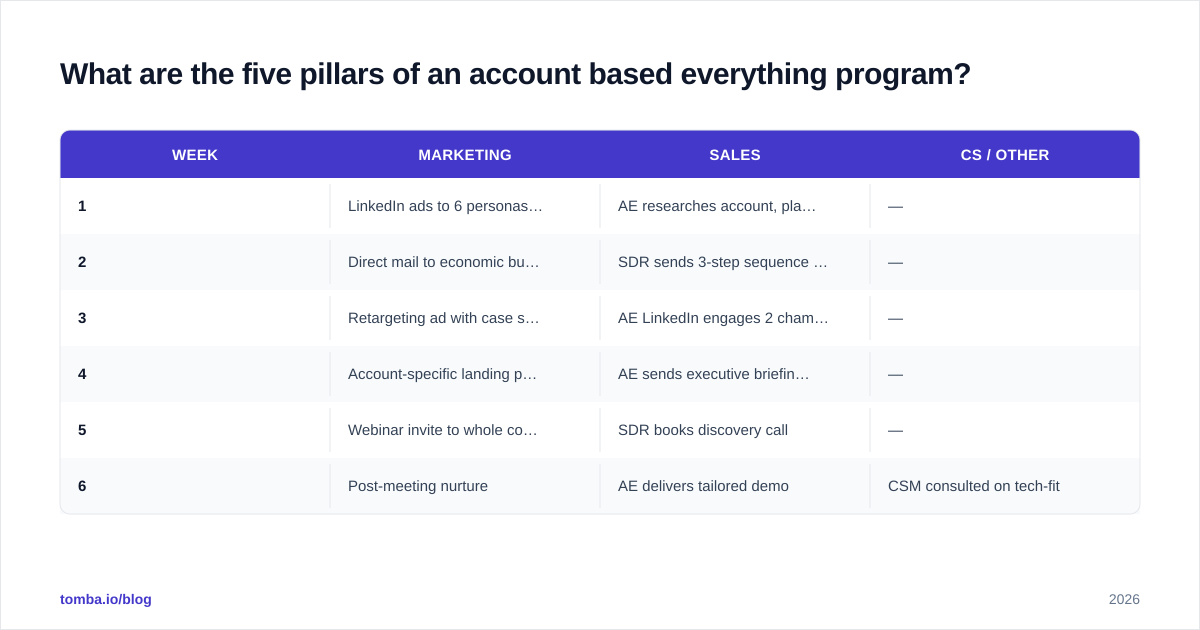
A play is a defined sequence of cross-team actions targeting one account or tier. Example tier-1 play over 6 weeks:
| Week | Marketing | Sales | CS / Other |
|---|---|---|---|
| 1 | LinkedIn ads to 6 personas at account | AE researches account, plans outreach | — |
| 2 | Direct mail to economic buyer | SDR sends 3-step sequence to 5 contacts | — |
| 3 | Retargeting ad with case study | AE LinkedIn engages 2 champions | — |
| 4 | Account-specific landing page | AE sends executive briefing invite | — |
| 5 | Webinar invite to whole committee | SDR books discovery call | — |
| 6 | Post-meeting nurture | AE delivers tailored demo | CSM consulted on tech-fit |
Every team knows what every other team is doing. No surprise calls, no duplicate touches.
Pillar 4: Shared metrics and comp#
If marketing is paid on MQLs and sales is paid on closed-won, they will not run plays together. ABX requires shared north-star metrics:
- Account engagement score — composite of meaningful interactions across the committee
- Pipeline coverage by tier — 3-5x quota in tier 1, 2-3x in tier 2
- Multi-threading depth — # of engaged contacts per opportunity (target 4+)
- Account velocity — days from first engagement to closed-won
- Net revenue retention by named-account cohort
Marketing's bonus partly depends on tier-1 closed-won. Sales' bonus partly depends on multi-threading. CS' bonus partly depends on expansion within the same target list.
Pillar 5: One operating cadence#
ABX runs on a weekly account review, not a monthly marketing review. Pod-style team (1 AE + 1 SDR + 1 CSM + 1 marketer per 50-100 accounts) meets weekly to review signals, agree on next plays, kill dead accounts, and surface escalations.
What does the 2026 ABX tech stack look like?#
You do not need every category, but you do need the data layer to be clean before you spend on orchestration.
| Layer | Purpose | Examples |
|---|---|---|
| ICP + account list | Build and tier target accounts | Crunchbase,ZoomInfo, Tomba B2B database |
| Contact data + enrichment | Map the buying committee | Tomba Email Finder, Apollo, ContactOut |
| Intent + signals | Surface in-market accounts | 6sense, Bombora, G2 Buyer Intent, Demandbase |
| ABM ads | Account-level advertising | LinkedIn ABM, RollWorks, Demandbase |
| Sales engagement | Multi-channel sequencing | Outreach, Salesloft, Instantly |
| CRM (system of record) | Account + opportunity data | Salesforce, HubSpot |
| Orchestration / RevOps | Plays, scoring, automation | Clay, Default, Tray.io |
| Web personalization | 1:1 landing pages | Mutiny, PathFactory |
| Analytics | Account-level reporting | Looker, Tableau, native ABM dashboards |
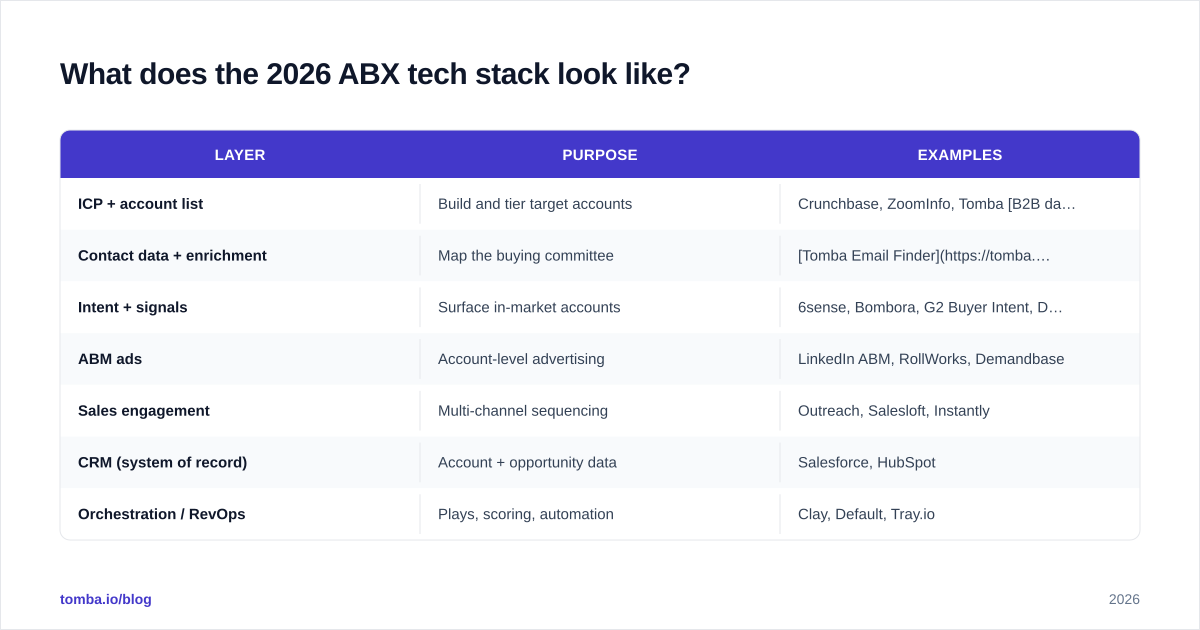
The most common mistake is buying an orchestration platform before the contact and enrichment layer works. Orchestration without clean data is just expensive automation of bad outreach.
How do you launch ABX in 90 days?#
Most teams over-plan and under-launch. A staged 90-day rollout beats a 12-month "transformation."
Days 1-30: Foundation#
- Define ICP from closed-won data (last 24 months, weighted to last 12)
- Build target list — start with 100 tier-1 accounts only
- Audit data quality: % of accounts with full committee mapped, valid emails, current titles
- Use a bulk email finder and verifier to clean and complete the list
- Pick 3 shared metrics. Get exec sign-off.
Days 31-60: First play#
- Run one tier-1 play across 20 accounts with one pod
- Document everything — what worked, what broke, where data was wrong
- Weekly account review starts here
Days 61-90: Scale#
- Expand to 100 tier-1 accounts across 3-5 pods
- Launch one tier-2 programmatic play
- Build the account engagement score in the CRM
- Tie at least 20% of marketing variable comp to target-account pipeline
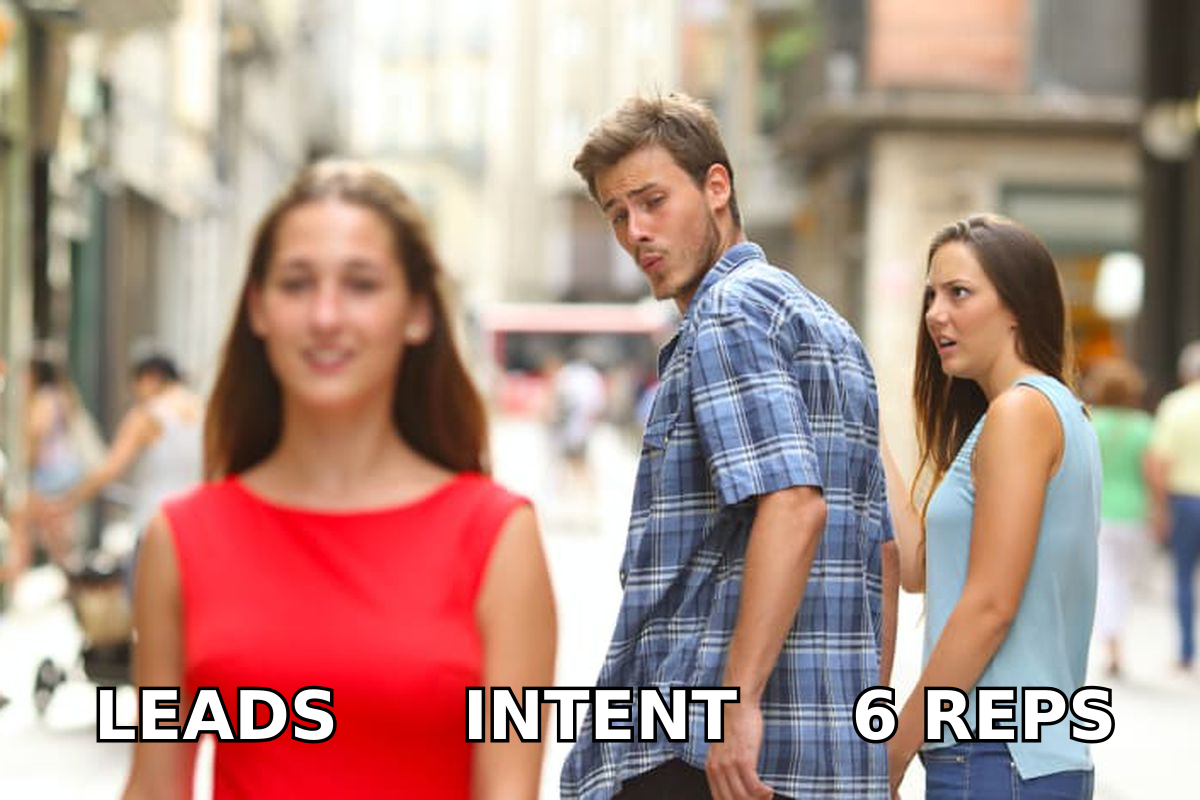
Avoid the temptation to buy a $120K ABM platform in month one. Buy it in month four when you know what plays you actually need to automate.
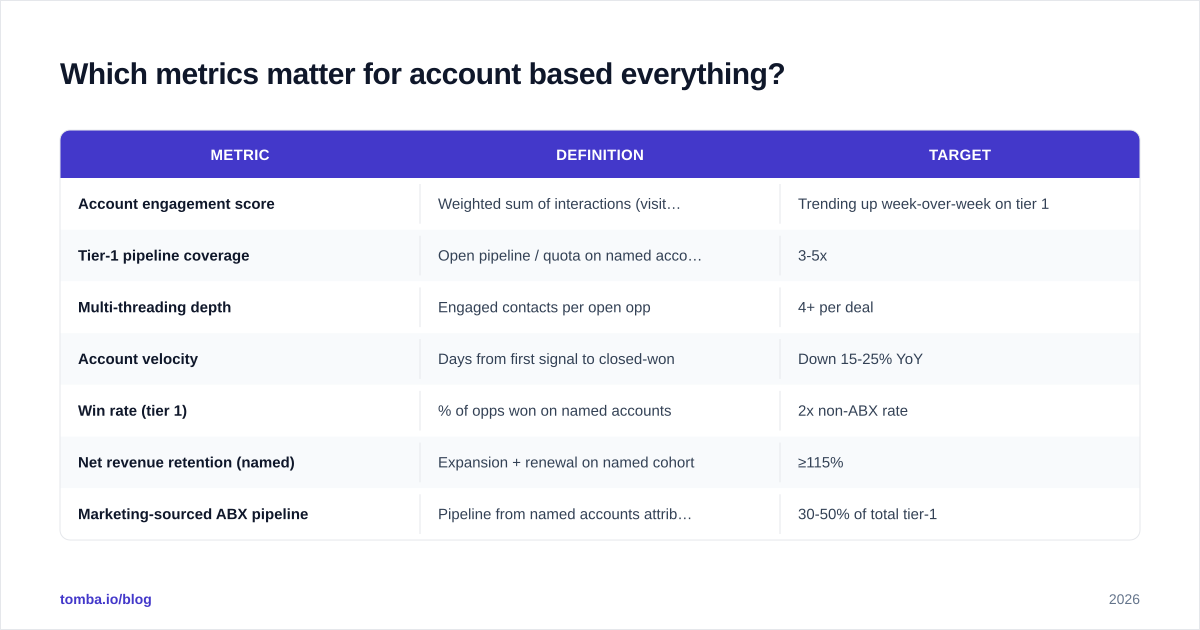
Which metrics matter for account based everything?#
Pick fewer. Report them weekly. Tie comp to them.
| Metric | Definition | Target |
|---|---|---|
| Account engagement score | Weighted sum of interactions (visits, opens, calls, meetings) per account | Trending up week-over-week on tier 1 |
| Tier-1 pipeline coverage | Open pipeline / quota on named accounts | 3-5x |
| Multi-threading depth | Engaged contacts per open opp | 4+ per deal |
| Account velocity | Days from first signal to closed-won | Down 15-25% YoY |
| Win rate (tier 1) | % of opps won on named accounts | 2x non-ABX rate |
| Net revenue retention (named) | Expansion + renewal on named cohort | ≥115% |
| Marketing-sourced ABX pipeline | Pipeline from named accounts attributed to marketing-led plays | 30-50% of total tier-1 |
Stop reporting MQLs at the board level. They predict nothing about account based revenue.
What are the most common ABX failure modes?#
Five patterns kill ABX programs in the first year. All are organizational, not technical.
1. "ABX is a marketing project." If sales does not co-own the list and the cadence, this is ABM with a new logo. Get the CRO and CMO in the same weekly review, or do not start.
2. List bloat. Teams want 5,000 accounts because it feels safer. 5,000 accounts means 5,000 mediocre touches. Stay under 500 in year one. Demote ruthlessly.
3. Dirty data. 30% of B2B contact data decays per year. If you skip enrichment and verification, reps stop trusting the list inside 60 days. Run quarterly cleanup with an email verifier and re-enrich missing roles.
4. Single-threaded relationships. AEs who only engage their original champion lose 60% of those deals when the champion leaves. ABX mandates 4+ engaged contacts per open opportunity.
5. Vanity tooling. Buying 6sense or Demandbase without first nailing pillars 1-3 wastes the spend. Build the list, clean the data, run one play, then buy orchestration.
How does ABX change customer success and expansion?#
CS in an ABX model is not a post-sale function — it is a co-owner of the account from day one. Three changes show up:
- CSMs sit in the same pod as the AE and marketer and join the same weekly account review.
- Expansion accounts are tiered with the same rigor as new-business accounts. A "tier-1 expansion" account gets the same play structure.
- CS engagement data (product usage, support tickets, executive QBRs) flows into the same account engagement score that marketing and sales see.
This is where net revenue retention becomes a leading indicator of GTM health, not just a CS KPI. Companies running mature ABX programs typically see NRR 10-15 points higher than peers.
How does AI fit into account based everything in 2026?#
AI did not replace ABX — it lowered the cost of running it at depth.
- Account research at scale — LLMs summarize 10-K filings, news, hiring patterns, and tech stack changes per account in minutes
- Buying committee inference — given a known champion, AI can predict the other 8-10 stakeholders and their roles
- Personalization — first-touch emails and landing pages are generated per account, not per segment
- Signal triage — AI ranks the 200 intent signals you receive each week so reps only act on the top 10
- Forecasting — account-level health scoring is now a model output, not a CRM stage average
The risk is that AI makes spray-and-pray look like personalization. The discipline of ABX — tight list, shared plays, multi-threading — is what stops AI from amplifying noise.
Who should and should not run ABX?#
ABX is not a universal upgrade. It pays off when:
- ACV is $20K+ (the play economics need a real deal size)
- Sales cycles are 60+ days
- Buying committees are 4+ people
- Your TAM is defined and addressable in under 5,000 accounts
- Marketing and sales leadership will commit to shared metrics
ABX is wrong when:
- You sell self-serve, low-ACV SaaS at PLG scale
- Your TAM is millions of SMBs and personalization economics don't work
- Sales and marketing won't share a list or a metric (fix that first)
How does Tomba fit into an account based everything stack?#
Tomba covers the contact and enrichment layer that every ABX program depends on. When your target list is 100-500 accounts, you cannot afford holes in the buying committee — every missing email is a missing touchpoint and a stalled play.
Three places Tomba shows up in an ABX workflow:
- Map the committee — use the domain search to pull every email associated with a target company, filtered by department or seniority
- Verify before sequencing — push contacts through the email verifier to keep bounce rates under 2% and protect sender reputation
- Enrich in bulk — the bulk email finder lets RevOps complete a 500-account list in one job instead of one rep at a time
Tomba pricing starts free (25 searches/month) and goes to $49/month Starter, $99/month Growth, $249/month Pro, with custom Enterprise — so the contact data layer is rarely the most expensive line in an ABX budget.
Final take: account based everything is the default in 2026#
ABX is not a tactic. It is the operating model B2B revenue teams adopt when buying committees expand, self-serve research dominates, and expansion outpaces new business. The companies winning in 2026 picked 100-500 accounts, lined up marketing, sales, and CS behind shared metrics, and ran plays weekly instead of campaigns quarterly.
Start with the foundation, not the platform. Get the ICP right, get the contact data clean, run one play, then scale. The orchestration tool you buy in month four will work because the data underneath it is finally trustworthy.
Ready to fix the contact and enrichment layer your ABX program runs on? The Tomba Email Finder maps full buying committees by domain, verifies in bulk, and feeds clean records straight into your CRM — so your tier-1 plays land on real inboxes, not bounce reports. Start free with 25 searches and scale to your full target list when you're ready.
// get started
Find, verify and enrich your first contacts today
Start on the free plan with 25 searches a month, then scale when your team is ready.
Free plan · No credit card required · GDPR & CCPA
// about the author