Account Based Marketing in 2026: The Complete B2B Playbook
Account based marketing flips the B2B funnel: instead of casting wide nets, you land a list of named accounts. Here's how the ABM playbook actually works in 2026.
Account Based Marketing in 2026: The Complete B2B Playbook
TL;DR
- Account based marketing (ABM) treats individual companies as markets of one, replacing volume-based MQL chasing with named-account focus.
- The 2026 ABM stack is intent data + enrichment + multi-channel orchestration + sales-marketing alignment — not just LinkedIn ads.
- Tier 1 (1:1) targets ~10 strategic accounts; Tier 2 (1:few) covers 50–200 clusters; Tier 3 (1:many) automates 1,000+ programmatic plays.
- The metric that matters is pipeline velocity inside the target account list, not lead volume or MQL count.
- ABM works only when marketing and sales share the same account list, the same definition of engagement, and the same comp plan inputs.
What is account based marketing?#
Account based marketing is a B2B growth strategy where marketing and sales agree on a finite list of high-fit companies and run coordinated campaigns to win them — instead of generating broad lead volume and hoping qualified buyers surface.
Think of traditional demand generation as a trawler dragging a wide net across the ocean. You catch a lot, most of it gets thrown back, and you pay for the fuel either way. ABM is spearfishing. You know which fish you want, you understand its habitat, and every motion is aimed at landing it.
The mechanics are simple, the discipline is not. You build a target account list (TAL), enrich it with buying-committee contact data, layer intent signals on top, and then run sequenced plays — ads, email, direct mail, BDR outreach, executive engagement — at the accounts most likely to buy in the next 90 days.
According to Gartner, 70% of B2B marketers reported running formal ABM programs in 2023, up from 15% in 2020. By 2026, ABM has effectively absorbed what used to be called "enterprise demand gen."
Why has ABM replaced traditional demand gen in B2B?#
Three structural changes killed the old MQL machine.
Buyer committees got bigger. The average B2B deal involves 6–10 stakeholders. A single "lead" from a content download tells you almost nothing about whether the account will buy. You need the committee, not the individual.
Intent data became affordable. Tools like 6sense, Bombora, and G2 Buyer Intent surface which accounts are researching your category — even before they visit your site. That used to cost $200k/year. Now it's table stakes.
CFOs stopped funding vanity metrics. "We generated 12,000 MQLs last quarter" doesn't survive a board review when only 80 of them closed. ABM ties every dollar to a named-account pipeline.
How is ABM different from inbound marketing?#
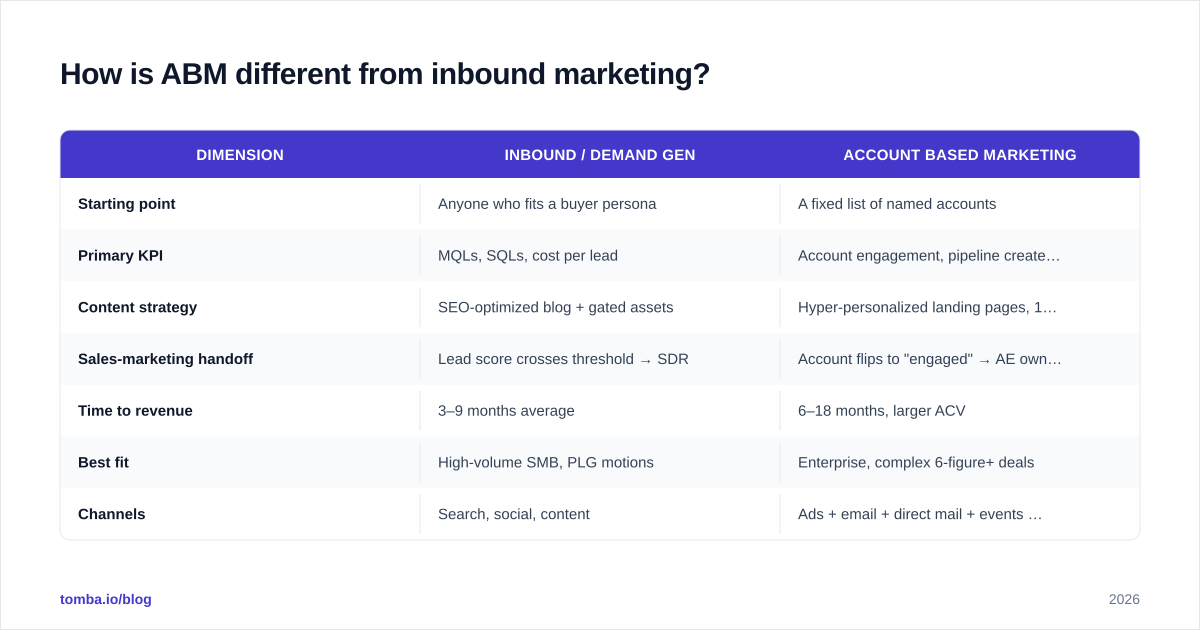
The two aren't enemies — most mature programs run both — but they answer different questions.
| Dimension | Inbound / Demand Gen | Account Based Marketing |
|---|---|---|
| Starting point | Anyone who fits a buyer persona | A fixed list of named accounts |
| Primary KPI | MQLs, SQLs, cost per lead | Account engagement, pipeline created in TAL |
| Content strategy | SEO-optimized blog + gated assets | Hyper-personalized landing pages, 1:1 video, custom decks |
| Sales-marketing handoff | Lead score crosses threshold → SDR | Account flips to "engaged" → AE owns it |
| Time to revenue | 3–9 months average | 6–18 months, larger ACV |
| Best fit | High-volume SMB, PLG motions | Enterprise, complex 6-figure+ deals |
| Channels | Search, social, content | Ads + email + direct mail + events + BDR |
| Failure mode | Drowning in unqualified leads | Wasted spend on wrong accounts |
The honest answer: if your average contract value is below $15k/year and your sales cycle is under 60 days, full ABM is overkill. Use account-based principles (TAL, enrichment, sales-marketing alignment) but skip the 1:1 production cost.
What are the three tiers of ABM?#
The tiered model — popularized by ITSMA and now standard at firms like Forrester — splits your TAL by investment level.
Tier 1 — Strategic ABM (1:1)#
- 5–25 accounts, hand-picked by the CRO and CMO
- Custom microsites, executive briefings, bespoke research reports
- Heavy AE + ABM marketer pairing, often a dedicated content producer
- Investment per account: $25k–$100k+
- Goal: land or expand a small number of "category-defining" logos
Tier 2 — Scaled ABM (1:few)#
- 50–200 accounts, clustered by industry, segment, or use case
- Shared content themes with light personalization (industry, role, pain)
- Programmatic display + retargeting + sequenced BDR plays
- Investment per account: $1k–$5k
- Goal: accelerate accounts already showing intent
Tier 3 — Programmatic ABM (1:many)#
- 1,000–10,000 accounts in the broader ICP
- Heavy automation: dynamic ads, web personalization, batch sequences
- Sales has access, but doesn't manually touch unless an account heats up
- Investment per account: under $200
- Goal: surface in-market accounts efficiently
Most programs stack all three. Tier 3 generates the heat-map; Tier 2 nurtures clusters; Tier 1 closes the whale.
What does a 2026 ABM tech stack look like?#
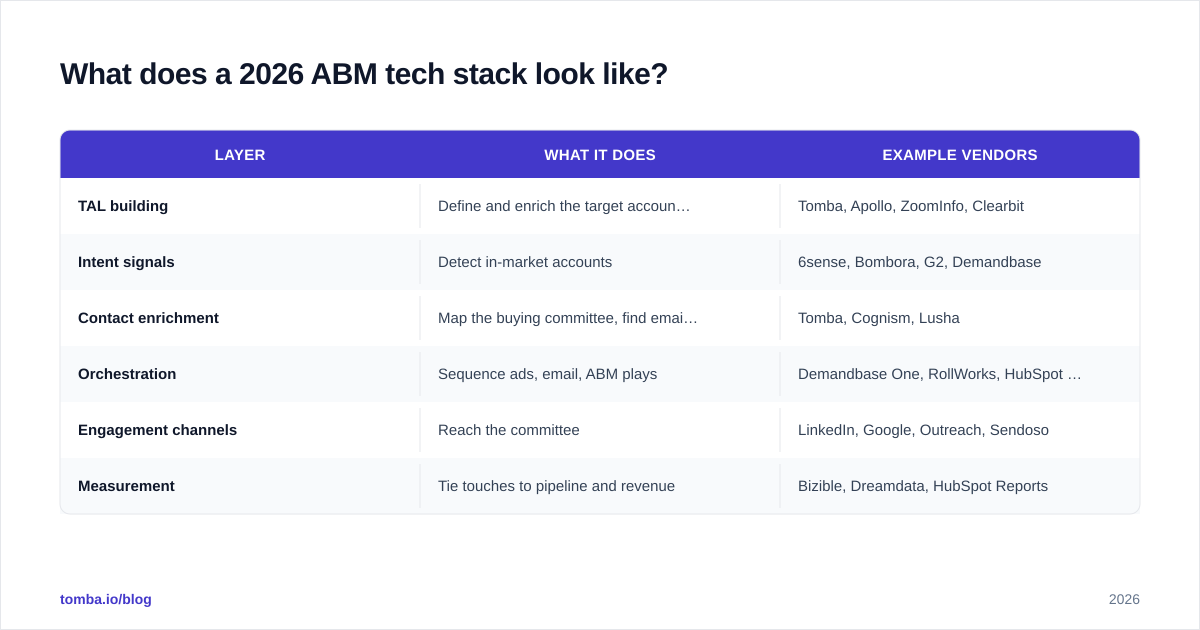
A working stack has six layers. You don't need a separate vendor for each — most modern platforms collapse 2–3 layers — but every function below has to exist somewhere.
| Layer | What it does | Example vendors |
|---|---|---|
| TAL building | Define and enrich the target account list | Tomba, Apollo,ZoomInfo, Clearbit |
| Intent signals | Detect in-market accounts | 6sense, Bombora, G2, Demandbase |
| Contact enrichment | Map the buying committee, find emails + phones | Tomba, Cognism, Lusha |
| Orchestration | Sequence ads, email, ABM plays | Demandbase One, RollWorks, HubSpot ABM |
| Engagement channels | Reach the committee | LinkedIn, Google, Outreach, Sendoso |
| Measurement | Tie touches to pipeline and revenue | Bizible, Dreamdata, HubSpot Reports |
The enrichment layer is where ABM programs quietly die. You can have the world's best intent data, but if you don't know the CFO's email at the account showing intent, the play stalls. This is where a deep B2B database plus a fast email finder earn their keep — they convert "this account is hot" into "here are the seven people we need to reach today."
How do you build a target account list (TAL)?#
The TAL is the single most important artifact in ABM. Get it wrong and every downstream activity wastes money.
Step 1 — Define the ideal customer profile (ICP)#
Pull your last 24 months of closed-won deals. Look at:
- Industry (NAICS or SIC code)
- Employee count band (e.g., 200–2,000)
- Revenue band ($50M–$1B)
- Tech stack signals (uses Salesforce, runs on AWS, has a Stripe integration)
- Geography
- Funding stage or public/private status
The ICP is the filter. If a company doesn't pass it, no marketing spend touches them.
Step 2 — Score the universe#
Apply the ICP to a B2B database or pull from your existing enrichment provider. You'll get a universe of 5,000–50,000 accounts depending on category.
Step 3 — Layer intent and fit#
Rank the universe by:
- Fit score (how closely they match closed-won)
- Intent score (are they actively researching the category?)
- Existing engagement (have they visited the site, attended a webinar, opened email?)
- Strategic value (logo halo, expansion potential)
Step 4 — Cut to size#
Most teams over-build their TAL. A practical cap for a 5-AE team is 300–500 active Tier 2 accounts at any given time. More than that and reps lose focus.
Step 5 — Lock the list quarterly#
Re-scoring weekly creates whiplash. Lock the TAL each quarter, agree it with sales in writing, and only allow swaps in extraordinary cases.
How do you find the buying committee inside a target account?#
Once an account is in the TAL, you need 5–10 named humans inside it. Marketing-to-account is a fiction; marketing-to-people-inside-the-account is the actual job.
Run this workflow for every Tier 1 and Tier 2 account:
- Use a domain search on the company's website to surface every public email pattern and known contact in one query.
- Layer on a LinkedIn finder to pull the actual decision-makers — typically VP of [function], Director of [function], and the C-suite sponsor.
- Pull phone numbers via a phone finder for the AE — the BDR can email, but the AE still needs a dialer for the late-stage conversation.
- Run every email through an email verifier before sequencing. Sending to dead addresses tanks your domain reputation and burns the account.
- Push the enriched committee into the CRM with a shared
account_idso marketing ads and sales sequences fire at the same humans.
The "research the buying committee" step is where ABM programs stall. Reps refuse to spend 45 minutes per account hand-mapping titles in LinkedIn. Automate it with a real enrichment pipeline or accept that your sequences will go to the wrong people.
What ABM plays actually work in 2026?#
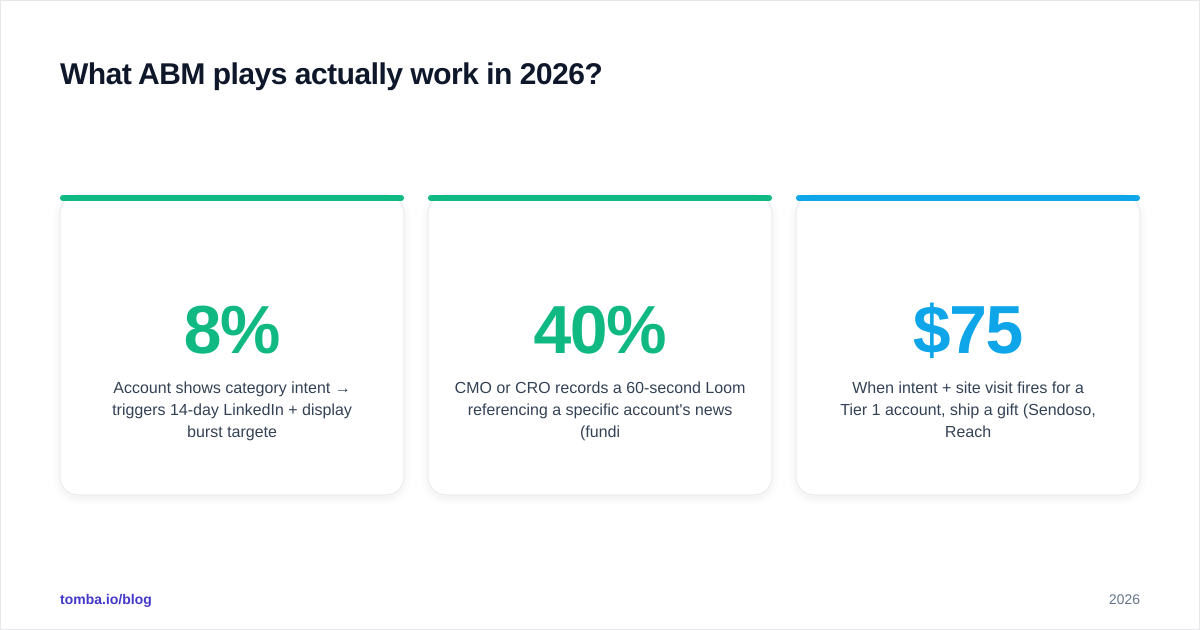
Six plays produce the bulk of ABM pipeline. The rest is theater.
1. Intent-triggered ad pulse#
Account shows category intent → triggers 14-day LinkedIn + display burst targeted at the buying committee → BDR follows with a sequenced touch on day 5. Conversion rate: 4–8% to meeting on the right TAL.
2. Executive 1:1 video#
CMO or CRO records a 60-second Loom referencing a specific account's news (funding round, exec hire, product launch). Sent only to Tier 1, only by the AE. Reply rates: 25–40%.
3. Reverse-IP web personalization#
Account visits your site → site swaps in their logo, industry stat, and a "Schedule a call" CTA tailored to their use case. Doubles conversion on existing TAL traffic.
4. Industry-clustered field events#
Small dinners (8–12 buyers) clustered by vertical. Invite-only from the TAL. Closed-won contribution per event: typically 2–4 deals over the next 6 months.
5. Direct mail to identified intent#
When intent + site visit fires for a Tier 1 account, ship a $75 gift (Sendoso, Reachdesk) with a hand-signed note from the AE. Meeting acceptance: 15–25%.
6. Retargeting the committee, not the visitor#
Most retargeting fires at the one person who visited. ABM retargeting fires at the entire mapped committee, even those who never clicked.
How do you measure ABM success?#
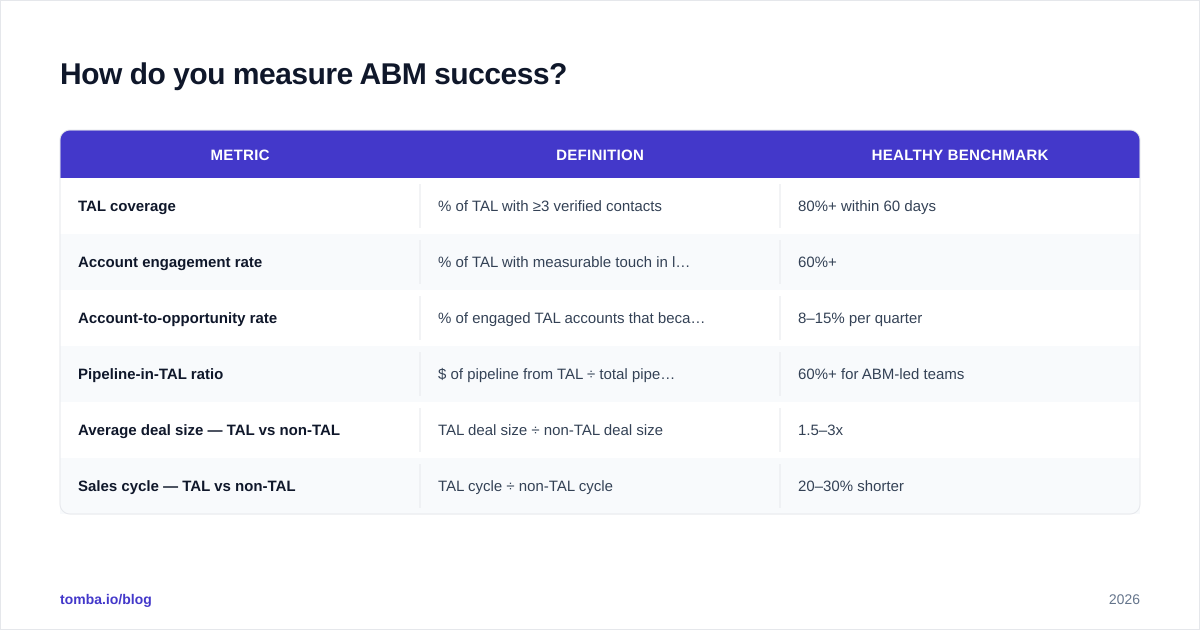
ABM dashboards look nothing like demand-gen dashboards. The metrics that matter:
| Metric | Definition | Healthy benchmark |
|---|---|---|
| TAL coverage | % of TAL with ≥3 verified contacts | 80%+ within 60 days |
| Account engagement rate | % of TAL with measurable touch in last 30 days | 60%+ |
| Account-to-opportunity rate | % of engaged TAL accounts that became opps | 8–15% per quarter |
| Pipeline-in-TAL ratio | $ of pipeline from TAL ÷ total pipeline | 60%+ for ABM-led teams |
| Average deal size — TAL vs non-TAL | TAL deal size ÷ non-TAL deal size | 1.5–3x |
| Sales cycle — TAL vs non-TAL | TAL cycle ÷ non-TAL cycle | 20–30% shorter |
Notice what's missing: MQLs, cost-per-lead, conversion rate from form fill. Those metrics are at best leading indicators and at worst actively misleading inside an ABM motion.
For the broader picture, the revenue operations function owns reconciling ABM metrics with finance — making sure the pipeline-in-TAL number aligns with bookings forecasted to the board.
What are the common ABM failure modes?#
Five patterns kill more ABM programs than budget cuts.
The TAL is too big. A 2,000-account "Tier 1" is not Tier 1. It's a regional segment with a fancy name. Real Tier 1 fits on one slide.
Marketing builds the TAL alone. If the AEs didn't sign the list in blood, they'll quietly work their own pipeline and ignore the program.
No comp plan reflects ABM. If BDRs are paid per meeting set, they'll book meetings outside the TAL because they're easier. Tie a meaningful chunk of variable comp to TAL activity.
Stack without process. Buying 6sense does not make you an ABM team. It gives you data. The process — who acts on which signal in which channel within which SLA — is the actual program.
No exit criteria. Accounts stay on the TAL forever, even after 18 months of zero engagement. Build a quarterly "graveyard" review and cut dead weight.
How does ABM fit with PLG and inbound?#
The 2026 reality: most B2B companies run a hybrid. PLG signups feed product-qualified accounts (PQAs) into the TAL. Inbound captures intent the ABM team can't manually hunt. ABM converts the high-value subset into enterprise contracts.
The pattern looks like this:
- Inbound + PLG generate volume and identify in-market accounts
- ABM filters them through the ICP and prioritizes top fit
- ABM plays convert the top tier into expansion deals or new enterprise logos
- The MQL number stops being a KPI and starts being a signal source
This is what G2 describes as the "flipped funnel" — and it's now the default for any B2B company above $20M ARR.
Frequently asked questions#
Is account based marketing only for enterprise? No. Mid-market SaaS teams selling $30k+ ACV deals run ABM successfully. Below $15k ACV, the production cost of personalized plays doesn't pencil out.
How long until ABM shows pipeline impact? Tier 3 programmatic plays produce signals within 60 days. Tier 1 and 2 typically need 2–3 quarters before pipeline-in-TAL meaningfully shifts. ABM is a long-cycle motion.
Do we need a dedicated ABM platform? Not at the start. A CRM, an email finder, an ad platform, and a HubSpot integration or Salesforce integration will get you the first $5M in pipeline. Add an orchestration platform when manual coordination breaks.
What's the biggest mistake new ABM teams make? Building the TAL alone. Marketing picks 500 logos that look great on a board slide; sales already has 500 accounts they're working that don't overlap. Co-build the list or don't bother.
Land more named accounts faster#
ABM lives or dies on whether you can reach the right people inside the right accounts — quickly, accurately, and at scale. That requires verified contact data on every member of the buying committee, not just whoever filled out a form.
Tomba sits at the enrichment layer of the ABM stack. Build your target account list, run a domain search against each account to surface every public contact, find the missing decision-makers with the Tomba Email Finder, verify deliverability before sequencing, and push the full committee straight into your CRM via the Tomba API. The free tier (25 searches/month) is enough to enrich one Tier 1 account end-to-end; the Starter plan at $49/month covers a working Tier 2 list, and Growth ($99/month) supports a full mid-market ABM program. See Tomba pricing for the breakdown.
Stop sending campaigns to lead lists. Start enriching named accounts and putting your sales team in the room with the actual buying committee.
Ready to find emails that actually work?
Join 150,000+ professionals who stopped guessing and started sending. Free credits on signup — no credit card required.
Get the Tomba newsletter
Practical outbound tactics and product updates — once every two weeks.
About the author