Account Based Marketing Attribution: The 2026 Playbook
Lead-based attribution lies to ABM teams. Here is how to model account based marketing attribution in 2026 — multi-touch, multi-buyer, and tied to pipeline.
Account Based Marketing Attribution: The 2026 Playbook
Account based marketing attribution is how B2B teams measure ABM impact at the account level, not the lead level. This guide covers the right model to pick, the data layer to build, and the way to tie every touch to pipeline and revenue.
TL;DR
- Lead-based attribution breaks the moment a buying committee has more than one person — which is every B2B deal.
- Account based marketing attribution rolls every touch from every contact at a target account into one timeline. It then assigns credit to channels, plays, and reps.
- Pick a model on purpose. First-touch flatters demand gen. Last-touch flatters SDRs. W-shaped and time-decay tell the truth about ABM motions.
- Your data layer matters more than your model. Identity stitching, intent signals, and clean contact data make or break the report.
- Tie attribution to pipeline created, pipeline accepted, and closed-won revenue — never to MQLs alone.
What is account based marketing attribution?#
Account based marketing attribution measures marketing impact at the account level, not the lead level. Every known touch at a target account rolls into one timeline. That covers email opens, ad views, webinar signups, sales calls, and intent signals. Credit for pipeline and revenue is then split across the channels that influenced the deal.
That sounds obvious. It is not how most marketing teams actually measure themselves.
The default funnel report still treats a single MQL as the unit of value. Picture an ABM motion. Seven people from a 4,000-employee target account engage with you over nine months — three from product, two from procurement, the VP of engineering, and the CFO. Lead attribution credits whichever of those seven happened to fill the demo form. Account attribution credits the entire pattern that produced it.
If you sell into committees, only the second view is honest.
Why does lead-based attribution fail ABM teams?#
Three structural problems push teams toward account based marketing attribution:
- Buying committees, not buyers. Gartner's research on B2B buying groups shows 6 to 10 stakeholders per deal. Lead attribution sees one of them.
- Anonymous-to-known gaps. A target account visits your pricing page 14 times before anyone fills out a form. Lead models start the clock at the form fill. Account models start it at the first anonymous visit you can resolve to the company.
- Channel double-counting. A LinkedIn ad served to four people at the same account looks like four separate impressions in lead reports. In an account view, it is one account-level touch with four reaches.
The cost of getting this wrong is not academic. It is wasted budget. Lead reports over-credit late-funnel paid search. They under-credit early-funnel ABM display, content syndication, and field events — the exact plays that warm up the committee.
What are the main attribution models for ABM?#
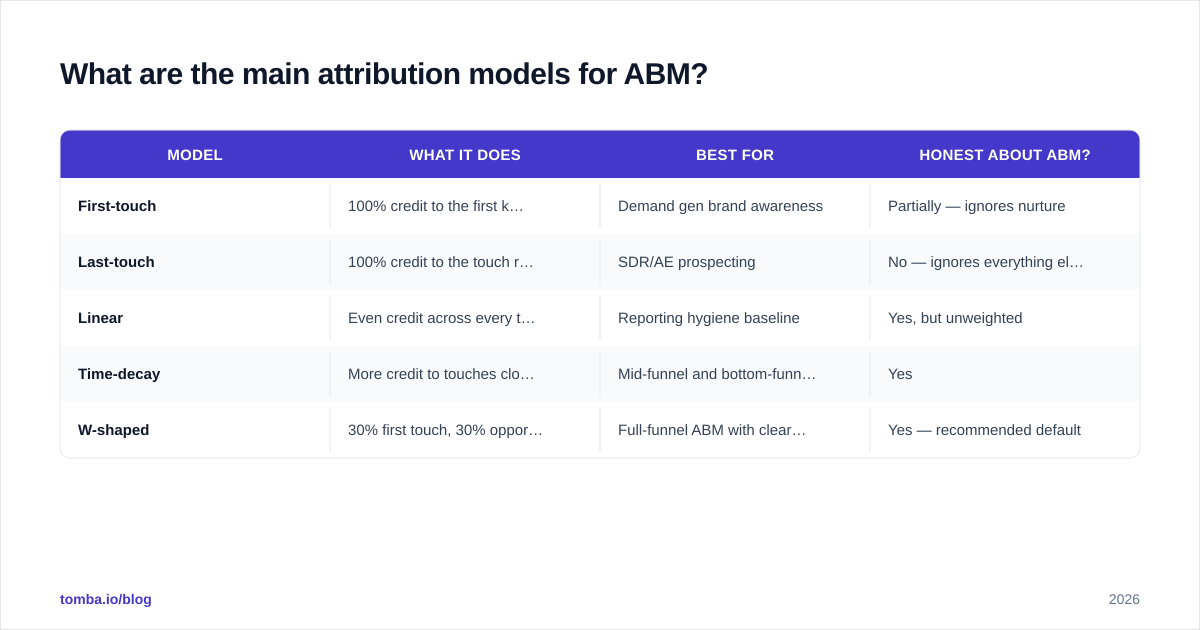
You will hear five models thrown around. Each tells a different story and serves a different team.
| Model | What it does | Best for | Honest about ABM? |
|---|---|---|---|
| First-touch | 100% credit to the first known touch on the account | Demand gen brand awareness | Partially — ignores nurture |
| Last-touch | 100% credit to the touch right before opportunity | SDR/AE prospecting | No — ignores everything else |
| Linear | Even credit across every touch on the account timeline | Reporting hygiene baseline | Yes, but unweighted |
| Time-decay | More credit to touches closer to opportunity creation | Mid-funnel and bottom-funnel plays | Yes |
| W-shaped | 30% first touch, 30% opportunity creation touch, 30% closed-won touch, 10% spread across the rest | Full-funnel ABM with clear stage gates | Yes — recommended default |
In practice, the best ABM teams run two models in parallel. W-shaped for revenue talks with the CFO. Time-decay for channel-level talks inside the marketing team. The models disagree, and the disagreement is the insight.
How do you build the data layer for account attribution?#
Models are the easy part of account based marketing attribution. Data is where teams die.
Account identity stitching
You need a single account_id that joins:
- CRM accounts (Salesforce, HubSpot)
- Marketing automation contacts (Marketo, HubSpot, Pardot)
- Web analytics sessions resolved to companies via reverse IP or first-party identification
- Ad platforms (LinkedIn Matched Audiences, 6sense/Demandbase)
- Intent data feeds (Bombora, G2, TrustRadius)
- Outbound activity (Outreach, Salesloft, calling logs)
Every record needs to map back to the same canonical account. That requires clean company domains, deduped accounts, and a way to resolve "Acme Inc." vs "acme.com" vs "Acme Incorporated" to one row.
Contact-level enrichment
For every known contact, you need their role, seniority, and department. That's how you model the buying committee. Enrichment tools like Tomba's data enrichment fill the gaps in your CRM. Forms, webinars, and scraped lists often come in with missing fields. Without role and seniority, you cannot tell whether you have reached the real buying committee or just three interns.
Anonymous resolution
Use a website visitor reveal tool to turn anonymous pageviews into accounts. This is the biggest unlock for first-touch attribution in ABM. Most target accounts research you for weeks before they identify themselves.
Outbound capture
If your SDRs prospect manually, every email send and call needs to log back to the account timeline. Tools like a LinkedIn finder or a bulk email finder pull contact data from LinkedIn or the open web. They should write back to CRM with source = outbound_prospecting. Otherwise those touches stay invisible to the model.
Which signals count as a "touch" at the account level?#
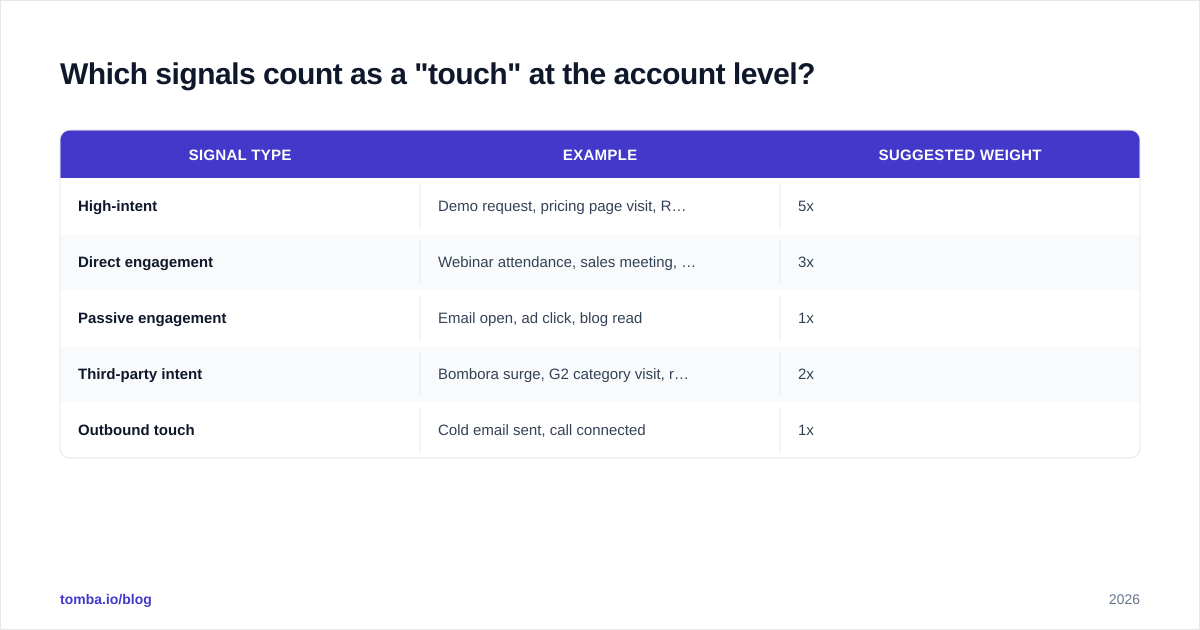
You decide, and the decision matters. Account based marketing attribution rewards teams that weight signals on purpose. Common weighted signals:
| Signal type | Example | Suggested weight |
|---|---|---|
| High-intent | Demo request, pricing page visit, RFP download | 5x |
| Direct engagement | Webinar attendance, sales meeting, email reply | 3x |
| Passive engagement | Email open, ad click, blog read | 1x |
| Third-party intent | Bombora surge, G2 category visit, review read | 2x |
| Outbound touch | Cold email sent, call connected | 1x |
Weighting is what separates a useful model from a vanity dashboard. An unweighted linear model says a banner impression and a sales call are equal. Nobody on the revenue team believes that.
How do you tie attribution to pipeline and revenue?#
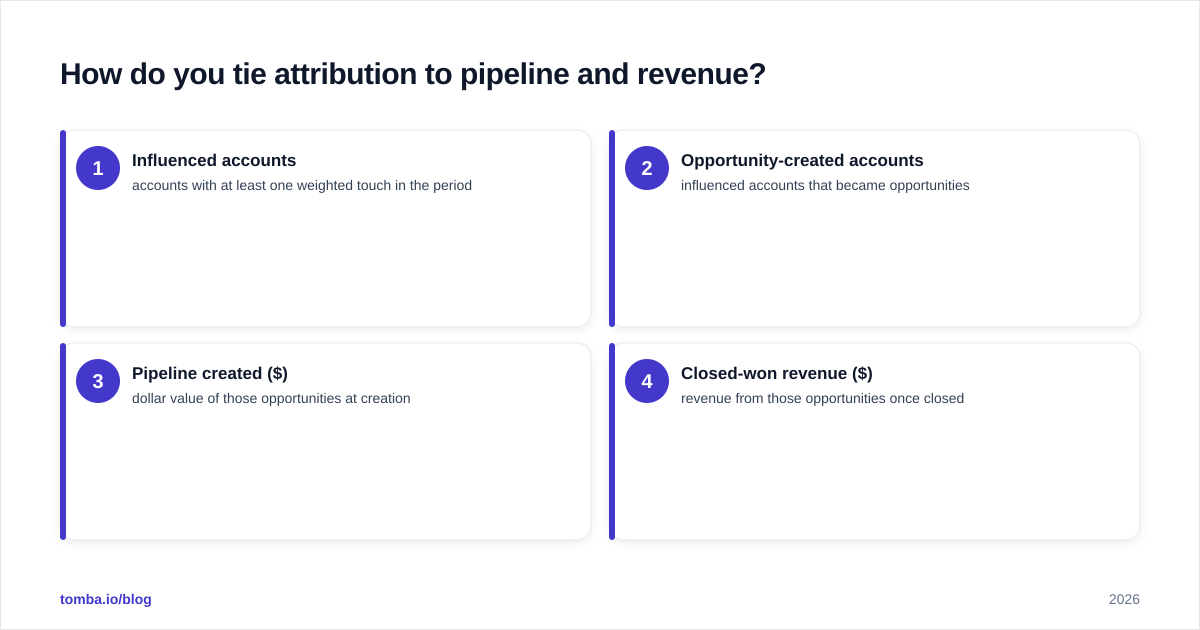
Account based marketing attribution only earns budget when it ties to four numbers:
- Influenced accounts — accounts with at least one weighted touch in the period
- Opportunity-created accounts — influenced accounts that became opportunities
- Pipeline created ($) — dollar value of those opportunities at creation
- Closed-won revenue ($) — revenue from those opportunities once closed
Then you compute per channel, per play, and per rep:
- Cost per influenced account
- Pipeline created per dollar spent
- Closed-won per dollar spent (the only number the CFO actually cares about)
- Sales cycle length for ABM-influenced vs non-influenced accounts
According to Forrester's research on B2B buying, accounts that engage with a coordinated ABM program close 20-40% faster. They also close at higher contract values than self-sourced opportunities. Your attribution report should prove or disprove that for your own funnel.
What does a real account based marketing attribution workflow look like?#
A condensed weekly version of what strong revenue ops teams run:
- Sync data sources nightly. CRM, MAP, ad platforms, intent feeds, web analytics, and outbound tools push to a warehouse like Snowflake or BigQuery.
- Resolve identities. Match contacts to accounts by email domain. Match anonymous sessions by reverse IP or first-party cookies. Flag conflicts for manual review.
- Stamp touches with weights. Every event row gets a
touch_weightfrom the table above. - Roll up to account timeline. For each account, produce an ordered list of weighted touches with timestamps and source channels.
- Apply attribution models. Compute first-touch, time-decay, and W-shaped credit per touch. Store all three. Let stakeholders pick the view that fits their question.
- Join to pipeline and revenue. Pull
opportunity_created_date,pipeline_amount, andclose_datefrom CRM. Tag each opportunity with its pre-opp touch history. - Report by channel, play, segment, and rep. Slice by ICP segment, by play, and by rep to find what's working.
What tools do ABM teams use to make this work?#
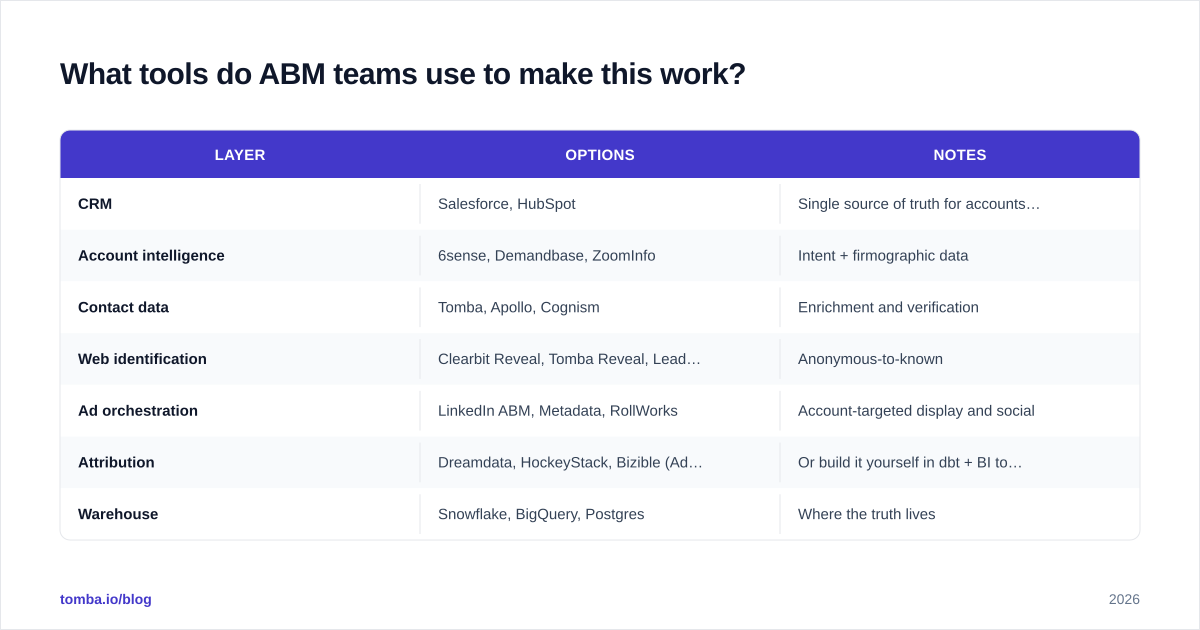
You do not need to buy everything. A pragmatic stack:
| Layer | Options | Notes |
|---|---|---|
| CRM | Salesforce, HubSpot | Single source of truth for accounts and opportunities |
| Account intelligence | 6sense, Demandbase, ZoomInfo | Intent + firmographic data |
| Contact data | Tomba, Apollo, Cognism | Enrichment and verification |
| Web identification | Clearbit Reveal, Tomba Reveal, Leadfeeder | Anonymous-to-known |
| Ad orchestration | LinkedIn ABM, Metadata, RollWorks | Account-targeted display and social |
| Attribution | Dreamdata, HockeyStack, Bizible (Adobe), Factors.ai | Or build it yourself in dbt + BI tool |
| Warehouse | Snowflake, BigQuery, Postgres | Where the truth lives |
Two notes on tool selection:
- The attribution platform is the last thing you should buy. If your CRM accounts are duplicated, your intent data is unstitched, and your contacts are missing roles, no attribution tool will save you. Fix the inputs first.
- Many teams over-invest in third-party intent feeds before basic web analytics resolution works. The cheapest win is usually a visitor reveal tool plus disciplined UTM hygiene.
For deeper reading, see Gartner's coverage of ABM measurement and the G2 ABM category research.
What are the most common mistakes?#
- Reporting only on closed-won. ABM cycles run 6-18 months. If you only report on closed revenue, you cannot optimize this quarter. Add pipeline-created as a leading indicator.
- Ignoring dark social. Slack DMs, podcast mentions, and word-of-mouth referrals never show up in your model. Run a "How did you hear about us?" field on demo requests. Reconcile it against your model.
- Forgetting product-led signals. If you have a free tier or trial, product usage at a target account is one of the highest-intent signals you have. Pipe it into the timeline.
- Confusing influence with causation. Attribution tells you which touches happened before pipeline. It does not prove they caused pipeline. Use holdout tests for the channels you care most about.
- Comparing ABM-influenced accounts to all accounts. That comparison is rigged. ABM accounts were pre-selected as ICP fits. Compare ABM-targeted ICP accounts to non-ABM ICP accounts.
How do you operationalize account based marketing attribution across the revenue team?#
Attribution is only useful when it changes behavior. Three rituals that work:
- Weekly pipeline review: Marketing presents the W-shaped attribution for opportunities created that week. Sales challenges the influence claims. The disagreement updates the model's weights.
- Quarterly channel reallocation: Lowest pipeline-per-dollar channels lose budget. Highest get more. No politics, just the number.
- Monthly ICP refit: Look at which firmographics actually closed. Update the target account list. Tools that scrape and clean account data — including the Tomba domain search and adjacent enrichment — feed this refit loop.
Strong revenue operations practices treat attribution as a living model, not a quarterly report.
Build the attribution layer that matches your motion#
If you sell into committees with cycles longer than 30 days, lead-based attribution is actively lying to you. Account based marketing attribution fixes that. Replace lead reports with account-level rollups, weighted touches, and two complementary models. Use W-shaped for revenue and time-decay for channels. Fix the data layer before you buy a platform. Report on pipeline created, not just closed-won, so you can optimize this quarter instead of next year.
Most attribution failures are really data failures. Before you can credit a touch, you need to know which account it belongs to. You also need to know who at that account it reached. That starts with clean, complete contact data on every record in your CRM. Tomba's email finder and verification stack help you fill the gaps in target-account contact data. Every touch your reps make then lands on the right timeline and shows up in the right report.
// get started
Find, verify and enrich your first contacts today
Start on the free plan with 25 searches a month, then scale when your team is ready.
Free plan · No credit card required · GDPR & CCPA
// about the author