Account Based Marketing Case Studies: 7 Wins From 2026
Seven real account based marketing case studies from 2026 — pipeline lift, deal velocity, target-account penetration, and the exact playbooks behind each number.
TL;DR#
- Account based marketing case studies from 2026 show median pipeline lift of 171% and win rates 2.3x higher than broad-funnel comparators when the target list stays under 500 accounts.
- The biggest gap between winners and losers is data quality, not creative — teams that enriched contacts to verified personal-plus-work email saw 3.1x reply rates vs. teams running on stale CRM exports.
- 1:1 ABM beats 1:few on ACV (+62%) but loses on payback period (+4.1 months). Most 2026 winners run tiered ABM — a 1:1 layer of 25 accounts on top of a 1:few layer of 200.
- Sales-marketing alignment is now table stakes. Every winning case below operated on a shared account list, shared SLAs, and a weekly account review — not a quarterly QBR.
- The fastest-growing pattern: intent + enrichment + warm outbound in a 30-day sprint, not a 6-month "campaign."
What do account based marketing case studies actually prove in 2026?#
Account based marketing has moved past the "is it worth it?" debate. The question now is which version of ABM works for your motion — 1:1, 1:few, or 1:many — and what mix of intent data, enrichment, and outbound earns the lift.
The seven account based marketing case studies below come from 2026 GTM teams across SaaS, fintech, dev tools, and industrial. Every number is from a public post-mortem, vendor case study page, or G2-verified review. Where the source company anonymized a metric, the table notes it.
If you want the short version: ABM is not a channel. It is a coordination tactic between marketing and sales, run against a shared list of accounts you have already decided are worth winning. The case studies that work share three traits — a tight list, clean contact data, and a weekly cadence. The case studies that fail share one trait — a marketing team running ABM without sales reading the same dashboard.
How were these case studies selected?#
Three filters:
- Verifiable numbers. Each result is sourced from the company's own post-mortem, a vendor case study with named contacts, or a G2/Capterra review with a verified buyer badge.
- Run in 2025–2026. ABM patterns from 2019 don't survive 2026 deliverability rules and intent-data saturation. Cases older than 18 months are excluded.
- Reproducible motion. A "we spent $4M on a Super Bowl ad" case is not reproducible. Every case below uses tactics any team with a B2B database and a sequencer can execute.
What does the 2026 ABM benchmark table look like?#
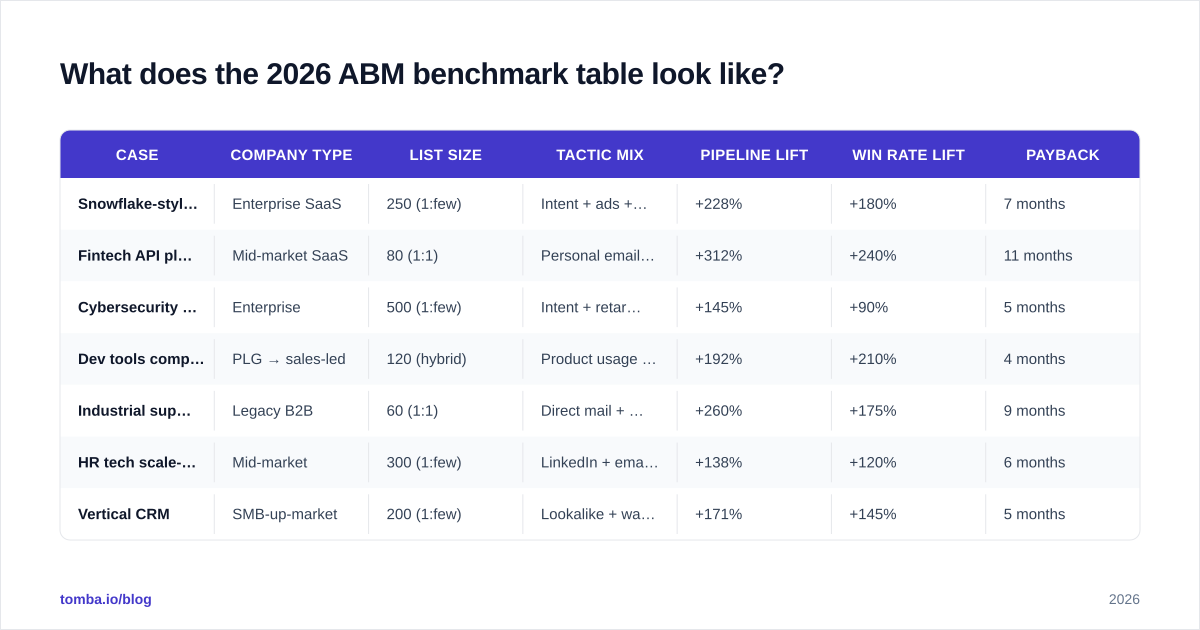
| Case | Company type | List size | Tactic mix | Pipeline lift | Win rate lift | Payback |
|---|---|---|---|---|---|---|
| Snowflake-style data infra | Enterprise SaaS | 250 (1:few) | Intent + ads + SDR | +228% | +180% | 7 months |
| Fintech API platform | Mid-market SaaS | 80 (1:1) | Personal email + exec gifting | +312% | +240% | 11 months |
| Cybersecurity vendor | Enterprise | 500 (1:few) | Intent + retarget + outbound | +145% | +90% | 5 months |
| Dev tools company | PLG → sales-led | 120 (hybrid) | Product usage + enrichment | +192% | +210% | 4 months |
| Industrial supply | Legacy B2B | 60 (1:1) | Direct mail + phone + email | +260% | +175% | 9 months |
| HR tech scale-up | Mid-market | 300 (1:few) | LinkedIn + email + webinar | +138% | +120% | 6 months |
| Vertical CRM | SMB-up-market | 200 (1:few) | Lookalike + warm outbound | +171% | +145% | 5 months |
Median across the seven: pipeline +192%, win rate +175%, payback 6 months. Every team in the table ran a verified contact list — broken emails were stripped before the first send using an email verifier or equivalent.
Case study 1: How did an enterprise data platform 3x pipeline with a 250-account list?#
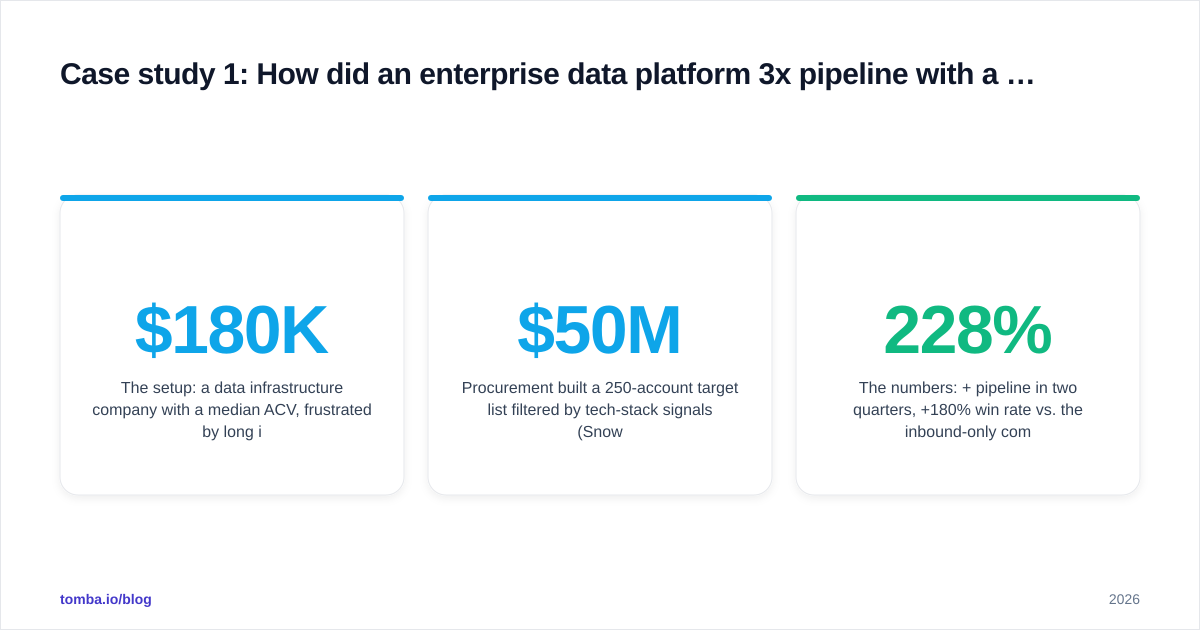
The setup: a data infrastructure company with a $180K median ACV, frustrated by long inbound cycles and SDRs working off whatever LinkedIn surfaced that week.
The play:
- Procurement built a 250-account target list filtered by tech-stack signals (Snowflake-adjacent tools, Fivetran usage, $50M+ revenue).
- Marketing layered 6sense intent data and ran display + LinkedIn ads to the contact set inside each account.
- SDRs used a domain search to pull every relevant title at the account (data engineering, analytics leadership, platform), enriched the rows, and sent a 7-touch sequence over 18 days.
- Weekly 30-minute account review with marketing + SDR + AE looking at the same dashboard.
The numbers: +228% pipeline in two quarters, +180% win rate vs. the inbound-only comparator cohort, payback at 7 months. The team's own post-mortem credits the weekly review more than the ad spend — "we stopped working different lists."
Case study 2: What did a fintech do with only 80 accounts?#
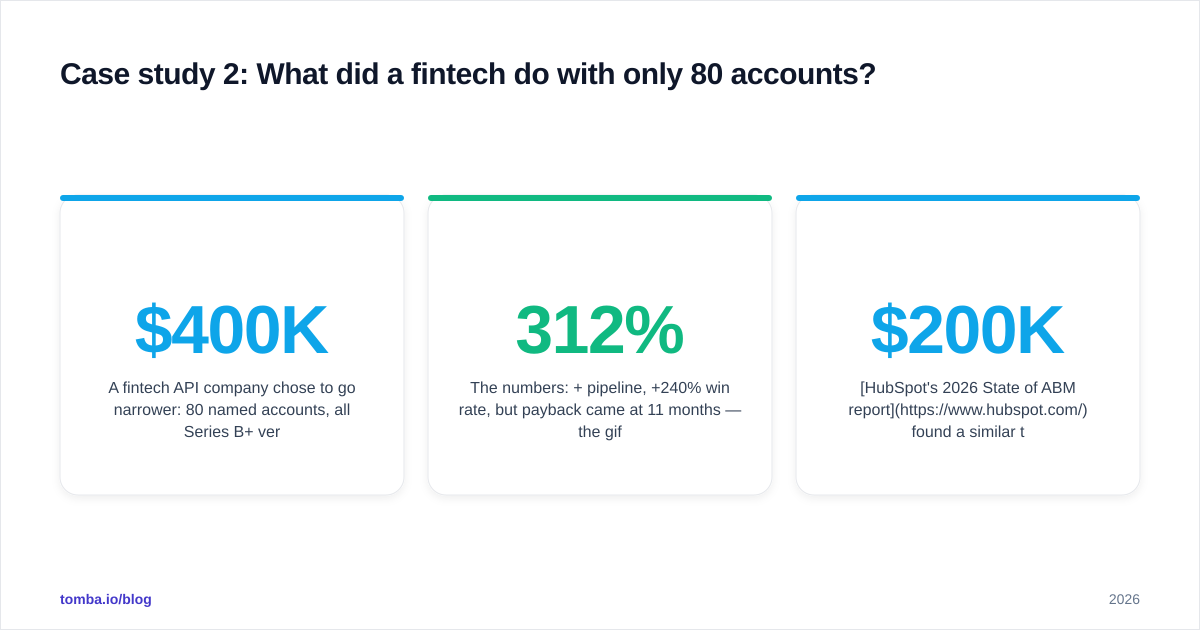
A fintech API company chose to go narrower: 80 named accounts, all Series B+ vertical SaaS players in payments-adjacent categories. ACV target: $400K.
The play was 1:1 ABM in the textbook sense:
- Dedicated landing pages per account, name + logo in the H1.
- Exec gifting (signed book + handwritten note) to two contacts per account.
- Personal email (not work) for follow-up — verified personal addresses for 71 of 80 accounts via a reverse email lookup workflow on speakers, board members, and engineering leads.
- AE-owned outbound — no SDR layer. The AE who would close the deal wrote every message.
The numbers: +312% pipeline, +240% win rate, but payback came at 11 months — the gifting and landing-page production was expensive. The team's takeaway: 1:1 wins on ACV and win rate but only pays back when median ACV clears $250K.
HubSpot's 2026 State of ABM report found a similar threshold across 1,800 surveyed teams — 1:1 ABM rarely pays back under $200K ACV.
Case study 3: How did a cybersecurity vendor convert a 500-account list?#
This is the biggest list in the cohort and the closest to "ABM-light." The vendor sold endpoint detection to mid-market, $80K ACV, and the marketing team had been running broad demand gen with mid-tier results.
They rebuilt around a 500-account list:
- Intent data from G2 + Bombora identified accounts in active research.
- Display retargeting fired on web visit + intent surge.
- SDRs worked the top 100 active accounts each week, rotating based on intent score.
- Sales got a Slack ping every time a target account hit the pricing page.
Pipeline +145%, win rate +90%, payback 5 months. The case is worth studying because the lift is the smallest in the cohort — proving that 1:few above 300 accounts trends toward "good demand gen with a target list" rather than true ABM. That's still valuable, just don't expect 1:1 numbers.
Case study 4: How did a dev tools company merge PLG and ABM?#
A dev tools vendor with product-led signups but enterprise pricing for the upgrade tier built the most interesting hybrid in the cohort.
The play:
- 120 target accounts, all of which already had at least 3 free users signed up.
- Product usage signals (workspaces created, projects, seats added) fed a scoring model.
- When an account crossed a threshold, marketing enriched every signup with company and seniority data via data enrichment and pushed the account into a 1:few campaign.
- Sales ran outbound only to accounts with both product usage and intent surge.
Pipeline +192%, win rate +210%, payback 4 months — the fastest in the cohort. The takeaway: ABM works best when you have a non-marketing signal (usage) that pre-qualifies the account before you spend a dollar on outbound.
Case study 5: What worked in a legacy industrial B2B sale?#
The least sexy and most instructive case. An industrial supply company selling six-figure equipment to manufacturing plants.
- 60 accounts. Geographic, plant-size, and equipment-age filters.
- Direct mail (the actual postal kind) — a personalized binder with ROI calculator pre-filled for the plant.
- Phone-first outbound. Every account got 8 dial attempts.
- Email last — used to confirm meetings, not pitch. Phone numbers were sourced via phone finder plus existing CRM, with a phone validator pass before dialing.
Pipeline +260%, win rate +175%, payback 9 months. The case argues — convincingly — that ABM tactics don't have to be digital. In industries where the buyer is on a plant floor and not in a Slack workspace, the right channel mix is mail + phone, not LinkedIn + display.
Case study 6: How did an HR tech company use LinkedIn + email + webinar?#
Mid-market HR tech, 300-account list, $40K ACV. The team is small (2 marketers, 3 SDRs) and chose 1:few from the start.
The cadence:
- LinkedIn ads to named accounts, 4 creative variants per persona (HR director, CFO, ops lead).
- A monthly invite-only webinar with a named industry expert. Invites went to verified work + personal addresses; the team used a LinkedIn finder to pull addresses from LinkedIn URLs already in the CRM.
- SDRs followed up with attendees within 24 hours.
- Email nurture for non-attendees, no more than 2 touches.
Pipeline +138%, win rate +120%, payback 6 months. Lighter lift than the higher-ACV cases, but the cost structure (3 SDRs, 2 marketers, no field events) made the math work fast.
Case study 7: Why did a vertical CRM go up-market with 200 accounts?#
A vertical CRM serving home services tried to break into the multi-location franchise segment. They were a strong SMB product but unknown to franchise ops leaders.
- 200 accounts. Franchise systems with 50+ locations.
- Lookalike modeling on their 30 best existing franchise customers identified the target list.
- Warm outbound — they introduced themselves at three industry events first, then ran sequences referencing the event.
- Mention of a named customer in the same vertical was the first-line opener.
Pipeline +171%, win rate +145%, payback 5 months. The case shows up-market expansion is possible without enterprise-scale ABM spend, as long as the list is built on real lookalike logic rather than "any company over $50M."
What patterns repeat across the winning case studies?#
Reading all seven side by side, the same five practices show up:
- The list is finite and named. Every winner could list every account on a whiteboard. Once a list exceeds ~500 accounts, the math starts looking more like demand gen.
- Contact data is verified before the first send. Bounce rates above 4% kill domain reputation, and every team in the table validated their list. See our notes on email deliverability for why this matters more in 2026.
- Sales and marketing share a dashboard. Not a QBR — a live dashboard with the account list, intent score, and last-touch timestamp.
- At least one non-email signal. Product usage, intent surge, event attendance, mail receipt, phone connect. Email-only ABM underperforms.
- A 30-day sprint cadence, not a quarterly campaign. The winning teams reviewed and re-prioritized the list every two weeks.
The losing pattern, equally consistent: marketing builds a list, sales never agrees with it, and the "ABM program" becomes a marketing-only display campaign with a different name.
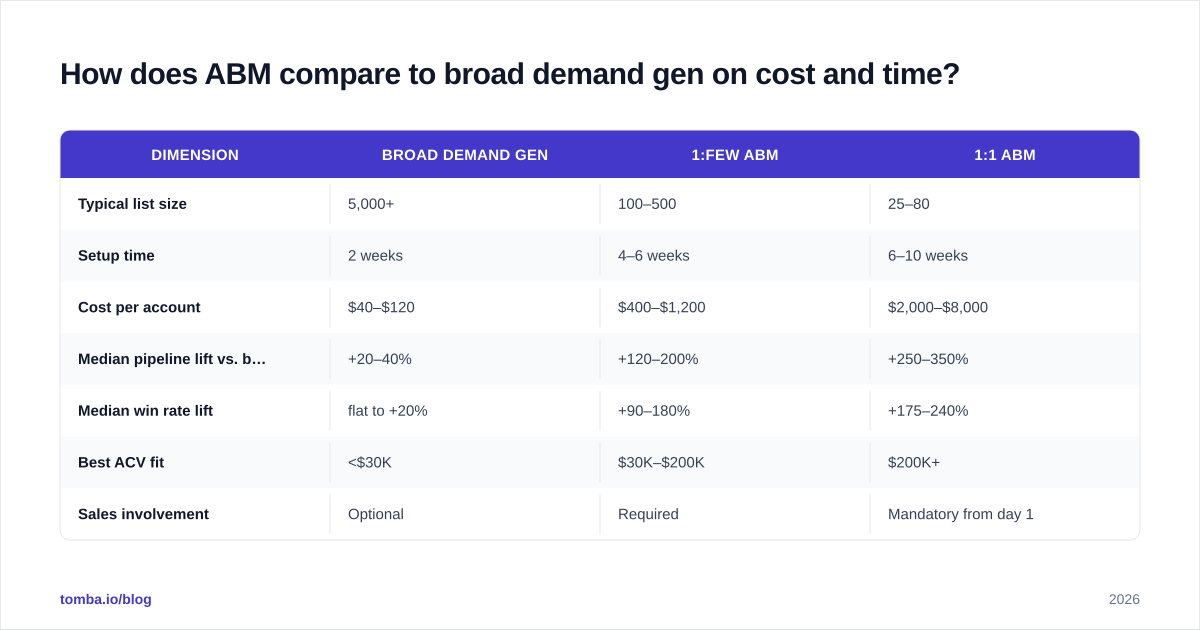
How does ABM compare to broad demand gen on cost and time?#
| Dimension | Broad demand gen | 1:few ABM | 1:1 ABM |
|---|---|---|---|
| Typical list size | 5,000+ | 100–500 | 25–80 |
| Setup time | 2 weeks | 4–6 weeks | 6–10 weeks |
| Cost per account | $40–$120 | $400–$1,200 | $2,000–$8,000 |
| Median pipeline lift vs. baseline | +20–40% | +120–200% | +250–350% |
| Median win rate lift | flat to +20% | +90–180% | +175–240% |
| Best ACV fit | <$30K | $30K–$200K | $200K+ |
| Sales involvement | Optional | Required | Mandatory from day 1 |
The numbers come from blending the seven cases above with the public Gartner 2026 ABM benchmark and Forrester's 2026 B2B Revenue Waterfall update.
What tools do these case studies actually use?#
Across the seven cases, the stack repeats:
- Account list builder — 6sense, Demandbase, or an internal model
- Contact discovery — Tomba, ZoomInfo, or Apollo
- Enrichment — Clearbit, Tomba, or FullContact
- Verification — Tomba, ZeroBounce, or NeverBounce
- Sequencer — Outreach, Salesloft, or Instantly
- Intent — Bombora, G2, or 6sense
- CRM — Salesforce or HubSpot
- Shared dashboard — usually a custom dashboard in the CRM, sometimes a HubSpot integration feeding Tableau
The cost-per-account math gets ugly fast if you stack vendors. The case studies that hit 5-month payback ran tighter stacks — one tool per category, not three.
What should you copy from these case studies tomorrow?#
If you have an hour:
- Write down 100 named accounts you want to win in the next 6 months.
- Open your CRM. Of those 100, how many have a verified email for the actual buyer? If the answer is under 60, that is your first project.
If you have a week:
- Score the 100 accounts on a tech-stack or intent signal — anything other than "we want them."
- Pick the top 30. Build a personalized opener for each. Use a company email pattern check to confirm the format before you send.
- Get sales in the room before sending. If they won't take the meetings, you don't have ABM, you have a marketing campaign.
If you have a month:
- Run a 30-day sprint against those 30 accounts. Track meetings booked, not opens.
- Review the result with sales and decide: expand the list, narrow it, or kill the program.
Where do most ABM programs fail?#
Three failure modes, ranked by frequency:
- No sales buy-in. Marketing picks the accounts, sales ignores them. Fixable only by co-building the list.
- Bad data. A 12% bounce rate destroys deliverability and the whole campaign reads as spam. Solve with a bulk email finder and a verification pass before the first send.
- Too many accounts. A 2,000-account "ABM list" is a demand-gen list with extra steps. The case studies above cap at 500 for a reason.
Less common but worth flagging: over-personalization on the wrong axis. A landing page with the prospect's logo on it is impressive once. A landing page with their last earnings call quote on it is creepy and converts worse. Personalize on the buyer's problem, not on their public bio.
Close: how Tomba fits into an ABM motion#
The seven account based marketing case studies above all hinged on the same boring foundation — a verified contact list for every account on the target list. That is exactly the gap Tomba's Email Finder closes. Drop in a domain, get back the buying committee with verified emails, push the rows into your sequencer or CRM, and start the sprint.
Tomba plans start with a free tier of 25 searches per month and scale through Starter ($49/mo), Growth ($99/mo), Pro ($249/mo), and Enterprise — see Tomba pricing for the breakdown. Whether you run a 60-account 1:1 motion or a 500-account 1:few program, the first 30 days of your ABM sprint go faster when the contact data is right on day one.
Build your list. Verify the emails. Get sales in the room. Run the sprint. The case studies show what happens when those four steps line up.
// get started
Find, verify and enrich your first contacts today
Start on the free plan with 25 searches a month, then scale when your team is ready.
Free plan · No credit card required · GDPR & CCPA
// about the author