Account Based Marketing For Manufacturers: 2026 Playbook
Account based marketing for manufacturers isn't B2B SaaS ABM with a hard hat. Here's how industrial GTM teams actually win named accounts in 2026.
TL;DR#
- Account based marketing for manufacturers works when you stop borrowing SaaS playbooks and start mapping plant-level buying committees, engineering specs, and procurement cycles.
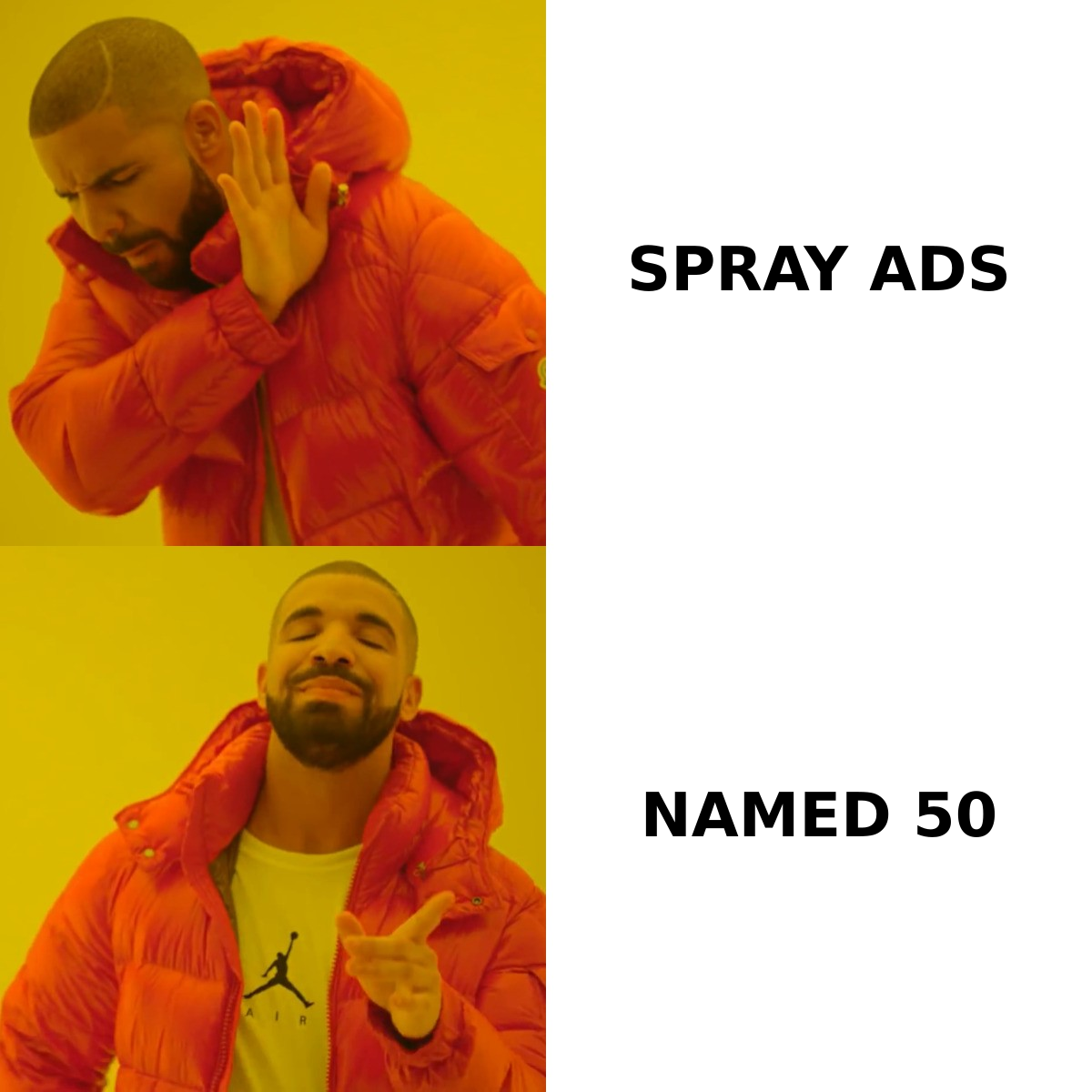
- A target list of 50-300 accounts beats a database of 50,000. Your CRM should hurt to look at because it's small.
- Buying committees in industrial deals run 8-14 people across engineering, operations, quality, procurement, and finance. ABM that only reaches the CFO loses.
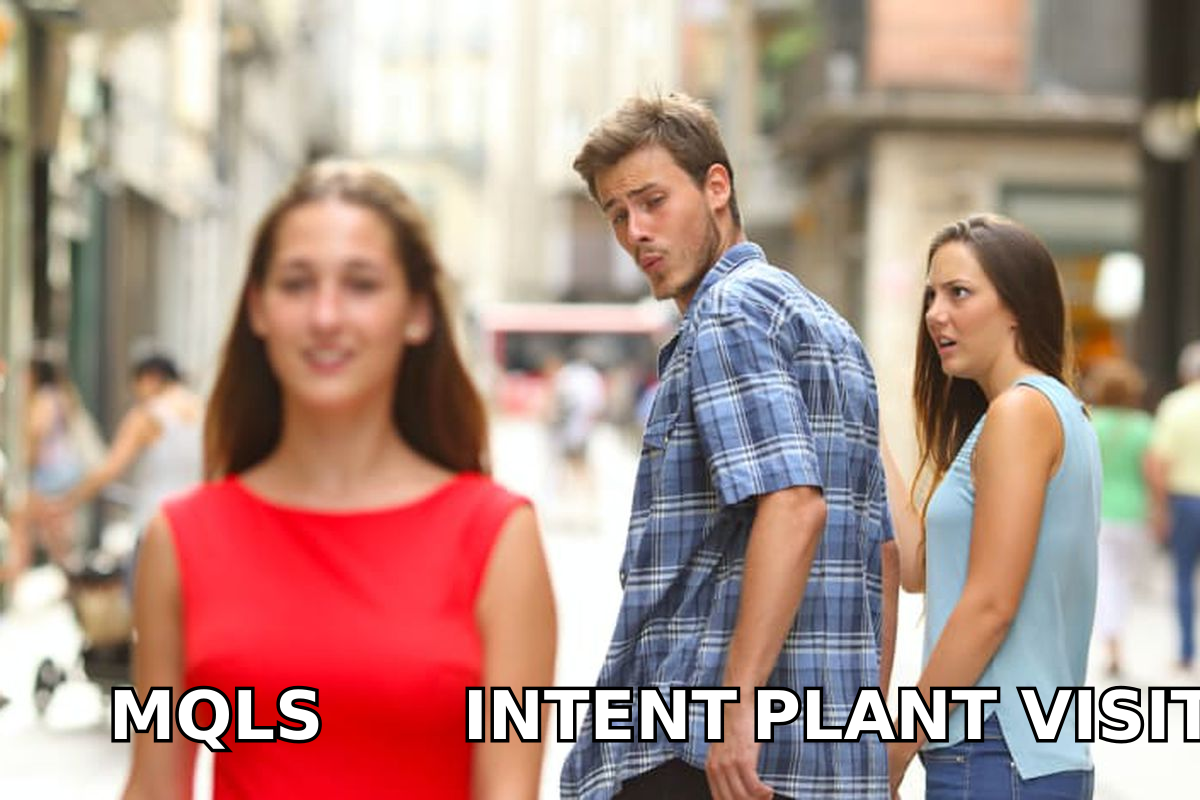
- Intent signals worth tracking: RFQ activity, distributor inquiries, capex announcements, hiring for plant managers, and trade-show booth visits — not just G2 page views.
- Tooling stack: tight ICP definition, contact data you trust, a few channels done well (direct mail, field events, LinkedIn, targeted email), and pipeline analytics tied to revenue.
What is account based marketing for manufacturers?#
Account based marketing for manufacturers is a go-to-market motion where industrial sellers pick a finite list of target plants, OEMs, or distributors and coordinate marketing and sales against those specific logos — instead of running broad lead-gen funnels and hoping a buyer with a $2M capex budget walks in.
The mechanics are the same as SaaS ABM: pick accounts, map the committee, run plays, measure pipeline against the named list. The reality is different. A manufacturer selling precision bearings into the wind-turbine industry has maybe 60 buyers worldwide who matter. A SaaS company can sell to 60,000 SMBs. That single fact rewrites every step of the playbook.
The teams that win industrial ABM stop optimizing for MQL volume and start optimizing for pipeline coverage on a named-account list. They treat the list itself as the product of marketing — not the content, not the campaigns. If the list is wrong, no creative will save the quarter.
Why is industrial ABM different from B2B SaaS ABM?#
Three structural differences change the playbook end-to-end.
Deal cycles are measured in quarters and years, not weeks. A capital equipment sale into an automotive plant might take 18 months from first RFQ to PO. Your ABM scoring model needs to treat a tooling engineer downloading a spec sheet very differently from a SaaS prospect opening a pricing page.
The buying committee is technical and physical. You're not just selling to a VP of Marketing scrolling on a phone. Plant managers walk the floor. Quality engineers measure tolerances. Procurement runs three-vendor bids by policy. Maintenance leads care about MTBF and parts availability for the next 20 years. Each of those roles consumes different content and meets at different cadences.
Digital footprints are smaller and dirtier. Industrial buyers don't live on LinkedIn the way revenue ops leaders do. Their email addresses are buried behind generic info@ aliases. Their job titles read "Senior Manufacturing Engineer III" not "Head of Demand Gen." This is where having a reliable email finder and data enrichment workflow matters more than another marketing automation seat.
How do you build the target account list?#
The named list is the whole game. Get it right and the rest is execution; get it wrong and every dollar after is wasted.
Start with a written ICP that any sales rep can recite. For a contract metal-stamping shop selling to Tier 1 automotive suppliers, the ICP might read: "North American manufacturing plants, 200-2000 employees, NAICS 3363 or 3324, with internal stamping capacity under 2000 tons, currently sourcing from offshore, located within 400 miles of our Ohio facility for JIT delivery."
That sentence excludes 98% of the world. Good.
From there, the list comes from four sources combined:
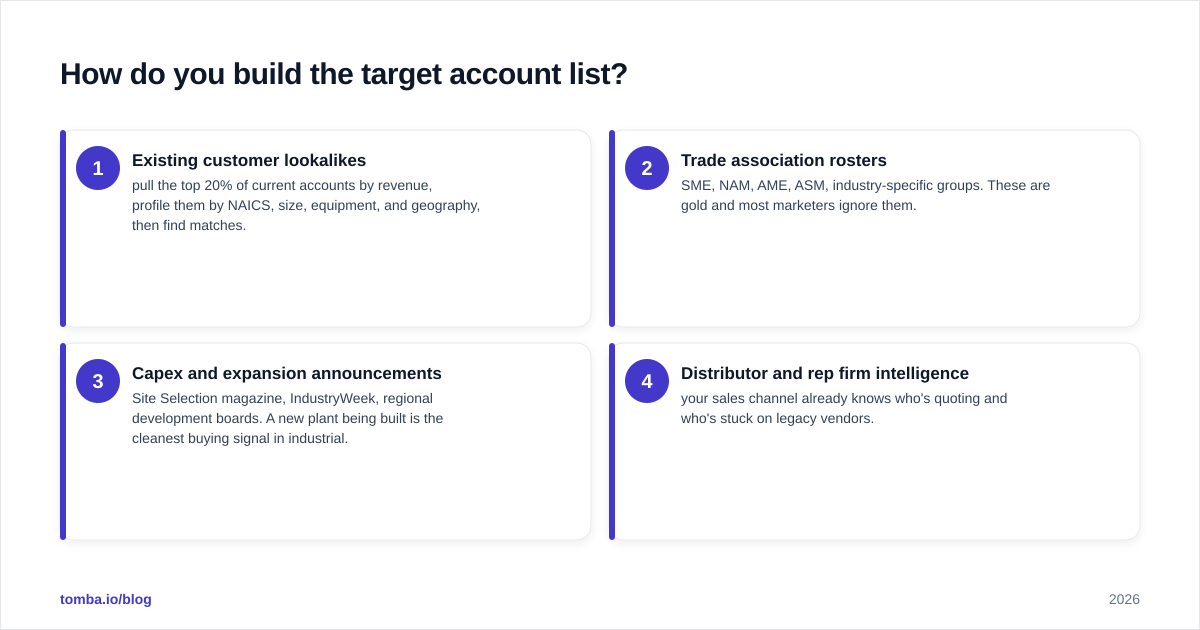
- Existing customer lookalikes — pull the top 20% of current accounts by revenue, profile them by NAICS, size, equipment, and geography, then find matches.
- Trade association rosters — SME, NAM, AME, ASM, industry-specific groups. These are gold and most marketers ignore them.
- Capex and expansion announcements — Site Selection magazine, IndustryWeek, regional development boards. A new plant being built is the cleanest buying signal in industrial.
- Distributor and rep firm intelligence — your sales channel already knows who's quoting and who's stuck on legacy vendors.
Run the combined list through your CRM, dedupe against existing pipeline, and cap it at a number sales can actually cover. For most manufacturers that's 50-300 logos per rep per year.
Who is actually on the manufacturing buying committee?#
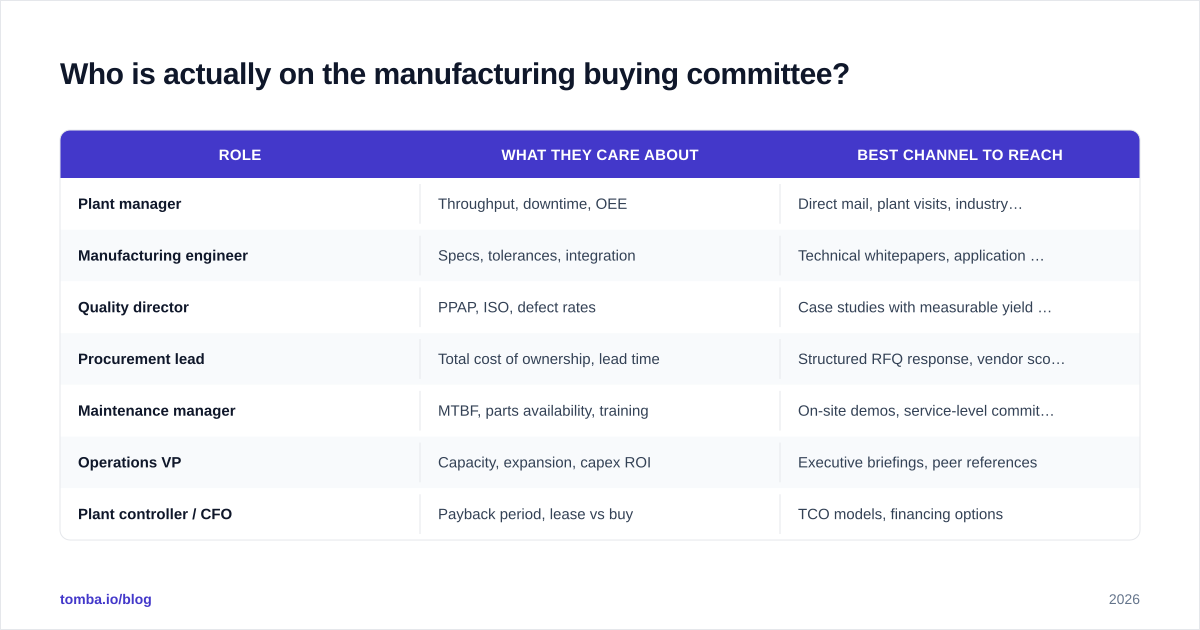
A typical capital purchase or strategic-supplier decision involves roles that simply don't exist in software ABM. The classic buying committee framework needs an industrial rewrite:
| Role | What they care about | Best channel to reach |
|---|---|---|
| Plant manager | Throughput, downtime, OEE | Direct mail, plant visits, industry events |
| Manufacturing engineer | Specs, tolerances, integration | Technical whitepapers, application notes |
| Quality director | PPAP, ISO, defect rates | Case studies with measurable yield gains |
| Procurement lead | Total cost of ownership, lead time | Structured RFQ response, vendor scorecards |
| Maintenance manager | MTBF, parts availability, training | On-site demos, service-level commitments |
| Operations VP | Capacity, expansion, capex ROI | Executive briefings, peer references |
| Plant controller / CFO | Payback period, lease vs buy | TCO models, financing options |
| EHS lead (on some deals) | Compliance, OSHA, environmental | Compliance documentation |
Eight to fourteen people on a real industrial deal is normal. ABM that only reaches the CFO loses, because the engineer killed the deal in week three when nobody answered a tolerance question.
You need contact-level coverage of at least five committee roles per target account before sales calls it "engaged." Building that map fast is where most teams stall. A workflow that combines domain search for plant-level org charts plus targeted LinkedIn finder lookups for the engineers and quality leads compresses what used to take a SDR three weeks into an afternoon.
What intent signals actually predict manufacturing pipeline?#
Software ABM lives on third-party intent feeds — G2, Bombora, TechTarget. Those are mostly useless for industrial. The intent signals that actually move a forecast in manufacturing are:
- RFQ activity in your own ERP and quoting tool — by far the strongest signal you own
- Distributor and rep inquiries flagged in CRM with account-level attribution
- Capex and expansion announcements from public filings and trade press
- Hiring patterns — postings for plant managers, maintenance leads, or NPI engineers signal a buying window
- Trade-show booth scans — but only if you actually scan and enrich within 24 hours
- Site visits to your spec-sheet pages, technical drawings, and CAD downloads
- Procurement portal activity — Ariba, Coupa, SAP Business Network alerts when an account opens a category review
Combine those into a simple weighted score per account. A capex announcement plus a CAD download in the same month beats any G2 intent feed for predicting a real RFQ in the next quarter.
What does an industrial ABM play actually look like?#
Generic "send a personalized LinkedIn message" advice falls apart in this market. Here are three play templates that work end-to-end in industrial GTM.
Play 1: The capex trigger play#
Trigger: a target account announces a new line, plant expansion, or capacity increase in trade press.
Within 72 hours, a coordinated outreach:
- Field rep sends a 1:1 email referencing the announcement to the operations VP and plant manager.
- Marketing ships a physical dimensional sample or capability binder by overnight courier.
- LinkedIn ads run against the named account targeting engineering and procurement titles for 60 days.
- A regional event invite goes to the manufacturing engineering team.
Conversion benchmark: 25-40% of targeted accounts open a real conversation within 90 days when the trigger is fresh.
Play 2: The displacement play#
Trigger: you know who the incumbent supplier is (your rep network told you, or a quality issue made the news).
Build a side-by-side capability comparison, a TCO model with the prospect's volumes, and a third-party reference call from a customer who switched. Stage it as a structured 3-meeting sequence: technical deep-dive, commercial discussion, plant visit.
Play 3: The new-product introduction (NPI) play#
Trigger: the target OEM is launching a new platform. NPI cycles are when sourcing decisions get re-opened.
Get on the bid list early. Provide DFM (design for manufacturability) feedback during prototype phase. Marketing's job is identifying which OEM platforms are entering NPI, then arming sales with engineering credibility content before the RFQ drops.
What tools and stack do you actually need?#
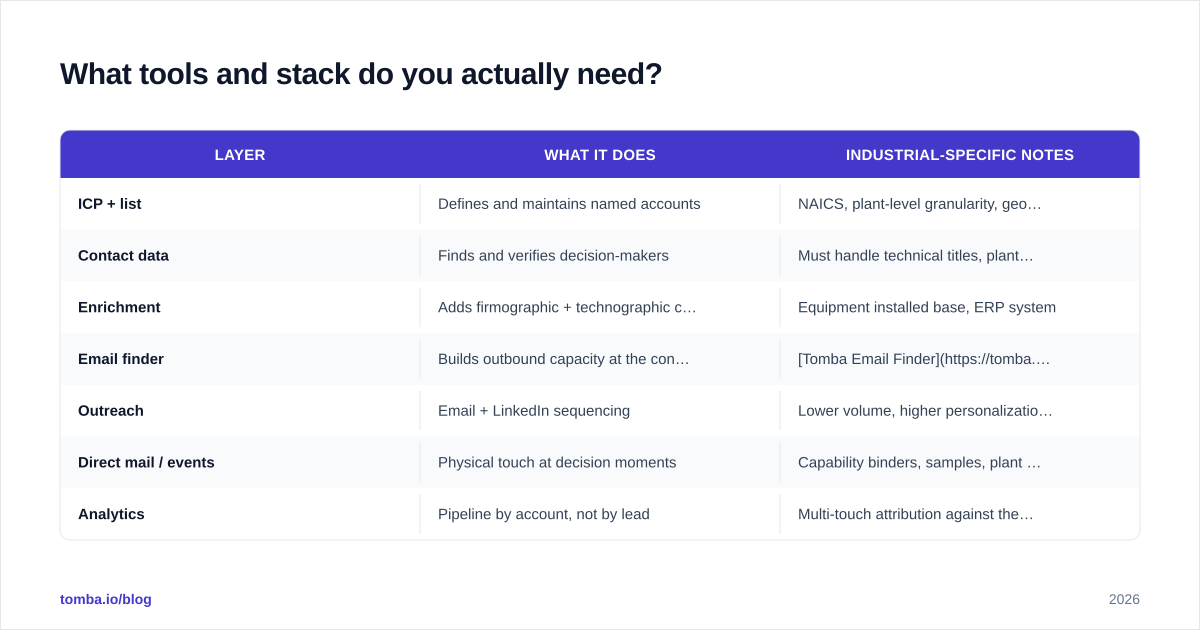
You do not need 18 martech tools. You need a tight stack where each piece earns its seat.
| Layer | What it does | Industrial-specific notes |
|---|---|---|
| ICP + list | Defines and maintains named accounts | NAICS, plant-level granularity, geography |
| Contact data | Finds and verifies decision-makers | Must handle technical titles, plant emails |
| Enrichment | Adds firmographic + technographic context | Equipment installed base, ERP system |
| Email finder | Builds outbound capacity at the contact level | Tomba Email Finder, with bulk verify for list hygiene |
| Outreach | Email + LinkedIn sequencing | Lower volume, higher personalization than SaaS |
| Direct mail / events | Physical touch at decision moments | Capability binders, samples, plant visits |
| Analytics | Pipeline by account, not by lead | Multi-touch attribution against the named list |
Most teams over-invest in the outreach layer and under-invest in list quality and committee mapping. Reverse that.
For contact discovery and verification specifically, the workflow we see working: pull the target plant from the named list, run domain search to map the engineering and procurement org, verify each address through an email verifier before any send, then sync verified contacts to your CRM with account-level enrichment. That keeps deliverability clean and prevents the classic ABM mistake of burning your sending reputation on bounced plant-level aliases.
How do you measure manufacturing ABM that actually means something?#
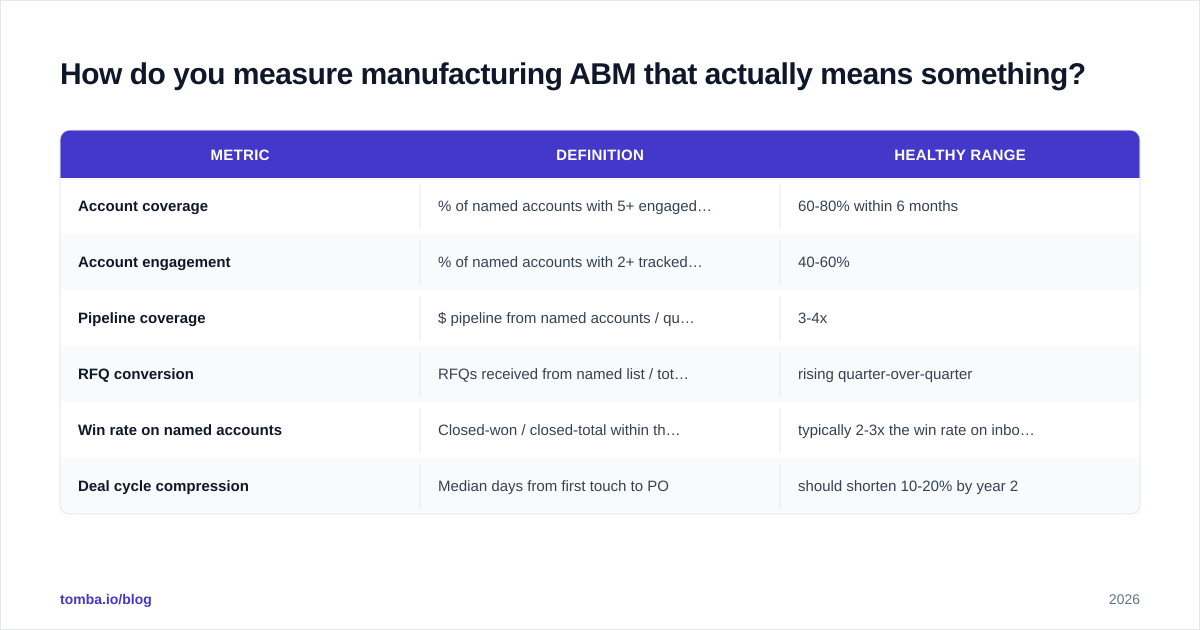
Throw away MQL and SQL counts. They lie at this volume. The metrics that matter for industrial ABM:
| Metric | Definition | Healthy range |
|---|---|---|
| Account coverage | % of named accounts with 5+ engaged committee contacts | 60-80% within 6 months |
| Account engagement | % of named accounts with 2+ tracked interactions in the quarter | 40-60% |
| Pipeline coverage | $ pipeline from named accounts / quarterly quota | 3-4x |
| RFQ conversion | RFQs received from named list / total RFQs | rising quarter-over-quarter |
| Win rate on named accounts | Closed-won / closed-total within the list | typically 2-3x the win rate on inbound |
| Deal cycle compression | Median days from first touch to PO | should shorten 10-20% by year 2 |
Report by account, not by campaign. The CFO does not care that the LinkedIn ads got 1.2% CTR. They care that 14 of 60 target accounts now have active pipeline.
How do you align sales, marketing, and the channel?#
Industrial ABM has a third party that pure SaaS doesn't: distributors and manufacturers' rep firms. Aligning them is half the work.
Weekly account reviews with sales — not monthly. Each rep walks through their top 10 accounts, current committee coverage, next play, and any signals from the channel. Marketing's job is to come with assets and data, not to demand reports.
For channel alignment, build a simple deal-registration process tied to the named list, share intent signals back to reps (capex announcements, hiring postings), and run joint plant visits when the deal warrants it. The rep network is your most underused intent feed — they know who is unhappy with the incumbent before any web tracker does.
Pair this with shared definitions of an engaged account and a qualified opportunity, written down and referenced in every pipeline meeting. RevOps teams that ignore this end up with marketing celebrating accounts that sales has already disqualified. Tools like HubSpot or Salesforce handle the plumbing, but the discipline is human.
What are the common mistakes manufacturers make with ABM?#
Five failure modes show up repeatedly:
- List too big. "We picked 2,000 target accounts." That's not ABM, that's a database. Cap aggressively.
- No committee map. Sales has the GM's number but nobody in engineering, quality, or procurement. The deal dies at technical evaluation.
- Treating it as a marketing project. ABM is a GTM operating model. If sales doesn't own the account list jointly with marketing, it fails.
- Copy-pasted SaaS plays. Free trials, product-led growth, demo gating — none of that maps to a $1.4M tooling order with 12-week lead times.
- Measuring by activity not by account. Emails sent, ads served, content downloaded. None of it matters if the named accounts aren't moving.
Avoid those and you're ahead of 80% of industrial marketing teams.
How fast can you get this running?#
A realistic 90-day stand-up for a manufacturer with an existing sales team:
- Days 1-15: Write the ICP, build the named list (target 150 accounts), agree on segmentation tiers (top 30 / next 60 / next 60).
- Days 16-30: Map buying committees on the top 30 — at least 6 verified contacts per account across 4 role types. Define your 3 plays.
- Days 31-60: Run the first wave of capex-trigger and displacement plays. Stand up weekly account reviews with sales. Track engagement, not just sends.
- Days 61-90: Measure pipeline coverage on the named list. Adjust list (drop 10 accounts that show zero signal, add 10 from new triggers). Brief the channel.
By day 90 a properly run industrial ABM motion should be producing 3-4x pipeline coverage on tier-1 accounts. If it isn't, the list is the most likely culprit — not the creative.
Ready to build the data layer underneath your ABM motion?#
A named-account list is only as good as the contacts behind it. If your reps are spending two hours hunting for an engineering manager's email instead of running plays, the data layer is the bottleneck. Tomba Email Finder builds verified committee maps from plant domains in minutes — search by company, role, or seniority, verify before you send, and push clean contacts into your CRM. Pair it with domain search to scope each target plant in one query and bulk verification to keep your sender reputation safe across higher-volume waves. Start free on the Tomba pricing tier and scale to Starter at $49/mo when your named list grows past a handful of accounts.
// get started
Find, verify and enrich your first contacts today
Start on the free plan with 25 searches a month, then scale when your team is ready.
Free plan · No credit card required · GDPR & CCPA
// about the author