Account Based Marketing Goals: The 2026 ABM Playbook
Most ABM programs fail because their goals look like demand-gen KPIs in disguise. Here's how to set account based marketing goals that actually move pipeline in 2026.
Account Based Marketing Goals: The 2026 ABM Playbook
TL;DR
- ABM goals are not lead-gen goals with a new label. If your top metric is still MQL volume, you're running demand gen with extra steps.
- The four goal tiers that matter in 2026: account selection quality, account engagement depth, pipeline influence, and revenue per target account.
- Sales and marketing must agree on the target account list (TAL) before any goal is set — misaligned TALs are the #1 reason ABM programs miss number.
- Benchmark: top-quartile ABM programs convert 12-18% of tier-1 accounts to opportunity within 6 months. Average is 4-6%.
- Tooling matters less than alignment, but you still need accurate contact data, intent signals, and a CRM that can roll up account-level activity.
What are account based marketing goals, really?#
Account based marketing goals are the measurable outcomes your ABM program commits to delivering against a defined list of target accounts — not against the open market. That distinction is the entire game.
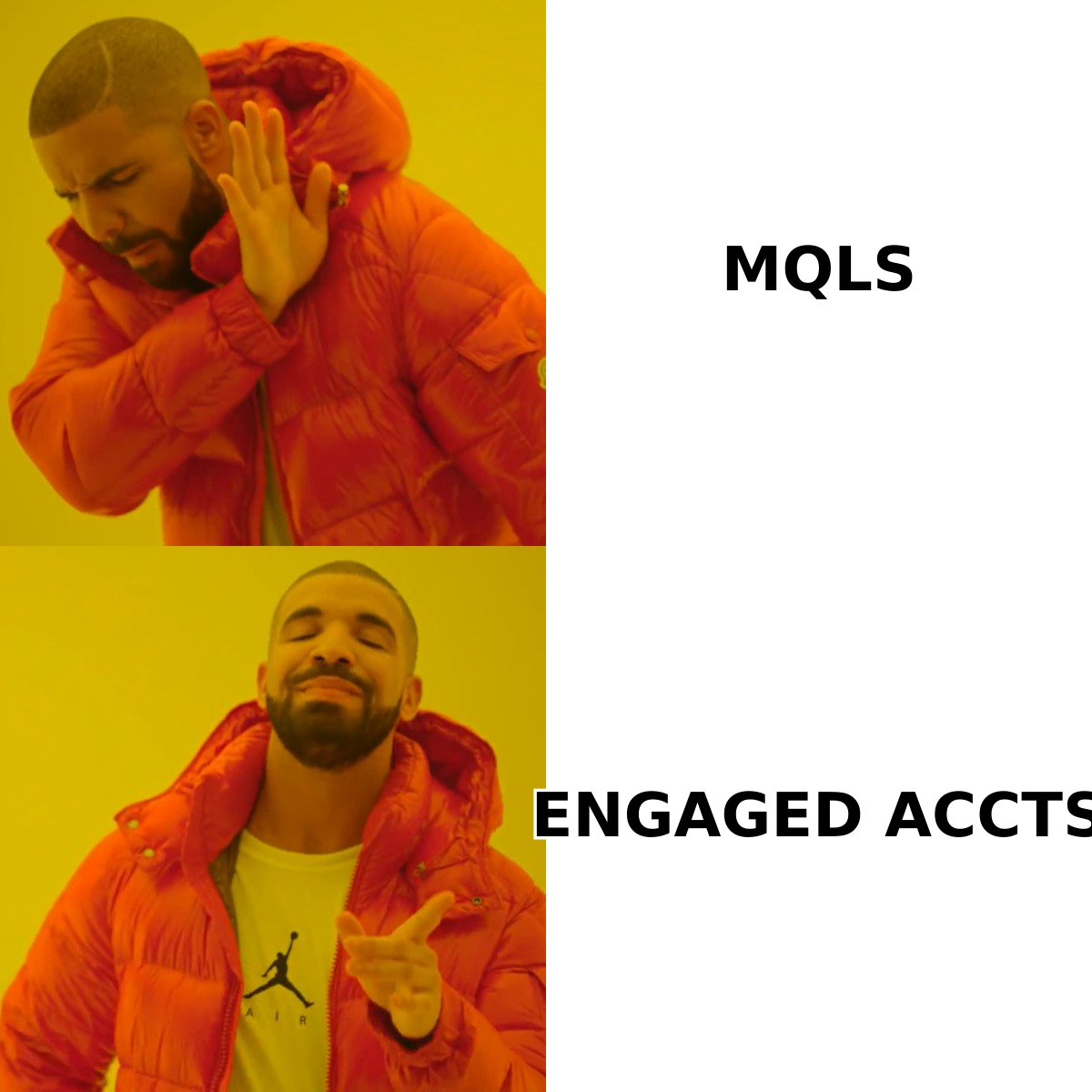
A demand gen team sets goals like "5,000 MQLs this quarter." An ABM team sets goals like "open 40 new conversations inside our top 200 enterprise accounts, with at least 12 reaching mid-funnel by Q3." The first metric rewards volume. The second rewards depth.
Think of it like fishing. Demand gen casts a wide net and counts everything that wriggles. ABM picks 200 specific fish, names them, and measures whether you actually landed the ones you wanted. If you set net-size goals for a spear-fishing operation, you'll always look like you're failing.
This matters in 2026 because buying committees have grown to an average of 11 people (Gartner), and the largest 5% of accounts now drive 60%+ of enterprise SaaS revenue. Goals that don't measure depth inside named accounts are measuring the wrong universe.
Why do most ABM goals fail to drive revenue?#
Most teams skip the alignment step. They inherit goals from a marketing OKR template, paste in "account-based" language, and run the same lead-volume playbook with prettier dashboards.
Here are the four most common failure patterns we see when auditing ABM programs:
- MQL goals dressed up as ABM goals. "Generate 800 account-level MQLs" is still a volume metric. It rewards quantity, punishes patience, and creates the same SDR-burnout flywheel ABM was supposed to fix.
- Sales never signed off on the target list. Marketing picked 500 accounts off a B2B database using firmographic filters. Sales is selling to a different 500. Now both sides hit "their" goals and neither moves the actual pipeline.
- No engagement depth metric. The program reports "accounts touched" or "accounts visited the site." Touching is not buying. You need a depth ladder — known, engaged, mid-funnel, opportunity, closed.
- Quarterly horizon on a multi-quarter motion. Enterprise ABM cycles run 9-18 months. Setting only quarterly goals forces teams to optimize for short-term vanity activity that won't show up in revenue for a year.
The fix is structural, not tactical. You need a goal stack that maps directly to the buyer's actual journey through your target list.
What is the right account based marketing goals framework?#
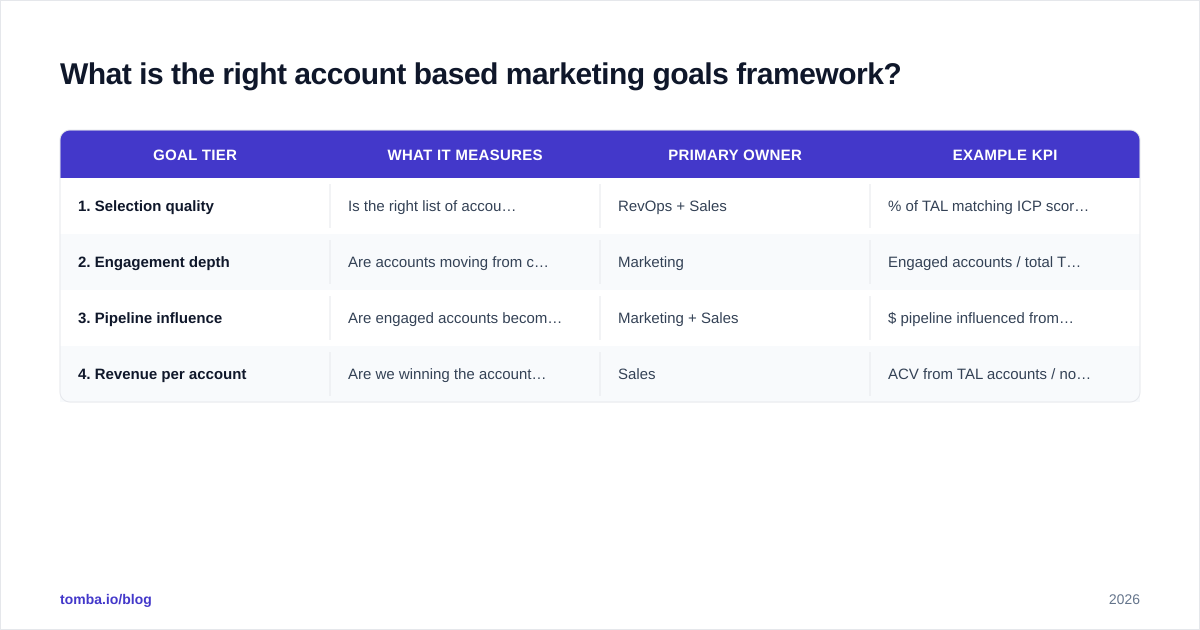
Use a four-tier framework. Each tier feeds the next, and each has its own owner.
| Goal tier | What it measures | Primary owner | Example KPI |
|---|---|---|---|
| 1. Selection quality | Is the right list of accounts on the list? | RevOps + Sales | % of TAL matching ICP scoring threshold |
| 2. Engagement depth | Are accounts moving from cold to known to engaged? | Marketing | Engaged accounts / total TAL per quarter |
| 3. Pipeline influence | Are engaged accounts becoming opportunities? | Marketing + Sales | $ pipeline influenced from TAL |
| 4. Revenue per account | Are we winning the accounts that matter? | Sales | ACV from TAL accounts / non-TAL accounts |
Tier 1 happens once a quarter. Tier 2 is your weekly dashboard. Tier 3 is your monthly board metric. Tier 4 is your annual scorecard.
If you only set goals at one tier, you'll optimize the wrong thing. A program that only tracks engagement (tier 2) ends up running webinars for accounts that will never buy. A program that only tracks revenue (tier 4) can't course-correct until it's too late.
How do you set ABM goals for tier-1, tier-2, and tier-3 accounts?#
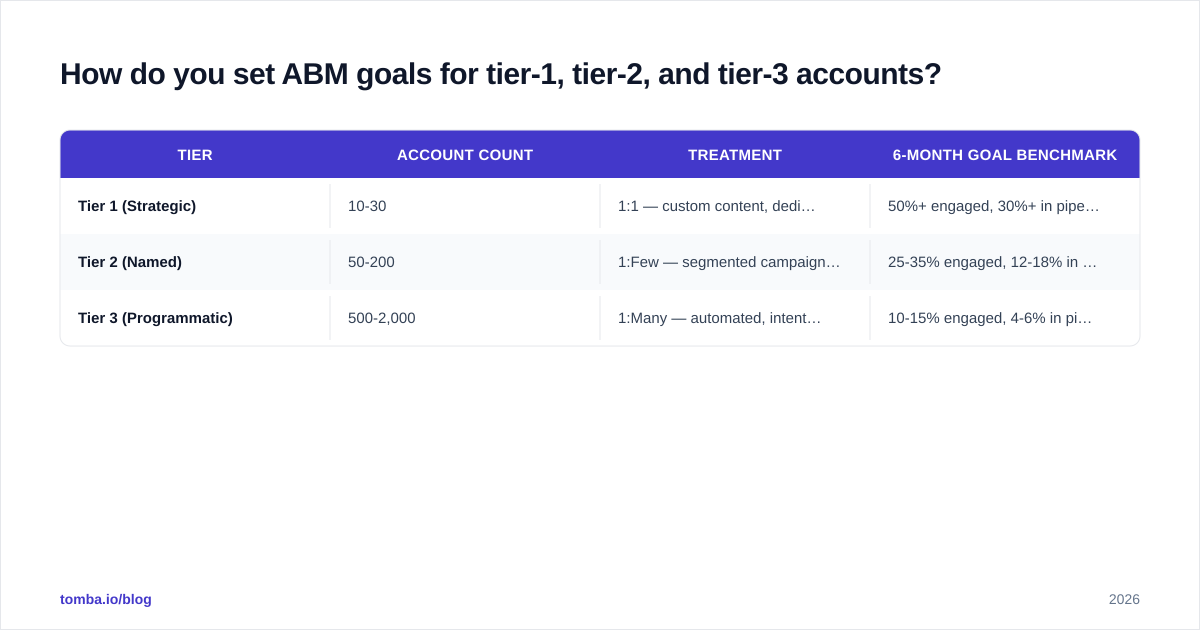
Not every named account deserves the same treatment. The standard ITSMA model splits the target list into three tiers, and goals scale with effort:
| Tier | Account count | Treatment | 6-month goal benchmark |
|---|---|---|---|
| Tier 1 (Strategic) | 10-30 | 1:1 — custom content, dedicated reps | 50%+ engaged, 30%+ in pipeline, 15%+ closed-won |
| Tier 2 (Named) | 50-200 | 1:Few — segmented campaigns, named reps | 25-35% engaged, 12-18% in pipeline |
| Tier 3 (Programmatic) | 500-2,000 | 1:Many — automated, intent-triggered | 10-15% engaged, 4-6% in pipeline |
These benchmarks come from blended data across Forrester, Gartner, and ITSMA's annual ABM benchmark study. Your actual numbers will vary by industry, ACV, and program maturity. New programs (year one) typically hit half these numbers.
The trap to avoid: setting tier-1 goals for tier-3 spend. A 1:Many programmatic motion will not produce 15% closed-won. If your budget is small, narrow the list. Don't water down the goals.
What metrics actually matter in 2026?#
The metrics that survived the last three years of ABM hype-and-correction:
- Account penetration: # of unique buying-committee contacts identified and engaged per account. Target 5+ for tier 1, 3+ for tier 2.
- Engagement velocity: days from first known engagement to mid-funnel activity (demo, trial, RFP). Top programs run under 45 days for tier 1.
- Pipeline influence rate: % of opportunities that show ≥3 marketing touches in the 90 days before creation.
- TAL coverage: % of named accounts with at least one engaged contact this quarter.
- Net new logo from TAL: # of net-new customers from the target list per quarter.
- Account-level ROI: revenue from TAL / total ABM program cost (people + tech + media).
What you should stop tracking: raw MQL volume, raw form-fills, raw page views. These don't tell you whether the right accounts are buying.
The data layer this needs is unglamorous but non-negotiable: clean firmographic data, verified contacts at multiple seniority levels per account, and accurate buying-signal data. Most teams underinvest here and then wonder why their engagement metrics drift. A solid data enrichment flow on top of your CRM is table stakes — without it, your "engaged account" count is half guesses.
How do sales and marketing align on ABM goals?#
The TAL is the contract. If both teams sign the same target account list with the same definition of "engaged" and "opportunity," 80% of the alignment problem disappears.
Run this four-step ritual every quarter:
- Joint TAL build. RevOps generates a candidate list from ICP scoring. Sales reviews account-by-account and adds/removes. Marketing accepts the final list. No silent edits.
- Shared definitions. Write down what "engaged" means (e.g., "≥3 contacts with ≥2 channel touches in 30 days"). Write down what "MQA" (marketing-qualified account) means. Pin it in the deal room.
- Joint goals, joint scoreboard. One dashboard. Both teams' bonus tied to the same TAL revenue number, even if their individual KPIs differ.
- Weekly account standup. 30 minutes. Top 20 accounts. What changed, what's blocking, what's the next play.
The teams that skip step 4 always drift apart by month two. ABM is a high-touch motion and high-touch motions need high-touch communication.
For the contact-data side of that ritual — building the buying committee map for each tier-1 account — most teams combine a LinkedIn finder for org-chart discovery with a verified email finder to get real contact paths to each committee member. Spending 4 weeks building a campaign for "the VP of Marketing" without knowing who that actually is wastes the entire quarter.
What does an ABM goal look like in practice?#
Bad goal: "Drive engagement with target accounts in Q3."
Better goal: "Move 40 of our 150 tier-2 accounts from 'known' to 'engaged' status by September 30, defined as ≥3 contacts with ≥2 multi-channel touches in a 30-day window, with at least 12 of those accounts reaching MQA status."
Notice what changed:
- Quantified (40, 150, 12)
- Time-bound (Sept 30)
- Definition-bound ("engaged" is defined inline)
- Layered (intermediate and outcome metric)
- Owned (implicitly: marketing for the 40, joint with sales for the 12)
Apply the SMART test, but with an ABM twist: every goal must name the account segment (tier, geo, vertical), the stage transition, the time window, and the measurement definition. If any of those four is missing, the goal will be gamed.
How do you measure ABM ROI when the cycle is 12+ months?#
This is the question that kills more ABM budgets than any other. CFOs see a 14-month sales cycle and a quarterly budget and conclude ABM "doesn't work." It does work — you're just measuring it wrong.
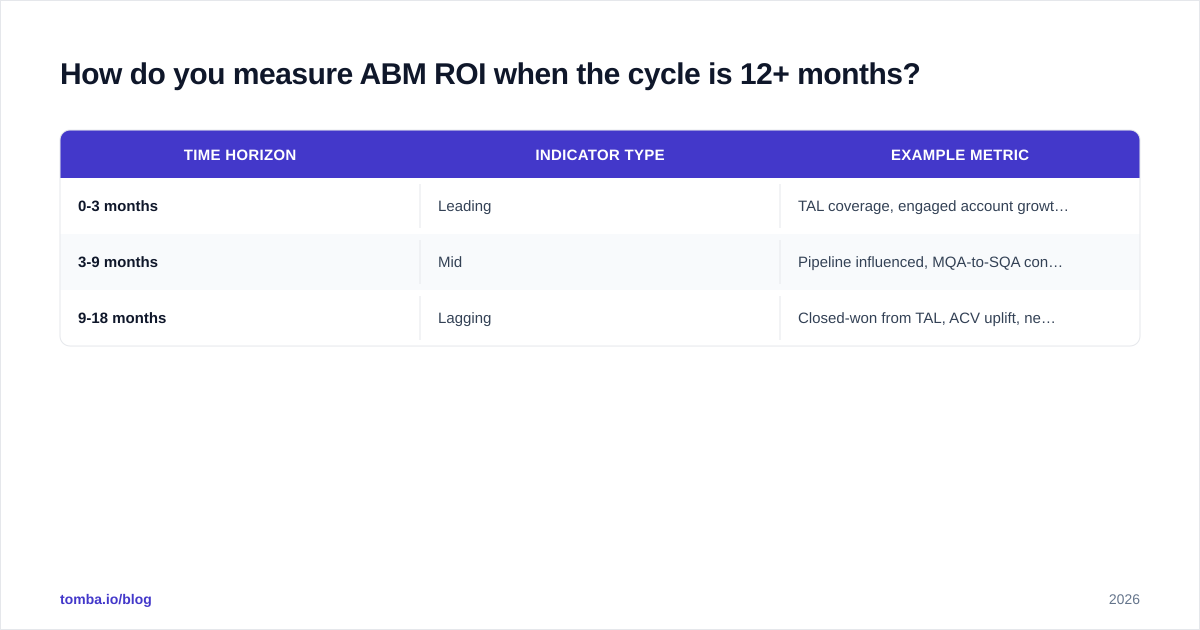
Use leading and lagging indicators stacked together:
| Time horizon | Indicator type | Example metric |
|---|---|---|
| 0-3 months | Leading | TAL coverage, engaged account growth rate |
| 3-9 months | Mid | Pipeline influenced, MQA-to-SQA conversion, average deal velocity |
| 9-18 months | Lagging | Closed-won from TAL, ACV uplift, net revenue retention from ABM cohort |
Report all three monthly. Don't let finance see only the lagging tier — they'll panic. Don't let the board see only the leading tier — they'll think you're spinning. The goal stack tells the full story.
A useful sanity check: compare ACV from TAL accounts vs. non-TAL accounts. If they're equal, your TAL selection is broken. Healthy ABM programs see 1.8-3x higher ACV from TAL accounts, because the list is supposed to be the highest-fit accounts in the market.
What tools do you need to hit ABM goals?#
Less than vendors tell you, more than spreadsheets allow. The actual minimum stack:
| Layer | Job | Examples |
|---|---|---|
| Account list + ICP scoring | Pick the right TAL | 6sense, Demandbase, internal scoring model |
| Contact data | Find and verify the buying committee | Tomba, Apollo,ZoomInfo |
| Intent signals | Know which accounts are in-market | 6sense, Bombora, G2 |
| Engagement layer | Run multichannel plays | HubSpot, Salesloft, Outreach |
| CRM + reporting | Roll everything up to account | Salesforce, HubSpot |
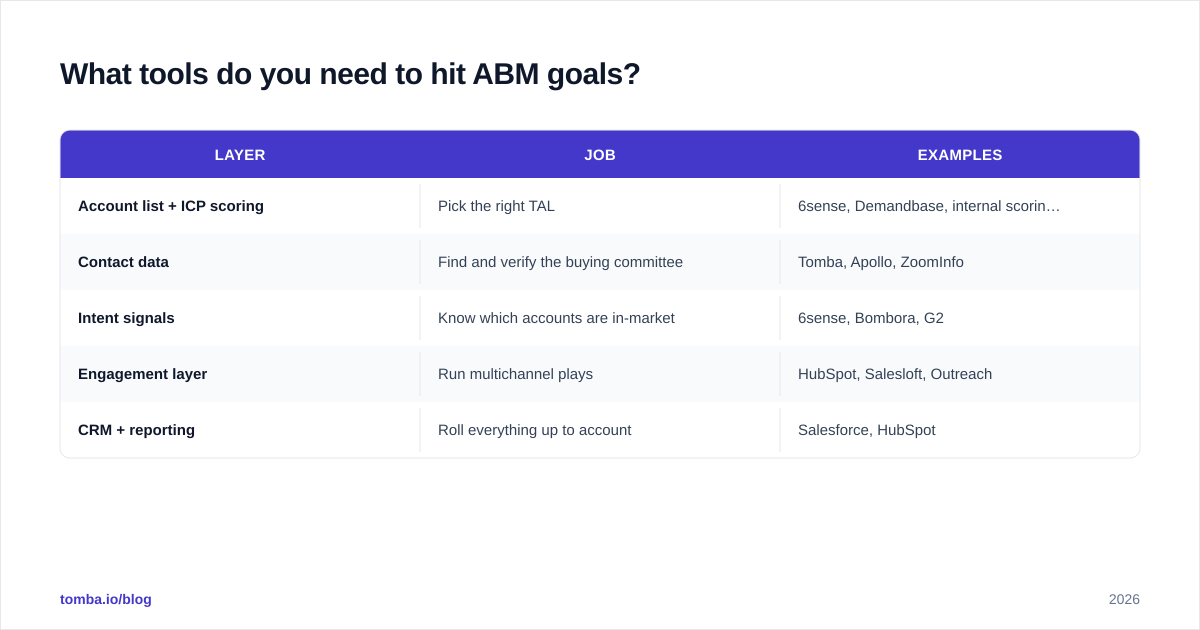
Don't buy all of these on day one. New programs should start with a CRM, a verified contact-data source (the Tomba Email Finder plus a domain search to map company-level email patterns are enough for the first 50 accounts), and a manual intent-signal process (LinkedIn engagement + content downloads). Add the heavier platforms once you've proven the motion works.
For teams running ABM through HubSpot, the HubSpot integration keeps verified contact records flowing into the right account properties so your engagement reports aren't built on stale or guessed emails. For Salesforce shops, the Salesforce integration does the same on the enterprise side.
What is the most common ABM goal-setting mistake?#
Cargo-cult goals. Teams read a Gartner report, see that top-quartile programs achieve 15% closed-won from TAL, and write that number into next year's OKRs without checking program maturity, budget, or list quality.
Year-one ABM programs almost never hit top-quartile benchmarks. Plan for it:
| Program maturity | Realistic TAL closed-won (annual) |
|---|---|
| Year 1 (pilot) | 3-5% |
| Year 2 (scaling) | 6-10% |
| Year 3+ (mature) | 12-18% |
| Top quartile | 18%+ |
If you set 15% in year one, you'll blow the budget on tactics that look good in slides and miss the number anyway. Set 4% in year one, hit 7%, and you have a program leadership trusts.
Frequently asked questions about ABM goals#
How many target accounts should I have? Tier 1: 10-30. Tier 2: 50-200. Tier 3: 500-2,000. Total TAL rarely exceeds 2,500 for a single segment.
How often should I revisit the TAL? Quarterly review, annual rebuild. Mid-quarter swaps should require sales-marketing sign-off.
Should I use MQLs at all in an ABM program? Only as a lower-funnel diagnostic, never as a primary goal. The first-class object is the account, not the lead.
What if my sales team doesn't believe in ABM? Start with their top 20 accounts. Run one quarter of joint plays. Show them the engagement data and pipeline. Belief follows results.
How do I budget for ABM? Roughly 30-40% of budget goes to tier 1 (where you have 10-30 accounts), 40-50% to tier 2, 10-20% to tier 3. Reverse the ratio and you've built a demand-gen program with an ABM label.
Build a contact foundation your ABM goals can actually rest on#
The cleanest ABM goal stack in the world breaks the moment your buying-committee data goes stale. The "engaged account" count quietly drifts. Sequences land in the wrong inbox. The "VP of Marketing" turns out to have left six months ago.
The Tomba Email Finder gives ABM teams the verified contact layer the rest of the stack assumes you already have — accurate emails for the people on each tier-1 account's buying committee, plus a bulk email finder for tier-2 and tier-3 lists. Start with the free plan (25 searches/month) to validate one tier-1 account, then scale up when the goals — and the pipeline — start to move.
// get started
Find, verify and enrich your first contacts today
Start on the free plan with 25 searches a month, then scale when your team is ready.
Free plan · No credit card required · GDPR & CCPA
// about the author