Account Based Marketing Personas: The 2026 ABM Playbook
Generic buyer personas kill ABM deals. Here's how to build account based marketing personas that map to real buying committees, trigger plays, and pipeline in 2026.
TL;DR
- Generic buyer personas fail in ABM because enterprise deals get closed by buying committees of 6 to 10 people, not a single "Marketing Mary."
- Account based marketing personas must be layered: an ICP fingerprint at the account level, plus 4 to 7 role-specific personas inside each target account.
- The personas that actually move pipeline include a champion, an economic buyer, a technical evaluator, a power user, a procurement gatekeeper, and at least one detractor.
- Build personas from CRM exports, win/loss interviews, intent data, and LinkedIn job posts — not from a one-hour workshop with sticky notes.
- Tie each persona to a specific play: which channel, which message, which signal triggers outreach, and which metric proves it worked.
If you are running ABM the way most teams run demand-gen — one persona, one message, one nurture track — you are leaving most of your pipeline on the table. Enterprise buying has fragmented. Gartner's research on B2B buying groups puts the average committee size at 6 to 10 stakeholders, and every one of them can veto a deal. Your account based marketing personas have to reflect that reality or your "personalized" campaigns are just spray-and-pray with better graphics.
This guide breaks down how mature ABM teams actually build, store, and operationalize personas in 2026. No fluff, no "imagine a day in the life of Marketing Mary" exercises. Just the structure, the data sources, and the plays that turn personas into closed-won revenue.
What are account based marketing personas?#
Account based marketing personas are role-specific, account-anchored profiles of the individuals inside a target account who influence, evaluate, approve, or block a purchase. They differ from classic buyer personas in three ways:
- They live inside an account, not in the abstract. The CFO at a 5,000-person logistics company is a different persona than the CFO at a 50-person SaaS startup, even though both have "CFO" as a job title.
- They are committee-aware. A persona is never used in isolation. It is one node in a buying committee map that includes 4 to 7 other personas.
- They are tied to plays, not just messaging. Each persona has a trigger (what makes us reach out), a channel (where we reach them), an offer (what we send), and a goal (what action proves the play worked).
Classic personas describe a person. ABM personas describe a person's job to be done inside this specific deal.
Why do generic personas fail in ABM?#
Generic personas were designed for a world where one buyer made one decision. That world is gone. Forrester's B2B buying research has documented this shift for over a decade — the modern enterprise purchase involves engineering, finance, security, procurement, legal, and the end-user team, often across multiple business units.
Three specific failure modes:
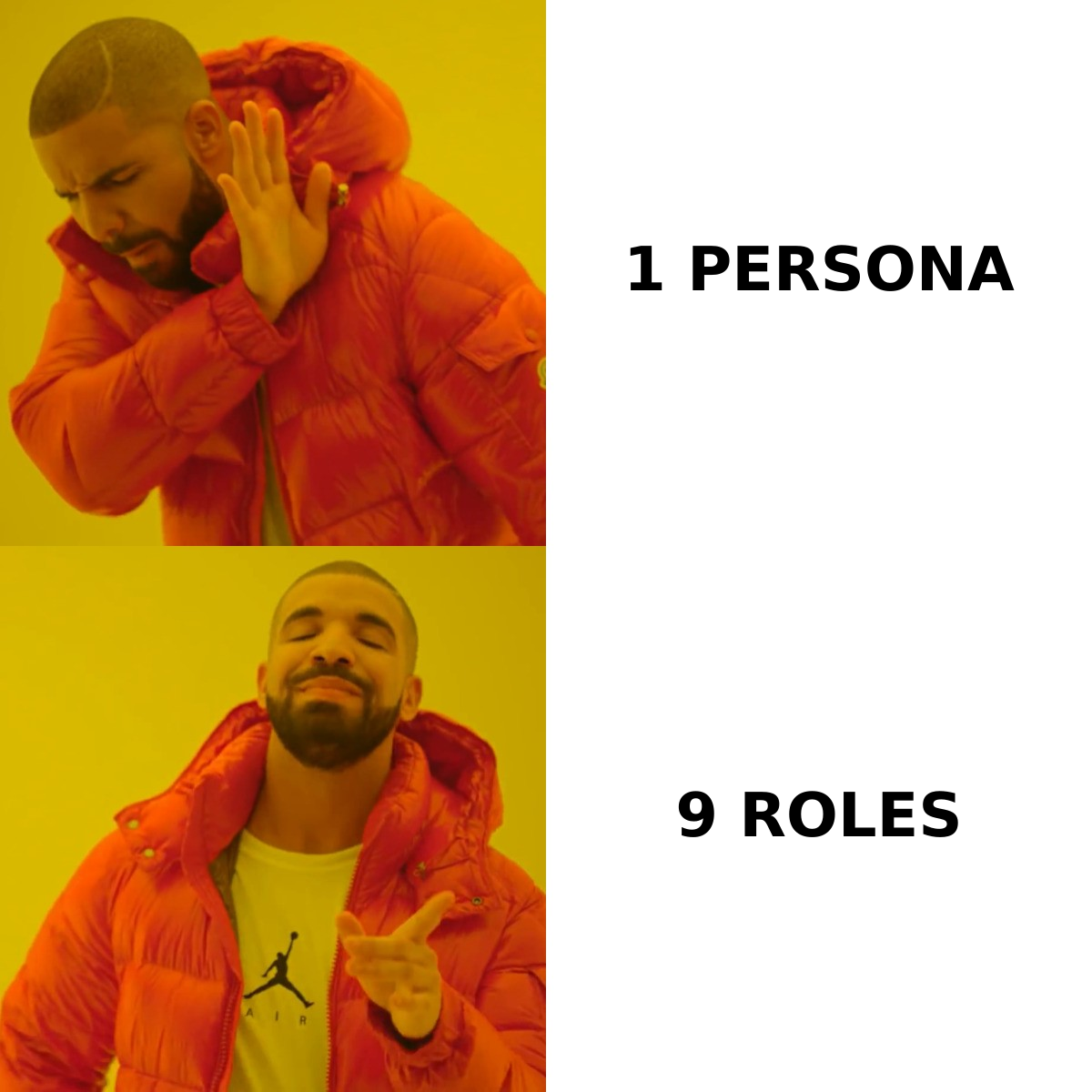
Failure 1: One message, six audiences. If your ABM campaign for a target account sends the same "Transform your operations" email to the CFO and the front-line ops manager, one of them will roll their eyes. Usually both.
Failure 2: No champion strategy. Generic personas tell you who buys. ABM personas tell you who sells internally for you. The champion persona is the single highest-leverage role in any enterprise deal and most personas don't even name it.
Failure 3: No blocker map. Procurement, security, and legal personas are often missing entirely. They don't buy your product, but they can kill your deal in week 11 of a 14-week cycle. If you haven't built a persona for them, you haven't built ABM.
How is an ABM persona different from an ICP?#
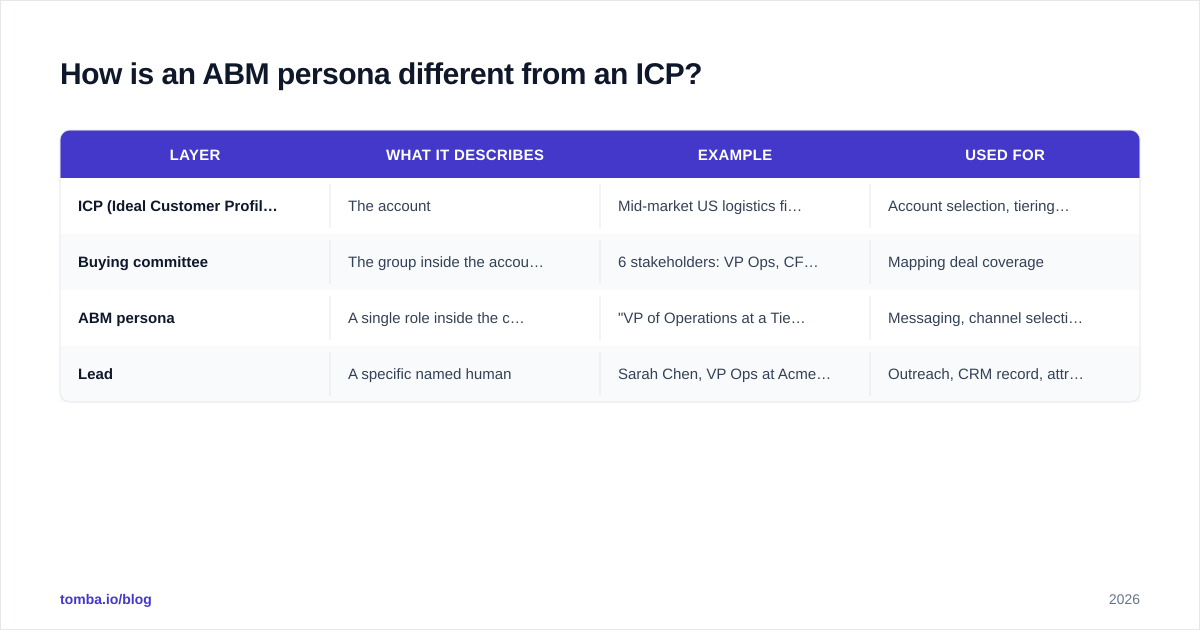
Easy to confuse, easy to get wrong. Here is the clean split:
| Layer | What it describes | Example | Used for |
|---|---|---|---|
| ICP (Ideal Customer Profile) | The account | Mid-market US logistics firm, 500-2,000 employees, $50M-$500M revenue, uses SAP | Account selection, tiering, list building |
| Buying committee | The group inside the account | 6 stakeholders: VP Ops, CFO, IT Director, Procurement Lead, 2 power users | Mapping deal coverage |
| ABM persona | A single role inside the committee | "VP of Operations at a Tier-1 logistics account" | Messaging, channel selection, play design |
| Lead | A specific named human | Sarah Chen, VP Ops at Acme Logistics | Outreach, CRM record, attribution |
ICP gets you to the right door. Personas tell you who answers it, and what each person cares about. You can read more on the technical definition in Tomba's B2B glossary.
Which personas should every ABM team build?#
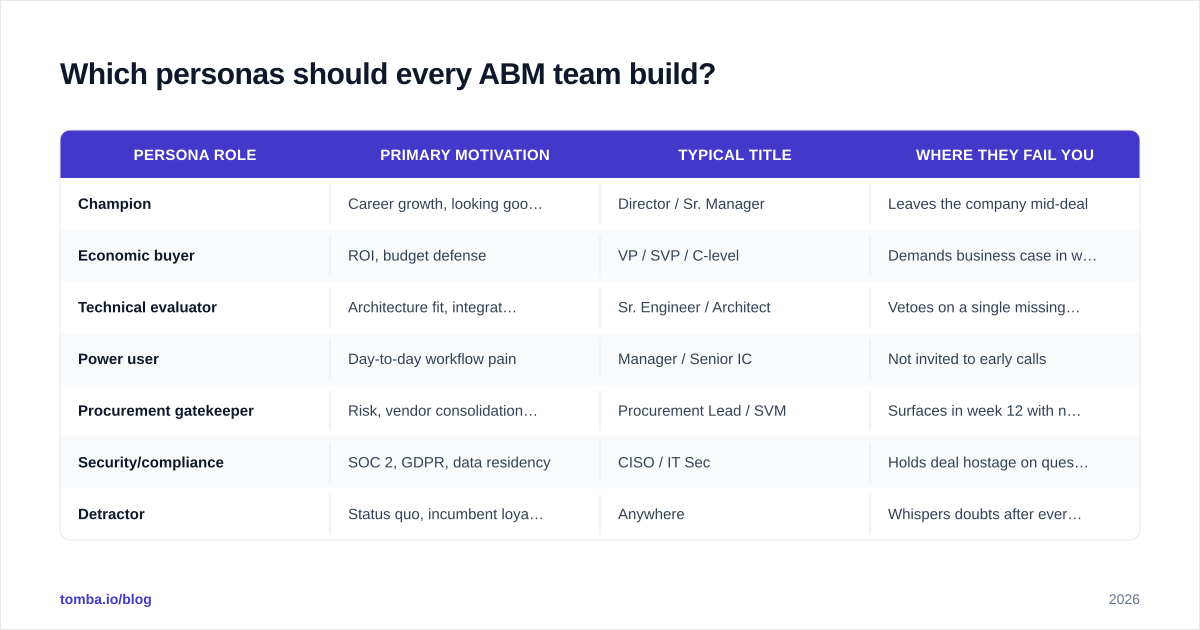
Most ABM programs over-engineer this. You do not need 30 personas. You need 5 to 7 that cover the structural roles in your typical buying committee. The roles below cover roughly 90% of enterprise SaaS deals.
| Persona role | Primary motivation | Typical title | Where they fail you |
|---|---|---|---|
| Champion | Career growth, looking good internally | Director / Sr. Manager | Leaves the company mid-deal |
| Economic buyer | ROI, budget defense | VP / SVP / C-level | Demands business case in week 10 |
| Technical evaluator | Architecture fit, integration risk | Sr. Engineer / Architect | Vetoes on a single missing feature |
| Power user | Day-to-day workflow pain | Manager / Senior IC | Not invited to early calls |
| Procurement gatekeeper | Risk, vendor consolidation, discount | Procurement Lead / SVM | Surfaces in week 12 with new requirements |
| Security/compliance | SOC 2, GDPR, data residency | CISO / IT Sec | Holds deal hostage on questionnaire |
| Detractor | Status quo, incumbent loyalty | Anywhere | Whispers doubts after every meeting |
If your current "ABM personas" doc has fewer than five of these, it is a buyer persona doc, not an ABM persona doc. Rebuild it.
How do you actually build account based marketing personas?#
The persona workshops where five marketers sit in a room and invent "Tactical Tom" are why personas have a bad reputation. They produce fiction. Here is a five-step build process that produces something usable.
Step 1: Pull the data, don't invent it#
For each persona role, pull at least 30 real examples from:
- Closed-won deals in the last 18 months (CRM export — Salesforce, HubSpot, Pipedrive)
- Closed-lost deals in the same window (the lost ones are more diagnostic)
- LinkedIn Sales Navigator searches for your ICP filtered by role
- Gong/Chorus call transcripts tagged by deal stage
- Win/loss interviews — ideally 10+ per persona
If you cannot find 30 examples, the role is either too narrow or not actually in your committee.
Step 2: Extract the structural attributes#
For each persona, capture the unchanging structural traits, not adjectives. "Detail-oriented" is not an attribute. "Reports to the CFO" is.
- Reporting line (who do they report to, who reports to them)
- Tenure in role (median + range)
- Budget authority (do they own a P&L line?)
- Tools they use daily (their tech stack tells you everything)
- Metrics they are measured on (their OKRs are your messaging)
- Career trajectory (what is their next promotion?)
Step 3: Capture the deal behaviors#
This is where most personas stop short. You need to know how each role behaves inside a deal:
- First-call posture (skeptical, curious, defensive, neutral)
- Information they always ask for (pricing, security, references, integration)
- Objections that come from this role specifically
- Internal language they use (their words, not yours)
- Who they listen to (analyst reports, peers, the champion, the CEO)
Step 4: Map the committee, not just the persona#
Once you have 5-7 personas, draw the typical committee for your top three account tiers. Tier 1 (strategic accounts) may have a 9-person committee. Tier 3 may have 4. Each tier gets its own committee template.
Step 5: Attach a play to each persona#
A persona without a play is a poster on a wall. For each persona, document:
- The trigger signal (job change, funding round, intent spike, technographic match)
- The channel (LinkedIn DM, cold email, paid social, direct mail, event)
- The first-touch message (copy, asset, hook)
- The follow-up sequence (3-5 touches)
- The success metric (reply, meeting booked, multi-thread, opportunity created)
Where does the persona data actually come from?#
You cannot build modern ABM personas from a workshop alone. You need data infrastructure. Here is the realistic data stack a 2026 ABM team uses:
| Data type | Source | What it tells you about personas |
|---|---|---|
| Firmographic | ZoomInfo, Apollo, Tomba B2B database | Account size, industry, location, tech stack |
| Contact + email | Tomba Email Finder, LinkedIn Sales Navigator | Reaching the actual humans inside the persona |
| Intent | Bombora, 6sense, G2 buyer intent | Which personas are researching right now |
| Engagement | HubSpot, Marketo, Salesforce | Which personas have engaged with us before |
| Conversational | Gong, Chorus, Fathom | How each persona actually talks in deals |
| Org structure | LinkedIn, Tomba domain search | Reporting lines, committee mapping |
| Job change | LinkedIn, Champify, UserGems | Champion movement (huge trigger) |
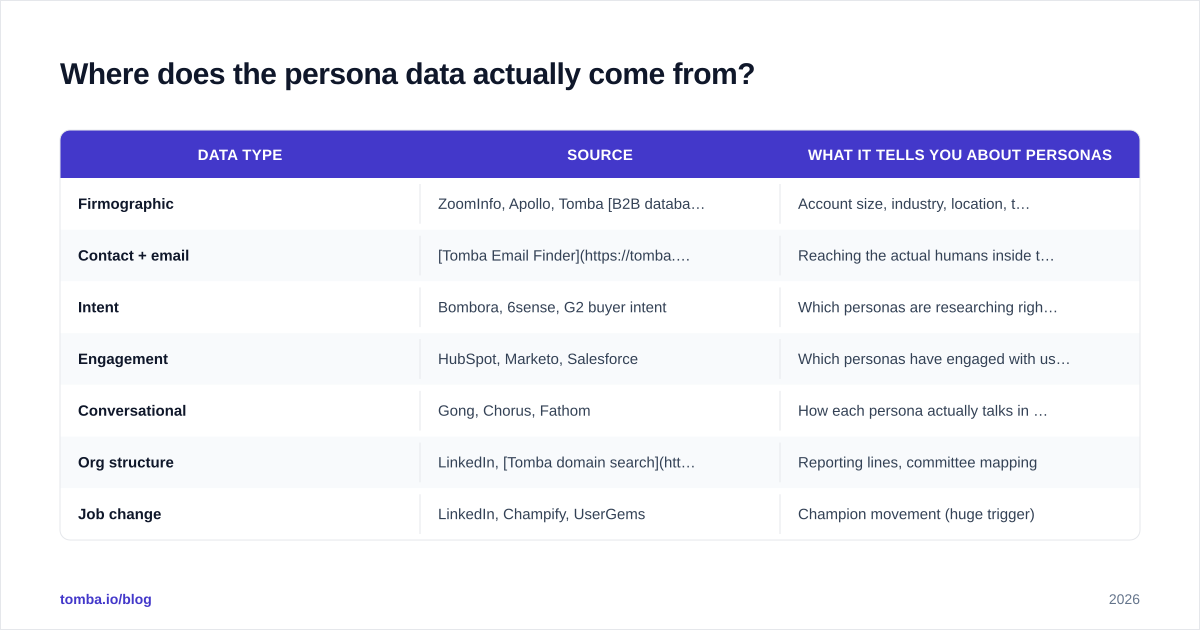
The single highest-leverage data source most teams miss is conversational data. Your Gong library has hundreds of hours of personas describing their own pain in their own words. Mine it. It beats any survey.
How do you find and contact the right personas?#
Building the persona is half the job. Getting in front of the actual humans who fit the persona is the other half. This is where ABM execution lives or dies.
Three steps that work in 2026:
1. Build the account list first. Pick 50 to 500 target accounts that match your ICP. Don't go wider — ABM at 5,000 accounts is just demand-gen with extra steps.
2. Map the committee for each account. Use LinkedIn Sales Navigator to identify 5-9 named humans per account who match your persona templates. Title search alone is not enough — you need to verify reporting lines and tenure.
3. Enrich with verified contact data. Title lists with no contact info don't generate pipeline. Use a bulk email finder to pull verified business emails for the whole committee. For high-priority accounts, layer in phone numbers for direct dials too. Verified data matters here — bouncing emails to a CFO at a target account is a credibility kill.
What does a persona-driven ABM play look like end-to-end?#
Here is a concrete example. Persona: VP of Operations at a Tier-1 logistics account. Trigger: company posts a job rec for "Director of Operations Excellence."
Day 0 — Signal detected. LinkedIn job post crawler flags the rec. RevOps creates a play.
Day 1 — Account research. SDR pulls the org chart for the ops function (LinkedIn + verified contact data). Maps 7 committee members.
Day 2 — Multi-thread outreach. Personalized email to the VP referencing the job rec ("Hiring an Ops Excellence Director suggests you're scaling the ops function. We help VPs like you handle X in Y") + a LinkedIn connection request from the AE + a paid LinkedIn ad served to the same VP.
Day 5 — Power user touch. Cold email to one of the ops managers (the power user persona) with a different angle — workflow pain, not strategic transformation.
Day 9 — Champion play. If the VP replies or engages, AE asks for an intro to the IT Director. If no reply, SDR moves to the Director of Operations directly.
Day 14 — Procurement-aware ad. Retarget the whole committee with a case study that includes vendor consolidation metrics — the procurement persona's love language.
Day 21 — Multi-threaded meeting. Goal: discovery call with 3+ personas in the committee, not just the VP.
Notice that the play is built from personas, not bolted on after. Each touch is keyed to a specific persona's motivation, language, and channel preference.
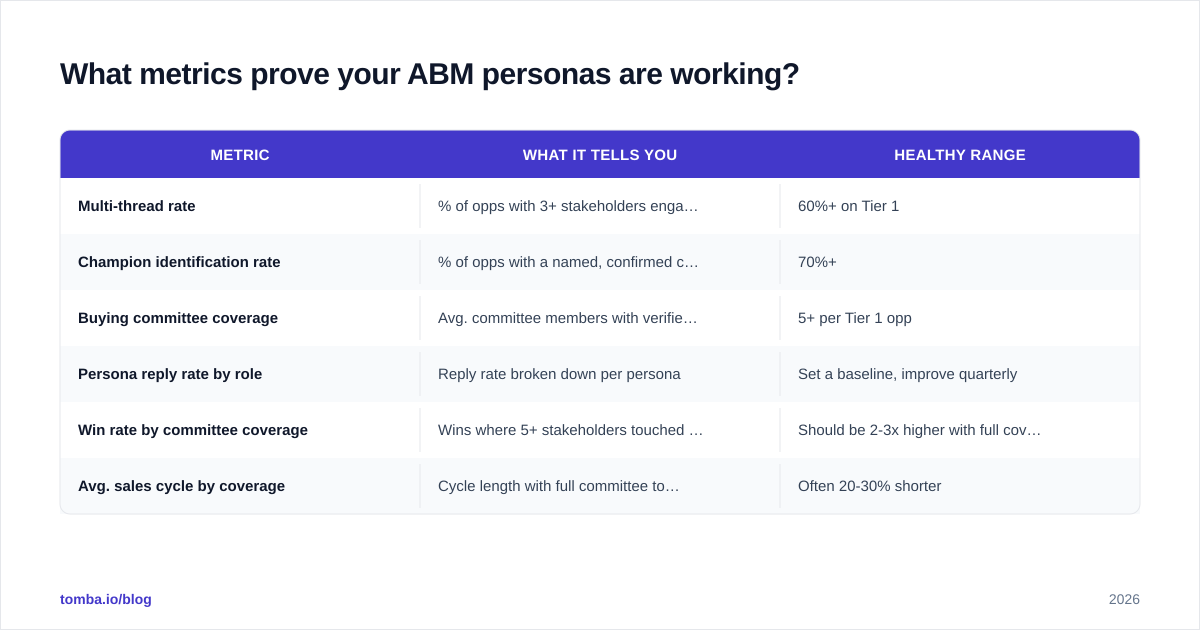
What metrics prove your ABM personas are working?#
Persona quality shows up downstream. Look for:
| Metric | What it tells you | Healthy range |
|---|---|---|
| Multi-thread rate | % of opps with 3+ stakeholders engaged | 60%+ on Tier 1 |
| Champion identification rate | % of opps with a named, confirmed champion | 70%+ |
| Buying committee coverage | Avg. committee members with verified contact + at least one touch | 5+ per Tier 1 opp |
| Persona reply rate by role | Reply rate broken down per persona | Set a baseline, improve quarterly |
| Win rate by committee coverage | Wins where 5+ stakeholders touched vs <3 | Should be 2-3x higher with full coverage |
| Avg. sales cycle by coverage | Cycle length with full committee touch | Often 20-30% shorter |
If you cannot pull these metrics, your CRM is not set up for ABM. Fix that before you build more personas. The standard ABM platforms — Demandbase, 6sense, RollWorks — all support committee tracking, and HubSpot's account-based marketing tools can do it for SMB ABM teams.
How do you keep ABM personas from going stale?#
Personas decay. The CFO persona of 2024 is not the CFO persona of 2026 — different tools, different metrics, different language. Maintenance rules that work:
- Quarterly refresh — re-pull data, update tools, retire dead language
- Job change watch — when champions move, that is both an opportunity (follow them) and a signal (your persona at the old account just changed)
- Win/loss feedback loop — every closed-won and closed-lost deal contributes one data point back to the relevant persona
- Sales-marketing review — 30-minute meeting per quarter, AE flags any persona that "isn't matching what I'm seeing"
- Tool stack monitoring — when a tracked target account adopts a new tool, that often means a new persona just joined the committee
Stale personas are worse than no personas. They give you false confidence.
What about AI-generated personas?#
You will see vendors selling "AI personas" that read your CRM and produce profiles automatically. Use these as a starting draft, never as the finished artifact. AI is good at clustering and summarizing. It is bad at capturing the political subtext of a buying committee — who hates whom, who got passed over for promotion, who is secretly evaluating a competitor. That intelligence comes from sales calls, not LLMs.
Where AI does help: drafting persona-specific email copy, summarizing call transcripts by persona, scoring intent signals per role. Treat AI as a force multiplier on the data work, not a replacement for it.
Get the contact data your ABM personas need#
Personas are only as useful as your ability to reach the actual humans inside them. Once you have mapped your 5-7 committee personas across your target accounts, you need verified email addresses and phone numbers for every committee member — or your "personalized" campaign turns into bounces and dead dials.
Tomba Email Finder gets you verified business emails for every persona in your target accounts, with company domain search for committee mapping, phone numbers for direct dials, and Salesforce, HubSpot, and Pipedrive integrations so the data lands where your ABM plays already live. Pricing starts free for 25 searches a month and scales to enterprise volumes — check the full Tomba pricing for ABM-scale plans. Build the personas, map the committee, and Tomba handles the contact layer that makes the whole play executable.
// get started
Find, verify and enrich your first contacts today
Start on the free plan with 25 searches a month, then scale when your team is ready.
Free plan · No credit card required · GDPR & CCPA
// about the author