Account Based Marketing Plan: The 2026 Playbook for Revenue Teams
Build a 2026 account based marketing plan that actually closes enterprise deals. Templates, scoring rubrics, channel mix, and the metrics your CFO will accept.
TL;DR#
- An account based marketing plan in 2026 is a tight contract between sales and marketing on which named accounts you'll win, how, and by when — not a campaign calendar.
- Tier accounts into 1:1 (10–25), 1:few (50–200), and 1:many (500–2,000). Each tier gets a distinct play, budget, and reporting line.
- The plan only works if the buying committee data is clean: titles, emails, phone numbers, and intent signals refreshed weekly.
- Track pipeline created in target accounts, engaged accounts, and average deal size, not MQLs. ABM kills the MQL.
- Pilot with 30 accounts and one sales pod for 90 days before you scale. Most ABM programs fail at month 4 because the data and the sales hand-off were never tested at small scale.
What is an account based marketing plan?#
An account based marketing plan is a written, sales-aligned strategy that picks a finite list of companies, defines the buying committee inside each one, and assigns specific marketing and sales actions to move them through a known buying journey.
Think of it like a wedding planner versus a billboard. A billboard talks to a million strangers and hopes 0.01% care. A wedding planner has one couple, knows their families, the venue, the budget, the in-laws who don't speak to each other, and runs everything around that. ABM is the wedding planner version of demand generation.
The plan is not a campaign brief. It's closer to a joint operating document between revenue operations, sales, and marketing. It typically includes:
- Named target account list (with tiering)
- Ideal Customer Profile (ICP) and buying-committee map per tier
- Channel mix per tier (ads, email, LinkedIn, direct mail, events, BDR plays)
- SLA between marketing and sales (response times, hand-off triggers)
- Reporting cadence and KPI definitions
- Budget allocation per tier
If your "ABM plan" is a Notion page of campaign ideas, you don't have one yet. You have a wishlist.
Why does ABM beat traditional demand gen in 2026?#
Three things changed between 2022 and 2026 that make broad demand gen worse, not better:
- Buying committees grew. Gartner now puts the average B2B buying group at 11+ stakeholders. You cannot reach 11 people with a single white paper download.
- Inboxes are hostile. Google and Microsoft tightened deliverability rules in 2024 and again in 2025. Generic "Hi {{first_name}}" sequences land in spam. Targeted, low-volume, high-relevance outreach survives.
- CFOs stopped buying MQL counts. When budgets tightened, finance asked the question marketing dreaded: which closed deals came from your MQLs? The honest answer was "we don't know" — and ABM, which measures pipeline at the account level, was the only frame that survived.
Forrester's research on the buying journey backs this up: 90%+ of B2B buyers complete most of the journey before talking to sales. The lever you have left is being present, useful, and recognized when those buyers — plural — show up to evaluate.
Who should run the ABM program?#
Not marketing alone. That's the single biggest failure pattern.
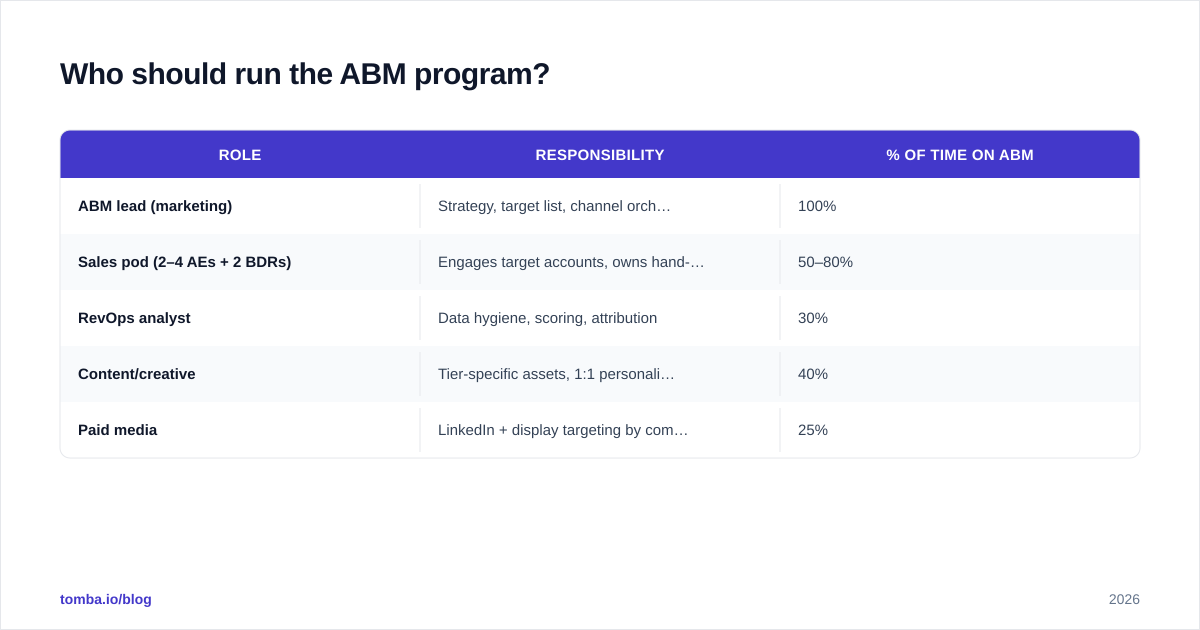
The minimum staffing for a real account based marketing plan:
| Role | Responsibility | % of time on ABM |
|---|---|---|
| ABM lead (marketing) | Strategy, target list, channel orchestration | 100% |
| Sales pod (2–4 AEs + 2 BDRs) | Engages target accounts, owns hand-off | 50–80% |
| RevOps analyst | Data hygiene, scoring, attribution | 30% |
| Content/creative | Tier-specific assets, 1:1 personalization | 40% |
| Paid media | LinkedIn + display targeting by company | 25% |
If you can't get sales to dedicate a pod, stop. ABM without sales is a content calendar with a fancy name.
How do you build the target account list?#
The list is the program. Spend 30% of your planning time here.
Step 1 — Define the ICP from closed-won data. Pull every closed-won deal in the last 18 months. Look at industry, employee count, revenue band, tech stack, region, and trigger events. The pattern that shows up in 60%+ of wins is your ICP. Anything else is aspiration.
Step 2 — Source the universe. You need a clean B2B database of every company that fits the ICP. Most teams pull from a combination of LinkedIn Sales Navigator, a B2B database like Tomba's, and their own CRM. Deduplicate aggressively — duplicate accounts kill ABM reporting.
Step 3 — Add intent and fit signals. Layer in signals that suggest the account is in market:
- Hiring for relevant roles (a security team scaling = pipeline for security tools)
- Tech stack changes (moved off Salesforce = window for CRM alternatives)
- Funding round in the last 90 days
- Visits to your pricing or comparison pages
- Engagement with competitor content on G2
Step 4 — Score and tier. A simple scoring model that works:
| Signal | Points |
|---|---|
| ICP fit (industry + size) | 30 |
| Intent (3rd party + 1st party) | 25 |
| Engagement (visits, content, events) | 20 |
| Existing relationship (CRM, alumni) | 15 |
| Strategic fit (logo value, expansion) | 10 |
Top 25 scoring accounts = Tier 1 (1:1). Next 150 = Tier 2 (1:few). Next 1,000 = Tier 3 (1:many).
Step 5 — Enrich the buying committee. For every Tier 1 and Tier 2 account, you need verified contacts for 6–11 stakeholders. This is where most plans break. Manual LinkedIn scraping doesn't scale, and stale CRM data tanks deliverability.
Practical workflow: use a tool like the Tomba Email Finder to pull verified emails for the committee, then run a domain search to find the people you didn't already know about. Re-verify every 90 days — B2B contact data decays at roughly 2.5% per month.
What does the channel mix look like per tier?#
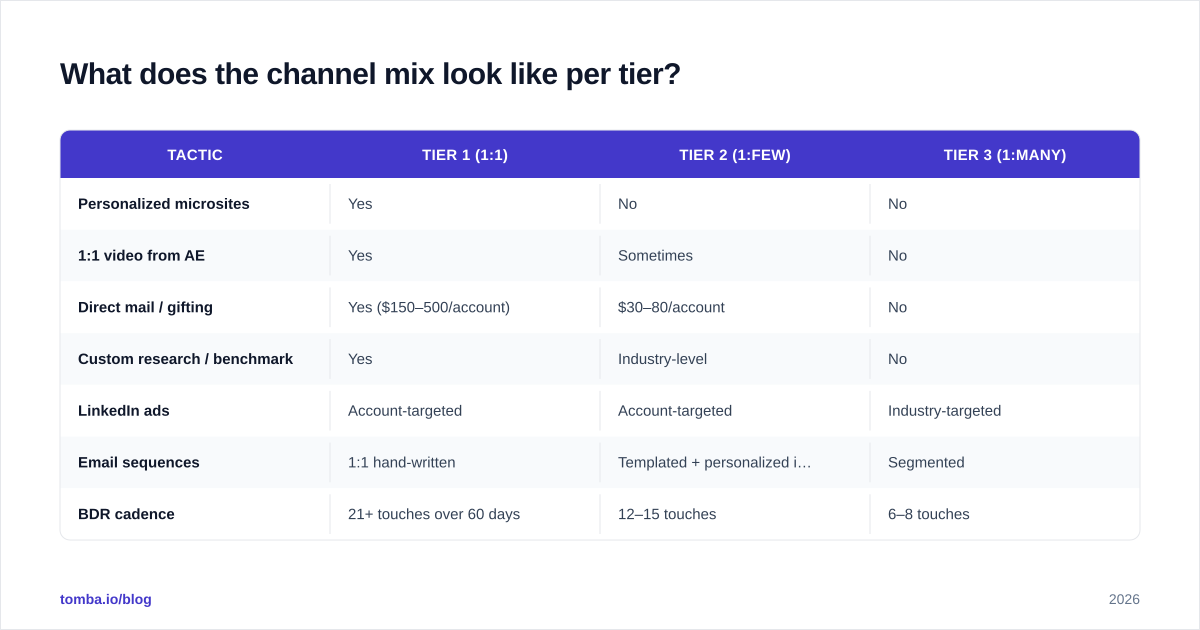
This is where the plan stops being theory and starts costing money. Match channel intensity to deal value.
| Tactic | Tier 1 (1:1) | Tier 2 (1:few) | Tier 3 (1:many) |
|---|---|---|---|
| Personalized microsites | Yes | No | No |
| 1:1 video from AE | Yes | Sometimes | No |
| Direct mail / gifting | Yes ($150–500/account) | $30–80/account | No |
| Custom research / benchmark | Yes | Industry-level | No |
| LinkedIn ads | Account-targeted | Account-targeted | Industry-targeted |
| Email sequences | 1:1 hand-written | Templated + personalized intro | Segmented |
| BDR cadence | 21+ touches over 60 days | 12–15 touches | 6–8 touches |
| Field events / dinners | Quarterly | Bi-annual cluster events | Webinars |
| Annual cost per account | $5,000–$25,000 | $500–$2,000 | $20–$80 |
The math: if your ACV is $80k, spending $15k on a Tier 1 account is rational when your close rate jumps from 4% (cold) to 25%+ (warm + multi-threaded).
How do marketing and sales actually align?#
Alignment isn't a Slack channel. It's a written SLA. Bake these into the plan:
- Shared target list. No "marketing's list" vs "sales's list." One list, one tool of record (usually the CRM with a custom "ABM tier" field).
- Defined hand-off triggers. Example: "When 3+ contacts at an account engage with mid-funnel content within 14 days, marketing books a 15-minute call for the AE within 48 hours."
- Round-robin or pod ownership. Each Tier 1 account has a named AE. No "let's see who picks it up."
- Joint QBR. Marketing and sales review the target list every quarter. Accounts that haven't moved get reclassified or replaced.
- Shared metric. Both teams report on pipeline created in target accounts, not their separate dashboards.
A good test: ask your top AE which accounts marketing is running campaigns against this quarter. If they don't know, you don't have ABM — you have parallel work.
What does the 90-day pilot look like?#
Do not roll ABM out across the entire sales org on day one. Pilot it.
Days 1–14 — Setup. Pick 30 accounts (top scoring), one sales pod (1 AE + 1 BDR), one ABM marketer. Build the list, enrich the committee, write the SLA, set up reporting in the CRM. Use a tool like Tomba's bulk email finder to pull all 30 committees in one batch.
Days 15–45 — Engage. Launch the channel mix. LinkedIn ads live, BDR cadence active, first 1:1 outreach sent, direct mail dropped for the top 10. Weekly stand-up between AE, BDR, and marketer. Track engaged accounts (any meaningful interaction) and meeting set rate.
Days 46–75 — Convert. First meetings happen. Marketing supports with custom content for opportunities that progress to discovery. Track opportunities created and average deal size in target accounts vs control.
Days 76–90 — Review. Run a structured review: pipeline created, meetings set, account engagement rate, cost per opportunity, win rate (early signal). Compare to the same pod's pre-ABM baseline. Decide what to scale, what to kill, what to fix.
A realistic pilot result: 30 accounts → 40% engaged → 8 meetings → 4 opportunities → 1–2 closed-won within 6–9 months. ABM is patient.
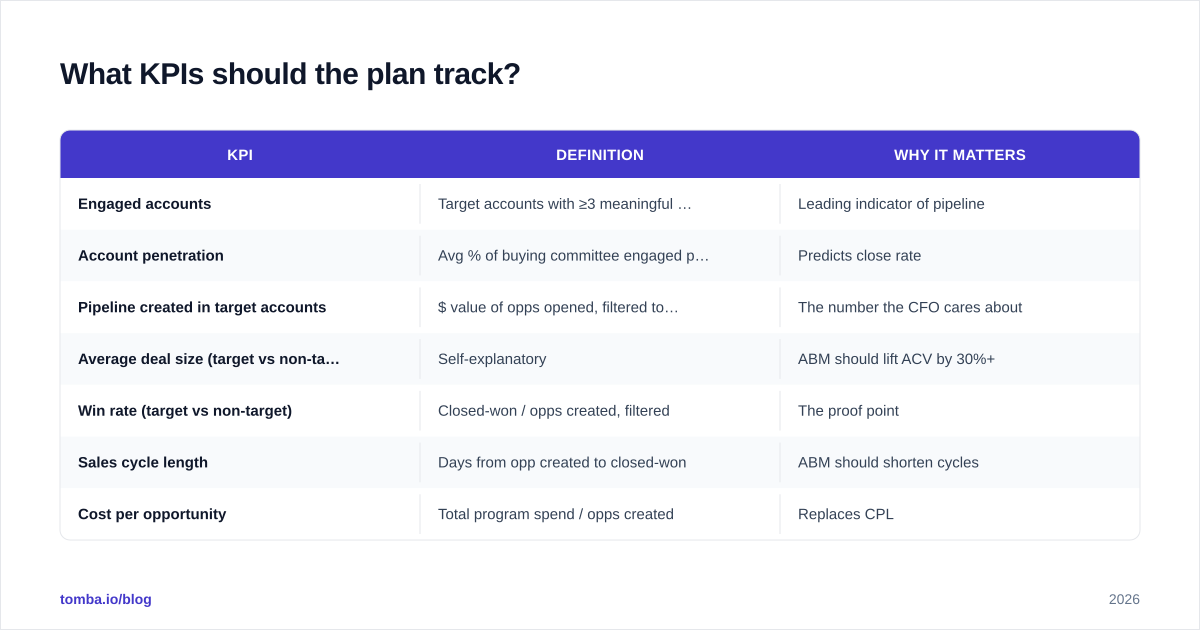
What KPIs should the plan track?#
Throw out the MQL. Replace it with this stack:
| KPI | Definition | Why it matters |
|---|---|---|
| Engaged accounts | Target accounts with ≥3 meaningful interactions in 30 days | Leading indicator of pipeline |
| Account penetration | Avg % of buying committee engaged per account | Predicts close rate |
| Pipeline created in target accounts | $ value of opps opened, filtered to target list | The number the CFO cares about |
| Average deal size (target vs non-target) | Self-explanatory | ABM should lift ACV by 30%+ |
| Win rate (target vs non-target) | Closed-won / opps created, filtered | The proof point |
| Sales cycle length | Days from opp created to closed-won | ABM should shorten cycles |
| Cost per opportunity | Total program spend / opps created | Replaces CPL |
| Influenced revenue | $ closed-won where ≥1 buying committee member engaged | The lagging proof |
Don't add "MQLs in target accounts." It sneaks the old metric back in. If you must, call it "engaged contacts" and use it only as a leading indicator.
What tools do you actually need?#
The ABM tooling category is bloated. The minimum viable stack:
| Layer | Purpose | Examples |
|---|---|---|
| CRM | System of record, target list, opps | Salesforce, HubSpot |
| Data + enrichment | Find and verify the buying committee | Tomba, Apollo,ZoomInfo |
| Intent | Signal which accounts are in-market | 6sense, Bombora, G2 Buyer Intent |
| Engagement | Sequences and cadence | Outreach, Salesloft, Saleshandy alternatives |
| Advertising | Account-targeted ads | LinkedIn, RollWorks, Demandbase |
| Orchestration | Trigger plays across channels | Demandbase, 6sense, or a Zapier-stitched version |
| Reporting | Account-level attribution | CRM dashboards + a BI tool |
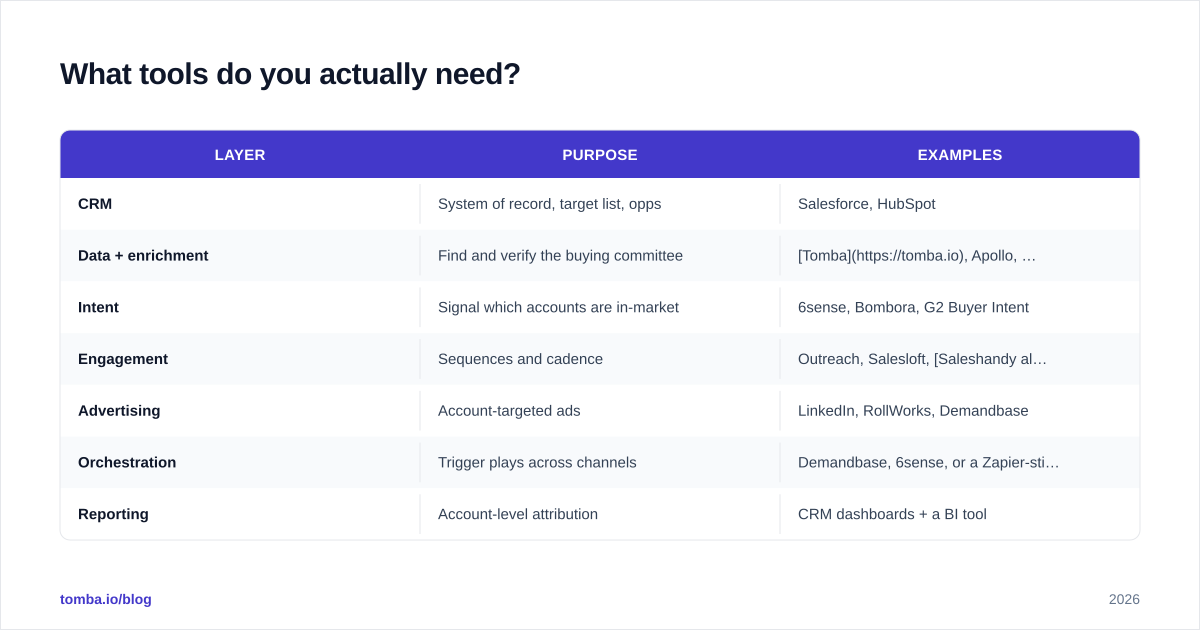
You do not need every tier of every category in year one. A typical pilot stack: CRM + Tomba for data + LinkedIn for ads + Outreach for sequences + a Looker dashboard for reporting. That's it.
For pulling and verifying the buying committees, the workflow most teams settle on is enrichment via API: hit the email finder API with a list of companies and titles, send verified contacts straight into the CRM, and let the email verifier re-check anything older than 90 days.
What are the most common ABM plan failures?#
After running this with dozens of teams, the same six failures repeat:
- The list is too big. "Top 500 accounts" isn't a list, it's a wishlist. Cut to 25 Tier 1 and earn the right to expand.
- Sales never agreed. Marketing built the list, sales is working different accounts. Dead on arrival.
- Bad contact data. 35% of emails bounce, sequences land in spam, BDRs lose faith. Fix the data layer first — see Tomba's notes on data sources.
- Measuring the wrong thing. Reporting MQLs makes ABM look worse than the old funnel. Switch to engaged accounts and pipeline.
- No content for the buying committee. You have a CMO ebook and an end-user blog post. You need IT, finance, security, and procurement assets too.
- Killing the program at month 4. ABM payback is 6–12 months. Quarterly leadership reviews need this baked in, or the budget gets cut just before pipeline shows up.
How do you scale beyond the pilot?#
After a successful 90-day pilot, scale on two axes — not both at once.
- More accounts per pod (30 → 75) keeps your channel mix and learnings intact, tests whether the playbook works at higher volume per team.
- More pods (1 → 3) tests whether the playbook is generalizable across reps. Pair each new pod with a marketer who shadowed the pilot.
Don't go from "1 pod, 30 accounts" to "5 pods, 500 accounts" in one quarter. You'll lose the data hygiene, the personalization quality, and the sales buy-in that made the pilot work.
Re-tier the list every quarter. Tier 1 accounts that haven't engaged in 6 months drop to Tier 2 or get retired. Tier 3 accounts showing strong intent get promoted. The list is a living document.
How does ABM fit with broader revenue operations?#
ABM is one play inside a RevOps motion, not a replacement for it. Inbound, partner, customer expansion, and product-led signals all feed accounts into the ABM list. RevOps owns the plumbing: scoring models, CRM hygiene, intent integration, attribution.
The plan should explicitly call out what's in scope and what isn't. A clean boundary: ABM owns named-account pipeline. PLG owns self-serve. Partner owns partner-sourced. They all share the customer data platform and a unified account record.
Vendors like HubSpot and Salesforce now ship native ABM fields and reports, so the data backbone is cheaper than it was in 2020. The expensive parts are still the people and the discipline.
Quick-start checklist for your 2026 plan#
- Pull closed-won analysis → write ICP doc
- Build target list, score, tier (25 / 150 / 1,000)
- Enrich Tier 1 + Tier 2 buying committees with verified contacts
- Write the marketing-sales SLA (one page, signed by both VPs)
- Pick the pilot pod and 30 accounts
- Set up reporting: engaged accounts, pipeline created, win rate, ACV
- Run 90-day pilot with weekly stand-ups
- QBR review, scale on one axis at a time
Close#
A 2026 account based marketing plan is mostly a list, a contract, and a feedback loop. The hardest part isn't the strategy — it's keeping the buying-committee data clean enough that every dollar you spend on ads, content, or BDR time actually hits the right inbox. If you start anywhere, start there: get verified contacts for your top 50 target accounts and ship the rest of the program around them. The Tomba Email Finder is built exactly for that — domain-by-domain enrichment of the buying committee with verification baked in, so your ABM pilot doesn't die on a 35% bounce rate. Start with the free tier, pull your first 25 target accounts this week, and the rest of the plan has a chance.
// get started
Find, verify and enrich your first contacts today
Start on the free plan with 25 searches a month, then scale when your team is ready.
Free plan · No credit card required · GDPR & CCPA
// about the author