Account Based Marketing Playbook: The 2026 Blueprint
A field-tested account based marketing playbook for 2026. Tiering, signals, sales-marketing alignment, plays, and the tech stack that actually closes named accounts.
Account Based Marketing Playbook: The 2026 Blueprint
TL;DR
- ABM in 2026 is not a campaign — it's an operating model that aligns marketing, SDRs, AEs, and CS around a fixed list of named accounts.
- The winning account based marketing playbook starts with tiering (1:1, 1:few, 1:many), then layers intent signals, multi-threaded outreach, and shared revenue goals.
- You need three things working together: a clean target account list, enriched buying-committee data, and a stack that triggers plays from signals — not from quarterly campaigns.
- Pipeline lift comes from depth, not volume. Top ABM teams reach 6-10 stakeholders per account before the first demo.
- ROI is measured at the account level: engagement score, meeting-set rate, opportunity creation, and deal velocity — not MQLs.
Most B2B teams say they "do ABM." Very few actually run a repeatable account based marketing playbook. They have a target list in a spreadsheet, a few personalized LinkedIn ads, and an SDR sequence with the prospect's first name pasted in. That isn't ABM. That's spray-and-pray with better grammar.
This guide walks through what a real 2026 ABM operating model looks like — the segmentation, the data layer, the plays, the stack, and the metrics that actually predict closed-won. Whether you're spinning up your first program or rebuilding one that stalled out, the structure below maps to what high-performing GTM teams are running today.
What is an account based marketing playbook?#
An account based marketing playbook is the documented set of decisions a revenue team makes about which accounts to pursue, how to pursue them, and how to measure success. It replaces the old funnel model (lead → MQL → SQL → opportunity) with an account-centric model (target → engaged → opportunity → closed-won), where marketing and sales work the same list with the same goals.
The shift matters because B2B buying changed. Gartner's research shows the average B2B purchase now involves 6-10 stakeholders, and buyers spend only 17% of their journey talking to any single vendor. You cannot win that buying committee one lead at a time. You have to surround the account.
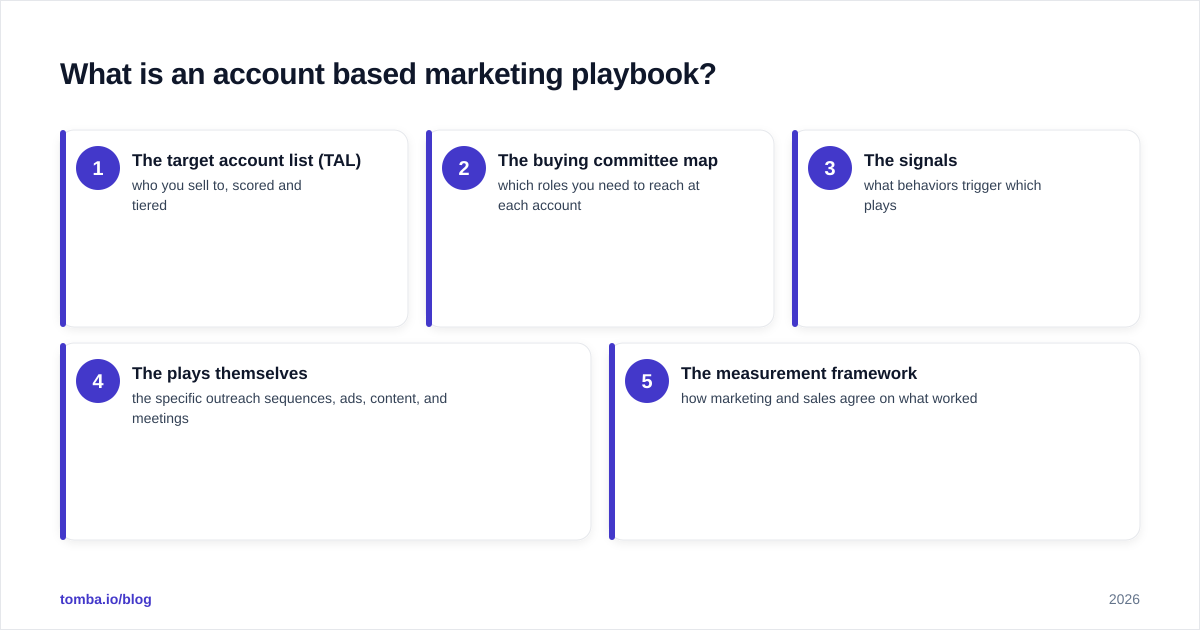
A complete playbook documents five things:
- The target account list (TAL) — who you sell to, scored and tiered
- The buying committee map — which roles you need to reach at each account
- The signals — what behaviors trigger which plays
- The plays themselves — the specific outreach sequences, ads, content, and meetings
- The measurement framework — how marketing and sales agree on what worked
Miss any of those and you have a campaign, not a program.
How do you tier accounts in 2026?#
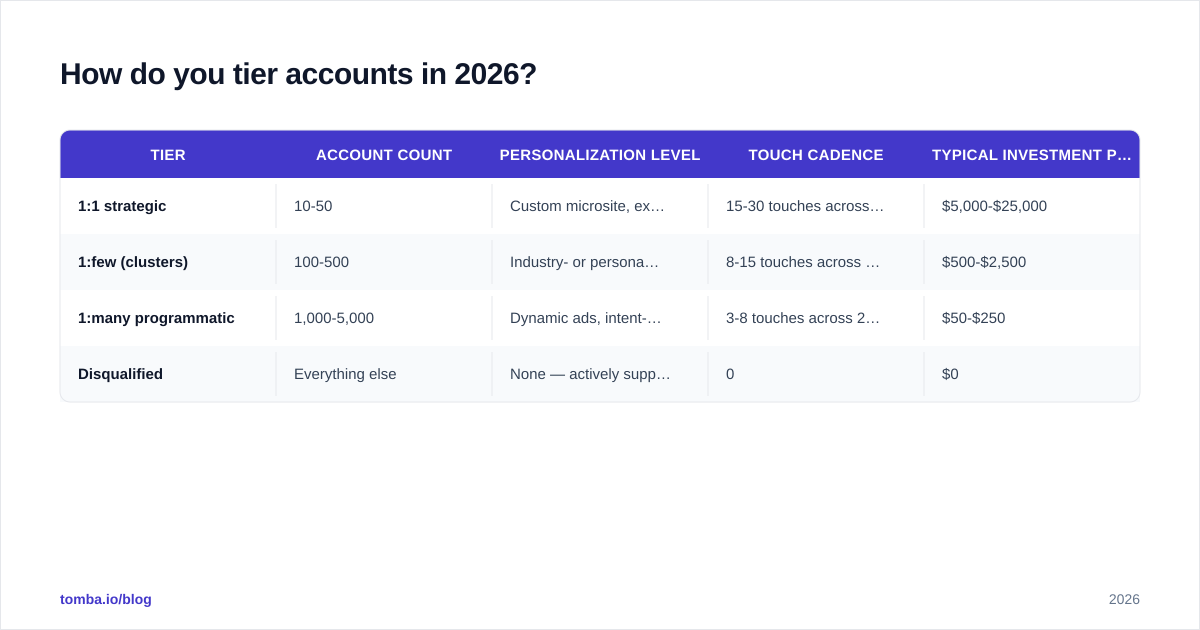
Tiering is the foundation. Without it, you'll either spread resources too thin or overinvest in accounts that were never going to close. The standard three-tier model still works, but the criteria have tightened.
| Tier | Account count | Personalization level | Touch cadence | Typical investment per account/quarter |
|---|---|---|---|---|
| 1:1 strategic | 10-50 | Custom microsite, exec gifts, bespoke content | 15-30 touches across 4-6 channels | $5,000-$25,000 |
| 1:few (clusters) | 100-500 | Industry- or persona-themed plays | 8-15 touches across 3-5 channels | $500-$2,500 |
| 1:many programmatic | 1,000-5,000 | Dynamic ads, intent-triggered emails | 3-8 touches across 2-3 channels | $50-$250 |
| Disqualified | Everything else | None — actively suppressed from spend | 0 | $0 |
A few rules that separate working tiering from theater:
- The TAL is a closed list. If your AEs can add accounts mid-quarter without RevOps approval, you don't have a TAL. You have a wishlist.
- Tier 1 has a named champion. If marketing can't tell you which AE owns each Tier 1 account and what stage the deal is in, the tier is fake.
- Suppression is a feature. Every account not on the TAL gets suppressed from paid media — that's where the budget for Tier 1 personalization comes from.
The criteria for getting on the TAL in the first place should combine fit (firmographic match to your ICP), capacity (do they have the budget and the problem you solve), and intent (are they showing buying behavior right now). Teams that skip the intent layer end up with TALs full of dream logos that have no current need.
How do you build the buying-committee map?#
Reaching one VP at a target account isn't ABM — it's a single-threaded gamble. The point of the account based marketing playbook is to surround the account, so the next step is mapping every role you need to engage.
For a typical mid-market software deal, that map looks something like:
- Economic buyer — VP or C-level who signs the contract
- Champion — director or manager who feels the pain
- Technical evaluator — IT, security, or ops who validates the solution
- End user — the people who will actually use the product daily
- Procurement — the gatekeeper on terms and price
- Influencers — adjacent leaders whose buy-in unlocks budget
You need contact data — work emails, mobile numbers, LinkedIn profiles, and titles — for every one of those roles before a play kicks off. This is where most programs break, because the data is stale, incomplete, or behind a paywall the SDRs can't easily access. A reliable email finder and phone finder integrated into the SDR workflow keeps the buying committee discoverable instead of guesswork. For account-level coverage, domain search pulls every reachable contact at a target company in one query.
The map should live in your CRM as structured contact relationships, not in a side spreadsheet. Tag each contact with their role on the committee and their engagement score so plays can target the right person at the right time.
What signals should trigger ABM plays?#
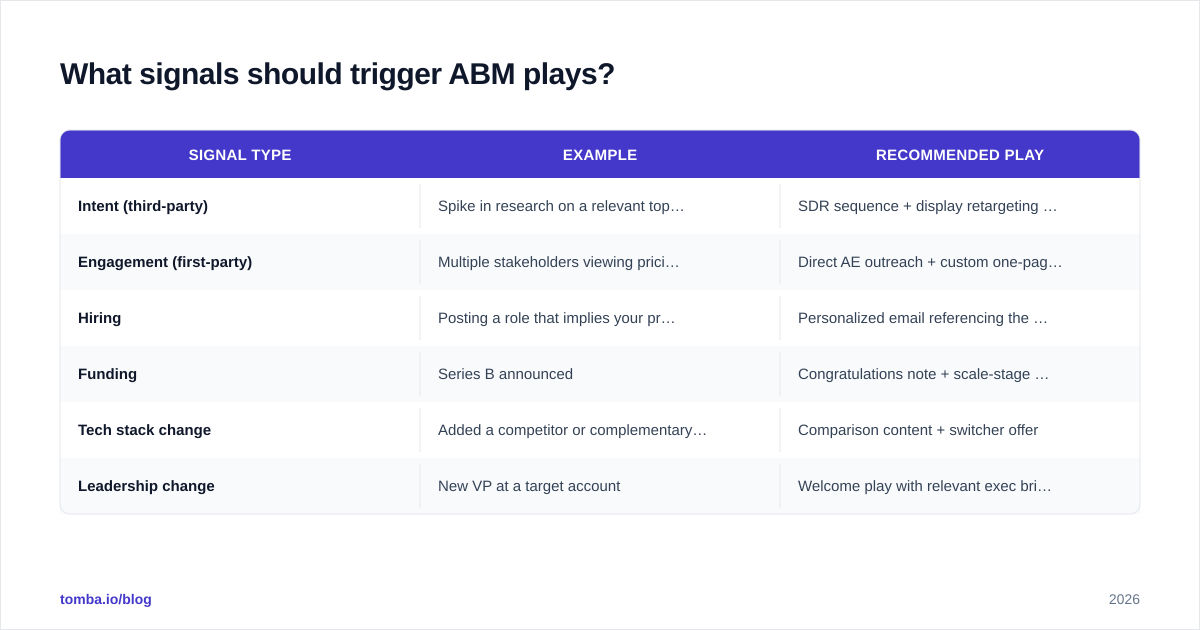
The biggest 2026 upgrade to the classic ABM playbook is signal-based triggering. Instead of marketing running campaigns on a calendar, plays fire when an account does something that suggests they're in-market.
The signals that consistently predict opportunity creation:
| Signal type | Example | Recommended play |
|---|---|---|
| Intent (third-party) | Spike in research on a relevant topic via G2, TrustRadius, or Bombora | SDR sequence + display retargeting + executive LinkedIn touch |
| Engagement (first-party) | Multiple stakeholders viewing pricing page | Direct AE outreach + custom one-pager |
| Hiring | Posting a role that implies your problem (e.g., "Director of Demand Gen") | Personalized email referencing the role + relevant case study |
| Funding | Series B announced | Congratulations note + scale-stage value prop |
| Tech stack change | Added a competitor or complementary tool | Comparison content + switcher offer |
| Leadership change | New VP at a target account | Welcome play with relevant exec briefing |
You don't need to chase all six. Most programs start with two — typically third-party intent plus first-party engagement — and add more as the data infrastructure matures. The point is that plays are reactive to account behavior, not pushed on a schedule.
The data layer that makes signals usable is the often-overlooked half of the playbook. Intent feeds, web analytics, CRM activity, and enrichment all have to land in one place where your marketing automation and SEP can read them. Data enrichment and bulk lead generation are how you keep the underlying contact records fresh enough for those signals to actually route to a real human.
What plays should be in the playbook?#
Plays are the executable units of ABM — a sequence of touches across channels triggered by a signal and aimed at a defined outcome (usually meeting booked or stage advanced). A mature account based marketing playbook ships with 8-15 named plays. Here are the ones that consistently produce pipeline.
The "in-market" play#
Triggered when an account crosses an intent threshold. SDR sends a personalized email referencing the topic, AE follows up with a LinkedIn voice note, marketing runs display retargeting against the buying committee, and the AE requests a 20-minute discovery call.
The "champion" play#
Triggered when a single contact at a target account engages repeatedly (downloads, webinar, multiple page views). The play deepens the relationship with that one person — exclusive content, executive 1:1, peer intro — so they become an internal champion who pulls the rest of the committee in.
The "multi-thread" play#
Triggered when a deal stalls at a single contact. Marketing fires personalized ads at the rest of the buying committee, an SDR introduces a peer at a similar customer, and the AE asks for a stakeholder mapping conversation.
The "competitive displacement" play#
Triggered when intent or a tech-stack signal indicates the account is using a competitor. Direct comparison content, customer references from switchers, and a tailored ROI model.
The "expansion" play#
Run by CS + marketing together against existing customers showing usage patterns that map to upsell SKUs. Treated with the same rigor as new logo plays.
Each play should be documented with the trigger, the channels, the assets, the SLAs (e.g., SDR must act within 4 business hours of trigger), and the success metric. If a play isn't producing pipeline after 60 days, kill it.
What does the 2026 ABM tech stack look like?#
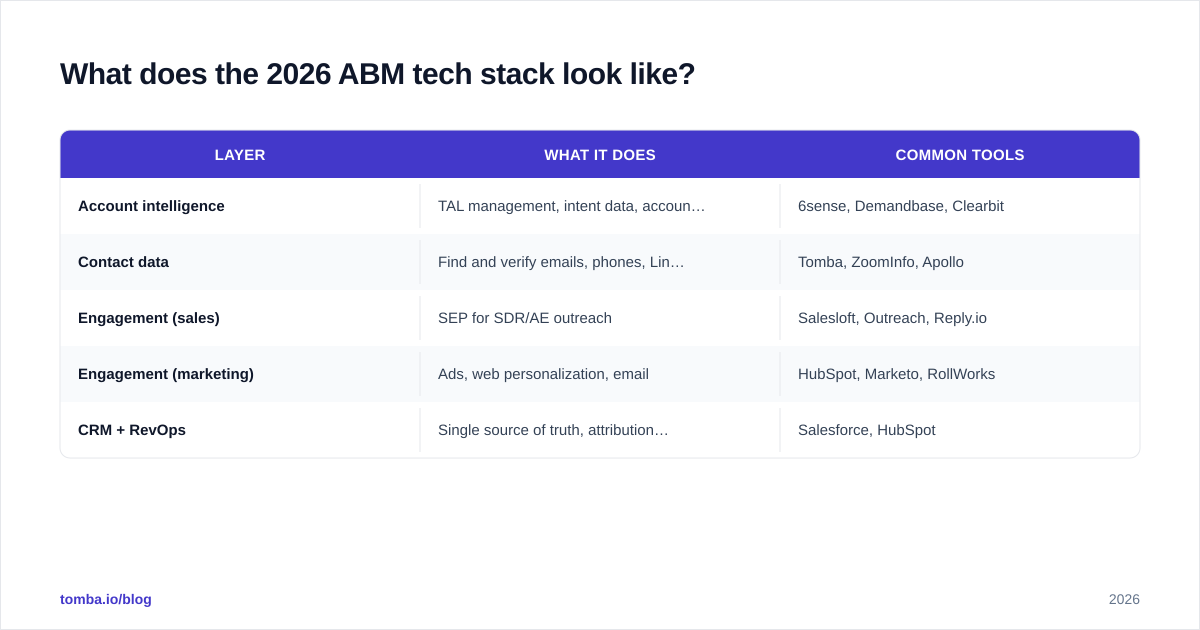
The stack has consolidated since 2023, but it still has five core layers. You can buy each piece from a different vendor or get most of them in a platform — both work, what matters is that the data flows cleanly between them.
| Layer | What it does | Common tools |
|---|---|---|
| Account intelligence | TAL management, intent data, account scoring | 6sense, Demandbase, Clearbit |
| Contact data | Find and verify emails, phones, LinkedIn for the buying committee | Tomba,ZoomInfo, Apollo |
| Engagement (sales) | SEP for SDR/AE outreach | Salesloft, Outreach, Reply.io |
| Engagement (marketing) | Ads, web personalization, email | HubSpot, Marketo, RollWorks |
| CRM + RevOps | Single source of truth, attribution, reporting | Salesforce, HubSpot |
Two integration points break more programs than any others:
- Intent → SEP. When a Tier 1 account spikes intent, an SDR sequence needs to fire automatically with the right contact list. If that requires a human to copy-paste accounts from one tool to another, the play won't run consistently.
- CRM ↔ enrichment. New contacts added to a target account should auto-enrich with email, phone, title, and role. A Tomba Salesforce or HubSpot integration keeps that loop closed.
For teams that prefer to assemble the stack from best-of-breed components rather than buy one all-in-one suite, the Tomba API and Zapier integration handle the data plumbing between intent sources, the CRM, and outbound tools.
How do marketing and sales actually align on ABM?#
Misalignment is what kills 80% of ABM programs. Marketing celebrates impressions; sales complains about lead quality; the TAL drifts; the program quietly dies after 18 months. The fix is structural, not motivational.
Three structural commitments that work:
Shared TAL ownership. RevOps owns the TAL. Marketing and sales propose additions and removals through a documented process, but neither side can unilaterally change it.
Joint pipeline targets. Marketing's quota is not MQLs. It's opportunities sourced and influenced within the TAL. Sales's quota is closed-won revenue from the TAL. Both sides win or lose on the same list.
Weekly account reviews. Marketing and sales review the top 20-30 accounts together every week. Where is each account in the buying journey? What's the next best action? Whose play is it? This replaces the marketing-status meeting and the sales-pipeline meeting with a single GTM forum.
The teams that align this way also redefine roles around the account. SDRs become "account development" and own multi-threading, not just first meetings. Field marketing partners with named AEs on Tier 1 plays. CS sits in on expansion plays. The org chart stays the same; the operating rhythm changes.
Industry research from Forrester and Gartner both put properly aligned ABM programs at 1.5-2x the win rate of non-ABM motions in the same companies — the alignment, not the tech, is what creates the lift.
How do you measure ABM ROI?#
If you're reporting MQLs to your CEO on an ABM program, you've already lost the argument. The right metrics ladder up from engagement to revenue, all measured at the account level.
Leading indicators:
- Account engagement score (composite of web visits, content downloads, ad interaction, meeting attendance across the buying committee)
- Buying committee coverage — % of target roles with at least one verified contact and one tracked engagement
- Meetings set per Tier 1 account per quarter
- Multi-thread depth — average number of distinct contacts engaged per active account
Pipeline indicators:
- Opportunities created within the TAL
- Average opportunity size vs. non-TAL deals
- Time from first engagement to opportunity
Revenue indicators:
- TAL closed-won revenue
- Win rate on TAL deals vs. non-TAL deals
- ACV uplift on TAL accounts
- Net revenue retention on existing TAL customers
A simple dashboard that surfaces all three layers — engagement, pipeline, revenue — every week is the single most important reporting artifact in the program. It's what keeps the CFO funding ABM in year two.
How do you roll out an account based marketing playbook?#
The biggest mistake new ABM teams make is trying to do all of this at once. A 90-day rollout focused on getting one tier working beats a 12-month "transformation" that delivers a beautiful framework and zero pipeline.
A realistic phased rollout:
Days 1-30: Foundation
- Define ICP and build TAL with RevOps (start with 100-300 accounts)
- Stand up the data layer — enrichment, intent feed, contact discovery
- Document buying committee map for the top 30 accounts
- Pick two signals to start with
Days 31-60: First plays
- Ship 3-5 plays end to end
- Run weekly account reviews with sales
- Build the engagement dashboard
Days 61-90: Iterate and prove
- Kill plays that aren't producing
- Add 2-3 more plays based on what's working
- Present the first quarterly review with engagement → pipeline → revenue numbers
By day 120 you'll know whether the program is working. Either accounts in the TAL are pulling ahead of non-TAL accounts on win rate and ACV, or they aren't. If they aren't, the problem is almost always one of three things: the TAL is wrong, the buying-committee data is incomplete, or the plays aren't actually firing on signals.
Closing thoughts#
A working account based marketing playbook isn't a deck. It's a set of operational decisions — who you'll pursue, how you'll surround them, what signals you'll act on, and how you'll know it's working — that the whole revenue team commits to and revisits every quarter. The teams that win in 2026 are the ones treating ABM as an operating model, not a campaign.
The non-negotiable foundation is clean, complete contact data for every account on your list. Without it, every play breaks on the first touch. Tomba's email finder and data enrichment keep the buying committee at every target account discoverable and current, so your SDRs and AEs spend their time running plays — not hunting for someone's work email. Start with a free Tomba account, pull contacts for your first 50 Tier 1 accounts, and run your first play this week.
// get started
Find, verify and enrich your first contacts today
Start on the free plan with 25 searches a month, then scale when your team is ready.
Free plan · No credit card required · GDPR & CCPA
// about the author