Account Based Marketing Programs: 2026 Playbook & Stack
Most account based marketing programs stall because teams skip tier design and pick tools first. Here's the 2026 framework, tech stack, and pitfalls.
TL;DR#
- Account based marketing programs work when you design tiers first (1:1, 1:few, 1:many) and let the tier dictate budget, content, and channel — not the other way around.
- The 2026 ABM stack is converging: intent data, identity resolution, contact enrichment, and orchestration are now table-stakes, while CDPs and ad networks are commodity layers.
- The single biggest predictor of ABM success is sales-marketing alignment on the target account list (TAL), not the tooling budget.
- Pipeline velocity, account engagement score, and influenced revenue beat MQLs as the right metrics. If your CMO still reports MQLs to the board, the program is mis-instrumented.
- Build phase one in 90 days with 25 tier-1 accounts, three plays, and one orchestration tool. Scale only after you can prove influenced pipeline.
What are account based marketing programs?#
Account based marketing programs are coordinated go-to-market motions where marketing, sales, and customer success target a defined list of named accounts with personalized campaigns, instead of casting a wide net for individual leads. Think of it as the difference between fishing with a net (demand gen) and spearfishing (ABM). You decide which fish you want, then build the spear for that exact fish.
In practice an ABM program has four moving parts: a target account list, account-level data (firmographics, intent, technographics, contacts), orchestrated plays across channels, and shared metrics owned jointly by sales and marketing. Remove any one of those and you have a campaign, not a program.
The category isn't new — ITSMA coined "ABM" in 2004 — but the 2026 version is unrecognizable from the 2018 version. AI-native research, identity graphs, and intent signals have collapsed the cost of personalization, while privacy regulation has gutted third-party cookies. The result is that the strongest ABM programs now look more like account-based GTM than account-based marketing. Marketing is one of three or four functions running the play, not the owner.
What types of account based marketing programs exist?#
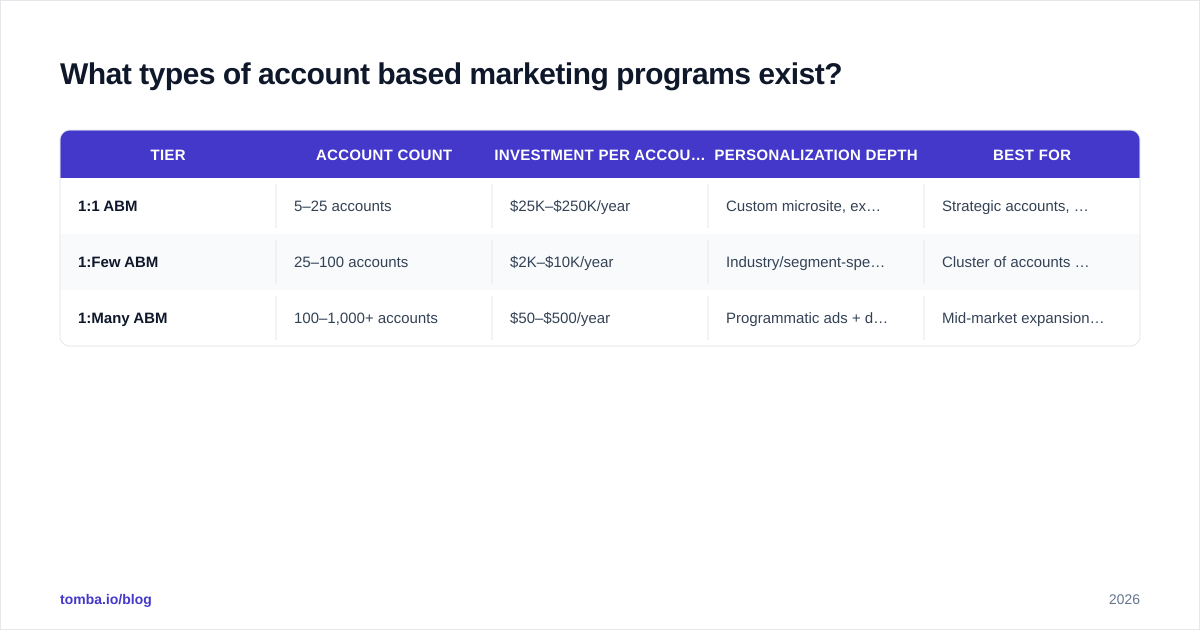
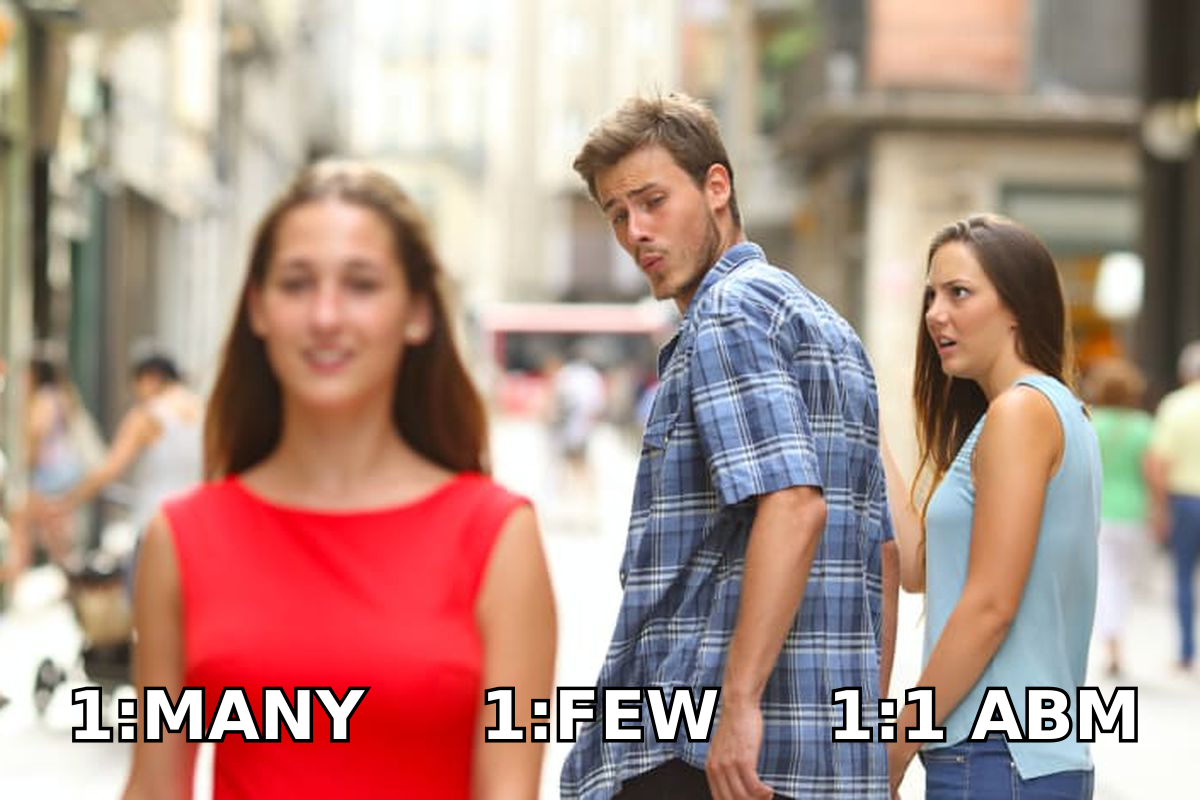
There are three established tiers, and getting the mix right is more important than the tool stack. Most failed programs are 1:1 ambitions on a 1:many budget — or vice versa.
| Tier | Account count | Investment per account | Personalization depth | Best for |
|---|---|---|---|---|
| 1:1 ABM | 5–25 accounts | $25K–$250K/year | Custom microsite, exec gifts, bespoke research | Strategic accounts, $500K+ ACV deals |
| 1:Few ABM | 25–100 accounts | $2K–$10K/year | Industry/segment-specific landing pages, role-based messaging | Cluster of accounts with shared pain (e.g. seven RIAs in Boston) |
| 1:Many ABM | 100–1,000+ accounts | $50–$500/year | Programmatic ads + dynamic email, light personalization | Mid-market expansion, mid-funnel nurture |
The 2026 wrinkle is that 1:many has gotten a lot smarter. With LLM-generated personalization plus identity resolution, you can hit hundreds of accounts with content that feels 1:few-grade. That used to require a dedicated content team — now one operator with Claude or GPT-4 plus a data enrichment pipeline can do it.
A useful sanity check: if a marketer can't tell you which tier any given account is in without checking a doc, the tiering is theoretical and won't drive behavior.
What does the 2026 ABM tech stack look like?#
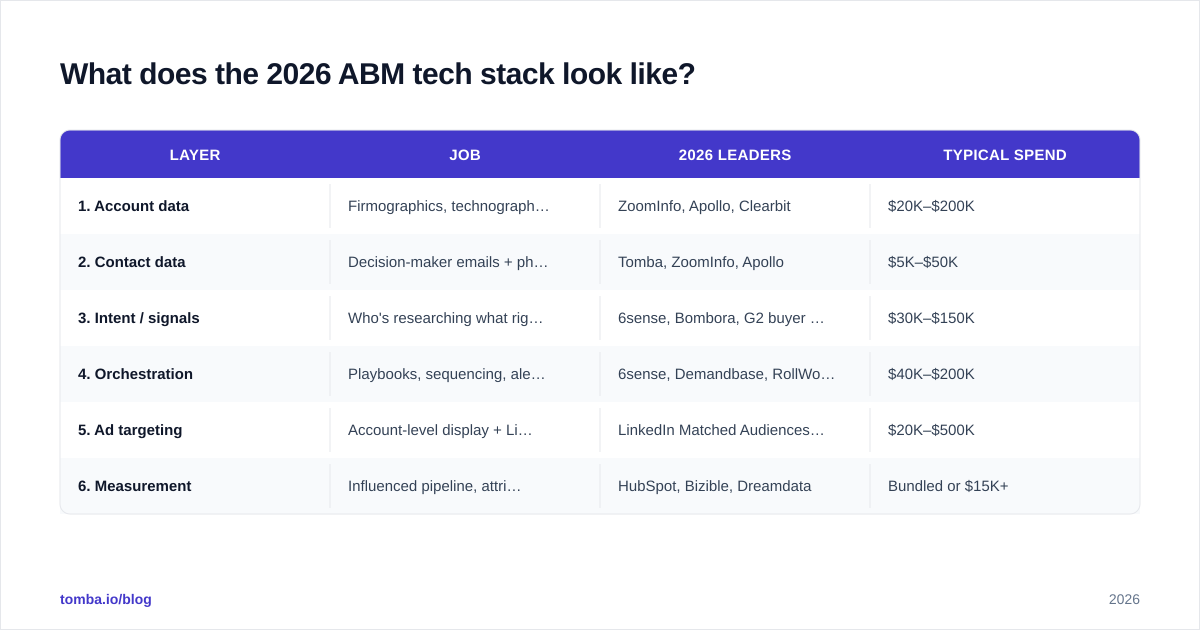
There are roughly six layers in a modern ABM stack. You don't need all six on day one. Most teams overspend on layer 4 (orchestration) and underspend on layers 1–2 (data).
| Layer | Job | 2026 leaders | Typical spend |
|---|---|---|---|
| 1. Account data | Firmographics, technographics, hierarchy | ZoomInfo, Apollo, Clearbit | $20K–$200K |
| 2. Contact data | Decision-maker emails + phones | Tomba, ZoomInfo, Apollo | $5K–$50K |
| 3. Intent / signals | Who's researching what right now | 6sense, Bombora, G2 buyer intent | $30K–$150K |
| 4. Orchestration | Playbooks, sequencing, alerts | 6sense, Demandbase, RollWorks | $40K–$200K |
| 5. Ad targeting | Account-level display + LinkedIn | LinkedIn Matched Audiences, Demandbase | $20K–$500K |
| 6. Measurement | Influenced pipeline, attribution | HubSpot, Bizible, Dreamdata | Bundled or $15K+ |
For most B2B teams under $50M ARR, my honest take is: skip layer 4 for the first 12 months. Run orchestration out of your CRM and a sequencing tool (Outreach.io alternative or Salesloft alternative options work fine). Spend the $80K you save on better account and contact data — that's where ABM programs actually win or lose.
For contact-level data specifically, you need accurate decision-maker emails for every named account. Generic B2B databases give you a list; what closes deals is verified emails for the actual buying committee. A purpose-built email finder plus an email verifier pass keeps your bounce rate low and your sender reputation clean — which matters more than ever now that Google's bulk-sender rules from 2024 are enforced industry-wide.

How do you build a target account list that actually works?#
The TAL is the single highest-leverage artifact in an ABM program. Get it wrong and no amount of orchestration saves you. Get it right and even a clunky stack produces pipeline.
A working TAL has three layers:
- ICP fit — firmographic and technographic match. Industry, size band, geo, tech stack, growth signals (hiring, funding, M&A).
- Propensity — likelihood to buy soon. Built from intent data, past engagement, and historical close patterns. This is the layer most teams skip and the layer where AI scoring helps most.
- Strategic value — accounts worth pursuing even at low propensity because of logo value, expansion potential, or beachhead in a new segment.
The standard mistake is to let sales hand marketing a list of accounts they like and call it a TAL. That gives you account requests, not an account list. A real TAL is built jointly, scored against the same criteria, and revisited quarterly.
A practical workflow I've seen work:
- Pull the last 24 months of closed-won deals from your CRM
- Cluster them by firmographics + buying triggers to define your ICP empirically
- Use a B2B database to find the full universe of accounts that match
- Layer in intent + technographic signals to rank propensity
- Sales and marketing leadership agree on the cut line and tier assignments
- Lock the list for one quarter — no mid-quarter "let me add this account" requests
Forrester's research on ABM consistently shows that programs with a locked, jointly-built TAL hit pipeline targets at roughly twice the rate of programs with a fluid list. The reason is mundane: if accounts can be added mid-quarter, content and play production never get scale economics.
What plays should an ABM program run?#
A play is a coordinated sequence of touches across channels, designed to move a specific account from one stage to the next. Most ABM programs over-engineer plays. You probably need three, not thirty.
Here's a tested play library for a starting program:
Play 1: Cold tier-1 account opening. Triggered when a tier-1 account hits any intent signal. Sequence: custom landing page → executive LinkedIn outreach from your SVP → handwritten note or executive gift → SDR follow-up referencing the gift → CEO podcast pitch as a soft touch. Goal: book a meeting with the economic buyer within 30 days.
Play 2: Active research signal. Triggered when an account shows surge intent on a competitor or category keyword. Sequence: retargeting ads with a comparison asset → BDR email referencing the specific competitor → LinkedIn DM from AE → custom one-pager mailed to office. Use a LinkedIn finder to pull the full buying committee and personalize across all of them in parallel.
Play 3: Stalled deal re-engagement. Triggered when an opportunity hasn't moved in 21 days. Sequence: customer case study from same industry → exec-to-exec email → meeting with new champion at the account. Don't ad-bomb stalled deals — it's the most common mistake and makes you look desperate.
The discipline that separates good ABM teams from bad ones is not running more plays. It's running fewer plays with cleaner triggers and better instrumentation. If you can't tell me which play sourced a piece of pipeline, the play didn't exist — it was just marketing activity.
How do you measure account based marketing programs?#
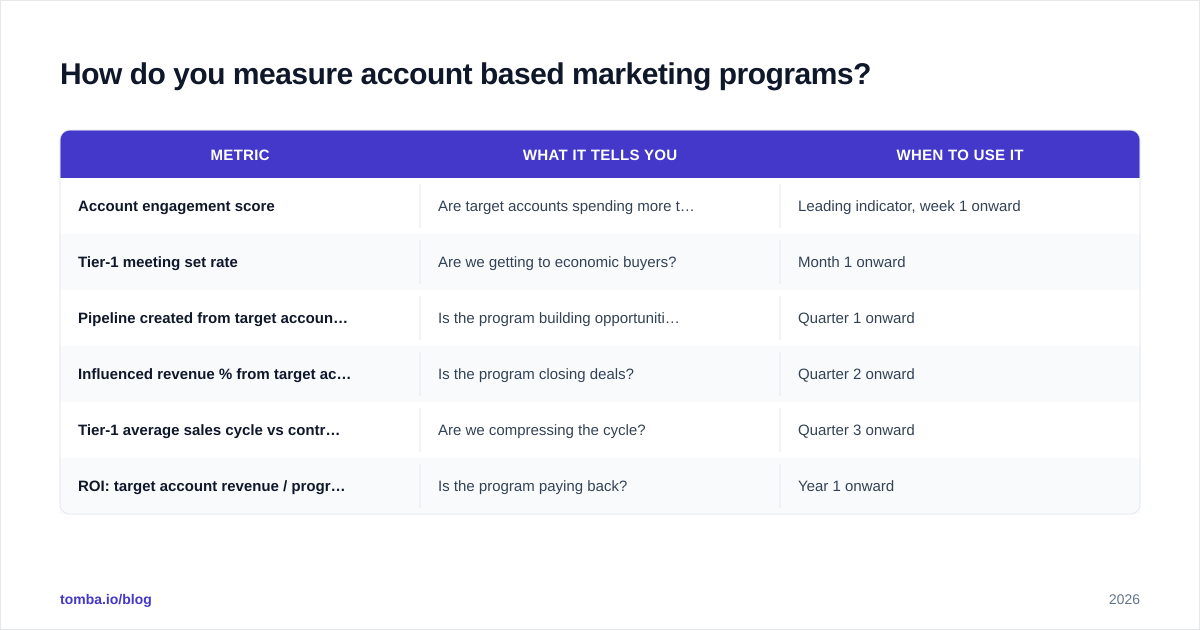
ABM programs that report on MQLs are measuring the wrong thing and will eventually get defunded. The right metrics ladder up from account engagement to influenced revenue.
| Metric | What it tells you | When to use it |
|---|---|---|
| Account engagement score | Are target accounts spending more time with us? | Leading indicator, week 1 onward |
| Tier-1 meeting set rate | Are we getting to economic buyers? | Month 1 onward |
| Pipeline created from target accounts | Is the program building opportunities? | Quarter 1 onward |
| Influenced revenue % from target accounts | Is the program closing deals? | Quarter 2 onward |
| Tier-1 average sales cycle vs control | Are we compressing the cycle? | Quarter 3 onward |
| ROI: target account revenue / program spend | Is the program paying back? | Year 1 onward |
A reasonable benchmark from Gartner and ITSMA: mature ABM programs report 1.5x–2x ACV expansion on targeted accounts, 30–40% sales cycle compression, and 2-3x marketing influenced pipeline vs non-ABM segments. If you're below those after 18 months, the issue is usually TAL quality or sales-marketing alignment, not tooling.
Bizible's old benchmark — that 87% of B2B marketers say ABM delivers higher ROI than other marketing — is directional but self-reported. Take it with salt and instrument your own program against your own non-ABM control segments.
How is AI changing ABM in 2026?#
AI is doing three useful things to ABM and one harmful thing.
Useful: research at scale. A BDR can now feed a target account name into an LLM, get a real briefing on org structure, recent news, strategic priorities, and likely pain points in under two minutes. What used to be a research analyst's job is now a $0.50 API call. This is the biggest unlock for 1:few personalization.
Useful: content variants. One core asset can fan out into 20 industry-specific variants with LLM-generated tweaks. The economics of 1:few personalization break-even at far fewer accounts than they used to.
Useful: intent synthesis. Multiple intent providers blended through an AI model produce a cleaner signal than any single provider. 6sense and Demandbase are racing to ship this; the open-source version with Claude or GPT plus raw intent feeds works surprisingly well.
Harmful: personalization theater. LLM-generated "personalized" first lines that just paraphrase the prospect's LinkedIn bio have flooded inboxes. Prospects can spot them in two seconds. Real personalization references something the prospect couldn't get from their bio — a strategic priority, a recent decision, a quote in an earnings call. If your AI personalization can be detected by the prospect, it's worse than no personalization.
For teams building AI-assisted ABM workflows, the practical setup in 2026 is: pull contact data through a Tomba API call, enrich account context from a research database, and run the briefing prompt through an LLM with a strict template. Don't let the LLM generate the entire email — let it brief the SDR, who writes the email.
Common pitfalls — and how to avoid them#
Buying a platform before defining the program. Most teams that ask "should we get 6sense or Demandbase?" before they have a TAL and three plays are about to waste $150K. Platforms accelerate working programs; they don't create them.
Treating ABM as marketing's program. If your CRO and CCO aren't co-signing the TAL and the metrics, it will fail when the first quarter doesn't hit. ABM is a GTM program with marketing operations underneath.
Mistaking activity for outcomes. "We ran 200 plays this quarter" is not a metric. "We compressed sales cycle by 22% on tier-1 accounts" is.
Personalization that isn't. Inserting a company name into a template is not personalization. Referencing the prospect's last earnings call is.
Letting the TAL drift. The most common slow death. Each quarter someone "just adds" a few accounts. Within two quarters the list is back to a marketing-qualified-everything spreadsheet.
Ignoring the data layer. ABM dies without accurate contact and account data. Run a quarterly audit on TAL data hygiene: verify emails, refresh contacts who've moved, kill records that bounce. Tools like bulk verify make this a 30-minute job per quarter rather than a week-long project.
What's the 90-day ABM program launch plan?#
A practical sequence I've seen work for teams under $50M ARR:
Days 1–30: Foundation. Build the TAL with sales (25 tier-1, 75 tier-1.5). Lock the list. Agree on three plays and the metrics scorecard. Procure contact and account data — don't over-buy tooling here. Set up the engagement scoring model in your CRM.
Days 31–60: Pilot. Launch one play against tier-1 accounts. Run weekly stand-ups between SDR, AE, and marketing on each account. Iterate the play weekly based on what's working. Build the dashboard for the six metrics above.
Days 61–90: Scale. Launch the second and third plays. Add tier-1.5 accounts to the lighter plays. Review TAL with sales; remove non-engagers, do not add new accounts mid-quarter. Calculate first ROI snapshot — even if it's directional.
By day 90 you should have evidence of whether ABM works for your business. If it does, that's when you buy the orchestration platform. Not before.
The bottom line#
Account based marketing programs are not a tool you buy or a campaign you run. They're a coordinated GTM operating model that pays off when the boring stuff — TAL discipline, data hygiene, shared metrics, real personalization — is done well. The 2026 stack makes the mechanics cheaper than ever, but it doesn't replace the operating discipline. A team with a locked TAL, three good plays, and clean data will outperform a team with every platform on the market every single time.
Start with the list. Start with the data. The rest follows.
Ready to build the data foundation under your ABM program? Most programs fail not because of bad plays, but because the contact data behind the target account list is stale or wrong. Tomba's email finder pulls verified decision-maker emails for every account on your TAL, integrates with your existing CRM and sequencer, and keeps your bounce rate under 3% — which is what protects your sender reputation when you scale outbound. Start with the free tier (25 searches/month) to test it against your top 25 tier-1 accounts, then scale to a paid plan as you expand. See Tomba pricing or jump straight into the email finder.
// get started
Find, verify and enrich your first contacts today
Start on the free plan with 25 searches a month, then scale when your team is ready.
Free plan · No credit card required · GDPR & CCPA
// about the author