Account Based Marketing Project Plan: 2026 Playbook
A practical, week-by-week account based marketing project plan for 2026 — covering account selection, team RACI, channel mix, budget, and the metrics that prove ABM is working.
Account Based Marketing Project Plan: 2026 Playbook
TL;DR
- An account based marketing project plan is a phased operating doc — not a slide. It defines accounts, plays, owners, budget, and exit criteria over a 90-180 day window.
- Most ABM programs stall because nobody owns the joint sales-marketing list. The fix is a RACI plus a tier model (1:1, 1:few, 1:many) you actually fund.
- Plan for four phases: foundation (weeks 1-3), pilot (weeks 4-8), scale (weeks 9-16), and review (weeks 17-20).
- Budget bands that work in 2026: $25k-$60k for a 1:many pilot, $75k-$200k for a 1:few program, $200k+ per pod for 1:1 strategic.
- Track pipeline velocity, account engagement score, meetings booked, and net-new logos — not MQLs.
What is an account based marketing project plan?#
An account based marketing project plan is the written, time-boxed operating document that turns "we should do ABM" into a sequenced rollout with owners, budgets, and measurable exit criteria. It sits one layer below your GTM strategy and one layer above your channel briefs.
A useful plan answers six questions in writing:
- Which accounts are in (and which are explicitly out)?
- Who owns the joint list — marketing or sales?
- What plays fire when an account hits each engagement stage?
- What does it cost per tier?
- What proves the program worked at days 30, 60, 90, and 180?
- What triggers a kill or a doubling-down?
If your current ABM doc cannot answer those six questions on a single page, you have a slide deck — not a project plan.
For a refresher on the operational layer that ABM rides on top of, see Tomba's revenue operations glossary entry. ABM is a RevOps program first and a marketing campaign second.
Why do most ABM project plans fail in the first 90 days?#
Three patterns kill ABM programs before they get traction:
The list is theoretical. Marketing builds an "ideal" target list from firmographic filters. Sales has never heard of half the accounts and ignores the rest. No joint review session ever happens. By day 45 the program is running on autopilot against accounts nobody is selling to.
The plays are channel-shaped, not account-shaped. Teams treat ABM like a renamed demand-gen campaign — same ads, same nurture, just narrower targeting. That is not ABM. ABM means a different play fires depending on what a specific named account has done this week.
Attribution gets argued instead of designed. Six months in, marketing claims credit for closed deals; sales claims they were already working those accounts. Nobody set the attribution model up front, so the post-mortem becomes a turf war.
The plan template later in this post forces all three problems to the surface in week one.
What does a 90-day ABM project plan look like?#
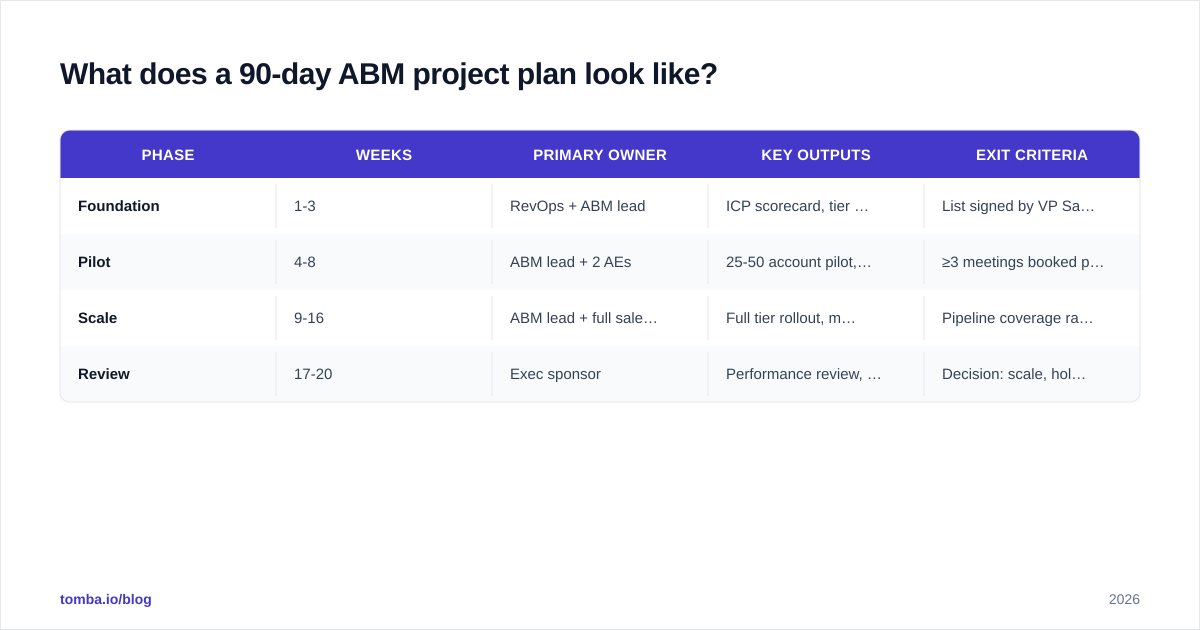
Here is the skeleton most B2B teams running 50-300 target accounts converge on. Adjust quantities, keep the structure.
| Phase | Weeks | Primary owner | Key outputs | Exit criteria |
|---|---|---|---|---|
| Foundation | 1-3 | RevOps + ABM lead | ICP scorecard, tier model, joint account list, RACI, tech stack audit | List signed by VP Sales and VP Marketing |
| Pilot | 4-8 | ABM lead + 2 AEs | 25-50 account pilot, 3 plays live, baseline metrics captured | ≥3 meetings booked per AE in pilot cohort |
| Scale | 9-16 | ABM lead + full sales pod | Full tier rollout, multi-channel orchestration, weekly ops review | Pipeline coverage ratio ≥ 3x for the cohort |
| Review | 17-20 | Exec sponsor | Performance review, tier rebalance, year-2 budget ask | Decision: scale, hold, or kill — in writing |
How do you pick accounts for the plan?#
This is where 80% of project plans secretly fail. The mistake is using a static firmographic filter and calling it an "ICP list." A useful 2026 account list combines three signals:
- Fit — firmographics + technographics (industry, headcount, revenue band, stack signals like "uses Salesforce" or "runs HubSpot Marketing Hub")
- Intent — third-party intent data (G2, Bombora, 6sense) plus first-party signals (pricing page visits, multiple stakeholders on the site, demo-form abandonment)
- Reachability — can you actually get verified contact data for 6-12 stakeholders per account? Plenty of "dream" accounts have private execs and no usable emails.
The reachability check is the one most teams skip. Run a sample of 50 candidate accounts through an email finder and a domain search before you commit to a target list. If you cannot reach the buying committee at 70%+ of accounts, the program will starve regardless of how good the creative is.
Then bucket the surviving accounts into tiers:
- Tier 1 (1:1, strategic) — 5-15 accounts. Custom landing pages, named-account ABM ads, hand-written outreach, exec-to-exec gifting. $5k-$20k spend per account, per quarter.
- Tier 2 (1:few, cluster) — 25-75 accounts grouped into 3-5 segments. Segment-specific case studies, vertical webinars, lighter personalization. ~$500-$2k per account, per quarter.
- Tier 3 (1:many, programmatic) — 100-1,000 accounts. Account-targeted display, retargeting, content syndication, light enrichment. ~$50-$200 per account, per quarter.
For the prospecting layer underneath tiers 1 and 2, the B2B database approach matters more than any single channel. You're trying to map every stakeholder, not just the economic buyer.
What goes in the RACI for an ABM project plan?#
A workable RACI for a 75-200 account program looks like this:
| Activity | ABM lead | RevOps | Sales (AE) | SDR | Content | Exec sponsor |
|---|---|---|---|---|---|---|
| Account list approval | R | C | A | C | I | I |
| Tier assignment | R | C | C | I | I | I |
| Play design | R | C | C | C | C | I |
| Outbound sequences | C | I | A | R | C | I |
| Custom creative (Tier 1) | A | I | C | I | R | I |
| Attribution model | C | R | C | I | I | A |
| QBR + rebalance | R | C | C | I | I | A |
(R = Responsible, A = Accountable, C = Consulted, I = Informed.)
The non-obvious row is "Attribution model." That's the one sales and marketing fight over six months in. Put a name next to "A" before you spend a dollar.
Which channels belong in the plan?#
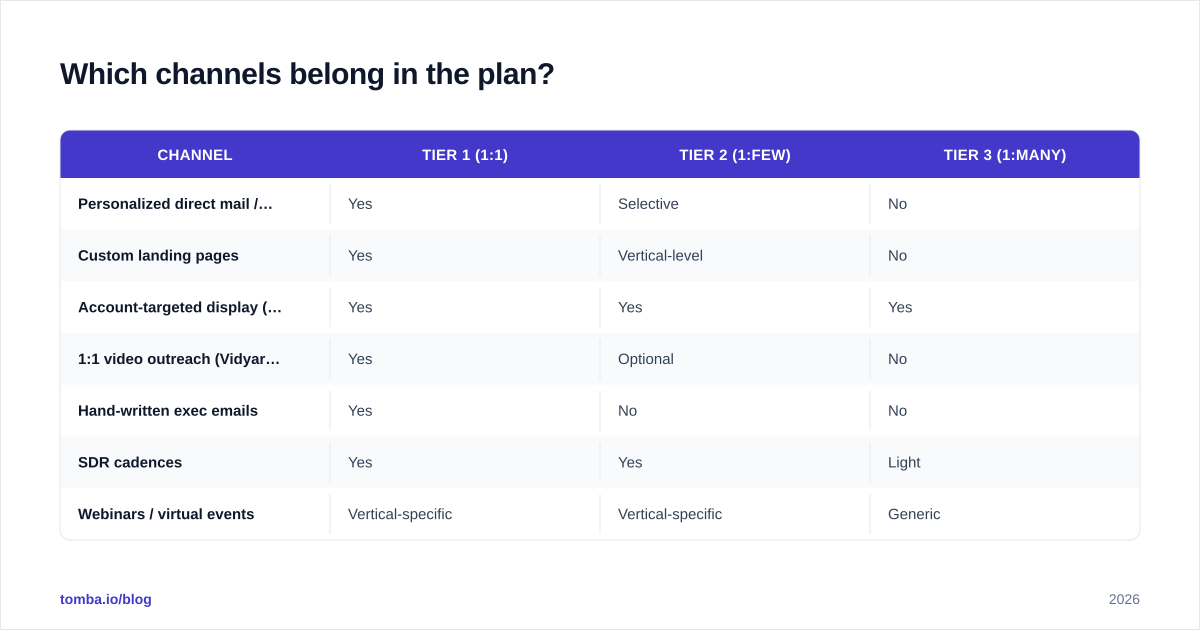
The channel mix shifts by tier. Stop running the same channel plan across all 200 accounts.
| Channel | Tier 1 (1:1) | Tier 2 (1:few) | Tier 3 (1:many) |
|---|---|---|---|
| Personalized direct mail / gifting | Yes | Selective | No |
| Custom landing pages | Yes | Vertical-level | No |
| Account-targeted display (LinkedIn, 6sense, Demandbase) | Yes | Yes | Yes |
| 1:1 video outreach (Vidyard, Loom) | Yes | Optional | No |
| Hand-written exec emails | Yes | No | No |
| SDR cadences | Yes | Yes | Light |
| Webinars / virtual events | Vertical-specific | Vertical-specific | Generic |
| Content syndication | No | Vertical | Yes |
| Retargeting | Yes | Yes | Yes |
| Sales intelligence + contact data | Tomba, LinkedIn finder, enrichment | Tomba bulk + enrichment | Tomba bulk |
The mistake is running gifting at Tier 3 ("everyone gets a Yeti") or running pure programmatic at Tier 1 ("our $5M target is in the same retargeting pool as 800 SMBs"). Match the spend to the strategy.
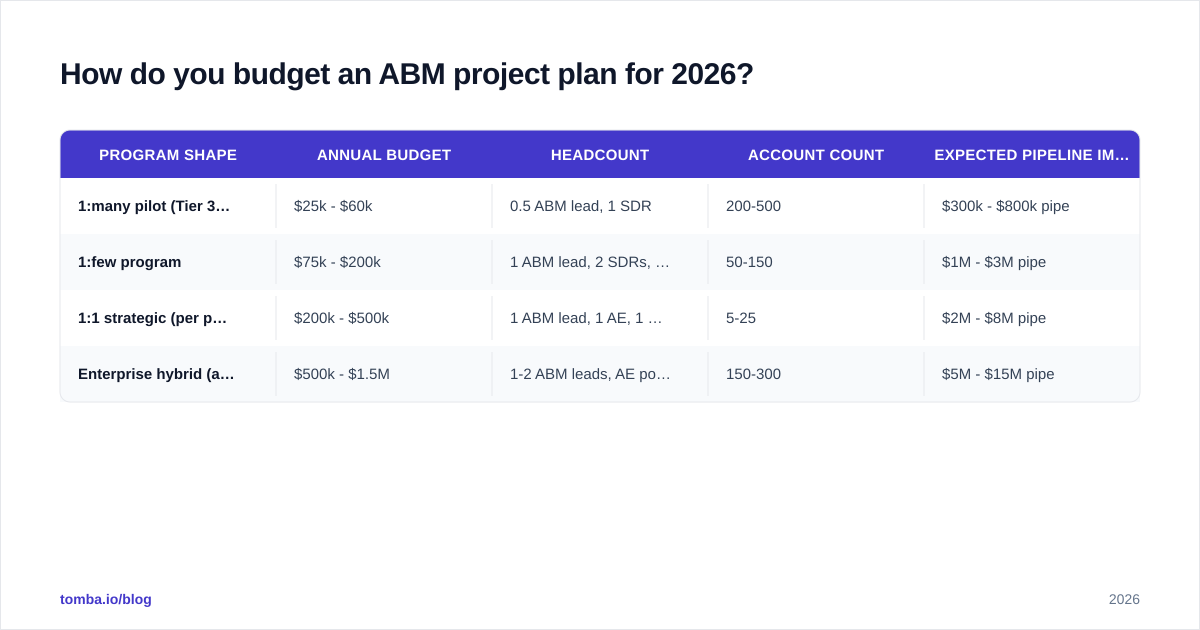
How do you budget an ABM project plan for 2026?#
Rough 2026 budget bands from real programs (not vendor decks):
| Program shape | Annual budget | Headcount | Account count | Expected pipeline impact |
|---|---|---|---|---|
| 1:many pilot (Tier 3 only) | $25k - $60k | 0.5 ABM lead, 1 SDR | 200-500 | $300k - $800k pipe |
| 1:few program | $75k - $200k | 1 ABM lead, 2 SDRs, design support | 50-150 | $1M - $3M pipe |
| 1:1 strategic (per pod) | $200k - $500k | 1 ABM lead, 1 AE, 1 SDR, content | 5-25 | $2M - $8M pipe |
| Enterprise hybrid (all 3 tiers) | $500k - $1.5M | 1-2 ABM leads, AE pod, RevOps | 150-300 | $5M - $15M pipe |
Two line items teams under-budget:
- Data and enrichment — contact discovery, data enrichment, and verification typically run 8-15% of total ABM spend. Underfunding this is why sequences bounce.
- Creative for Tier 1 — custom landing pages and 1:1 video are expensive per account but generate 4-6x the engagement of templated assets.
What KPIs belong in the project plan?#
Stop reporting MQLs against an ABM program. MQL volume against a fixed 200-account list is a meaningless number. The KPIs that actually run a 2026 ABM program:
- Account engagement score — composite of site visits, content consumption, ad engagement, and SDR responses, weighted by tier
- Stakeholder coverage — % of target buying committee with verified contact info and at least one meaningful touch
- Meetings booked from target accounts — split by tier and by whether the meeting was inbound, outbound, or hybrid
- Pipeline coverage ratio — open pipeline against target accounts ÷ remaining quota
- Velocity — average days from first identified intent signal to closed-won
- Win rate within target list vs control — the only credible "did ABM work" metric, assuming you held out a control cohort
Hold out a control. A 10-15% account cohort that gets only baseline marketing is the cheapest insurance policy your program will ever buy. Without it, every QBR turns into an attribution debate.
For benchmark context on what "good" looks like, Gartner's research on ABM and HubSpot's ABM benchmarks are reasonable starting points. Take vendor blog claims with appropriate skepticism.
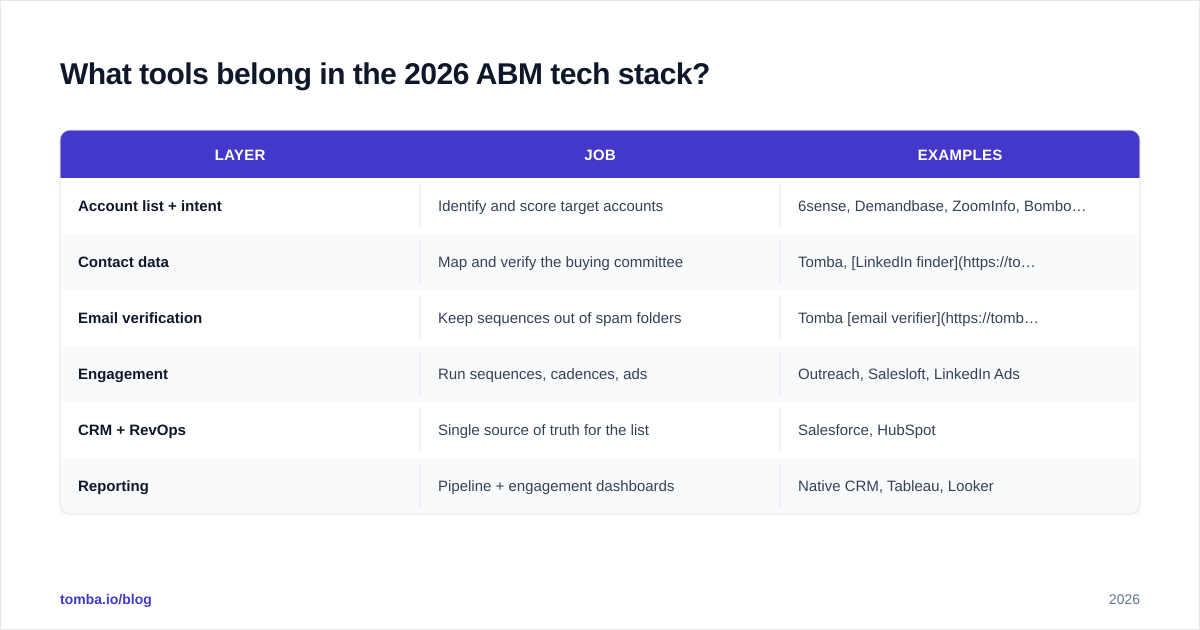
What tools belong in the 2026 ABM tech stack?#
You don't need 14 tools. A working 2026 stack:
| Layer | Job | Examples |
|---|---|---|
| Account list + intent | Identify and score target accounts | 6sense, Demandbase,ZoomInfo, Bombora |
| Contact data | Map and verify the buying committee | Tomba, LinkedIn finder, Apollo |
| Email verification | Keep sequences out of spam folders | Tomba email verifier, ZeroBounce |
| Engagement | Run sequences, cadences, ads | Outreach, Salesloft, LinkedIn Ads |
| CRM + RevOps | Single source of truth for the list | Salesforce, HubSpot |
| Reporting | Pipeline + engagement dashboards | Native CRM, Tableau, Looker |
Two tool decisions matter more than the others. First: pick one tool as the system of record for the joint account list. Two sources of truth equals zero sources of truth. Second: budget for bulk verification before every send. A 5% bounce rate against named Tier 1 accounts is a credibility-killer that ads can't undo.
What does week one of the plan actually look like?#
If you're starting Monday, here is a concrete week-one checklist:
- Day 1 — Kickoff with VP Sales, VP Marketing, exec sponsor. Agree program goal in one sentence. Agree the 30-60-90 exit criteria.
- Day 2 — Draft the ICP scorecard (10-15 weighted attributes). Stress-test against 5 closed-won and 5 closed-lost deals from last quarter.
- Day 3 — Pull a 500-account long list from CRM + intent tools. Run reachability check via domain search and enrichment. Cut the list to 200.
- Day 4 — Joint review session with sales. Each AE accepts or rejects accounts in their territory. Final list signed off.
- Day 5 — Tier the accepted list (Tier 1 / 2 / 3). Lock the RACI. Schedule weekly ops review for the rest of the quarter.
By Friday of week one you should have a signed list, a tier model, a RACI, and a recurring meeting on the calendar. If any of those four are missing, do not move into week two.
How does this plan compare to a demand-gen project plan?#
Worth being explicit because the two get blurred constantly:
| Dimension | Demand-gen project plan | ABM project plan |
|---|---|---|
| Universe | Everyone in the ICP | Named accounts only |
| Primary metric | MQLs, SQLs | Account engagement, pipeline within list |
| Personalization | Persona-level | Account-level (Tier 1: contact-level) |
| Sales-marketing fit | Loose | Joint ownership, weekly sync |
| Channel philosophy | Volume + capture | Orchestration around accounts |
| Time to first credible result | 60-90 days | 90-180 days |
| Cost per opportunity | Lower | Higher (but better-fit pipeline) |
Most teams running both keep them as separate plans with separate reporting. Trying to roll them into one dashboard is how the ABM program quietly gets buried inside the demand-gen number.
Closing CTA#
You can't run an ABM project plan without verified contact data for the buying committee — every named-account play falls apart when emails bounce or stakeholders are missing. Tomba's Email Finder is built for exactly this layer: find decision-makers by domain or name, verify in bulk before sequences fire, and feed clean records into your CRM. Free tier gives you 25 searches to map your first cohort. Paid plans start at $49/mo, with bulk and API access on Growth and Pro — see Tomba pricing. Build the list right in week one, and the rest of the project plan stops being a guessing game.
// get started
Find, verify and enrich your first contacts today
Start on the free plan with 25 searches a month, then scale when your team is ready.
Free plan · No credit card required · GDPR & CCPA
// about the author