Account Based Marketing Resources: The 2026 Toolkit Guide
A curated stack of account based marketing resources—tools, frameworks, data, and templates—to help your revenue team target, engage, and close high-value accounts in 2026.
TL;DR
- Account based marketing (ABM) flips the funnel: you pick the accounts first, then build marketing and sales around them — so your resources need to support targeting, data, orchestration, and measurement, not just email volume.
- The best account based marketing resources fall into five buckets: strategy frameworks, account data and intent platforms, orchestration/advertising tools, contact data and enrichment, and templates/playbooks.
- You don't need a six-figure platform to start. A tight target account list, accurate contact data, and a disciplined cadence beat an over-tooled stack every time.
- Use the comparison table below to match platform tiers (DIY, mid-market, enterprise) to your team size and budget.
- Accurate contact data is the foundation the whole program sits on — verified emails and direct dials decide whether your ABM plays ever reach a human.
What is account based marketing, really?#
Account based marketing is a go-to-market strategy where marketing and sales agree on a finite list of high-value accounts and treat each one as a market of its own. Instead of casting a wide net and sorting leads later, you reverse the order: define the accounts, map the buying committee, then personalize outreach across email, ads, social, and direct mail.
Think of it like fishing with a spear instead of a net. A net catches volume — and a lot of bycatch you throw back. A spear demands you pick the fish first, aim, and commit. ABM is the spear. That's why the resource stack looks different from demand-gen: you invest less in lead-capture forms and more in account intelligence, multi-threading, and coordinated plays.
The discipline has matured. What used to be an enterprise-only motion is now run by Series A startups using lighter, cheaper tools. For the canonical definition and history, Wikipedia's account-based marketing entry is a solid neutral primer, and HubSpot's ABM resources cover the inbound-meets-ABM angle in depth.
What are the five categories of account based marketing resources?#
Every functional ABM program draws on five resource categories. Map your current stack against these before you buy anything new — most teams are over-invested in one box and starved in another.
- Strategy and frameworks — Your ICP definition, tiering model (1:1, 1:few, 1:many), and the plays you'll run. This is documentation, not software.
- Account data and intent — Firmographic, technographic, and intent signals that tell you which accounts are in-market right now.
- Orchestration and advertising — The engine that coordinates ads, email, and sales tasks against the same account list.
- Contact data and enrichment — The names, verified emails, and direct dials of the buying committee inside each target account.
- Templates and playbooks — Reusable cadences, email frameworks, landing pages, and measurement dashboards.
The mistake most teams make is buying category 3 (an expensive orchestration platform) before nailing categories 1 and 4. An orchestration engine pointed at a fuzzy ICP and stale contact data just automates waste faster.
Which account based marketing platforms should you compare in 2026?#
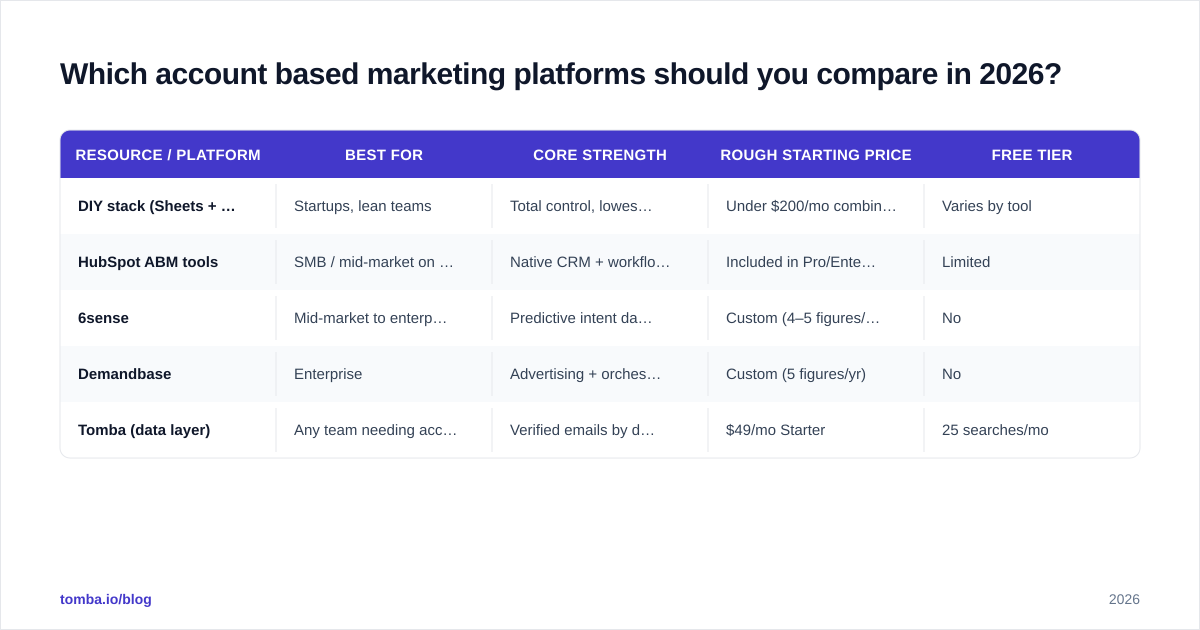
Platform choice depends on company size, budget, and how much of the motion you want automated versus run by hand. The table below groups the most-evaluated options by tier so you can shortlist without sitting through ten demos.
| Resource / Platform | Best for | Core strength | Rough starting price | Free tier |
|---|---|---|---|---|
| DIY stack (Sheets + data + sequencer) | Startups, lean teams | Total control, lowest cost | Under $200/mo combined | Varies by tool |
| HubSpot ABM tools | SMB / mid-market on HubSpot | Native CRM + workflows | Included in Pro/Enterprise | Limited |
| 6sense | Mid-market to enterprise | Predictive intent data | Custom (4–5 figures/yr) | No |
| Demandbase | Enterprise | Advertising + orchestration | Custom (5 figures/yr) | No |
| Tomba (data layer) | Any team needing accurate contacts | Verified emails by domain | $49/mo Starter | 25 searches/mo |
A practical read: if you live in HubSpot, start with its native ABM features and a strong contact-data source before layering on a 6sense-class intent platform. Enterprise teams running paid-media-heavy programs lean toward Demandbase. Everyone, regardless of tier, needs a reliable contact-data layer — which is where the next section comes in.
Why is contact data the resource ABM teams underinvest in?#
Because the prettiest orchestration dashboard is worthless if the emails bounce. ABM lives or dies on reaching the actual buying committee — usually 6 to 10 stakeholders per account — and that requires current, verified contact data at the individual level.
Here's the gap: intent platforms tell you Acme Corp is researching your category. They rarely hand you the verified email of the VP of Engineering and the procurement lead who actually sign. You have to enrich the account into named, reachable people. That's a distinct resource.
A focused workflow looks like this:
- Use domain search to pull every known email pattern and contact at a target account in one query.
- Run each address through an email verifier so your bounce rate stays low and your sender reputation intact.
- Push enriched, verified contacts into your CRM via data enrichment so the account record is complete before a rep ever reaches out.
This matters more than ever in 2026. Inbox providers are stricter about sender reputation, and a 15% bounce rate on a cold ABM campaign can land your domain in spam folders for weeks. Clean data isn't hygiene — it's deliverability insurance. If you want the deeper mechanics, our breakdown of email deliverability covers how bounce rates feed reputation.
What ABM frameworks and templates should you steal?#
You don't need to invent the playbook. The frameworks below are battle-tested; copy them and adapt to your ICP.
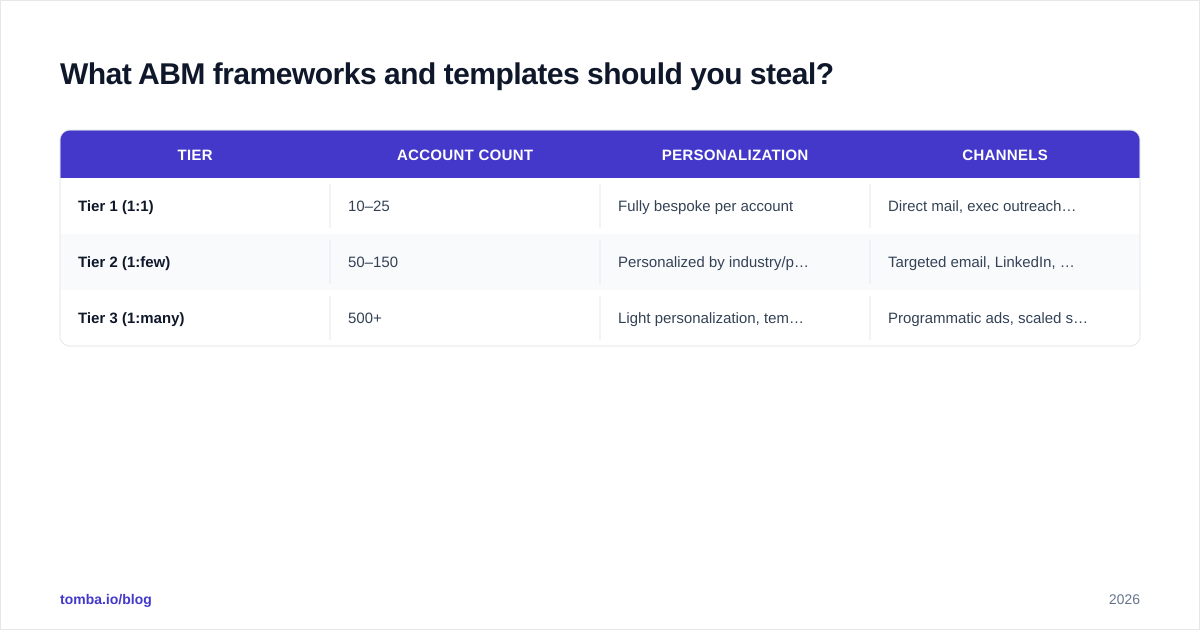
The tiering framework. Split your target accounts into three tiers based on revenue potential and fit:
| Tier | Account count | Personalization | Channels |
|---|---|---|---|
| Tier 1 (1:1) | 10–25 | Fully bespoke per account | Direct mail, exec outreach, custom microsites |
| Tier 2 (1:few) | 50–150 | Personalized by industry/persona cluster | Targeted email, LinkedIn, ads |
| Tier 3 (1:many) | 500+ | Light personalization, templated | Programmatic ads, scaled sequences |
The buying-committee map. For every Tier 1 account, document the economic buyer, the champion, the technical evaluator, the blocker, and the end user. Then enrich contact data for each role so no stakeholder goes un-threaded.
The cadence template. A 21-day, multi-channel touch pattern — email, LinkedIn view, connection request, value-add email, phone call, ad retargeting — keeps your accounts warm without burning the relationship. Pair it with subject lines tested for opens; our subject line tester is a free way to pressure-test those.
Measurement. Track account engagement, pipeline created, and influenced revenue — not vanity opens. Analyst frameworks from Gartner on B2B buying journeys are worth reading to align your stages with how committees actually buy.
How do you assemble a starter ABM stack on a budget?#
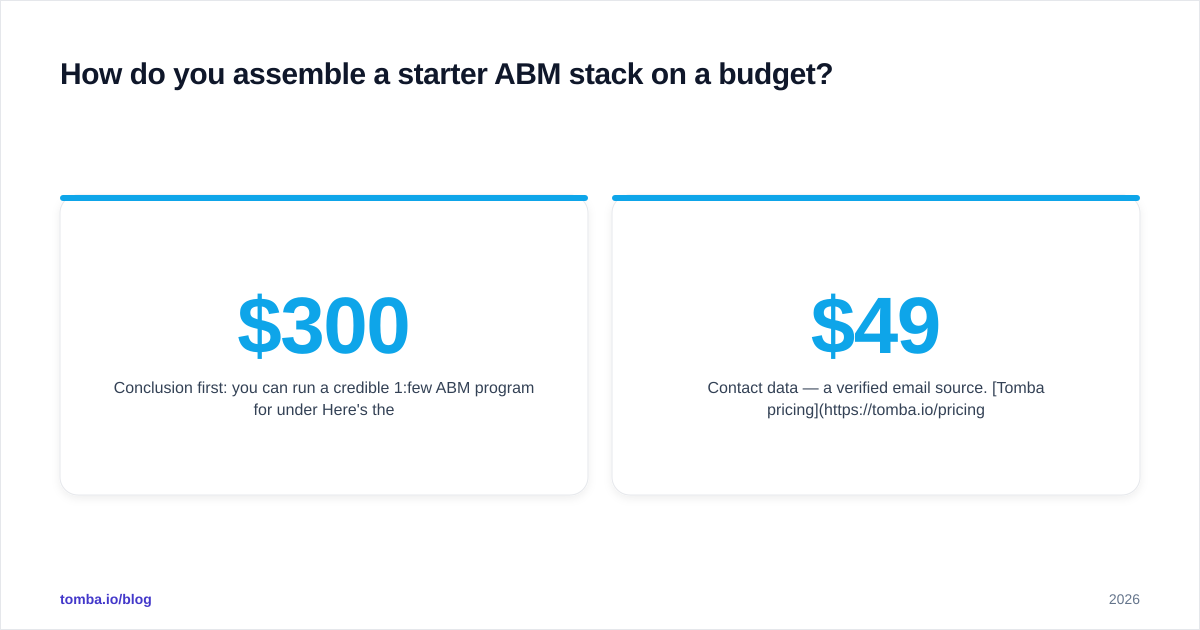
Conclusion first: you can run a credible 1:few ABM program for under $300/month. Here's the lean stack.
- Strategy — a shared doc with your ICP, tier list, and play definitions. Cost: free.
- Account list + intent — start with manual research and your CRM's existing data; add an intent tool only once the manual motion proves out.
- Contact data — a verified email source. Tomba pricing starts with a free tier of 25 searches/month, then $49/mo Starter, $99/mo Growth, $249/mo Pro, and custom Enterprise. This is your foundation layer.
- Orchestration — your existing email sequencer plus LinkedIn. You do not need a dedicated ABM platform on day one.
- Templates — the tiering, committee-map, and cadence frameworks above.
Scale up only when you hit a real ceiling. If reps are spending hours hunting for emails, automate that with the bulk email finder and connect it to your CRM through the HubSpot integration or Salesforce integration. If you're flying blind on which accounts are in-market, then evaluate an intent platform.
Is ABM better than traditional demand generation?#
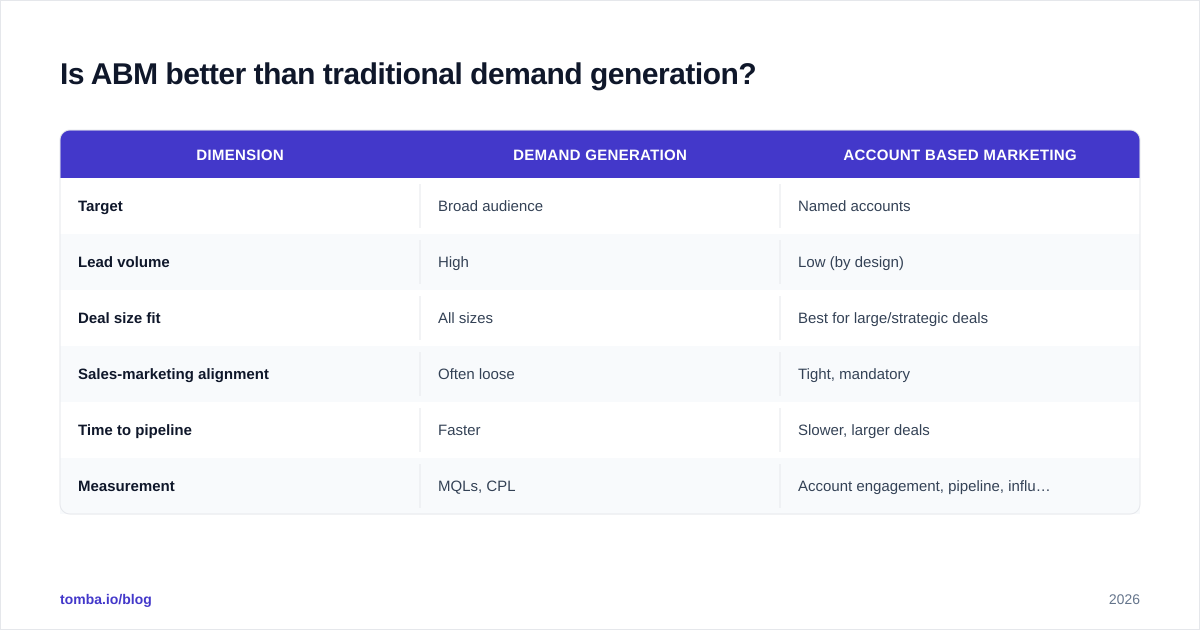
Neither is universally better — they answer different questions. Demand gen optimizes for volume and efficiency at the top of the funnel. ABM optimizes for depth and win rate on a finite set of high-value accounts. The honest answer:
| Dimension | Demand generation | Account based marketing |
|---|---|---|
| Target | Broad audience | Named accounts |
| Lead volume | High | Low (by design) |
| Deal size fit | All sizes | Best for large/strategic deals |
| Sales-marketing alignment | Often loose | Tight, mandatory |
| Time to pipeline | Faster | Slower, larger deals |
| Measurement | MQLs, CPL | Account engagement, pipeline, influenced revenue |
Most mature go-to-market orgs run both: demand gen feeds the broad middle, ABM concentrates firepower on the accounts that move the number. If your average contract value is high and your total addressable market is countable, ABM should be the larger share of your budget. For a structured view of how this fits the wider motion, see our primer on revenue operations.
What's the single biggest ABM mistake to avoid in 2026?#
Treating ABM as a tool purchase instead of an alignment problem. Buying a platform doesn't create alignment between sales and marketing — agreeing on the account list, the definition of engagement, and who owns each play does. The software just executes the agreement you've already reached.
The second-biggest mistake is starting outreach on dirty data. A perfectly orchestrated campaign aimed at outdated emails produces bounces, hurts your domain reputation, and burns the very accounts you spent weeks selecting. Fix the data layer first.
Putting your account based marketing resources to work#
The strategy, the tiering, the intent signals — none of it reaches a human until you have a verified email and a direct line to the buying committee. That's the resource everything else depends on, and it's the one most teams treat as an afterthought.
Start there. Use the Tomba Email Finder to turn your target account list into verified, reachable contacts — search by domain, name, or company, verify before you send, and push clean records straight into your CRM. Begin on the free tier with 25 searches a month, then scale to a paid plan once your ABM plays are reaching the right people instead of bouncing. Your orchestration engine is only as good as the data you point it at — make that data accurate first, and the rest of your account based marketing stack finally earns its keep.
// get started
Find, verify and enrich your first contacts today
Start on the free plan with 25 searches a month, then scale when your team is ready.
Free plan · No credit card required · GDPR & CCPA
// about the author