Account Based Marketing Segmentation: The 2026 Playbook
Most ABM programs fail because the segmentation underneath them is sloppy. Here's how to tier, cluster, and prioritize accounts in 2026 so your plays actually land.
Account-based marketing only works when the "accounts" part is deliberate. Pick the wrong companies, lump them into one undifferentiated list, and even brilliant creative gets wasted on prospects who will never buy. Segmentation is the unglamorous layer that decides whether ABM returns pipeline or just burns budget.
This playbook covers how to segment target accounts in 2026 — the tiers, the clustering signals, the data you need, and the mistakes that quietly sink most programs.
TL;DR#
- Account based marketing segmentation is the practice of grouping target companies by fit, intent, and value so each group gets the right depth of investment and the right plays.
- Start with a defensible ICP, then layer firmographic, technographic, intent, and engagement signals on top.
- Use a three-tier model (1:1, 1:few, 1:many) to match spend to account value — don't treat every account identically.
- Clean, enriched contact data is the foundation; segmentation built on stale records collapses on contact.
- Review segments quarterly. Accounts move tiers as intent spikes, headcount shifts, and tech stacks change.
What is account based marketing segmentation?#
Account based marketing segmentation is the process of dividing your total addressable market into groups of companies that share fit and buying-readiness characteristics, then assigning each group a level of marketing and sales investment.
Think of it like seating a restaurant. You don't give every walk-in the chef's tasting menu — you match the experience to the party. A two-top gets quick, efficient service; a VIP booking gets the personalized treatment. ABM segmentation does the same with accounts: a strategic enterprise target earns a custom microsite and an executive dinner, while a long-tail account gets an automated, scaled program.
Technically, segmentation sits between your ideal customer profile (ICP) and your activation channels. The ICP says who could buy. Segmentation says which of them to prioritize, and how hard. Without it, ABM degrades into expensive spray-and-pray.
Why does segmentation make or break ABM?#
Because ABM concentrates resources. The entire premise is spending more per account on fewer accounts. If you concentrate that spend on the wrong companies, you amplify the error instead of a generic campaign that at least spreads risk.
Three failure modes are common:
- Flat lists. Every account gets the same nurture, so high-value targets get under-served and low-value ones get over-served.
- Fit without intent. You target a perfect-fit company that has zero buying motion, then wonder why the custom landing page got two visits.
- Stale data. Segments built on contacts who left 18 months ago route plays to dead inboxes.
Good segmentation fixes all three by forcing you to rank accounts on more than one axis and to keep the underlying data fresh.
What signals should you segment on?#
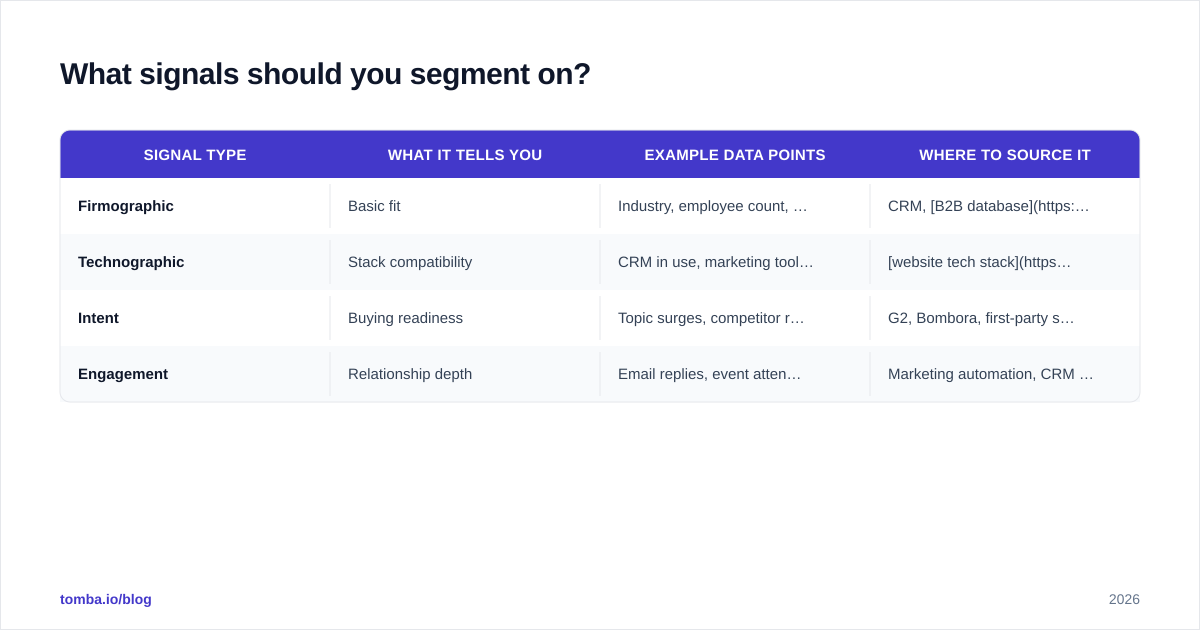
There are four signal families. The best programs blend all four rather than over-indexing on firmographics alone.
| Signal type | What it tells you | Example data points | Where to source it |
|---|---|---|---|
| Firmographic | Basic fit | Industry, employee count, revenue, geography | CRM, B2B database |
| Technographic | Stack compatibility | CRM in use, marketing tools, hosting, languages | website tech stack checks, BuiltWith |
| Intent | Buying readiness | Topic surges, competitor research, content consumption | G2, Bombora, first-party site visits |
| Engagement | Relationship depth | Email replies, event attendance, demo requests | Marketing automation, CRM activity |
Firmographics get you a long list. Technographics narrow it to companies that can actually deploy you. Intent tells you who's in-market right now. Engagement tells you who already knows you. Stack them, and a vague TAM of 40,000 companies becomes a ranked, actionable set.
A note on data quality: intent and technographic signals are only as good as the contact records they attach to. If you can't reach a decision-maker at an in-market account, the signal is academic. This is why enrichment and verification belong inside the segmentation workflow, not bolted on afterward. Pulling current decision-maker contacts with an email finder and confirming them with an email verifier keeps each segment addressable.
How do you build the tier model?#
The workhorse of ABM segmentation is the three-tier model. It maps directly to the classic ABM "flavors" popularized by ITSMA and the ABM community: Strategic (1:1), Scale (1:few), and Programmatic (1:many).
Tier 1 — Strategic (1:1)#
A handful of accounts, usually 10–50, that justify fully bespoke programs. Custom research, named-account plans, personalized content, executive sponsorship. Cost per account is high; you can only afford this for accounts with very large deal potential and strong fit.
Tier 2 — Scale (1:few)#
Clusters of 5–15 accounts that share an industry, use case, or pain point. You build a "lightly personalized" play for the cluster — a vertical-specific landing page, a tailored webinar — and run it across all members. Hundreds of accounts can sit here.
Tier 3 — Programmatic (1:many)#
The long tail. Thousands of accounts that fit the ICP but don't yet warrant manual effort. You run automated, scaled plays — retargeting, dynamic ads, automated email sequences — and watch for intent spikes that promote accounts up into Tier 2.
The point isn't the exact counts. It's matching investment to opportunity so your best people work your best accounts.
How do you score and prioritize accounts within tiers?#
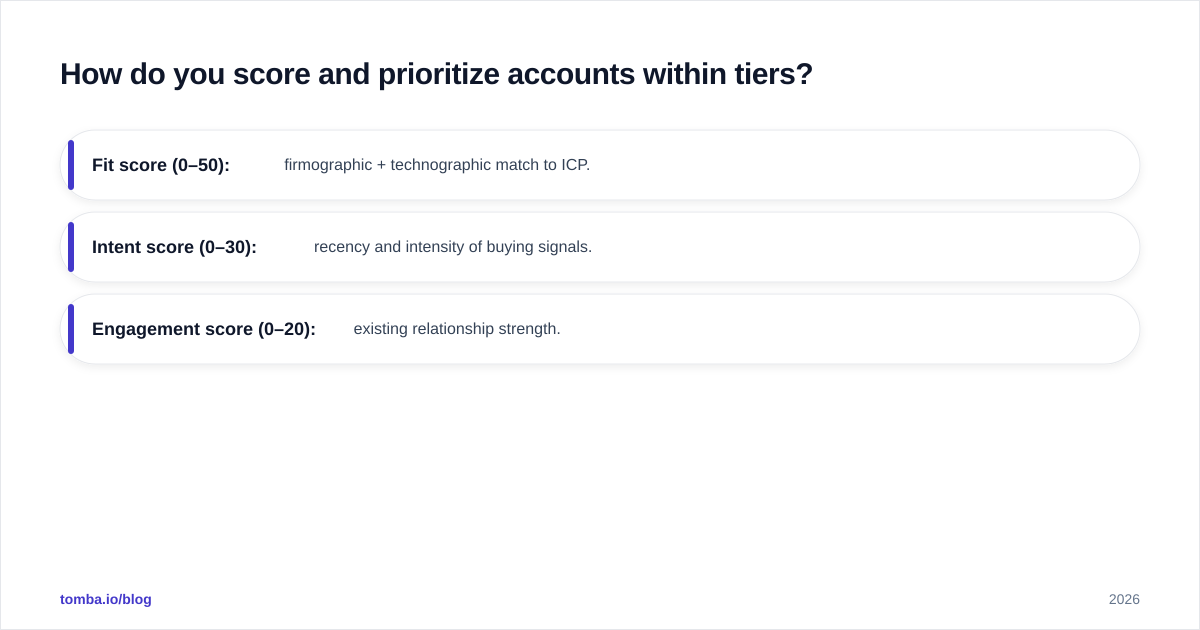
Tiering is the coarse cut. Scoring is the fine cut. Build a simple weighted model:
- Fit score (0–50): firmographic + technographic match to ICP.
- Intent score (0–30): recency and intensity of buying signals.
- Engagement score (0–20): existing relationship strength.
Sum to a 0–100 priority score. Anything above ~75 with strong fit is a Tier 1 candidate; mid-range scores cluster into Tier 2; everything else runs programmatically until a signal moves it.
Keep the model transparent. Sales reps abandon scores they don't understand. If a rep can't explain in one sentence why Account X is a 4 and Account Y is a 2, the model is too opaque. For more on aligning these definitions across teams, our revenue operations glossary entry covers the RevOps side of keeping marketing and sales on one scoring language.

What does clustering look like in practice?#
Clustering is how you make Tier 2 efficient. Instead of 300 individual plans, you group accounts that respond to the same message. Common clustering dimensions:
- By industry/vertical — manufacturing vs. SaaS vs. healthcare have different pains and compliance needs.
- By use case — accounts that would buy you for the same job, regardless of industry.
- By lifecycle stage — net-new vs. expansion vs. win-back.
- By trigger event — recent funding, leadership change, M&A, new office.
Trigger-based clusters are especially powerful because they carry built-in timing. A company that just raised a Series B has budget and growth pressure; a cluster built around "raised funding in the last 90 days" practically writes its own outreach angle. You can detect many of these triggers through data enrichment that appends funding, headcount, and role-change data to your account records.
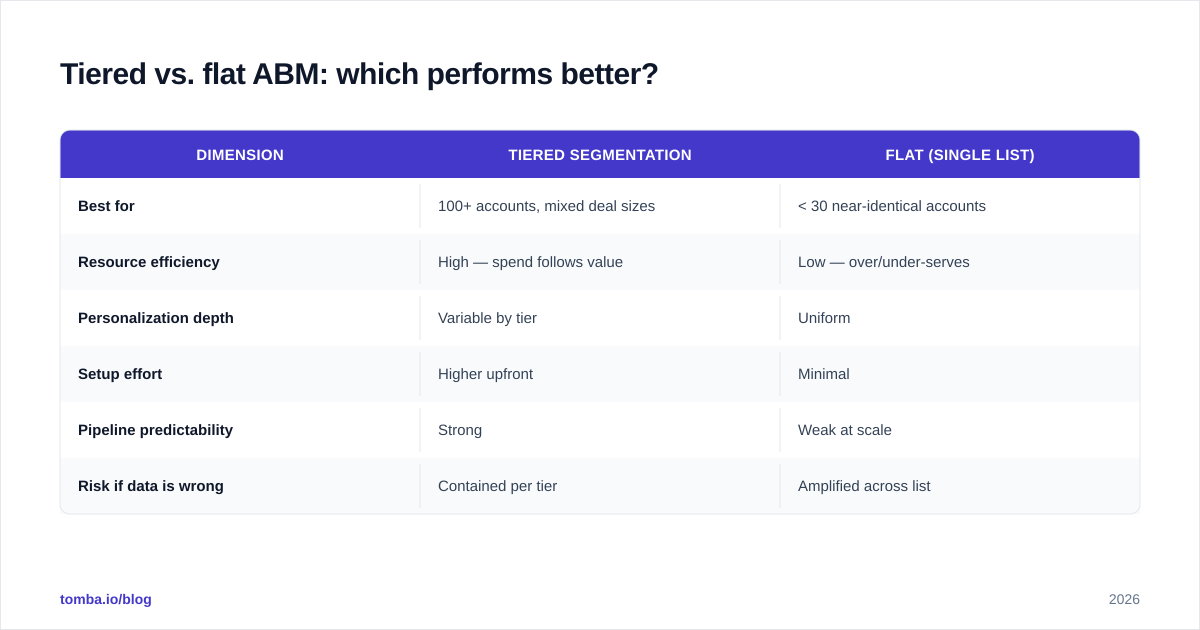
Tiered vs. flat ABM: which performs better?#
For any program above a few dozen accounts, tiered wins — but flat has a narrow place. Here's the honest comparison.
| Dimension | Tiered segmentation | Flat (single list) |
|---|---|---|
| Best for | 100+ accounts, mixed deal sizes | < 30 near-identical accounts |
| Resource efficiency | High — spend follows value | Low — over/under-serves |
| Personalization depth | Variable by tier | Uniform |
| Setup effort | Higher upfront | Minimal |
| Pipeline predictability | Strong | Weak at scale |
| Risk if data is wrong | Contained per tier | Amplified across list |
The only time flat makes sense is a tiny, homogeneous target set — say, the 20 logos in a single sub-vertical where every account is roughly the same size and stage. The moment your list spans a range of deal values, tier it.
What data foundation do you need first?#
Segmentation is a data problem before it's a strategy problem. You need three things in place:
- A clean account list. De-duplicated, with consistent firmographic fields. Garbage firmographics produce garbage tiers.
- Reachable contacts. Each priority account needs verified decision-maker contacts. A segment you can't contact is a spreadsheet, not a program.
- Refreshable signals. Intent and technographic data decay fast; build a cadence to refresh them.
This is where most ABM rollouts stall. Teams design an elegant tier model, then discover their CRM contacts are 30% stale and half the "decision-makers" have changed jobs. Before you tier anything, run your account list through enrichment and verification. Tools like Clearbit and Apollo cover parts of this; a focused email-finding and verification layer like Tomba fills the contact-reachability gap so your segments stay actionable. You can pull contacts at scale with a bulk email finder and confirm them before they enter a sequence.
How often should you re-segment?#
Quarterly, with continuous monitoring for promotions. Accounts are not static:
- An account with no intent last quarter spikes after a leadership change — promote it.
- A Tier 1 account goes dark for two quarters — demote it and reclaim the resources.
- A whole vertical lights up after a regulatory shift — spin up a new Tier 2 cluster.
Set a standing quarterly review where marketing and sales jointly re-rank. Between reviews, let intent triggers auto-promote accounts from Tier 3 to Tier 2 so you never miss a buying window. Tie this to your marketing qualified lead definitions so promotions feed cleanly into the funnel.
What are the most common segmentation mistakes?#
- Too many tiers. Five tiers sounds precise; in practice nobody can operate it. Three is plenty for most teams.
- Static segments. Set-and-forget segmentation rots within two quarters.
- Ignoring sales input. Reps know which "perfect-fit" accounts are actually unwinnable. Bake their feedback into scoring.
- Confusing fit with intent. A perfect ICP match with no buying motion is a Tier 3 account, not a Tier 1.
- Building on dirty data. The fastest way to discredit ABM internally is to send a personalized exec gift to someone who left the company a year ago.
Avoiding these isn't clever — it's discipline. The teams that win at ABM are not the ones with the fanciest scoring model; they're the ones who keep their data clean and review their segments on schedule.
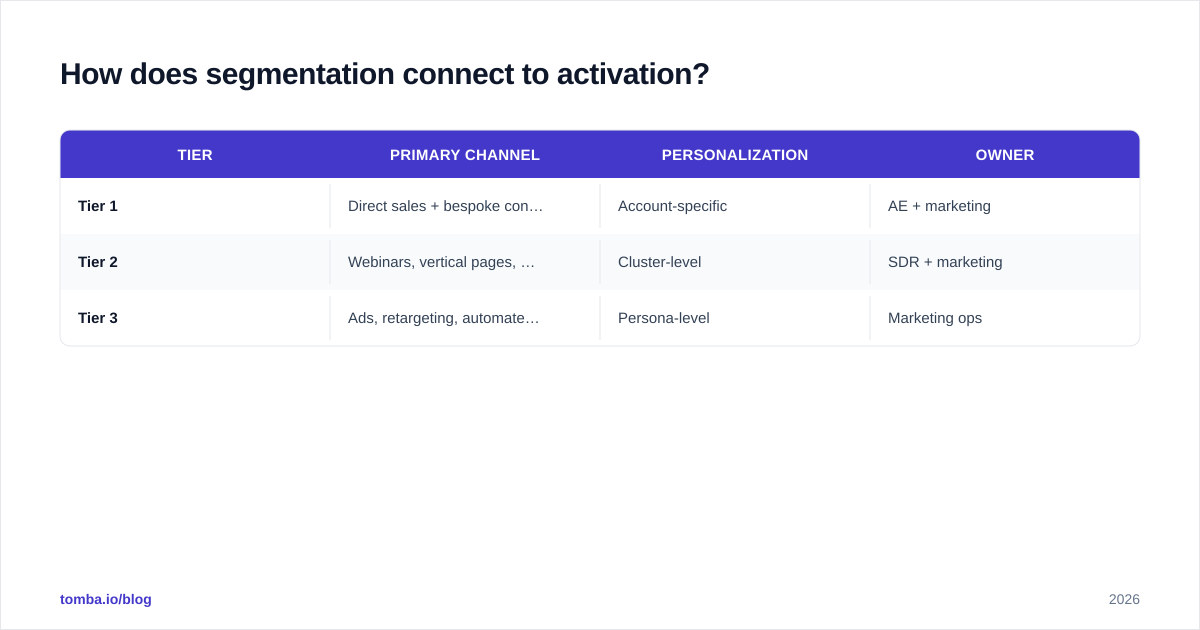
How does segmentation connect to activation?#
Segmentation only pays off when each segment maps to a distinct play. A quick mapping:
| Tier | Primary channel | Personalization | Owner |
|---|---|---|---|
| Tier 1 | Direct sales + bespoke content | Account-specific | AE + marketing |
| Tier 2 | Webinars, vertical pages, sequenced email | Cluster-level | SDR + marketing |
| Tier 3 | Ads, retargeting, automated nurture | Persona-level | Marketing ops |
Notice that contact data quality matters most as you move up the tiers — a Tier 1 program lives or dies on reaching the right five people, while Tier 3 tolerates some list noise. Either way, accurate contacts are the connective tissue between a clean segment and a play that lands. If you run sequenced outreach in Tier 2, pair your segmentation with verified addresses to protect email deliverability and keep your sender reputation intact.
Putting it together#
Account based marketing segmentation isn't a one-time setup — it's an operating rhythm. Define a defensible ICP, layer firmographic, technographic, intent, and engagement signals, sort accounts into three tiers, score within them, cluster Tier 2 by shared triggers, and review the whole thing quarterly. Keep the data underneath it clean, and your plays land where the revenue actually is.
The hard part is rarely the strategy. It's keeping every segment addressable as contacts churn and companies change. That's the layer worth automating first.
Ready to make your segments reachable? Before you launch a single ABM play, get verified, current decision-maker contacts for every target account. The Tomba Email Finder pulls professional emails by domain, name, or company so your Tier 1 list is built on people who actually work there — start free with 25 searches a month and check Tomba pricing when you're ready to scale segmentation across your whole TAM.
// get started
Find, verify and enrich your first contacts today
Start on the free plan with 25 searches a month, then scale when your team is ready.
Free plan · No credit card required · GDPR & CCPA
// about the author