Account Based Marketing Social Media: The 2026 Playbook
Spray-and-pray social ads burn budget. Here's how to run account based marketing on social media in 2026 — target named accounts, sync enrichment data, and prove pipeline.
TL;DR
- Account based marketing social media is the practice of running social ads, organic engagement, and 1:1 outreach against a named list of target accounts — not a broad audience.
- It works because B2B buying committees live on LinkedIn and X, and you can match company + contact data directly to ad audiences and DMs.
- The hard part is not the ads — it's the data layer. Clean, enriched account and contact lists are what make targeting precise instead of wasteful.
- Measure it on pipeline and account engagement, not likes. Reach within target accounts is the only vanity metric that matters.
- Build a three-layer motion: ads for air cover, sales social selling for the 1:1 touch, and enrichment to keep the list accurate.
What is account based marketing on social media?#
Account based marketing on social media is targeting a fixed list of high-value accounts with paid and organic social activity, instead of casting a wide net and hoping the right buyers show up. Think of it as the difference between a billboard on a highway and a personalized letter to ten houses you already know you want as neighbors.
Traditional demand gen optimizes for volume — more clicks, more MQLs, more leads in the funnel. ABM flips the model. You start with the 50, 200, or 1,000 companies that match your ideal customer profile (ICP), then you orchestrate social touches across every stakeholder in those accounts. The "social media" layer is where most of your buyers already spend professional attention, which makes it the highest-leverage channel for ABM in 2026.
The motion has three jobs running at once:
- Air cover — paid social ads served only to people who work at your target accounts.
- 1:1 engagement — your reps and execs commenting, sharing, and DMing specific buying-committee members (classic social selling).
- Data hygiene — a constantly refreshed list of accounts and contacts so the first two layers don't decay.
When those three layers reinforce each other, a buyer sees your brand in their feed, recognizes a rep who commented on their post, and arrives at a sales call already warm. That compounding familiarity is the entire point.
Why does social media work so well for ABM?#
Because the buying committee is already there, and the platforms let you target by company. According to Gartner, a typical B2B purchase now involves six to ten decision-makers — and on a single deal, you rarely know all their names up front. Social platforms let you reach the whole company even when your CRM only has two contacts.
LinkedIn is the obvious anchor. Its company-targeting, matched audiences, and lookalike-by-account features were built for exactly this. But X (Twitter), YouTube, and even Meta have a role for retargeting and brand recall. LinkedIn's own marketing data shows account-based campaigns consistently outperform broad B2B targeting on cost-per-qualified-lead — because you stop paying to reach people who will never buy.
There's a second, quieter reason: trust. A cold ad from an unknown vendor gets ignored. But when that same ad runs alongside a rep who genuinely engages with a prospect's posts, the brand stops being a stranger. Social is the one channel where paid and human touches can occupy the same surface area.
How is ABM social different from regular social marketing?#
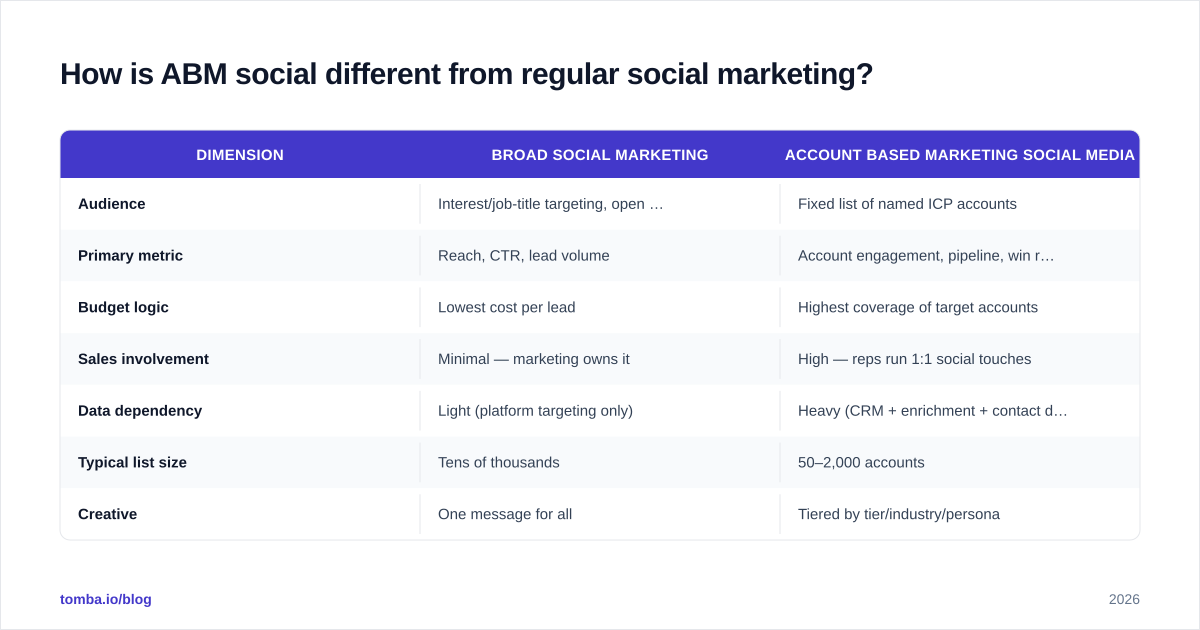
The simplest test: if you can't name the companies you're trying to reach, it isn't ABM. Here's the side-by-side.
| Dimension | Broad social marketing | Account based marketing social media |
|---|---|---|
| Audience | Interest/job-title targeting, open funnel | Fixed list of named ICP accounts |
| Primary metric | Reach, CTR, lead volume | Account engagement, pipeline, win rate |
| Budget logic | Lowest cost per lead | Highest coverage of target accounts |
| Sales involvement | Minimal — marketing owns it | High — reps run 1:1 social touches |
| Data dependency | Light (platform targeting only) | Heavy (CRM + enrichment + contact data) |
| Typical list size | Tens of thousands | 50–2,000 accounts |
| Creative | One message for all | Tiered by tier/industry/persona |
The biggest operational shift is the data dependency row. Broad social marketing leans on the platform's own targeting. ABM social leans on your data — your account list, your contact records, your firmographic enrichment. If that data is stale, your "precise" campaign is quietly serving ads to people who left the company a year ago.
How do you build the target account list?#
Start with fit, layer on intent, then enrich for contacts. The list is the product — everything downstream depends on it.
Step 1 — Define the ICP with hard filters. Industry, employee count, revenue band, tech stack, region. Resist the urge to make it broad. A tight list of 150 accounts you can actually orchestrate beats 5,000 you can only spray.
Step 2 — Pull the accounts. Use your CRM closed-lost and pipeline history, a B2B database for net-new accounts, and intent signals (content downloads, review-site activity, website visits).
Step 3 — Identify the buying committee. For each account, you need the actual humans: economic buyer, champion, technical evaluator, and blockers. This is where most ABM programs stall — they have companies but no contacts.
Step 4 — Enrich and verify. Append job titles, LinkedIn URLs, work emails, and phone numbers, then keep them current. Data enrichment turns a flat company list into a contact-level map you can target on social and follow up by email. Pair it with a LinkedIn finder so every committee member maps to a profile you can engage.
Step 5 — Tier the list. Tier 1 gets fully personalized 1:1 treatment; Tier 2 gets light personalization by industry; Tier 3 gets programmatic ads only. Spend your human effort where the deal size justifies it.
Reverse the flow when you have anonymous demand: tools that handle website visitor reveal can tell you which target accounts are already browsing, so you can prioritize the accounts showing real interest today.
What does an ABM social media campaign look like in practice?#
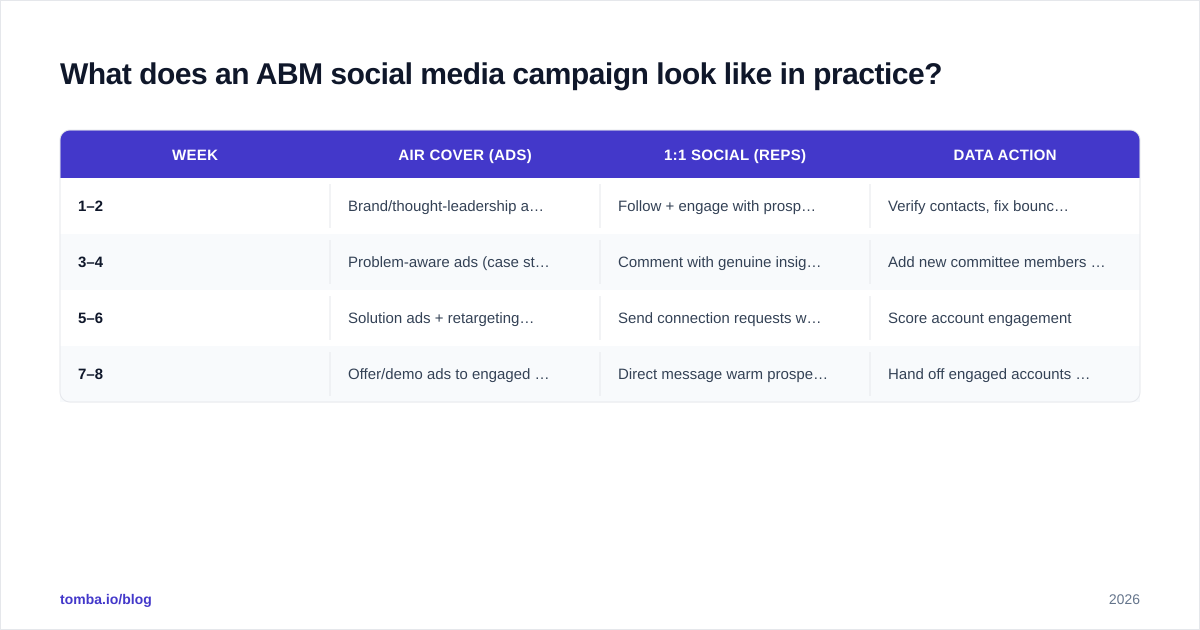
A layered sequence that runs over weeks, not a single blast. Here's a realistic 8-week shape for a Tier 1 cohort.
| Week | Air cover (ads) | 1:1 social (reps) | Data action |
|---|---|---|---|
| 1–2 | Brand/thought-leadership ads to all committee members | Follow + engage with prospects' posts | Verify contacts, fix bounces |
| 3–4 | Problem-aware ads (case studies) | Comment with genuine insight, no pitch | Add new committee members found |
| 5–6 | Solution ads + retargeting site visitors | Send connection requests with context | Score account engagement |
| 7–8 | Offer/demo ads to engaged contacts | Direct message warm prospects | Hand off engaged accounts to sales |
Notice the ads and the human touches escalate together. By week 7, a prospect has seen four ads and had three genuine interactions with a rep — so the demo request doesn't feel cold. The data column never stops, because a list that was 95% accurate in week 1 is closer to 90% by week 8 as people switch roles.
The creative should be tiered, too. HubSpot's ABM guidance makes the point well: personalization isn't writing 200 unique ads, it's grouping accounts by shared context (industry, pain, trigger event) so a handful of message variants each feels relevant to its segment.
Which metrics actually prove ABM social is working?#
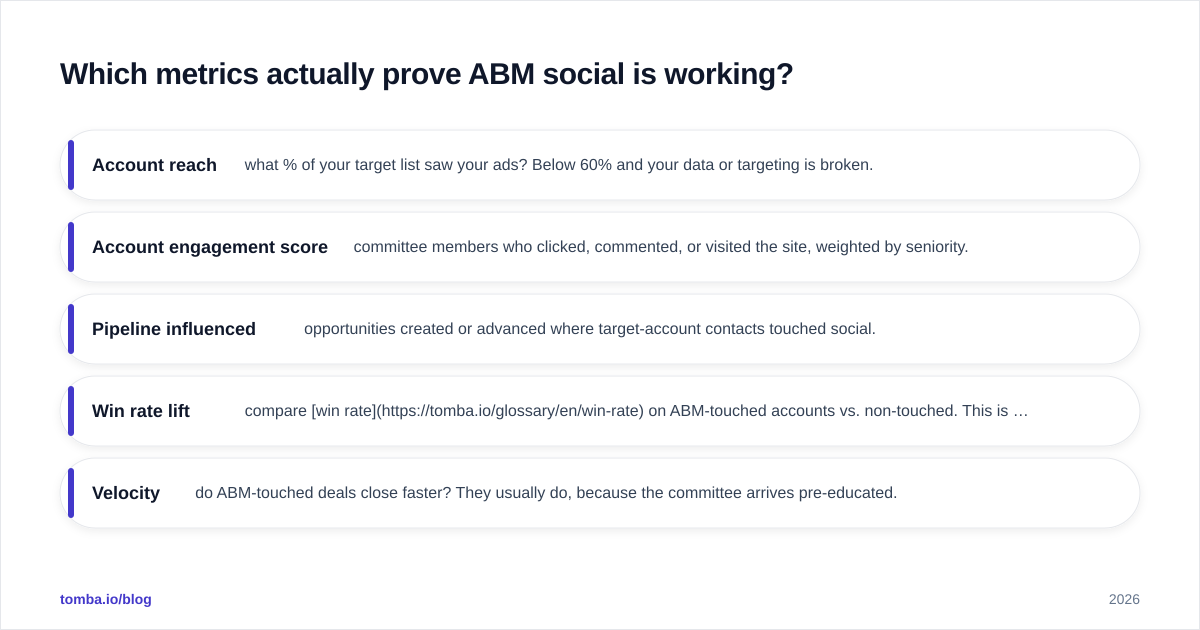
Measure account progression, not engagement theater. Likes and impressions only matter if they're inside your target accounts. Track these instead:
- Account reach — what % of your target list saw your ads? Below 60% and your data or targeting is broken.
- Account engagement score — committee members who clicked, commented, or visited the site, weighted by seniority.
- Pipeline influenced — opportunities created or advanced where target-account contacts touched social.
- Win rate lift — compare win rate on ABM-touched accounts vs. non-touched. This is the number your CFO cares about.
- Velocity — do ABM-touched deals close faster? They usually do, because the committee arrives pre-educated.
Avoid the trap of optimizing campaigns toward cheap clicks. In ABM, a $14 click from your dream account's VP of Engineering is worth more than 100 free clicks from people who can't buy. The whole economic model is inverted from broad demand gen — and your dashboards should reflect that.
What tools and data do you need to run it?#
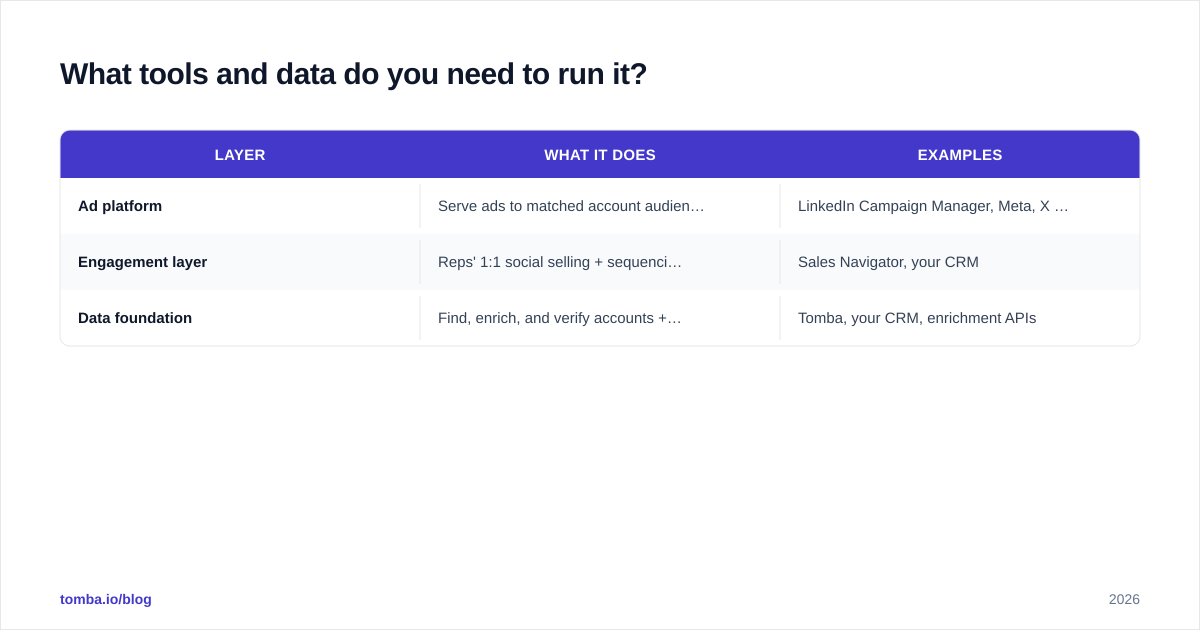
You need three categories of tooling: an ad platform, a sales engagement layer, and a data foundation. The first two are well-served by the big platforms. The third is where programs quietly fail.
| Layer | What it does | Examples |
|---|---|---|
| Ad platform | Serve ads to matched account audiences | LinkedIn Campaign Manager, Meta, X Ads |
| Engagement layer | Reps' 1:1 social selling + sequencing | Sales Navigator, your CRM |
| Data foundation | Find, enrich, and verify accounts + contacts | Tomba, your CRM, enrichment APIs |
The data foundation is the unglamorous part that determines whether the other two work. You can't upload an account match list to LinkedIn if you don't have clean company domains. You can't follow up a warm DM by email if the address bounces. This is why a reliable email finder and an email verifier sit at the center of any serious ABM social motion — they turn a list of company names into reachable, multi-channel contacts.
For programs running hundreds of accounts, a bulk email finder lets you enrich the whole list in one pass, and domain search surfaces every known contact at a target company so you don't miss a committee member. Check vendor neutrality on review sites like G2 before you commit — ABM tooling is a crowded market and fit varies a lot by company size.
A practical rule: re-verify your active ABM contact list every 30–60 days. B2B data decays at roughly 2–3% per month as people change jobs, so a list left untouched for a quarter can be nearly 10% wrong — which on a 200-account program means dozens of wasted ad impressions and dead follow-ups.
How do you avoid the most common ABM social mistakes?#
Most failures trace back to one of four things: a list that's too broad, data that's stale, ads with no human follow-through, or measurement built on vanity metrics. Fix those and you're ahead of most programs.
- Too broad: If your "ABM" list has 10,000 accounts, it's just demand gen with extra steps. Cut it until you can name the top tier from memory.
- Stale data: Schedule re-verification. Treat your account list like a perishable asset, not a one-time purchase.
- No human layer: Ads alone don't close enterprise deals. The 1:1 social selling is what converts familiarity into conversation.
- Vanity metrics: Report pipeline and win-rate lift to leadership. Save impressions for the campaign optimization dashboard only.
Get those right and ABM social becomes the most efficient channel in your B2B stack — because every dollar is aimed at a company you already decided you want.
Where Tomba fits#
Account based marketing social media lives or dies on its data layer, and that's exactly where Tomba helps. Use the Tomba Email Finder to turn your target account list into verified, reachable contacts across every member of the buying committee — so your LinkedIn audiences match, your retargeting lands, and your reps' DMs are backed by a real email follow-up. Start on the free tier (25 searches/month), then scale to the Starter plan at $49/mo as your account list grows; see full Tomba pricing for Growth and Pro tiers. Clean data is the cheapest performance lever in ABM — fix it first, and every ad dollar and rep hour after that works harder.
// get started
Find, verify and enrich your first contacts today
Start on the free plan with 25 searches a month, then scale when your team is ready.
Free plan · No credit card required · GDPR & CCPA
// about the author