Account Based Marketing Software in 2026: The Complete Guide
Account based marketing software lets you target whole buying committees instead of single leads. Here's how the 2026 platforms compare on intent data, ads, and price.
TL;DR
- Account based marketing (ABM) software helps you target whole buying committees at named accounts instead of chasing one lead at a time — combining intent data, advertising, web personalization, and CRM orchestration.
- The 2026 market splits into three tiers: full-stack platforms (6sense, Demandbase), CRM-native ABM (HubSpot, Salesforce), and lightweight orchestration tools (RollWorks, Terminus).
- Pricing ranges from roughly $1,000/mo for entry orchestration to six-figure annual contracts for enterprise intent platforms. Most vendors hide pricing behind a demo.
- ABM software is only as good as the contact data feeding it. A platform that knows an account is "in-market" is useless if you can't reach the right people there.
- Pair your ABM platform with an accurate email finder and data enrichment layer so your target-account list turns into real conversations, not bounced sends.
What is account based marketing software?#
Account based marketing software is the technology layer that lets you run marketing and sales against a defined list of target accounts rather than a broad pool of individual leads. Think of it like fishing with a spear instead of a net: instead of casting wide and hoping, you pick the specific fish, then coordinate every cast around catching it.
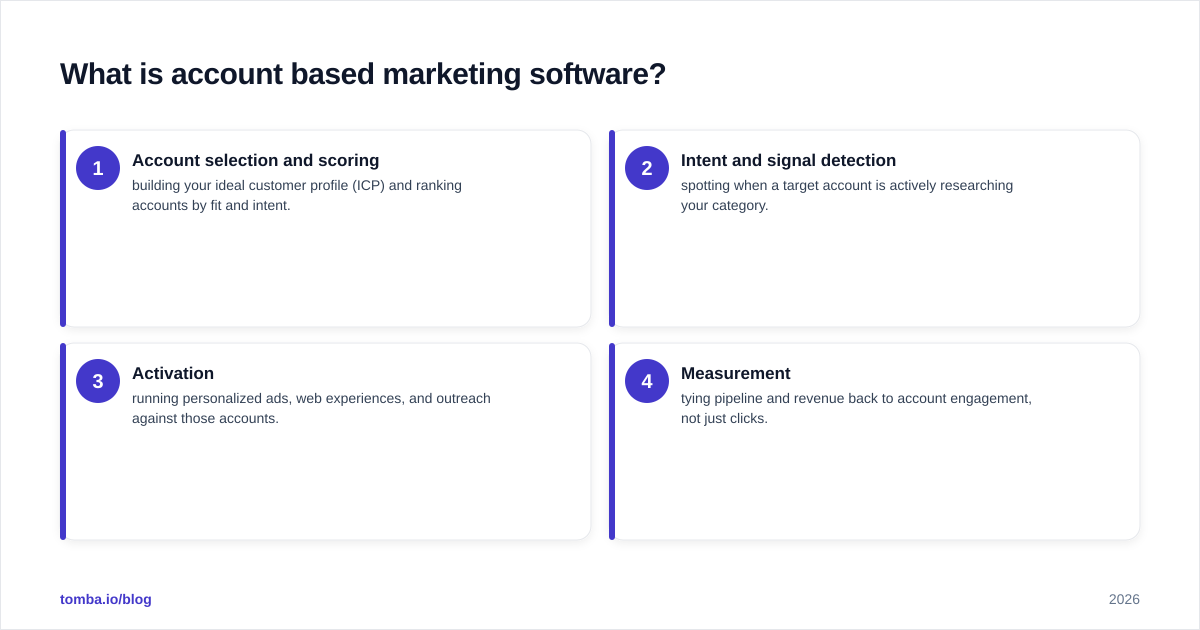
In practice, that means a single platform (or a connected stack) that handles four jobs:
- Account selection and scoring — building your ideal customer profile (ICP) and ranking accounts by fit and intent.
- Intent and signal detection — spotting when a target account is actively researching your category.
- Activation — running personalized ads, web experiences, and outreach against those accounts.
- Measurement — tying pipeline and revenue back to account engagement, not just clicks.
Traditional demand-gen software optimizes for lead volume. ABM software optimizes for account penetration — how many of the right people at a target company you've engaged. That shift changes the whole metric set, which is why revenue operations teams treat ABM as its own motion rather than a feature bolted onto email marketing.
How does ABM software actually work?#
Most platforms follow the same loop, even if they brand the stages differently. The diagram below shows the flow from raw firmographic data to closed revenue.

- Define the ICP and target list. You set firmographic filters (industry, size, region, tech stack) and the platform resolves them into a named account list. Some tools auto-expand your list using lookalike modeling.
- Layer intent data. First-party signals (visits to your pricing page) and third-party signals (research activity across publisher networks) flag which accounts are warming up. This is the engine that 6sense and Demandbase are built around.
- Match accounts to people. The platform — or your enrichment layer — maps each account to the actual buying committee: the economic buyer, the champion, the blockers.
- Activate across channels. Display ads, LinkedIn, personalized landing pages, and sales sequences fire in a coordinated way so a CFO and a VP of Engineering at the same company see a consistent story.
- Measure at the account level. Dashboards report account engagement, pipeline influenced, and velocity — not open rates in isolation.

The hard part is almost never the activation. It's step three — turning "Acme Corp is in-market" into "here are the seven decision-makers at Acme and their verified work emails." That's where most ABM programs quietly leak budget.
Which account based marketing software is best in 2026?#
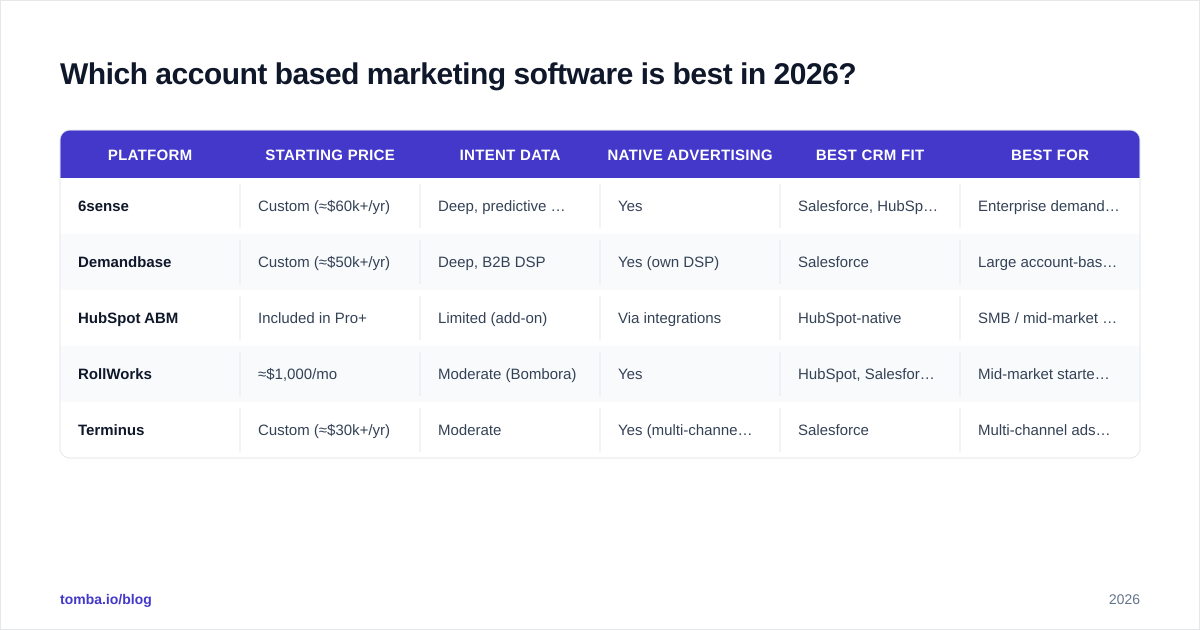
There's no single winner — the right choice depends on company size, CRM, and whether you need built-in advertising. Here's how the major platforms compare on the attributes that actually drive a buying decision.
| Platform | Starting price | Intent data | Native advertising | Best CRM fit | Best for |
|---|---|---|---|---|---|
| 6sense | Custom (≈$60k+/yr) | Deep, predictive AI | Yes | Salesforce, HubSpot | Enterprise demand teams |
| Demandbase | Custom (≈$50k+/yr) | Deep, B2B DSP | Yes (own DSP) | Salesforce | Large account-based orgs |
| HubSpot ABM | Included in Pro+ | Limited (add-on) | Via integrations | HubSpot-native | SMB / mid-market on HubSpot |
| RollWorks | ≈$1,000/mo | Moderate (Bombora) | Yes | HubSpot, Salesforce | Mid-market starters |
| Terminus | Custom (≈$30k+/yr) | Moderate | Yes (multi-channel) | Salesforce | Multi-channel ads + chat |
A few honest caveats on that table:
- "Custom pricing" means sales-led. Expect annual contracts, onboarding fees, and seat minimums. The numbers above are directional ranges reported on review sites like G2, not list prices.
- Intent depth ≠ accuracy for your category. 6sense and Demandbase both license and model intent, but the signal quality varies by industry. Run a pilot against accounts you already closed to sanity-check the predictions.
- CRM fit decides your real total cost. If you're a HubSpot shop, HubSpot's native ABM tools may get you 80% of the value without a second six-figure contract. Bolting an enterprise platform onto the wrong CRM doubles your integration work.
Do you need a dedicated ABM platform or just better data?#
Conclusion first: most teams under ~50 employees don't need a six-figure ABM platform yet — they need a clean target list, accurate contact data, and disciplined orchestration in the CRM they already own.
Here's the trap. ABM software is excellent at telling you which accounts are in-market. It is mediocre — and often expensive — at telling you exactly who to contact and how to reach them. The platforms enrich at the account level; they're far weaker at person-level contact data, especially verified email and direct dials.
So the spend decision usually comes down to maturity:
- Early-stage / SMB: Skip the platform. Build your account list, enrich it with verified contacts, and run plays through your CRM and a sequencer. Your money is better spent on data quality and a B2B database than on a predictive intent engine you won't fully use.
- Mid-market: Start with a lighter tool like RollWorks or HubSpot's ABM module. Add intent only when you've proven the motion converts.
- Enterprise: A full platform earns its keep when you're orchestrating dozens of channels across hundreds of accounts and need account-level attribution for the board.

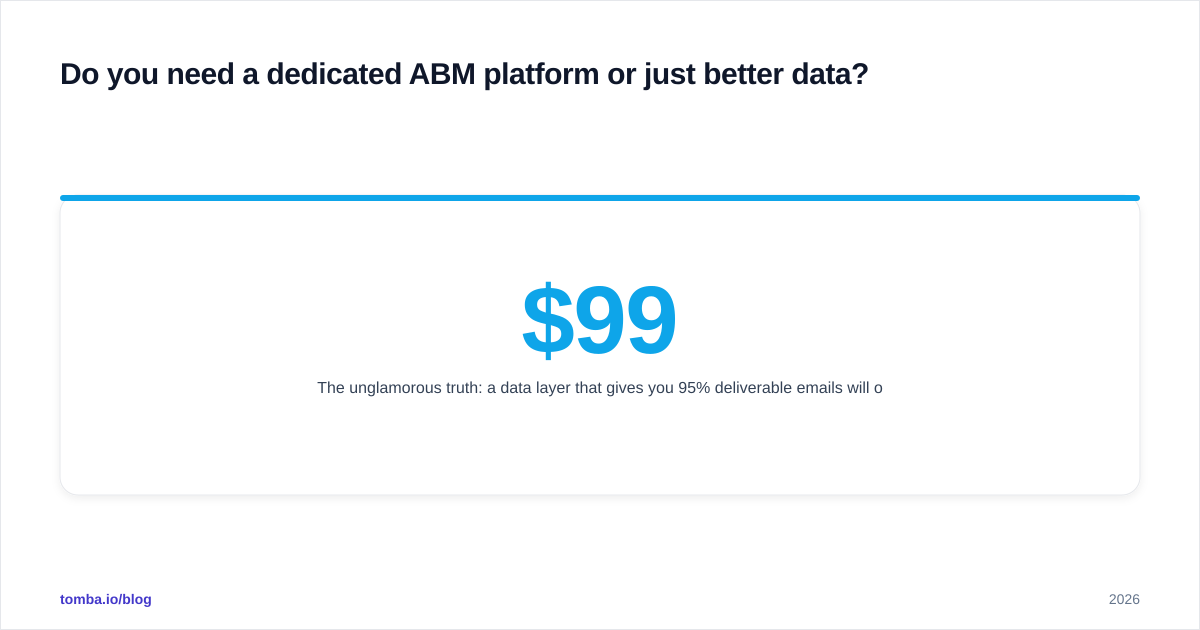
The unglamorous truth: a $99/mo data layer that gives you 95% deliverable emails will out-perform a $60k platform feeding garbage contacts into beautiful dashboards. Garbage in, expensive garbage out.
What features matter most when evaluating ABM software?#
Don't get dazzled by the demo. Score every vendor against the same checklist so you're comparing capability, not sizzle.
- ICP and list building. How granular are the firmographic and technographic filters? Can it ingest your CRM's closed-won data to model lookalikes?
- Intent signal quality. First-party (your site) plus third-party (research networks). Ask for a transparent explanation of where the intent comes from — vague "AI" answers are a red flag.
- Contact data depth. This is the make-or-break. How many verified contacts per account? What's the email accuracy rate? Can you export, or are you locked in? Most platforms are thin here, which is why teams bolt on a dedicated email verifier.
- Activation channels. Native display, LinkedIn, retargeting, web personalization, chat. More channels means more coordination but also more vendor lock-in.
- CRM and MAP integration. Native two-way sync with Salesforce or HubSpot, not a nightly CSV. Check whether it writes account scores back to records your reps actually see.
- Attribution and reporting. Account-level engagement, pipeline influence, and velocity. Single-touch attribution alone won't justify an ABM budget to finance.
- Time to value. Enterprise platforms can take a quarter to onboard. Factor that into ROI.
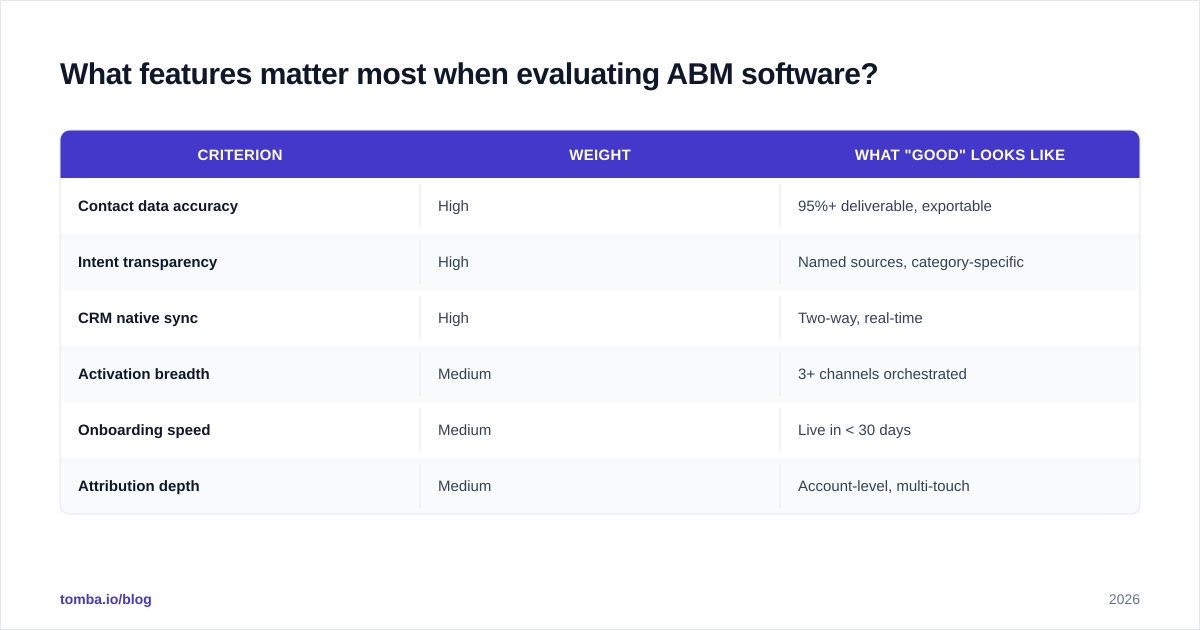
A quick scoring matrix keeps the evaluation honest:
| Criterion | Weight | What "good" looks like |
|---|---|---|
| Contact data accuracy | High | 95%+ deliverable, exportable |
| Intent transparency | High | Named sources, category-specific |
| CRM native sync | High | Two-way, real-time |
| Activation breadth | Medium | 3+ channels orchestrated |
| Onboarding speed | Medium | Live in < 30 days |
| Attribution depth | Medium | Account-level, multi-touch |
How do you feed ABM software with accurate contact data?#
Your ABM platform identifies the account. You still have to identify and reach the people. Here's the workflow that keeps the funnel from leaking:
- Export the target-account list from your ABM platform (or build it from your ICP filters).
- Run a domain search on each account to surface the people in the buying committee. Tomba's domain search returns role-based and named contacts for a company domain in one call.
- Find and verify the right emails. Use an email finder to resolve names to professional addresses, then verify them so your sender reputation survives the campaign.
- Enrich and sync. Push verified contacts and firmographics back into your CRM so reps and ABM ads target real, reachable humans.
- Refresh on a cadence. B2B contact data decays ~2-3% per month as people change jobs. Re-verify quarterly.
This is the layer enterprise ABM platforms underinvest in, and it's the cheapest place to win. You can bolt accurate, verified contact data onto any ABM stack — 6sense, Demandbase, HubSpot, or a homegrown spreadsheet — without changing platforms. Tools like Tomba integrate through the Tomba API, bulk uploads, and native HubSpot and Salesforce integrations, so the data flows where your plays run.
What are common ABM software mistakes to avoid?#
- Buying the platform before defining the ICP. The software won't fix a fuzzy target list. Define your ICP on paper first.
- Treating intent as truth. Intent is a probability, not a purchase order. Validate against accounts you've actually closed.
- Ignoring the data layer. As covered above — accurate, verified contacts are the foundation. Skipping this is the #1 reason ABM programs stall.
- No sales-marketing alignment. ABM is a team sport. If reps don't trust the account scores, the platform becomes shelfware.
- Vanity metrics. Account engagement that never converts to pipeline is theater. Tie everything back to revenue and win rate.
- Over-buying channels. You don't need six activation channels on day one. Master one or two, then expand.
According to analysts at Gartner, B2B buying groups now involve six to ten decision-makers — which is exactly why account-level targeting beats single-lead chasing. But that same complexity is why your contact data has to cover the whole committee, not just the one champion who filled out a form.
Frequently asked questions#
Is ABM software worth it for small businesses? Usually not as a standalone platform. Small teams get more from a clean target list, verified contact data, and orchestration inside their existing CRM. Graduate to a platform once the motion is proven.
What's the difference between ABM software and a CRM? Your CRM stores and manages relationships and deals. ABM software sits on top, deciding which accounts to pursue, detecting intent, and coordinating multi-channel plays. They're complementary, not competing — the best setups sync tightly.
Can I run ABM without buying any platform? Yes. A target-account list, an email finder, a verifier, a sequencer, and disciplined CRM hygiene will run a credible ABM program. Platforms add intent prediction and account-level attribution at scale, not the core ability to do ABM.
How accurate is the contact data inside ABM platforms? It varies widely and is rarely their strength. Most teams supplement with a dedicated data provider to hit the 95%+ deliverability cold outreach demands.
The bottom line#
The best account based marketing software in 2026 is the one that matches your company size, CRM, and channel needs — 6sense and Demandbase for enterprise intent, HubSpot for native simplicity, RollWorks or Terminus for mid-market. But whichever platform you choose, its output is only as strong as the contact data underneath it.
Before you sign a six-figure ABM contract, fix the cheap leak first. Use the Tomba Email Finder to turn your target-account list into verified, reachable buying committees — by domain, name, or company — with accuracy that keeps your sends out of the spam folder and your ABM dashboards reporting real conversations instead of bounces. Start free with 25 searches a month, then scale on a plan that fits; see Tomba pricing for the details. Your ABM platform finds the account. Tomba helps you reach the people who actually sign.
Get the Tomba newsletter
Practical outbound tactics and product updates — once every two weeks.
About the author