Account Based Marketing Solution: 2026 Buyer's Guide
Choosing an account based marketing solution in 2026? Compare platform types, pricing, and the data layer that decides whether your ABM program books pipeline or burns budget.
TL;DR
- An account based marketing solution is the stack — orchestration platform, intent data, ad targeting, and contact data — that lets you treat a named list of accounts as a market of one.
- There is no single "best" tool. The right solution depends on whether you need full-funnel orchestration (Demandbase, 6sense), advertising-led ABM (RollWorks), or a lean data-plus-automation build you assemble yourself.
- The most common failure is not the platform — it's a thin or stale contact layer. ABM only works when you can reach the actual humans on the buying committee.
- Expect to spend $20k–$120k/year on enterprise ABM platforms, or build a focused stack from $49–$300/month if you run the orchestration in your existing CRM and sequencer.
- Budget for accurate emails, phones, and enrichment first. Tools like the Tomba Email Finder feed every other layer in the stack.
What is an account based marketing solution?#
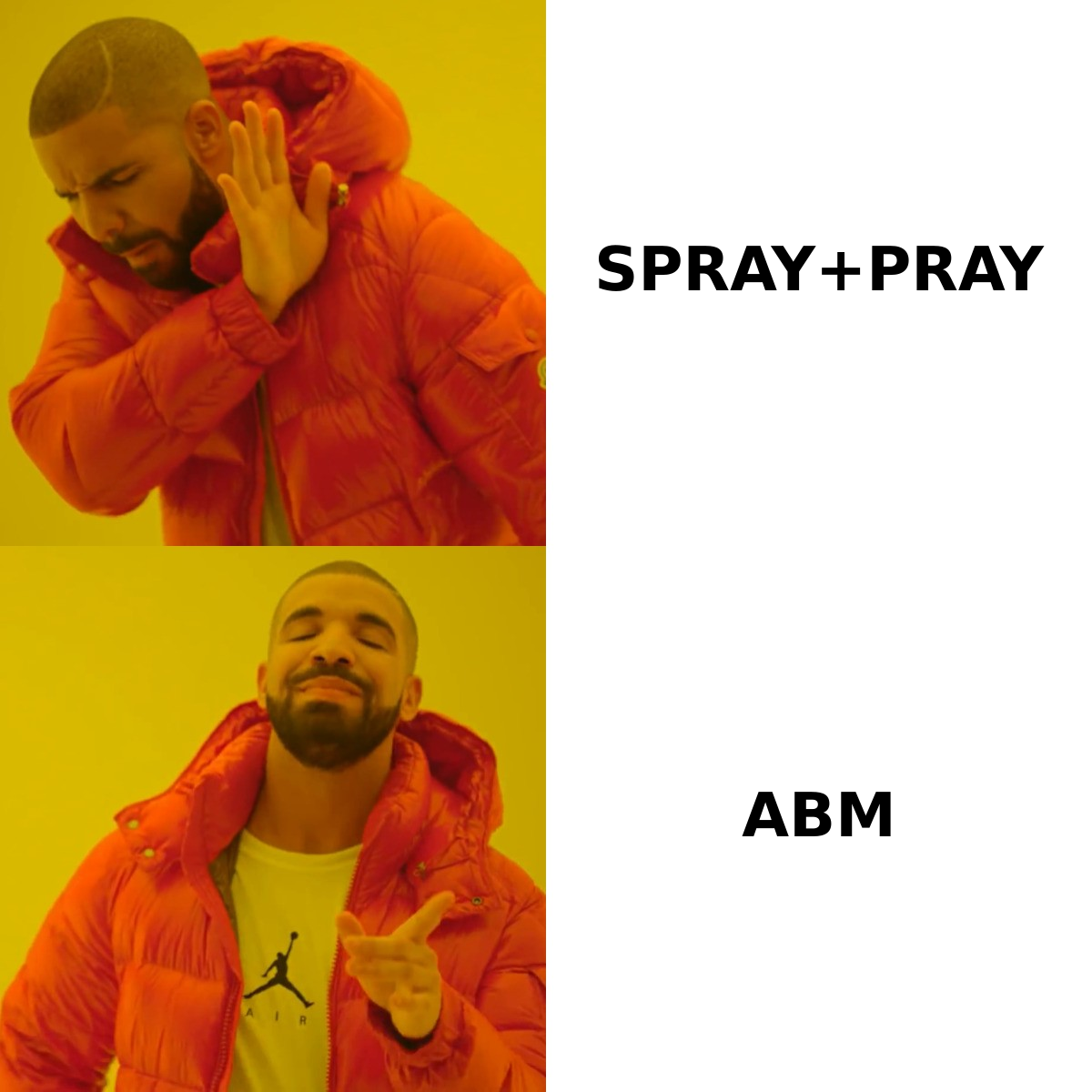
An account based marketing solution is the combination of software and data that lets you run marketing and sales against a defined list of target accounts instead of a broad audience. Think of it like the difference between fishing with a net and fishing with a spear. Demand generation casts a net and sorts whatever comes in. ABM picks the specific fish — the 200 or 2,000 companies you actually want — and coordinates every touch around landing them.
In practice, an ABM solution covers four jobs:
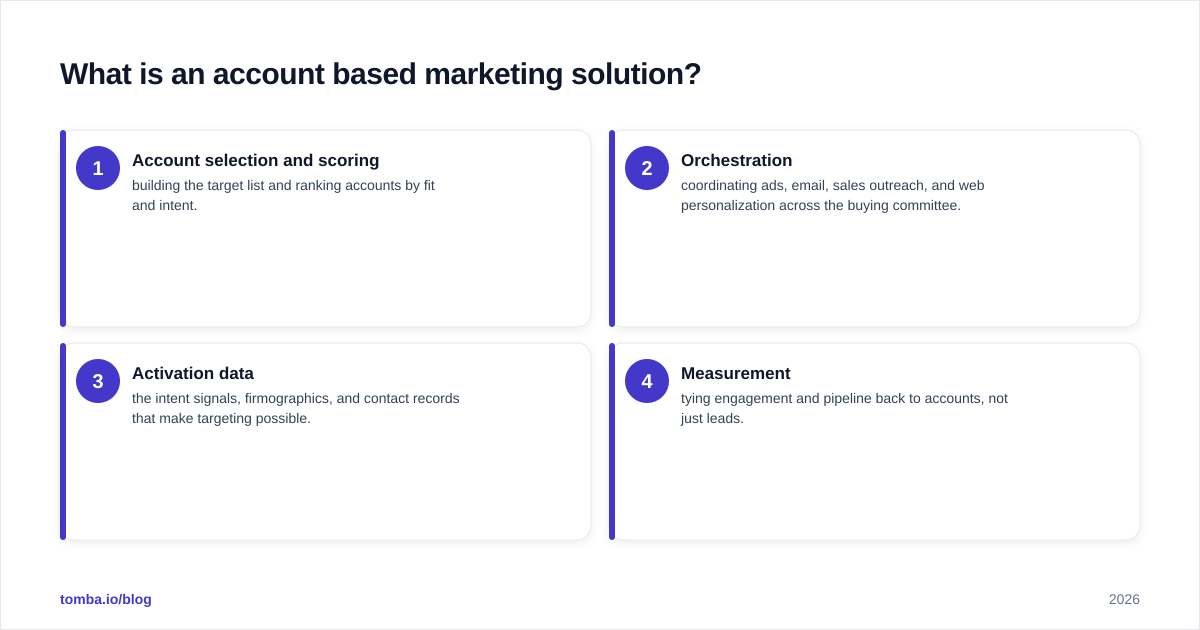
- Account selection and scoring — building the target list and ranking accounts by fit and intent.
- Orchestration — coordinating ads, email, sales outreach, and web personalization across the buying committee.
- Activation data — the intent signals, firmographics, and contact records that make targeting possible.
- Measurement — tying engagement and pipeline back to accounts, not just leads.
The category overlaps heavily with revenue operations because ABM forces marketing and sales onto one shared definition of success: pipeline and revenue from named accounts.
Why do most ABM programs fail at the data layer?#
Most ABM programs fail before the first ad ever serves, and the cause is almost always data. You can buy the most sophisticated orchestration platform on the market, but if your contact records are 30% stale, your "personalized" campaign is shouting at people who left the company a year ago.
Here is the chain reaction. Your platform identifies a hot account showing intent. Great. Now you need to reach the seven people on the buying committee — the economic buyer, the champion, two influencers, the technical evaluator, and so on. If you only have one generic info@ address and a CEO who never reads cold email, the signal is wasted. The account was ready; your reach was not.
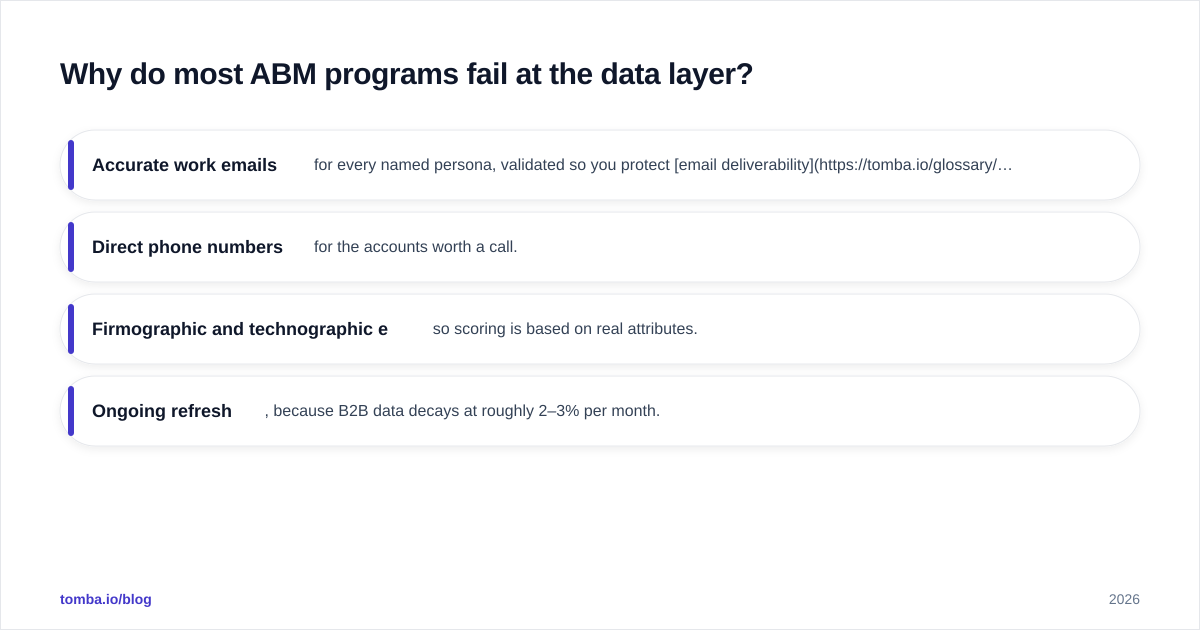
This is why the data layer deserves your attention before the platform layer. A strong ABM data foundation needs:
- Accurate work emails for every named persona, validated so you protect email deliverability.
- Direct phone numbers for the accounts worth a call.
- Firmographic and technographic enrichment so scoring is based on real attributes.
- Ongoing refresh, because B2B data decays at roughly 2–3% per month.
You can layer enrichment into your CRM with data enrichment and fill committee gaps with a bulk email finder before any campaign goes live. Get this right and every downstream dollar works harder.
What types of account based marketing solution exist?#
Not every team needs the same thing. ABM solutions fall into four broad shapes, and matching the shape to your motion matters more than chasing the biggest logo.
1. Full-funnel orchestration platforms. These are the enterprise suites — 6sense and Demandbase — that combine intent data, predictive scoring, ad targeting, and orchestration in one place. Powerful, expensive, and best for teams with a dedicated ABM function.
2. Advertising-led ABM. Tools like RollWorks focus on account-based advertising and retargeting, with lighter orchestration. Good when paid is your primary channel.
3. Sales-led / orchestration-light. Some teams run ABM straight out of their CRM plus a sequencer, using strong data and tight sales-marketing alignment instead of a dedicated platform. Lower cost, more manual, very effective for focused lists.
4. Data-and-signal layers. Intent providers and contact-data tools that don't run campaigns themselves but feed whatever orchestration you already own.
How do the leading account based marketing solutions compare?#
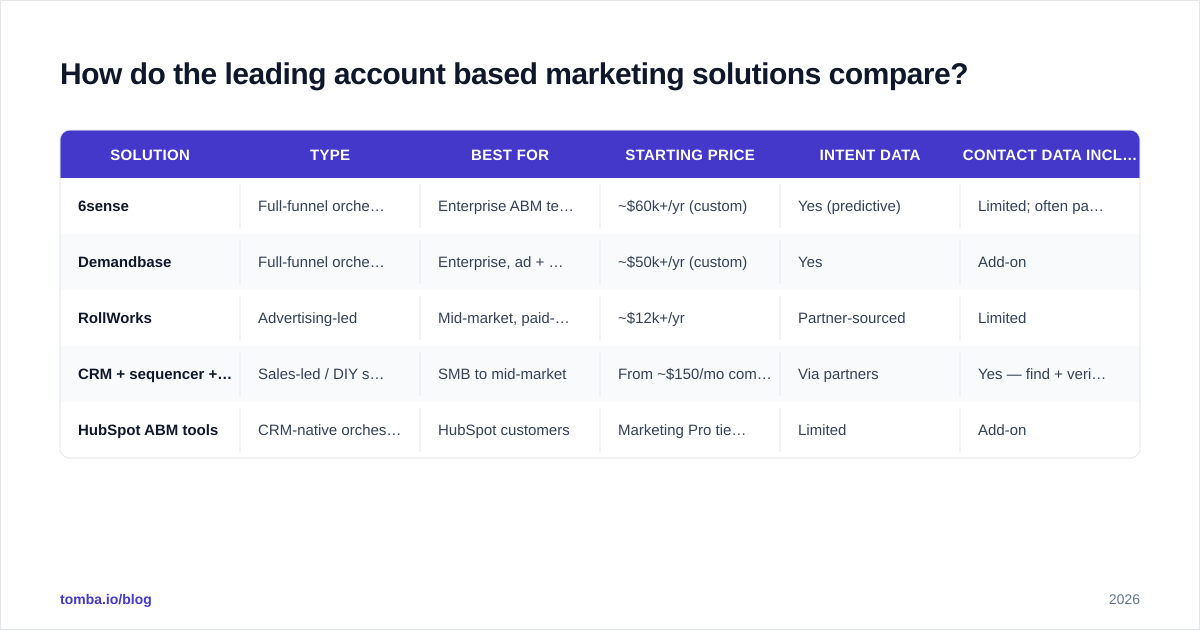
The table below compares representative options across the shapes above. Pricing is approximate and based on publicly discussed ranges — always confirm with the vendor, since most enterprise ABM pricing is custom and quote-based.
| Solution | Type | Best for | Starting price | Intent data | Contact data included |
|---|---|---|---|---|---|
| 6sense | Full-funnel orchestration | Enterprise ABM teams | ~$60k+/yr (custom) | Yes (predictive) | Limited; often paired |
| Demandbase | Full-funnel orchestration | Enterprise, ad + sales | ~$50k+/yr (custom) | Yes | Add-on |
| RollWorks | Advertising-led | Mid-market, paid-first | ~$12k+/yr | Partner-sourced | Limited |
| CRM + sequencer + Tomba | Sales-led / DIY stack | SMB to mid-market | From ~$150/mo combined | Via partners | Yes — find + verify + enrich |
| HubSpot ABM tools | CRM-native orchestration | HubSpot customers | Marketing Pro tiers | Limited | Add-on |
The honest takeaway: enterprise suites buy you integration and predictive scoring, but they assume you already have clean activation data. The DIY stack costs a fraction and gives you total control, but you own the orchestration discipline. For many teams under 200 employees, a sales-led build with excellent data outperforms a six-figure platform that nobody has time to operate.
For deeper vendor research, cross-reference verified user reviews on G2's ABM category and how analysts frame the space in Gartner's account-based marketing coverage.
How do you build an account based marketing solution stack?#
Build it in layers, bottom up. Skipping a layer is how budgets evaporate.
Layer 1 — Define the account list. Start from your ICP and win history. Pull the firmographic attributes of your best closed-won deals and reverse-engineer the list. Keep it tight; a focused 300-account list beats a vague 5,000.
Layer 2 — Build the contact and committee map. For each account, identify the 4–8 personas who influence the deal. This is where most stacks are thin. Use domain search to pull every reachable contact at a target company, then verify each address with an email verifier so your sends stay clean. Add direct dials with a phone finder for accounts that warrant calls.
Layer 3 — Add intent and scoring. Layer in intent signals (from your platform or a standalone provider) to rank which accounts are in-market now. Combine fit score and intent score into a single priority tier.
Layer 4 — Orchestrate the plays. Coordinate ads, sales sequences, LinkedIn touches, and web personalization. The point of ABM is that a prospect sees a consistent story across channels in the same week, not random touches months apart.
Layer 5 — Measure by account. Track account engagement, pipeline created, and influenced revenue. Report on accounts moving through stages, not raw lead counts.
A practical sequence: enrich and verify the full list first, push it into your CRM, then turn on orchestration. If you operate at scale, run committee discovery through a bulk lead generation workflow and connect it to your CRM with native integrations so records stay fresh automatically.
How much should an account based marketing solution cost?#
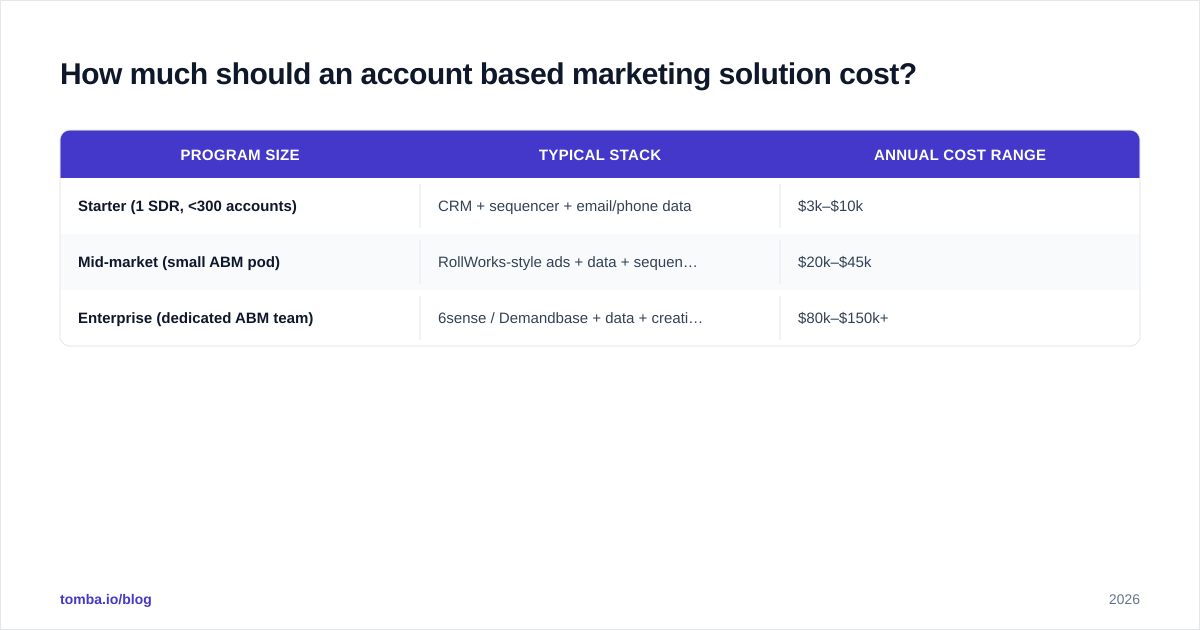
Conclusion first: spend in proportion to your average deal size and list size, and always fund the data layer before the platform layer.
A rough budgeting frame:
| Program size | Typical stack | Annual cost range |
|---|---|---|
| Starter (1 SDR, <300 accounts) | CRM + sequencer + email/phone data | $3k–$10k |
| Mid-market (small ABM pod) | RollWorks-style ads + data + sequencer | $20k–$45k |
| Enterprise (dedicated ABM team) | 6sense / Demandbase + data + creative | $80k–$150k+ |
Notice the data line item appears in every tier. Even an enterprise suite needs a reliable contact source feeding it. On the lean end, you can stand up a credible program with a CRM you already pay for plus Tomba pricing that starts free (25 searches/month) and scales through Starter at $49/month and Growth at $99/month. That keeps the data layer honest without committing to a six-figure platform before you've proven the motion.
When is an enterprise ABM platform actually worth it?#
Buy the big platform when three things are all true: you have a dedicated ABM or RevOps owner, your deal sizes justify five-figure software, and your target list is large enough that manual orchestration breaks down. Predictive intent and unified reporting genuinely pay off at that scale.
Skip it — or defer it — when you have a focused list, a small team, and deals that close on relationships and direct outreach more than on coordinated air cover. In that case, a sales-led stack with great data and a disciplined sequence will outperform an underused platform every time. You can always graduate to a suite once the motion is proven and the volume demands it.
The mistake is buying the platform to create discipline. Software amplifies a process; it doesn't supply one.
Frequently asked questions#
Is account based marketing the same as lead generation? No. Lead generation optimizes for volume of individuals; ABM optimizes for depth across named accounts. Many teams run both — broad demand gen for the long tail, ABM for the strategic accounts.
Can I do ABM without a dedicated platform? Yes. A CRM, a sequencer, accurate contact data, and tight sales-marketing alignment are enough to run effective ABM against a focused list. Platforms add scale and automation, not the strategy itself.
What data do I need to start? A defined account list, the buying-committee contacts for each account, verified emails and phones, and basic firmographic enrichment. That foundation supports any orchestration layer you add later.
How do I keep ABM data from going stale? Re-verify and re-enrich on a schedule — quarterly at minimum for active accounts. Automate it through CRM integrations so records refresh without manual exports.
The bottom line#
An account based marketing solution is only as good as the contacts it can reach. Before you evaluate a single orchestration platform, make sure you can find and verify every member of the buying committee at every target account — accurately, and at scale. That's the layer that decides whether your ABM program books pipeline or just burns budget.
Start there. Use the Tomba Email Finder to map and reach the real decision-makers inside your target accounts, verify every address before you send, and enrich your CRM so your ABM stack runs on data you can trust. Build the data foundation first, and every dollar you spend on orchestration after it works harder.
// get started
Find, verify and enrich your first contacts today
Start on the free plan with 25 searches a month, then scale when your team is ready.
Free plan · No credit card required · GDPR & CCPA
// about the author