Account Based Marketing Success Stories: 7 Real Wins in 2026
Seven real account based marketing success stories — the targeting, plays, and numbers behind pipeline wins you can copy in 2026.
Account based marketing gets pitched as magic. It is not. The wins below came from boring discipline: a short list, clean data, and plays that actually fit how the target buys. Here are seven account based marketing success stories worth copying — and the exact mechanics that made them work.
TL;DR#
- The pattern in every win: a tight account list (10–200, not 5,000), enriched contact data, and coordinated sales + marketing touches — not louder broadcasting.
- Tiering beats volume. One-to-one ABM for a few whales, one-to-few for clusters, one-to-many for the long tail. Mixing tiers is where pipeline actually compounds.
- Data quality is the silent multiplier. Teams that verified contacts and mapped buying committees before launch saw 2–3x better reply and meeting rates.
- Intent + timing matter more than creative. The best results came from reaching accounts already showing in-market signals.
- You can start small. Several of these wins began with one rep, a spreadsheet, and a $49/mo data tool — not a six-figure platform.
What counts as an ABM success story?#
A real ABM success story shows three things: a defined target account list, a coordinated set of plays across channels and teams, and a measurable lift in account-level outcomes — pipeline, win rate, deal size, or cycle time. "We sent more emails and got more leads" is not ABM. ABM flips the funnel: you pick the accounts first, then build demand inside them.
The framework below is the spine of every story in this post. Land, expand, and orchestrate around the buying committee — not the single lead.
If you want the textbook definition and category history, Gartner's ABM coverage and the ITSMA / Momentum research it spawned are the standard references. But definitions are cheap. Let's look at what teams actually did.
Which account based marketing success stories actually moved pipeline?#
1. The 100-account list that 3x'd win rate#
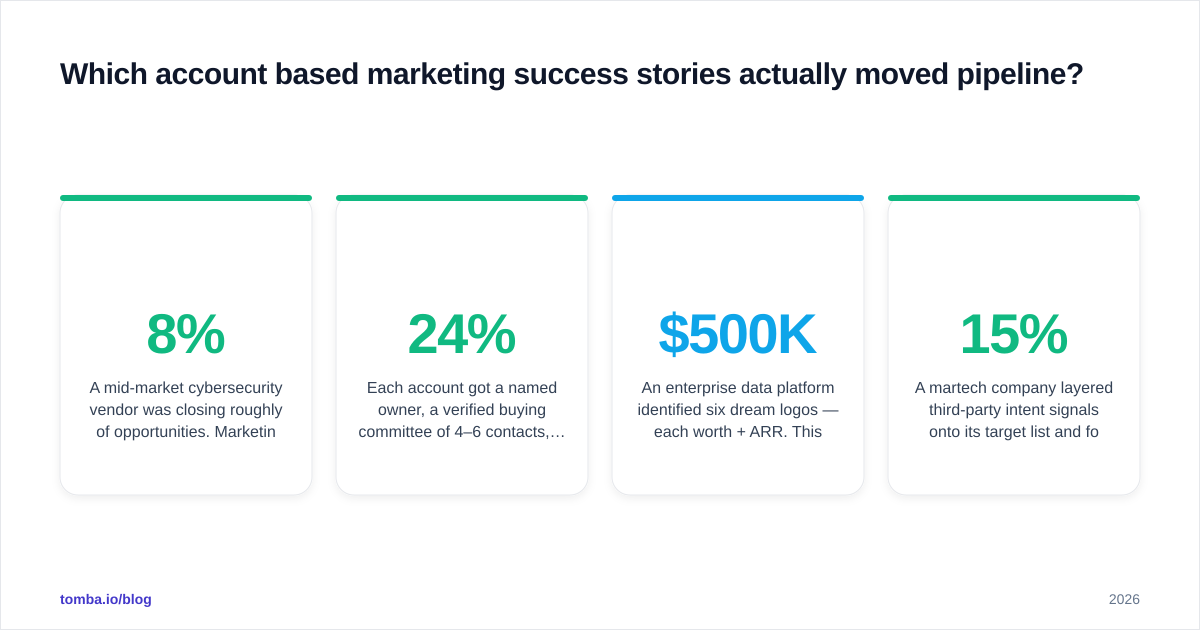
A mid-market cybersecurity vendor was closing roughly 8% of opportunities. Marketing was generating thousands of MQLs that sales ignored. They scrapped the volume model and built a 100-account list scored on firmographic fit and tech-stack signals.
Each account got a named owner, a verified buying committee of 4–6 contacts, and a 6-week sequence mixing email, LinkedIn, and a personalized landing page. Win rate on those accounts climbed to roughly 24%. The unlock was not creative — it was that sales finally trusted the list because the data underneath it was clean and the win rate math was visible per account.
Lesson: Shrink the list until your reps believe in it. Trust drives follow-up; follow-up drives pipeline.
2. One-to-one ABM for six strategic whales#
An enterprise data platform identified six dream logos — each worth $500K+ ARR. This was pure one-to-one ABM. The team built a custom microsite per account, mapped 12–20 stakeholders, and ran executive-to-executive outreach backed by a tailored business case.
Two of the six closed within the fiscal year. Cost per account was high, but ROI was absurd because the deal sizes justified white-glove effort. This is the tier most teams skip because it does not scale — and that is exactly why it works for whales.
Lesson: For accounts above a certain deal size, scale is the wrong goal. Depth is.
3. Intent data turned a cold list warm#
A martech company layered third-party intent signals onto its target list and found that ~15% of accounts were actively researching their category. They routed those accounts to sales within 24 hours with a play built around the specific topic each account was researching.
Reply rates on intent-flagged accounts ran roughly 3x higher than the cold baseline. The accounts were not better — the timing was. Reaching a buyer mid-research beats reaching them at random every time.
Lesson: Spend on timing before you spend on creative. An average message at the right moment beats a brilliant one at the wrong one.
)
4. The SDR-marketer pod that killed the handoff#
A B2B fintech merged one SDR and one marketer into a single "pod" owning 40 accounts together. No lead handoff, no finger-pointing. They planned plays jointly each Monday and shared a single account dashboard.
Meetings booked per account doubled versus the old assembly-line model. The structural change — shared ownership — did more than any single tactic. This is revenue operations thinking applied to ABM: align the incentives and the activity follows.
Lesson: ABM is an operating model, not a campaign. If sales and marketing have separate scoreboards, you do not have ABM.
5. Reactivating closed-lost with fresh contact data#
A SaaS vendor pulled 200 closed-lost accounts from the prior 18 months. Many had new decision-makers since the original deal died. They re-enriched the buying committees, found current emails and phone numbers, and ran a "what's changed" sequence.
About 11% of the dead accounts re-entered pipeline. The cost was almost nothing — the accounts were already qualified; they just needed current data enrichment to find who was in the seat now.
Lesson: Your CRM is full of ABM-ready accounts. Refresh the contacts before you buy new lists.
How do the ABM tiers compare?#
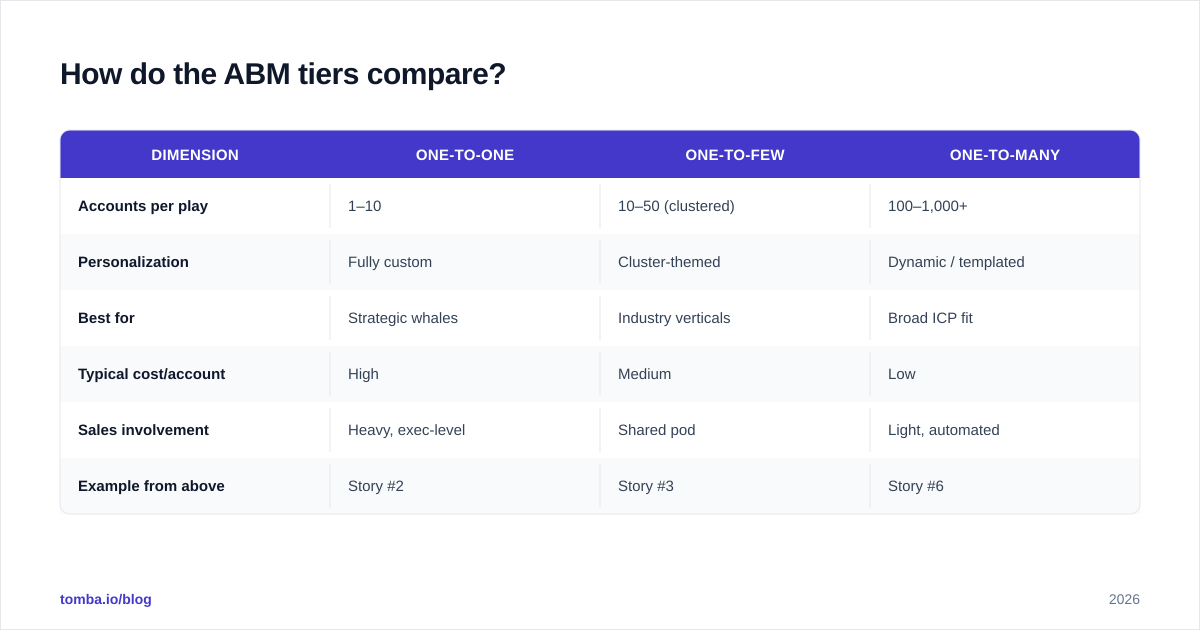
The stories above span three classic ABM tiers. Picking the wrong tier for an account is the most common failure — running one-to-one effort on a long-tail account burns money; running one-to-many on a whale leaves money on the table.
| Dimension | One-to-One | One-to-Few | One-to-Many |
|---|---|---|---|
| Accounts per play | 1–10 | 10–50 (clustered) | 100–1,000+ |
| Personalization | Fully custom | Cluster-themed | Dynamic / templated |
| Best for | Strategic whales | Industry verticals | Broad ICP fit |
| Typical cost/account | High | Medium | Low |
| Sales involvement | Heavy, exec-level | Shared pod | Light, automated |
| Example from above | Story #2 | Story #3 | Story #6 |
The teams with the best results did not pick one tier — they ran a portfolio. Whales got white-glove treatment, vertical clusters got themed campaigns, and the long tail got automated-but-targeted sequences. Pipeline compounded because every account got the right amount of effort.
What about ABM at smaller companies?#
6. One rep, a spreadsheet, and a $49/mo stack#
Not every ABM success story has an enterprise budget. A two-person startup ran one-to-many ABM with a single rep. They built a 300-account list, used a domain search to pull the right contacts per company, verified the emails, and ran a templated-but-segmented sequence.
They booked 30+ qualified meetings in a quarter on a tooling budget under $100/month. The lesson is not that cheap tools beat platforms — it is that the discipline (tight list, verified data, segmented messaging) is what matters. Tooling is downstream of method.
Lesson: You can run real ABM before you can afford a platform. Method first, software second.
7. The vertical play that owned a niche#
A scheduling-software company picked a single vertical — dental practices — and went deep. One-to-few ABM with vertical-specific messaging, case studies from peer practices, and outreach timed to the industry's budget cycle.
They became the obvious choice in that niche, with win rates far above their horizontal average. Narrowing the market made every message more relevant, and relevance is the whole game.
Lesson: A narrow vertical you dominate beats a broad market where you are noise.
)
What do all these ABM wins have in common?#
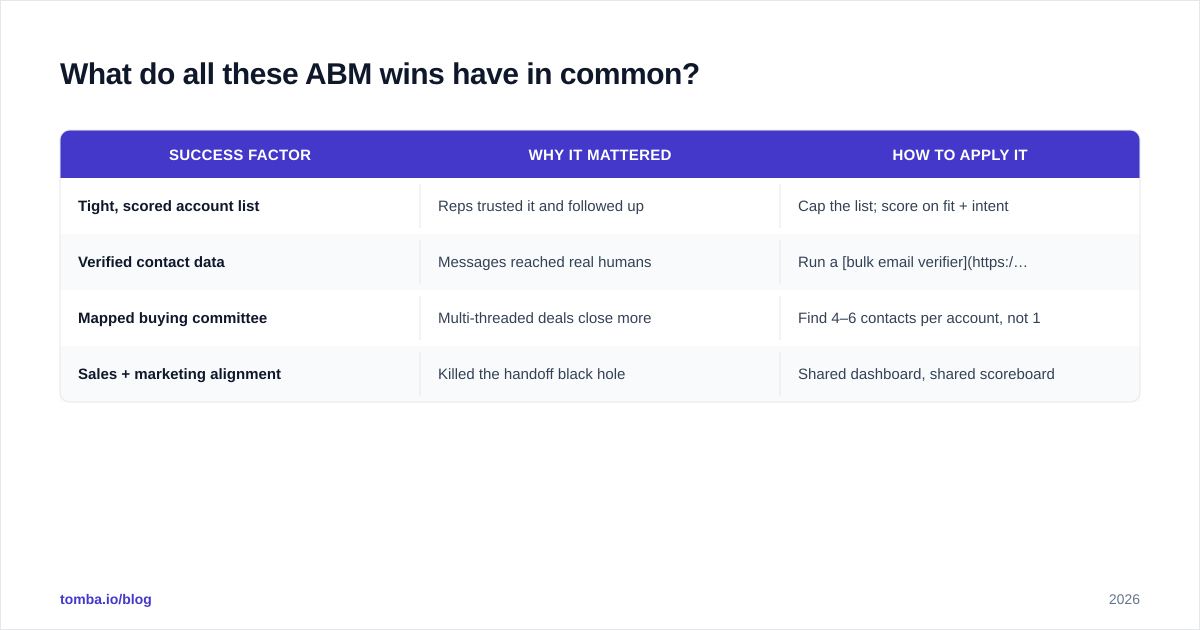
Strip away the industries and budgets and the same four ingredients show up every time. Here is the scorecard.
| Success factor | Why it mattered | How to apply it |
|---|---|---|
| Tight, scored account list | Reps trusted it and followed up | Cap the list; score on fit + intent |
| Verified contact data | Messages reached real humans | Run a bulk email verifier before launch |
| Mapped buying committee | Multi-threaded deals close more | Find 4–6 contacts per account, not 1 |
| Sales + marketing alignment | Killed the handoff black hole | Shared dashboard, shared scoreboard |
Notice what is not on that list: a specific platform, a clever subject line, a viral creative. Those help at the margin. The wins came from fundamentals. Most failed ABM programs fail on ingredient #1 or #2 — a bloated list built on stale data — long before creative ever enters the picture.
For deeper benchmarking on what "good" looks like, HubSpot's ABM research and peer reviews on G2's ABM category are useful reality checks against vendor hype.
How do you start your own ABM success story?#
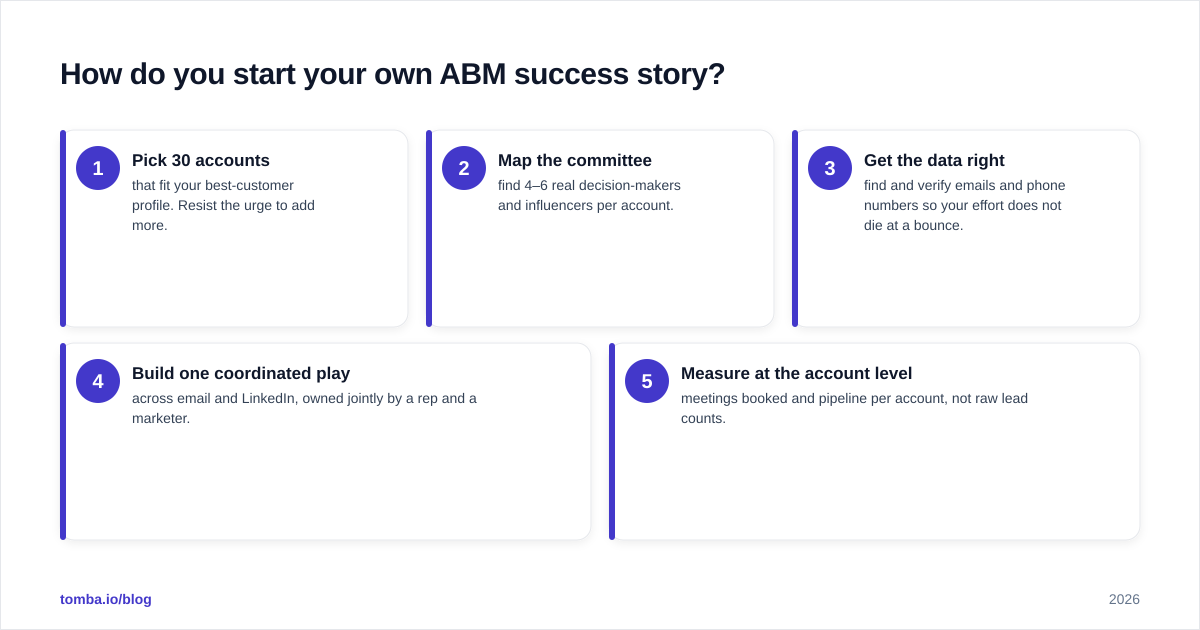
You do not need a six-month rollout. Run a 30-day pilot:
- Pick 30 accounts that fit your best-customer profile. Resist the urge to add more.
- Map the committee — find 4–6 real decision-makers and influencers per account.
- Get the data right — find and verify emails and phone numbers so your effort does not die at a bounce.
- Build one coordinated play across email and LinkedIn, owned jointly by a rep and a marketer.
- Measure at the account level — meetings booked and pipeline per account, not raw lead counts.
If the pilot produces even a handful of qualified meetings, you have your own success story to scale. The teams above all started exactly here.
The data layer behind every ABM win#
Every story in this post depended on one unglamorous thing: knowing who to contact and reaching them reliably. A bloated list of unverified contacts is the fastest way to turn an ABM program into expensive noise.
That is where Tomba's Email Finder fits. Feed it your target account domains and it returns the named contacts and verified professional emails behind each company — so your buying committee map is built on real, deliverable data instead of guesses. Pair it with the built-in email verifier to scrub the list before launch, and you remove the single most common reason ABM plays stall. It starts free (25 searches/mo), with paid plans from $49/mo — see full Tomba pricing if you are ready to scale a pilot into a program. Build the list, verify the data, then go run your own success story.
// get started
Find, verify and enrich your first contacts today
Start on the free plan with 25 searches a month, then scale when your team is ready.
Free plan · No credit card required · GDPR & CCPA
// about the author