Account Based Marketing Tactics: A 2026 ABM Playbook
A field-tested guide to the account based marketing tactics that actually move pipeline in 2026 — tiering, data, multi-threading, and measurement.
Account-based marketing stopped being a buzzword years ago. In 2026 it is just how serious B2B teams sell into enterprise: pick the accounts that matter, treat each one like a market of one, and coordinate sales and marketing around the same target list. The hard part is not the philosophy. It is the execution — the specific account based marketing tactics that turn a target list into booked revenue.
This playbook skips the theory and gives you the moves that work, the data you need underneath them, and an honest look at where ABM fails.
TL;DR#
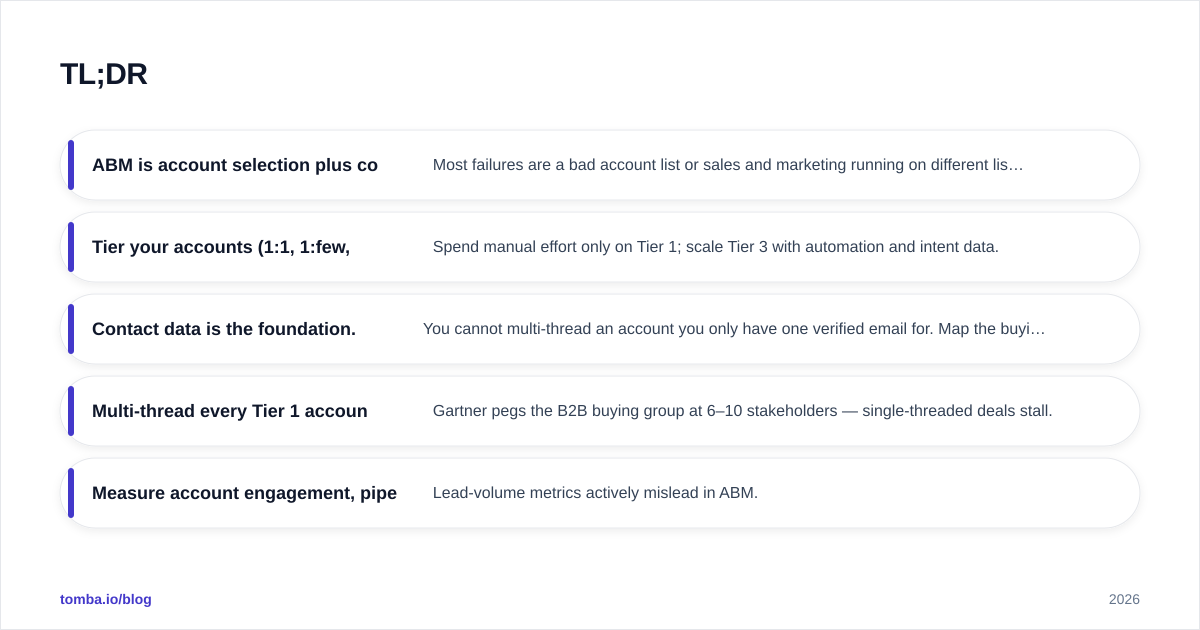
- ABM is account selection plus coordination. Most failures are a bad account list or sales and marketing running on different lists — not a creative problem.
- Tier your accounts (1:1, 1:few, 1:many). Spend manual effort only on Tier 1; scale Tier 3 with automation and intent data.
- Contact data is the foundation. You cannot multi-thread an account you only have one verified email for. Map the buying committee first.
- Multi-thread every Tier 1 account. Gartner pegs the B2B buying group at 6–10 stakeholders — single-threaded deals stall.
- Measure account engagement, pipeline, and influence — not MQLs. Lead-volume metrics actively mislead in ABM.
What is account based marketing, really?#
Account based marketing is a go-to-market strategy where you treat individual accounts (companies) as the unit of targeting instead of individual leads. Think of it as fishing with a spear instead of a net. Traditional demand gen casts a wide net, catches whatever swims in, and sorts the catch later. ABM picks the specific fish first, then aims everything — ads, email, sales outreach, events, content — at that one target.
Technically, ABM is the alignment of marketing and sales around a shared, finite list of named accounts, with coordinated plays across channels and a shared definition of what "engaged" and "won" mean. The strategy only works when both teams operate from the same list. That coordination problem is the root of most failed programs — see Tomba's primer on revenue operations for why RevOps usually owns the shared-list mandate.
The payoff is real when it works. According to HubSpot's research on ABM, companies running mature account-based programs report larger deal sizes and tighter sales-marketing alignment than peers relying on volume-based demand gen. But "mature" is the operative word — the tactics below are what separate mature programs from expensive list-building exercises.
How do you build the target account list?#
Everything downstream depends on this. A brilliant campaign aimed at the wrong 200 accounts is wasted money.
Start with your Ideal Customer Profile (ICP) — the firmographic and technographic traits of accounts that close fast, stay long, and expand. Pull your closed-won deals from the last 18 months and look for patterns: industry, employee count, revenue band, tech stack, region. Then score your total addressable market against those traits.
Layer in intent signals to prioritize. An account that fits your ICP and is researching your category right now is worth ten that merely fit. Intent data from third-party providers, plus your own first-party signals (pricing-page visits, repeat content downloads, demo abandons), tells you which fitting accounts are actually in-market.
Use Tomba's domain search to pressure-test a target account quickly: pull the company's email pattern and the named contacts you can reach, before you commit budget to it. If you cannot find or reach the buying committee, the account is not actionable yet.
What are the three tiers of ABM tactics?#
Not every account deserves the same effort. The standard model splits your list into three tiers, and the account based marketing tactics differ sharply by tier.
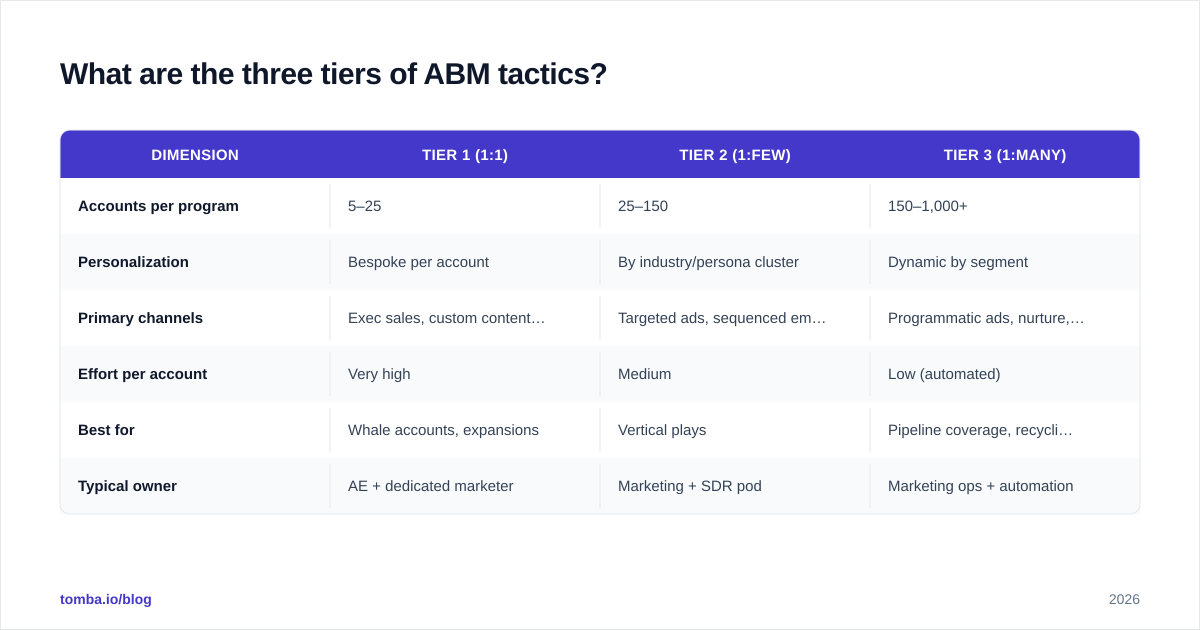
| Dimension | Tier 1 (1:1) | Tier 2 (1:few) | Tier 3 (1:many) |
|---|---|---|---|
| Accounts per program | 5–25 | 25–150 | 150–1,000+ |
| Personalization | Bespoke per account | By industry/persona cluster | Dynamic by segment |
| Primary channels | Exec sales, custom content, events | Targeted ads, sequenced email, webinars | Programmatic ads, nurture, intent triggers |
| Effort per account | Very high | Medium | Low (automated) |
| Best for | Whale accounts, expansions | Vertical plays | Pipeline coverage, recycling |
| Typical owner | AE + dedicated marketer | Marketing + SDR pod | Marketing ops + automation |
Tier 1 (1:1) is true one-to-one marketing for your highest-value targets. You build custom landing pages, write account-specific content, run executive dinners, and have an AE and a marketer assigned to each account. Reserve this for accounts where a single win changes your quarter.
Tier 2 (1:few) clusters similar accounts — say, all mid-market fintechs — and personalizes by the cluster's shared pains. You get most of the relevance of 1:1 at a fraction of the cost.
Tier 3 (1:many) is ABM at scale. You run programmatic ads and automated sequences against hundreds of ICP-fit accounts, then promote accounts up to Tier 2 when they show engagement. This is where intent data earns its keep.
The mistake teams make is treating all accounts as Tier 1 (unsustainable) or all as Tier 3 (no different from demand gen). Tier deliberately, and move accounts between tiers as their engagement changes.
Why does contact data make or break ABM?#
You cannot run account-based plays against an account you can't reach. This is the unglamorous foundation nobody puts in the keynote.
A real ABM motion targets the buying committee, not a single contact. Gartner's B2B buying research finds that a typical complex purchase involves 6 to 10 decision-makers. If you have one verified email at a target account, you are single-threaded — and single-threaded deals die when your champion changes jobs.
So before you launch a play, map the committee: economic buyer, champion, technical evaluator, end users, and the inevitable blocker. For each role you need a name, a verified email, and ideally a direct line. That means:
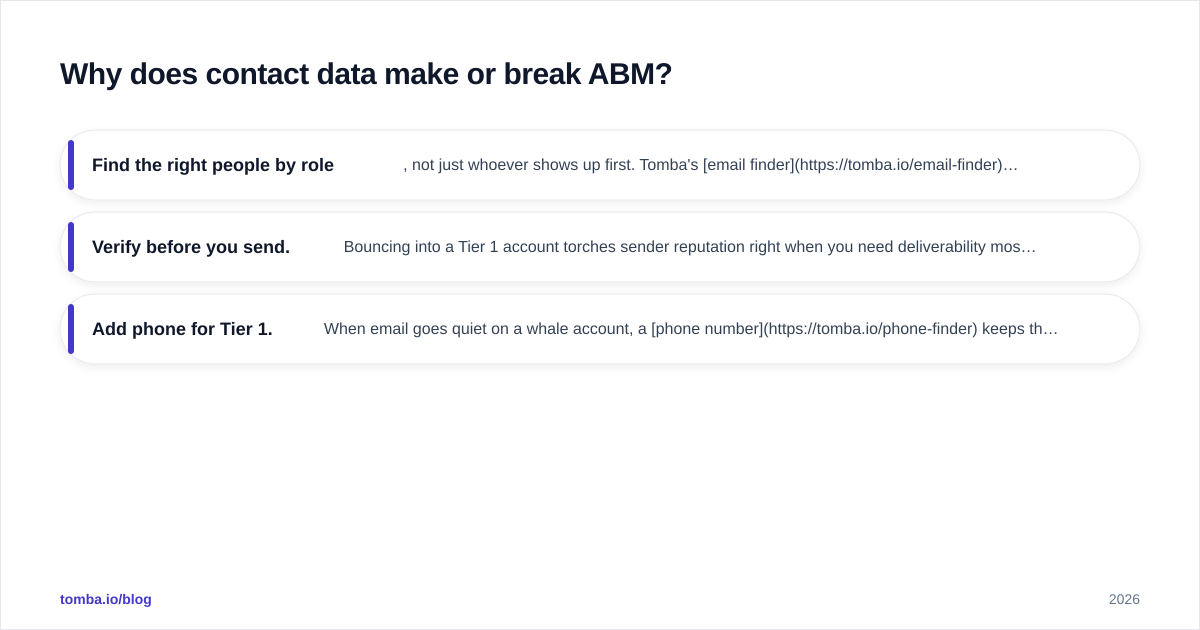
- Find the right people by role, not just whoever shows up first. Tomba's email finder resolves names to professional addresses by domain and role so you can build the full committee.
- Verify before you send. Bouncing into a Tier 1 account torches sender reputation right when you need deliverability most. Run addresses through an email verifier first.
- Add phone for Tier 1. When email goes quiet on a whale account, a phone number keeps the thread alive.
Then enrich and sync. Push the mapped committee into your CRM so sales and marketing see the same picture. Tomba's data enrichment fills firmographic and contact gaps, and the HubSpot and Salesforce integrations keep the account record current as people change roles. Stale committee data is the silent killer of ABM — people change jobs every 18–24 months, and your beautiful map decays with them.
What are the highest-leverage ABM plays in 2026?#
Tactics, not theory. These are the plays that consistently produce engagement and pipeline.
1. The multi-threaded warm-up. Before sales reaches out, marketing runs targeted ads and useful content at 3–5 committee members for two to three weeks. By the time the AE emails, the brand is familiar. Air cover before the ground assault.
2. Personalized landing pages. For Tier 1, build a page that names the account and speaks to its specific situation. "Here's how [Acme] could cut onboarding time by 40%" outperforms a generic demo page by a wide margin. Tools make these cheap to spin up now.
3. Intent-triggered sequences. When a Tier 3 account spikes on intent data, auto-promote it: trigger a sequenced email + ad burst and alert the assigned SDR. Speed-to-signal is the whole game here — a week-old intent spike is cold.
4. Executive-to-executive outreach. For your biggest targets, have your VP or CEO reach out to their counterpart. A peer-level message lands very differently than an SDR's. This requires accurate seniority data, which is exactly what contact mapping gives you.
5. The reactivation play. Mine closed-lost and churned accounts that still fit ICP. They know you, the relationship exists, and the only thing that changed is timing. Re-enrich the committee (people have moved) and re-engage.
6. Account-based retargeting. Sync your target-account list to ad platforms so your spend only hits ICP accounts. You stop paying to advertise to people who will never buy.
Layer these by tier. A Tier 1 account might get plays 1, 2, and 4 simultaneously; a Tier 3 account gets plays 3 and 6 on autopilot until it earns promotion.
How do you measure ABM without lying to yourself?#
Throw out MQL volume. In ABM, counting leads is like judging a spearfisher by how much water they splashed. The metrics that matter operate at the account level.
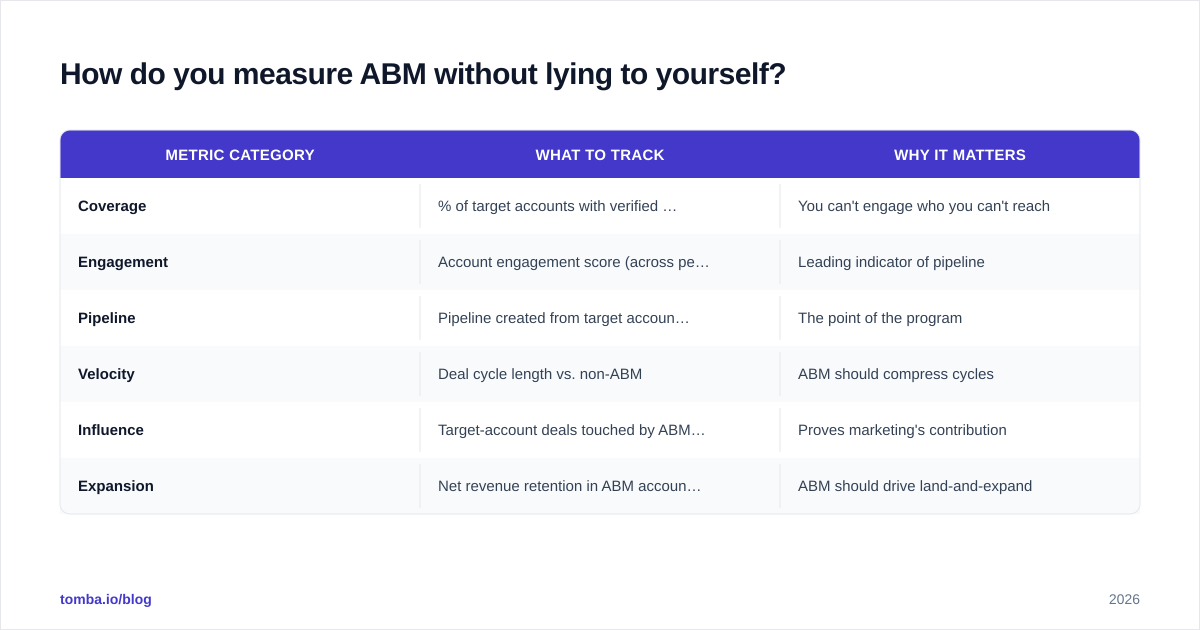
| Metric category | What to track | Why it matters |
|---|---|---|
| Coverage | % of target accounts with verified committee contacts | You can't engage who you can't reach |
| Engagement | Account engagement score (across people + channels) | Leading indicator of pipeline |
| Pipeline | Pipeline created from target accounts | The point of the program |
| Velocity | Deal cycle length vs. non-ABM | ABM should compress cycles |
| Influence | Target-account deals touched by ABM plays | Proves marketing's contribution |
| Expansion | Net revenue retention in ABM accounts | ABM should drive land-and-expand |
Track account engagement as your leading indicator — a rolling score of how many committee members engaged, across how many channels, over what window. Rising engagement predicts pipeline weeks before a deal appears.
Then measure pipeline and influence, not attribution wars. In a 6–10 person buying group with a year-long cycle, last-touch attribution is fiction. Use G2's buyer-behavior data and your own win-rate analysis to understand which plays correlate with wins, and accept that ABM is a team sport where influence beats clean attribution.
A useful gut check: if your dashboard could just as easily belong to a demand-gen team, you are not measuring ABM. Account coverage, account engagement, and target-account pipeline are the three numbers that keep a program honest.
Where does ABM fail, and how do you avoid it?#
Three failure modes account for most dead programs.
Bad list, great execution. The most common one. Teams pour creativity into a target list built on gut feel rather than ICP data and closed-won analysis. Fix it by grounding the list in evidence and re-scoring quarterly.
Sales and marketing on different lists. Marketing runs plays against 200 accounts; sales works a different 150. Engagement evaporates between the cracks. Fix it with a single shared list in the CRM, jointly owned, reviewed in a recurring sync.
Data decay. You build a perfect committee map in Q1, and by Q3 a third of those contacts have moved roles. Plays misfire silently. Fix it by re-enriching target-account contacts on a schedule — quarterly for Tier 1, at minimum. Continuous verification and enrichment is not a nice-to-have; it is the maintenance cost of running ABM at all.
Notice that all three failures are data and coordination problems, not creative ones. That's the recurring lesson of account-based marketing: the tactics are only as good as the account list and contact data underneath them.
Putting it together#
Start small. Pick 20 Tier 1 accounts, map every buying committee, get sales and marketing on the same list, run three coordinated plays, and measure account engagement and pipeline for one quarter. Prove the motion, then scale into Tier 2 and Tier 3 with automation and intent data. A focused 20-account pilot that books two enterprise deals beats a 500-account program that engages no one.
The strategy is straightforward. The execution lives and dies on whether you can reliably find, verify, and reach the right people inside your target accounts — at scale, and again every quarter as the data decays.
That's the part Tomba is built for. Use the Tomba Email Finder to map full buying committees by domain and role, verify every address before you send, and enrich the records straight into HubSpot or Salesforce so sales and marketing finally work the same list. Start on the free tier (25 searches/month), then scale to Starter at $49/mo when your target list grows. Build the contact foundation first — the plays only work when you can actually reach the account.
Ready to find emails that actually work?
Join 150,000+ professionals who stopped guessing and started sending. Free credits on signup — no credit card required.
Get the Tomba newsletter
Practical outbound tactics and product updates — once every two weeks.
About the author