Account Based Marketing Techniques: 12 Plays for 2026
A no-fluff field guide to the account based marketing techniques that actually move pipeline in 2026 — tiering, intent, multi-threading, and the data layer underneath.
Account based marketing techniques have stopped being a "nice to have" experiment that lives in one corner of the marketing team. In 2026 they are how serious B2B revenue teams concentrate budget on the 50 to 500 accounts that can actually move a number. The problem is that most "ABM" still looks like demand gen with a fancier label: the same broad campaigns, the same MQL handoffs, the same spray-and-pray sequences pointed at a slightly smaller list.
This guide is the opposite. Below are the specific, repeatable plays that distinguish account based marketing that compounds from ABM theater that burns budget.
TL;DR#
- ABM is account selection plus orchestration, not just "targeted ads." The technique that matters most is choosing the right accounts and coordinating every channel against them.
- Tier your accounts (1:1, 1:few, 1:many) so spend matches account value — a Tier 1 account deserves a custom microsite; a Tier 3 account deserves a personalized email and a retargeting pixel.
- Intent data and multi-threading are the two highest-leverage techniques in 2026 — find the in-market accounts, then reach 6 to 10 people inside each one, not a single champion.
- Clean contact data is the silent prerequisite. Every play below collapses if your account list is missing verified emails, direct dials, and the right titles.
- Measure pipeline and account engagement, not lead volume. ABM dashboards track tiers moving from aware → engaged → opportunity, not cost-per-lead.
What is account based marketing, really?#
Account based marketing is a go-to-market strategy where you treat individual companies — not individual leads — as the unit of marketing. Instead of casting a wide net and filtering inbound leads, you pick a finite list of high-fit accounts and orchestrate sales, marketing, and customer success to win them.
Think of traditional demand generation like fishing with a net across the whole lake and keeping whatever you catch. ABM is spearfishing: you decide which specific fish you want before you ever get in the water, and every move is aimed at those targets. The technical reality is a tight loop between an ideal customer profile (ICP), an account list, coordinated plays, and shared revenue accountability — which is why ABM lives at the intersection of marketing and revenue operations.
The strategy works because B2B buying is a committee sport. Gartner's research has repeatedly shown a typical B2B purchase involves six to ten decision-makers, each arriving with their own information. You cannot win that committee with one lead and one nurture track. You win it by influencing the whole account.
Which account based marketing techniques actually matter in 2026?#
Here are the twelve plays worth your time, grouped by the stage they belong to.
1. Build a sharp ICP before you touch a campaign#
Every other technique depends on this one. Your ideal customer profile is the filter that decides which accounts make the list. Define it with hard firmographics (industry, employee count, revenue band, tech stack, region) and disqualifiers (e.g., "no companies under 50 employees," "no current competitor customers"). A vague ICP produces a bloated list, and a bloated list dilutes every dollar.
2. Tier your account list#
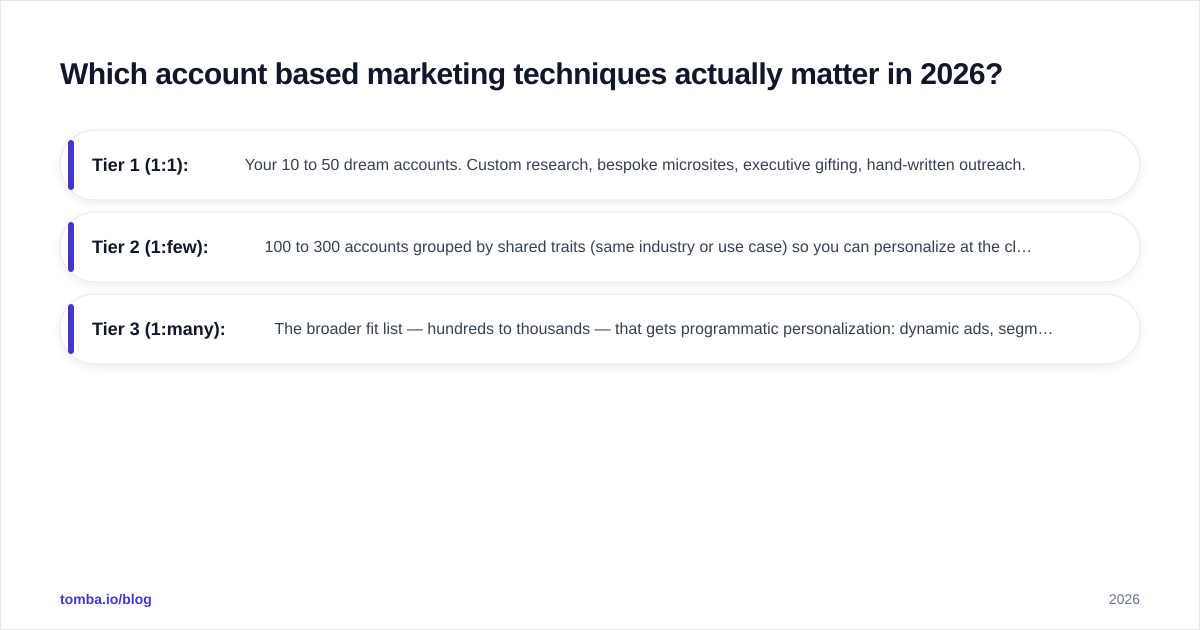
Not every target account deserves the same investment. Split your list into three tiers:
- Tier 1 (1:1): Your 10 to 50 dream accounts. Custom research, bespoke microsites, executive gifting, hand-written outreach.
- Tier 2 (1:few): 100 to 300 accounts grouped by shared traits (same industry or use case) so you can personalize at the cluster level.
- Tier 3 (1:many): The broader fit list — hundreds to thousands — that gets programmatic personalization: dynamic ads, segmented email, retargeting.
3. Layer in intent data#
Intent data tells you which accounts are actively researching your category right now. Third-party intent (from review sites, publisher networks) plus first-party signals (pricing-page visits, repeat docs views) let you prioritize accounts that are in-market this quarter instead of marketing to everyone equally. An account showing a spike in "email finder API" research is worth a same-week response.
4. Multi-thread every Tier 1 and Tier 2 account#
Single-threading — betting the deal on one champion — is the most common ABM failure. Map the buying committee (economic buyer, champion, technical evaluator, blockers) and reach 6 to 10 contacts per account. This is where contact data quality becomes the bottleneck: you need verified emails and titles for everyone on the committee, not just the one name your SDR found on LinkedIn. A reliable email finder and domain search turn an account name into a full, verified contact map in minutes.
5. Personalize at the right altitude#
Personalization is not "Hi {{FirstName}}." For Tier 1, reference the account's actual initiatives — a recent funding round, a job posting that signals a priority, a product launch. For Tier 2, personalize to the segment ("Here's how other Series B fintechs handle X"). For Tier 3, dynamic content blocks keyed to industry are enough. Match effort to tier.
6. Run coordinated, multi-channel plays#
A play is a sequenced set of touches across channels aimed at one account in a defined window. Example Tier 1 play: targeted LinkedIn ads warm the account → SDR sends a personalized email → AE connects with the economic buyer on LinkedIn → a direct-mail piece lands → a custom landing page ties it together. The point is coordination, not channel count.
7. Align sales and marketing on shared accounts#
ABM dies when marketing "generates leads" and sales "works deals" in separate silos. Both teams commit to the same account list, the same definitions of engagement, and a shared SLA on follow-up. Weekly account reviews — not lead reviews — keep them honest.
8. Use retargeting to stay present#
Pixel your target accounts and serve them consistent messaging across the open web and social. Retargeting is cheap air cover that keeps your brand in front of the committee between sales touches.
9. Activate your CRM and enrich it continuously#
Stale CRM data silently kills ABM. Job changes, new hires on the committee, and corrected titles all need to flow in. Continuous data enrichment keeps account records current so your plays hit real, reachable people.
10. Recycle closed-lost and dormant accounts#
Accounts that said "not now" 9 months ago are often your warmest ABM targets today. Build a play specifically for re-engaging closed-lost Tier 1 and 2 accounts when a trigger (new exec, funding, intent spike) appears.
11. Engage existing customers for expansion#
ABM is not only for net-new. Your best expansion revenue comes from running the same orchestration against current accounts — mapping new buying centers and multi-threading into adjacent teams.
12. Measure account engagement, not leads#
Replace cost-per-lead dashboards with an account journey: how many Tier 1 accounts moved from aware → engaged → opportunity → closed this quarter? Engagement minutes, committee coverage, and pipeline created per tier are the metrics that matter.
)
ABM vs. traditional demand generation: which fits your team?#
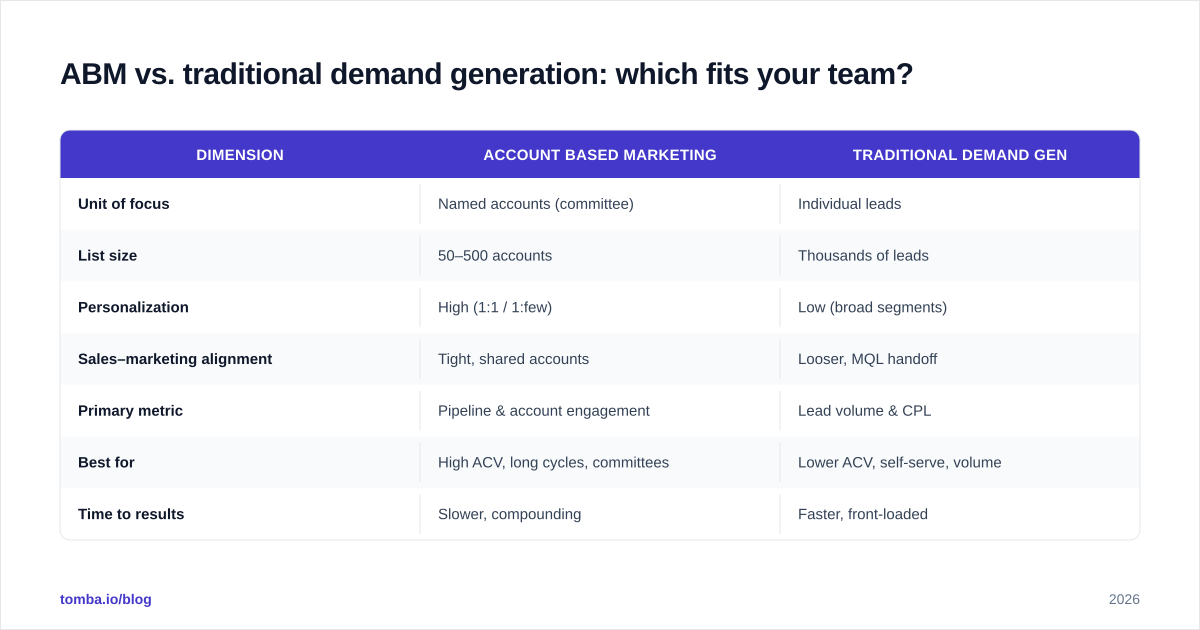
Neither approach is universally "better" — they solve different problems. ABM concentrates resources on a known list; demand gen fills the top of the funnel broadly. Many teams run both: demand gen feeds the database, ABM works the high-value subset.
| Dimension | Account Based Marketing | Traditional Demand Gen |
|---|---|---|
| Unit of focus | Named accounts (committee) | Individual leads |
| List size | 50–500 accounts | Thousands of leads |
| Personalization | High (1:1 / 1:few) | Low (broad segments) |
| Sales–marketing alignment | Tight, shared accounts | Looser, MQL handoff |
| Primary metric | Pipeline & account engagement | Lead volume & CPL |
| Best for | High ACV, long cycles, committees | Lower ACV, self-serve, volume |
| Time to results | Slower, compounding | Faster, front-loaded |
| Data dependency | Very high (verified contacts) | Moderate |
The honest rule of thumb: if your average contract value is high and your sales cycles involve a buying committee, ABM techniques will out-earn broad demand gen. If you sell a low-ACV, high-velocity product, pure ABM is overkill.
What ABM tech stack do you actually need?#
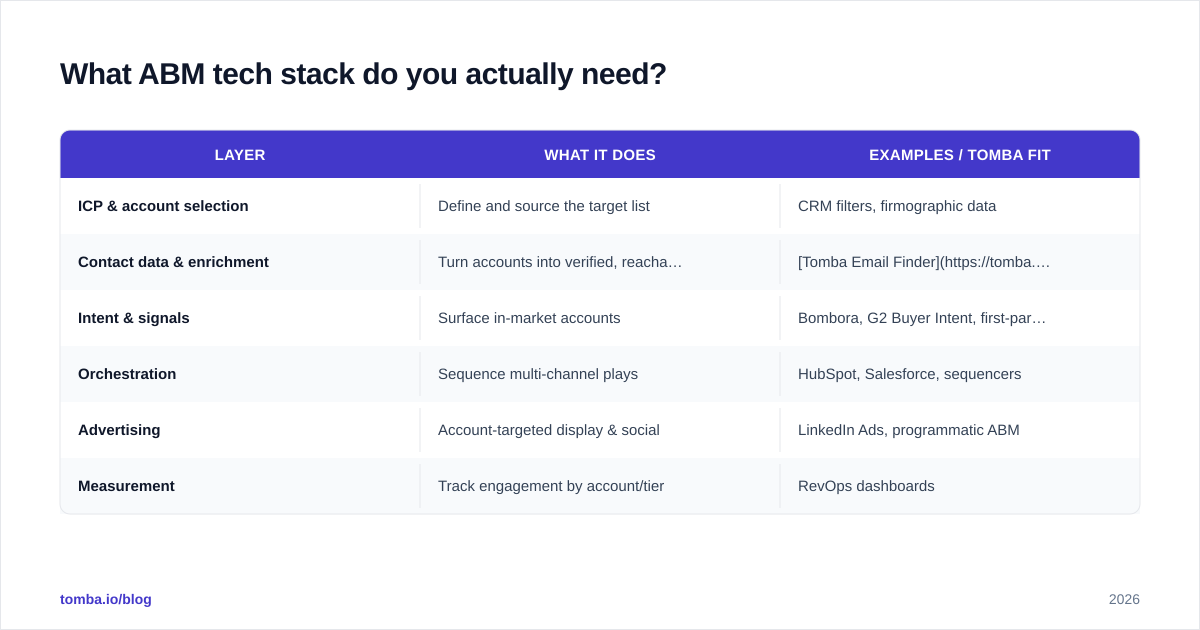
You do not need every category below to start, but you do need the data layer.
| Layer | What it does | Examples / Tomba fit |
|---|---|---|
| ICP & account selection | Define and source the target list | CRM filters, firmographic data |
| Contact data & enrichment | Turn accounts into verified, reachable people | Tomba Email Finder, email verifier, bulk lookup |
| Intent & signals | Surface in-market accounts | Bombora, G2 Buyer Intent, first-party |
| Orchestration | Sequence multi-channel plays | HubSpot, Salesforce, sequencers |
| Advertising | Account-targeted display & social | LinkedIn Ads, programmatic ABM |
| Measurement | Track engagement by account/tier | RevOps dashboards |
The layer teams underinvest in is the second one. You can have the slickest orchestration platform on the market, but if 30% of your committee emails bounce or point to the wrong person, the play never lands. That is why ABM mature teams treat contact accuracy as a first-class requirement — verifying emails before send, finding direct contacts by domain, and enriching records on an ongoing basis rather than once at import.
)
How do you launch your first ABM program in 90 days?#
You do not need a year-long transformation. A focused 90-day pilot proves the model.
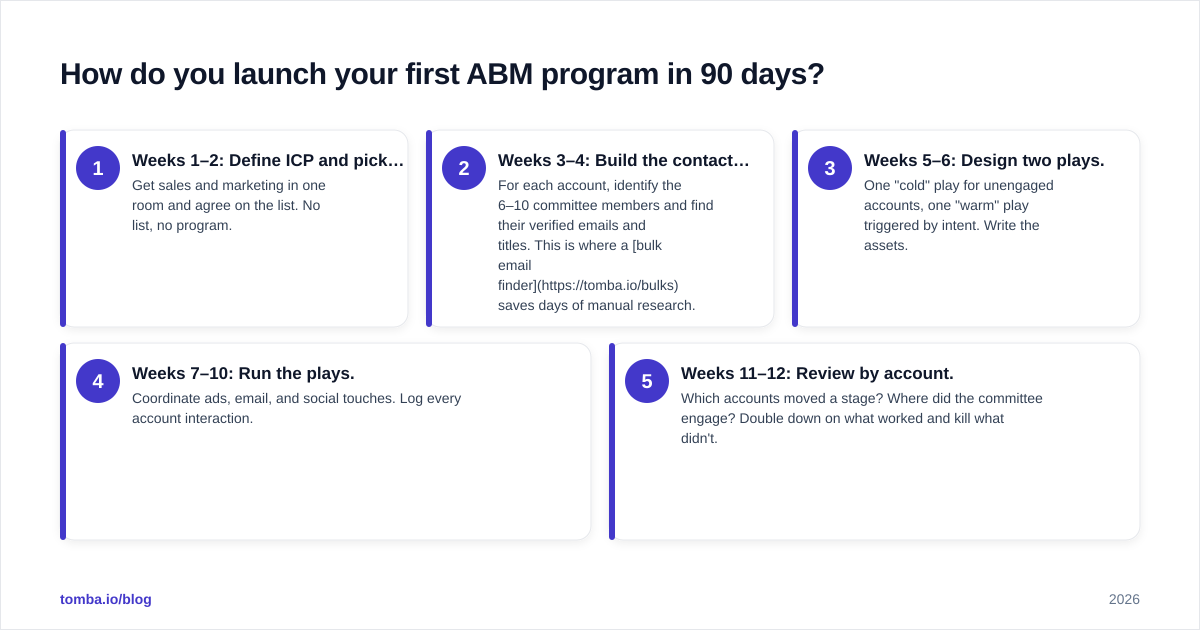
- Weeks 1–2: Define ICP and pick 25 Tier 1 accounts. Get sales and marketing in one room and agree on the list. No list, no program.
- Weeks 3–4: Build the contact map. For each account, identify the 6–10 committee members and find their verified emails and titles. This is where a bulk email finder saves days of manual research.
- Weeks 5–6: Design two plays. One "cold" play for unengaged accounts, one "warm" play triggered by intent. Write the assets.
- Weeks 7–10: Run the plays. Coordinate ads, email, and social touches. Log every account interaction.
- Weeks 11–12: Review by account. Which accounts moved a stage? Where did the committee engage? Double down on what worked and kill what didn't.
The discipline that makes or breaks the pilot is data hygiene at step 2. According to data-quality research aggregated by vendors like HubSpot, B2B contact data decays at roughly 20–30% per year as people change jobs — which means a list you built last year is already partly wrong. Verify before you orchestrate.
What are the most common ABM mistakes to avoid?#
- Too many accounts. A "Tier 1" of 400 accounts is not Tier 1. Concentration is the point.
- Single-threading. Betting the account on one contact who can ghost you or leave.
- Personalization theater. Inserting a company name into a generic email is not ABM.
- No sales buy-in. If sales didn't help pick the list, they won't work it.
- Vanity metrics. Reporting impressions and clicks instead of account stage progression.
- Dirty data. Launching plays against unverified contacts and blaming the channel when nothing lands.
Avoiding the last point is mostly mechanical: run your committee list through an email verifier before every major send, and re-enrich quarterly. Tools like G2 maintain category breakdowns if you want to compare orchestration platforms, but the platform choice matters far less than the quality of the list you feed it.
How do you scale ABM once the pilot works?#
Scaling is not "add more accounts to Tier 1." It is building repeatable systems: templated plays per segment, automated enrichment pipelines, and intent triggers that auto-assign accounts to the right tier. As you expand from 25 to 250 accounts, the manual contact research from your pilot becomes the bottleneck — this is the point where you wire an email finder API into your CRM so that every new account on the list is automatically resolved into a verified contact map without an SDR doing it by hand.
The teams that win at scale treat ABM as an operating system, not a campaign. The plays stay the same; the data and orchestration get automated underneath them.
Bottom line#
Account based marketing techniques work when you do the unglamorous parts well: pick the right accounts, tier them honestly, reach the whole committee, and keep your data clean enough that every play actually reaches a human. The strategy rewards concentration and punishes spray-and-pray dressed up in ABM language.
If your ABM program is stalling on data — bounced committee emails, missing decision-makers, stale CRM records — start at the foundation. The Tomba Email Finder turns an account name or domain into a verified, multi-threaded contact map so your plays land on the right people the first time. Try it free with 25 searches a month, then scale through the Starter plan at $49/mo as your account list grows. Get the data layer right, and every other ABM technique on this list starts compounding.
// get started
Find, verify and enrich your first contacts today
Start on the free plan with 25 searches a month, then scale when your team is ready.
Free plan · No credit card required · GDPR & CCPA
// about the author