Account Based Marketing Tools: The 2026 Buyer's Guide
ABM only works when your tech stack can find, target, and enrich the right accounts. Here's how to pick account based marketing tools that actually move pipeline in 2026 — not just spend budget.
Account-based marketing promises to flip the funnel: instead of collecting leads and hoping a few fit, you pick the accounts worth winning and build everything around them. The strategy is sound. The reason most ABM programs stall is the tooling — teams buy a six-figure platform before they can even reliably identify and reach the people inside their target accounts.
This guide breaks down the categories of account based marketing tools, what each layer actually does, how the major platforms compare, and a framework for assembling a stack that fits your team size and budget.
TL;DR#
- ABM tooling is a stack, not a single product. You need four layers: target-account data, intent/identification, orchestration, and measurement.
- Most teams overspend on orchestration and underspend on data. Bad contact data quietly sinks even the best platform.
- Full-suite platforms (Demandbase, 6sense, Terminus) are powerful but expensive and slow to implement; best-of-breed stacks are leaner and cheaper to start.
- Use the comparison table below to match a tool to your stage, then read the framework section before you sign anything.
- Whatever platform you choose, accurate contact discovery and enrichment is the foundation — start there with a tool like Tomba Email Finder.
What are account based marketing tools?#
Account based marketing tools are the software that lets you treat a defined list of high-value companies as "markets of one." Instead of running campaigns to anonymous segments, you coordinate targeted advertising, sales outreach, web personalization, and reporting around named accounts and the buying committees inside them.
Think of it like a wedding planner versus a billboard. A billboard (traditional demand gen) shouts at everyone driving past and hopes the right people notice. A wedding planner (ABM) knows exactly who the guests are, what each one cares about, and orchestrates a tailored experience for them. ABM tools are the planner's clipboard, contact list, and seating chart.
Technically, the category spans everything from data enrichment and intent providers to ad platforms, web personalization engines, and multi-touch attribution. No single vendor does all of it well, which is why "ABM stack" is the more honest term.
What are the core layers of an ABM stack?#
Before comparing brands, get clear on the four jobs your stack has to do. According to Gartner's research on ABM, the programs that succeed are the ones that tie account selection directly to sales execution — not the ones with the flashiest ad tech.
Layer 1 — Target-account data. Who are you going after, and who sits on the buying committee? This is firmographic data, technographics, and — critically — accurate contact details (emails, phones, LinkedIn) for the decision-makers. Tools here include B2B databases, enrichment APIs, and email finders.
Layer 2 — Intent and identification. Which target accounts are actually in-market right now, and which anonymous visitors on your site belong to them? This is intent data (third-party and first-party) plus website visitor identification.
Layer 3 — Orchestration. How do you coordinate ads, email, sales tasks, and personalization across the committee? This is the "ABM platform" layer most people picture — display advertising, sequences, and play automation.
Layer 4 — Measurement. Did it work? Account-level attribution, pipeline influence, and engagement scoring that your CRM can actually report on.
The mistake teams make is buying Layer 3 first because it's the most visible, then discovering Layers 1 and 2 are empty. A beautiful orchestration engine pointed at stale contact data just automates waste.
What types of ABM tools exist?#
Vendors cluster into a few recognizable shapes:
- Full-suite ABM platforms — Demandbase, 6sense, Terminus. They bundle intent, advertising, web personalization, and analytics. Strong if you have a mature RevOps function to run them.
- Sales intelligence and data platforms — ZoomInfo, Apollo, Cognism, Tomba. They supply the account and contact data the rest of the stack runs on.
- Ad and personalization tools — RollWorks, Mutiny, Folloze. They handle targeted display and dynamic landing pages.
- CRM and engagement layers — HubSpot, Salesforce, Salesloft, Outreach. They execute the human touches and hold the account record.
Most real-world stacks mix two or three of these. A common lean pattern: a data provider for Layer 1, your CRM's native ABM features for Layer 3, and a focused intent or visitor-reveal tool for Layer 2.
Which account based marketing tools compare best in 2026?#
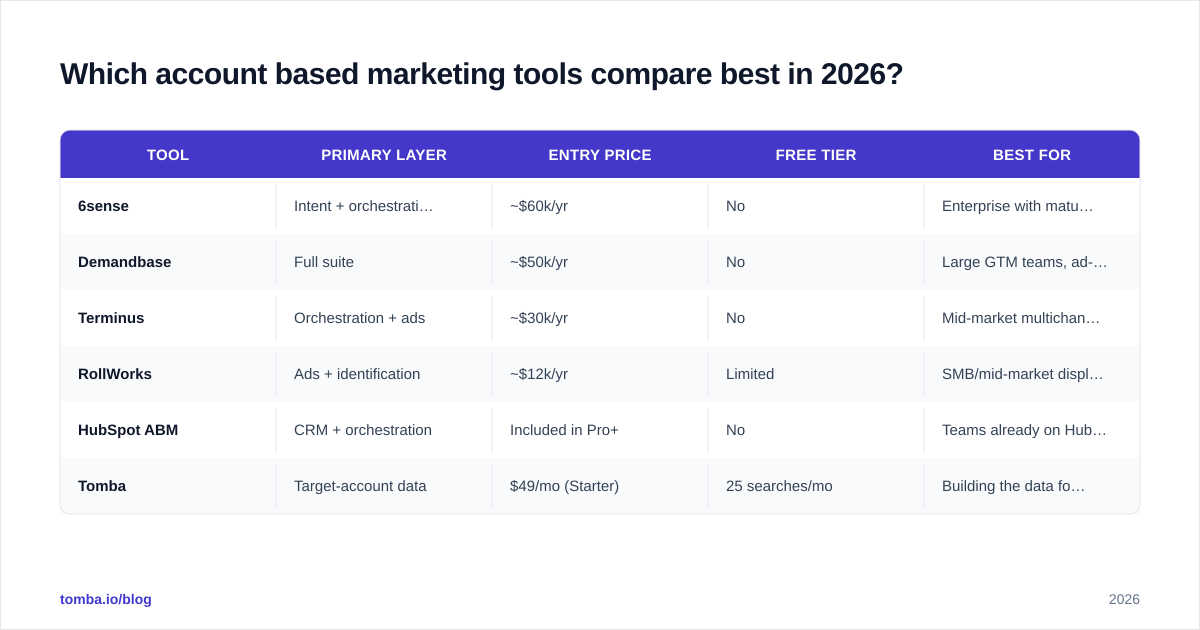
Here's a head-to-head across the attributes that actually drive the buying decision. Pricing reflects publicly listed entry points or typical contract minimums as of 2026; enterprise quotes vary widely.
| Tool | Primary layer | Entry price | Free tier | Best for |
|---|---|---|---|---|
| 6sense | Intent + orchestration | ~$60k/yr | No | Enterprise with mature RevOps |
| Demandbase | Full suite | ~$50k/yr | No | Large GTM teams, ad-heavy ABM |
| Terminus | Orchestration + ads | ~$30k/yr | No | Mid-market multichannel ABM |
| RollWorks | Ads + identification | ~$12k/yr | Limited | SMB/mid-market display ABM |
| HubSpot ABM | CRM + orchestration | Included in Pro+ | No | Teams already on HubSpot |
| Tomba | Target-account data | $49/mo (Starter) | 25 searches/mo | Building the data foundation affordably |
Two honest caveats. First, the enterprise suites deliver real value once they're fully implemented, but implementation routinely takes a quarter or more and demands a dedicated owner. Second, none of them removes the need for clean contact data — they assume you bring it or buy their data add-on at extra cost. Cross-check vendor claims on a neutral source like G2's ABM software category before you commit.
For a sense of where the category is heading, Forrester's B2B research consistently points to the same conclusion: the differentiator in 2026 isn't more channels, it's tighter alignment between the data that selects accounts and the plays that engage them.
How do you build a lean ABM stack without overspending?#
Conclusion first: start with data and identification, prove pipeline on a small account list, then add orchestration only when manual coordination becomes the bottleneck.
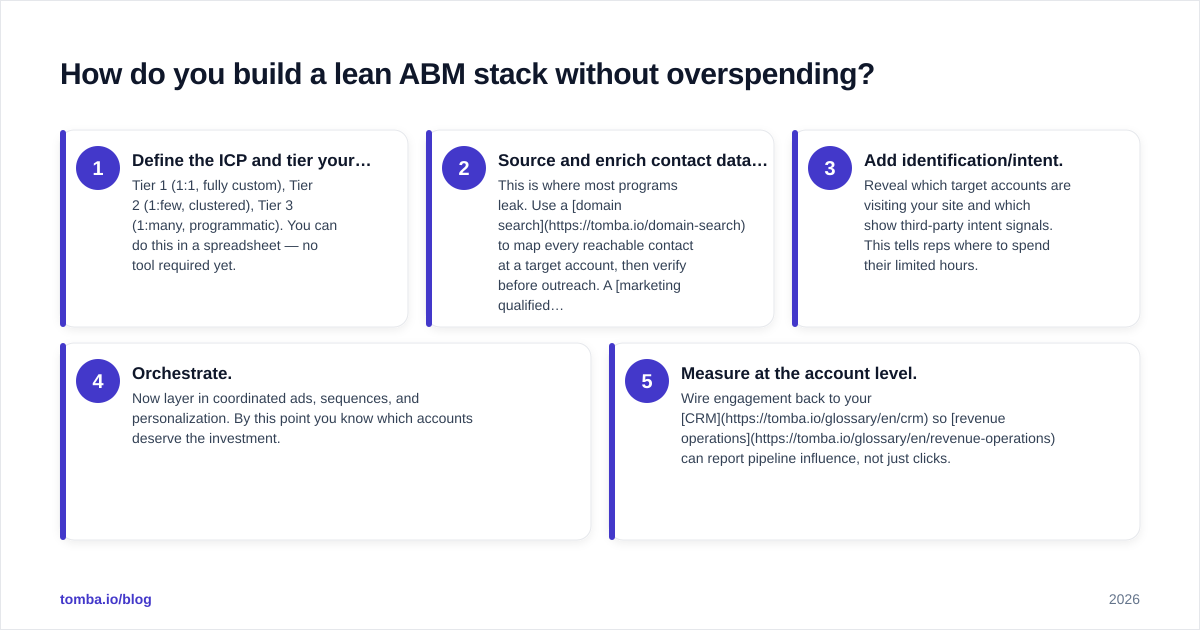
Here's the sequence that keeps spend proportional to proof:
- Define the ICP and tier your accounts. Tier 1 (1:1, fully custom), Tier 2 (1:few, clustered), Tier 3 (1:many, programmatic). You can do this in a spreadsheet — no tool required yet.
- Source and enrich contact data for the buying committee. This is where most programs leak. Use a domain search to map every reachable contact at a target account, then verify before outreach. A marketing qualified lead means nothing if the email bounces.
- Add identification/intent. Reveal which target accounts are visiting your site and which show third-party intent signals. This tells reps where to spend their limited hours.
- Orchestrate. Now layer in coordinated ads, sequences, and personalization. By this point you know which accounts deserve the investment.
- Measure at the account level. Wire engagement back to your CRM so revenue operations can report pipeline influence, not just clicks.
A team running this sequence can launch a credible Tier 1/Tier 2 program for a few hundred dollars a month, then graduate to a suite once volume justifies it. Connect the pieces through Tomba's HubSpot integration or Salesforce integration so enriched contacts flow straight into the account record.
When should you buy a full ABM platform vs. assemble a stack?#
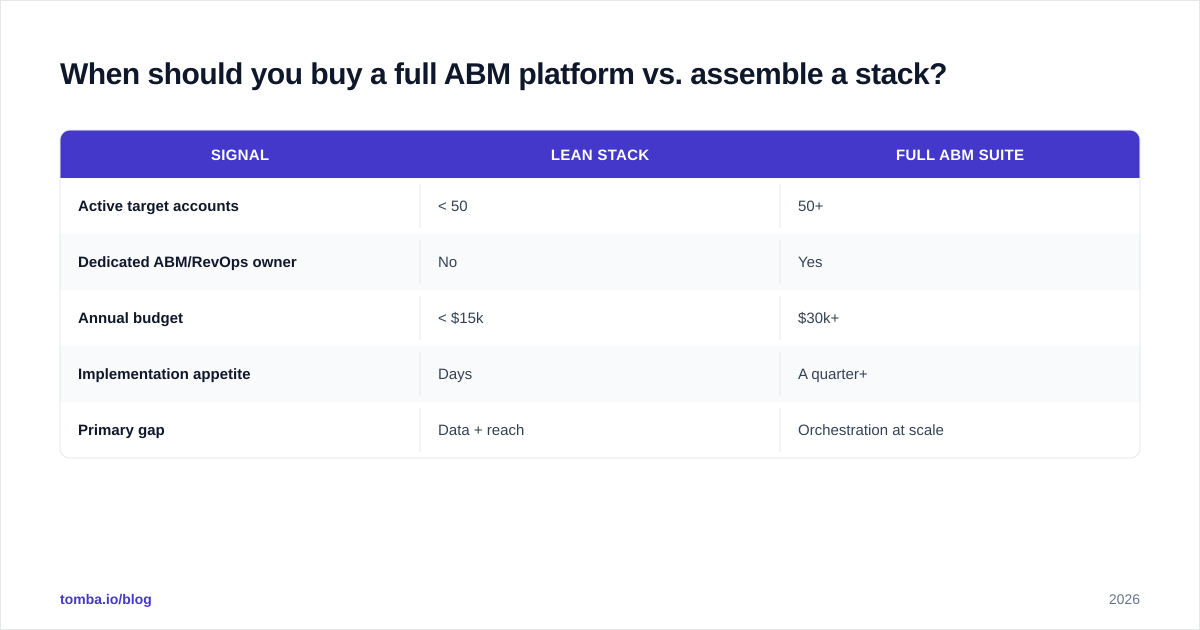
Buy the suite when three things are true at once: you have 50+ active target accounts in flight, a dedicated RevOps or ABM owner to run the platform, and a sales-marketing relationship strong enough to act on the signals. Below that threshold, a full suite is an expensive way to do what a spreadsheet, a data provider, and your existing CRM already cover.
| Signal | Lean stack | Full ABM suite |
|---|---|---|
| Active target accounts | < 50 | 50+ |
| Dedicated ABM/RevOps owner | No | Yes |
| Annual budget | < $15k | $30k+ |
| Implementation appetite | Days | A quarter+ |
| Primary gap | Data + reach | Orchestration at scale |
The pattern that wastes the most money is buying enterprise orchestration to compensate for a weak data layer. It never works — the platform faithfully delivers personalized ads to contacts whose emails you can't even confirm. Fix the foundation first.
How does data quality decide whether ABM works?#
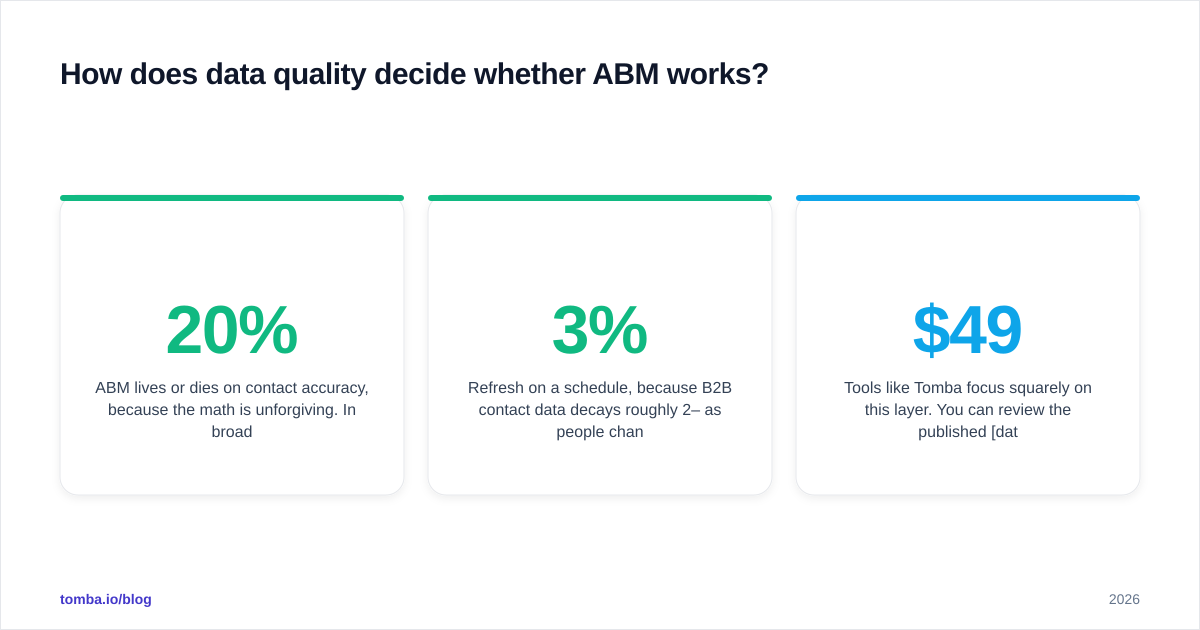
ABM lives or dies on contact accuracy, because the math is unforgiving. In broad demand gen, a 20% bounce rate is annoying. In ABM, where each Tier 1 account might have a buying committee of six and you're targeting a few hundred accounts total, a 20% data failure means you're silently missing a fifth of the people you spent months selecting.
That's why the data layer deserves more scrutiny than the dashboards. Before outreach, you should be able to:
- Find every relevant contact at a target domain — use find email addresses by company and role.
- Verify each address so sequences don't burn your sender reputation — run them through an email verifier.
- Enrich the record with title, seniority, and phone so reps can prioritize and multithread.
- Refresh on a schedule, because B2B contact data decays roughly 2–3% per month as people change jobs.
Tools like Tomba focus squarely on this layer. You can review the published data sources and the transparent Tomba pricing — Free (25 searches/mo), Starter $49/mo, Growth $99/mo, Pro $249/mo, and Enterprise — which makes it realistic to build the data foundation before you've committed to a five-figure suite. For broader context on the discipline, HubSpot's account-based marketing guide is a solid neutral primer on aligning the strategy with execution.
What's the simplest way to start ABM this quarter?#
Pick 25 dream accounts. Map the buying committee for each. Find and verify every contact. Personalize one outbound play and one ad audience. Measure replies and meetings by account, not by lead. That's a complete ABM pilot you can run in weeks, and it tells you exactly which heavier tools — if any — you actually need next.
If the pilot proves the motion, scale the account list before you scale the tech. More accounts justify orchestration; more orchestration without more qualified accounts just inflates cost.
Start with the foundation#
Every ABM stack, lean or enterprise, runs on one thing: knowing exactly who to reach inside each target account and being able to reach them. That's the layer to get right before anything else.
Tomba Email Finder lets you map the full buying committee at any target domain, verify every address, and push enriched contacts straight into your CRM — starting free with 25 searches a month and scaling to bulk discovery when your account list grows. Build the foundation first, then add orchestration when the pipeline proves you need it. Find the people behind your dream accounts, and the rest of the ABM stack finally has something to work with.
// get started
Find, verify and enrich your first contacts today
Start on the free plan with 25 searches a month, then scale when your team is ready.
Free plan · No credit card required · GDPR & CCPA
// about the author