Account Based Marketing vs Inbound Marketing: 2026 Guide
ABM hunts named accounts with 1:1 precision; inbound pulls buyers in at scale. Here's how to pick, blend, and budget both in 2026 — with a side-by-side breakdown.
TL;DR
- Account-based marketing (ABM) flips the funnel: you pick a finite list of high-value accounts first, then orchestrate personalized 1:1 outreach across sales and marketing. Inbound marketing does the opposite — you publish content that pulls a wide audience in, then filter for fit.
- ABM wins on deal size, sales-marketing alignment, and enterprise win rates. Inbound wins on cost-per-lead, compounding SEO traffic, and reaching buyers you haven't identified yet.
- They are not rivals. The strongest 2026 GTM motions run inbound as the demand engine and ABM as the conversion layer on top of your best-fit accounts.
- The hidden cost of ABM is data: accurate contact and account intelligence. Bad emails sink even a perfectly targeted play.
- Pick ABM when you sell few, expensive deals to named buyers. Pick inbound when you sell to a broad, self-educating market. Most teams need both.
What is account-based marketing?#
Account-based marketing is a focused growth strategy where marketing and sales agree on a specific set of target accounts and treat each one as a "market of one." Instead of casting a wide net and hoping qualified buyers surface, you decide upfront which companies are worth winning — usually based on revenue potential, industry fit, and strategic value — then build coordinated campaigns aimed squarely at the decision-makers inside them.
Think of ABM like fishing with a spear instead of a net. You're not trying to catch whatever swims by; you've identified the specific fish you want and you're going after it deliberately. A typical ABM motion involves building an account list, mapping the buying committee (often 6–10 people in enterprise deals), enriching each contact with verified data, and then hitting them with personalized ads, emails, direct mail, and sales touches that all reference the same narrative.
The model inverts the traditional funnel. Rather than awareness → interest → decision across a huge anonymous crowd, ABM starts narrow and goes deep. Forrester's research on account-based strategies has repeatedly shown that aligning marketing and sales around named accounts lifts win rates and deal velocity — which is why ABM became the default enterprise B2B playbook.
What is inbound marketing?#
Inbound marketing earns attention by creating content and experiences buyers actively seek out — blog posts, SEO landing pages, webinars, free tools, newsletters — so prospects come to you instead of being interrupted. The philosophy, popularized by HubSpot, is "attract, engage, delight": publish something genuinely useful, rank for the questions your buyers ask, and convert that traffic into leads with gated offers and email nurture.
Where ABM is a spear, inbound is a magnet. You don't know exactly who will show up, but you build gravity that pulls in anyone researching your category. A single well-ranked guide can generate qualified leads for years at near-zero marginal cost. That compounding quality is inbound's superpower — and its patience tax. Content takes months to rank, and you'll attract plenty of poor-fit traffic alongside the gold.
Inbound is fundamentally a volume-and-filter game. You accept that most visitors won't buy, optimize for the small percentage who will, and let scale do the work. It thrives in markets with broad demand, lots of search volume, and buyers who self-educate before talking to sales.
Account based marketing vs inbound marketing: what's the core difference?#
The core difference between account based marketing vs inbound marketing is direction of motion: ABM pushes tailored messages out to a known, finite list; inbound pulls an unknown, broad audience in. Everything else — budget shape, metrics, team structure — flows from that one distinction.
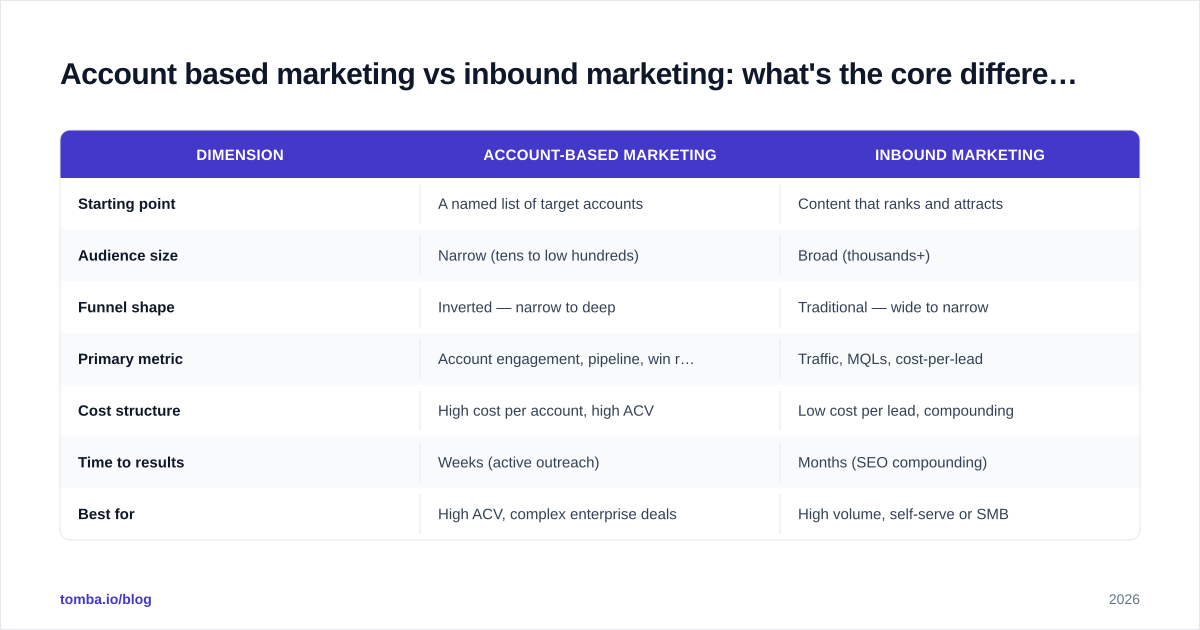
ABM is "land the accounts we chose." Inbound is "discover the accounts who chose us." One starts with a target list and measures account engagement; the other starts with content and measures traffic-to-lead conversion. Here's the side-by-side:
| Dimension | Account-Based Marketing | Inbound Marketing |
|---|---|---|
| Starting point | A named list of target accounts | Content that ranks and attracts |
| Audience size | Narrow (tens to low hundreds) | Broad (thousands+) |
| Funnel shape | Inverted — narrow to deep | Traditional — wide to narrow |
| Primary metric | Account engagement, pipeline, win rate | Traffic, MQLs, cost-per-lead |
| Cost structure | High cost per account, high ACV | Low cost per lead, compounding |
| Time to results | Weeks (active outreach) | Months (SEO compounding) |
| Best for | High ACV, complex enterprise deals | High volume, self-serve or SMB |
| Personalization | 1:1 or 1:few, deeply tailored | 1:many, segment-level |
| Sales involvement | Tight, from day one | Later, after lead qualifies |
| Data dependency | Critical — needs verified contacts | Moderate — form fills self-report |
Notice the last row. ABM lives or dies on data quality. If your target list is built on guessed email addresses and stale job titles, your perfectly orchestrated campaign lands in nobody's inbox. Inbound is more forgiving here because the prospect hands you their own contact details when they fill out a form.

Is ABM better than inbound marketing?#
Neither is "better" — they solve different problems, and the right answer depends on your average contract value and how your buyers research. ABM is better when you sell a small number of expensive deals to identifiable companies. Inbound is better when you sell to a large, diffuse market that educates itself through search.
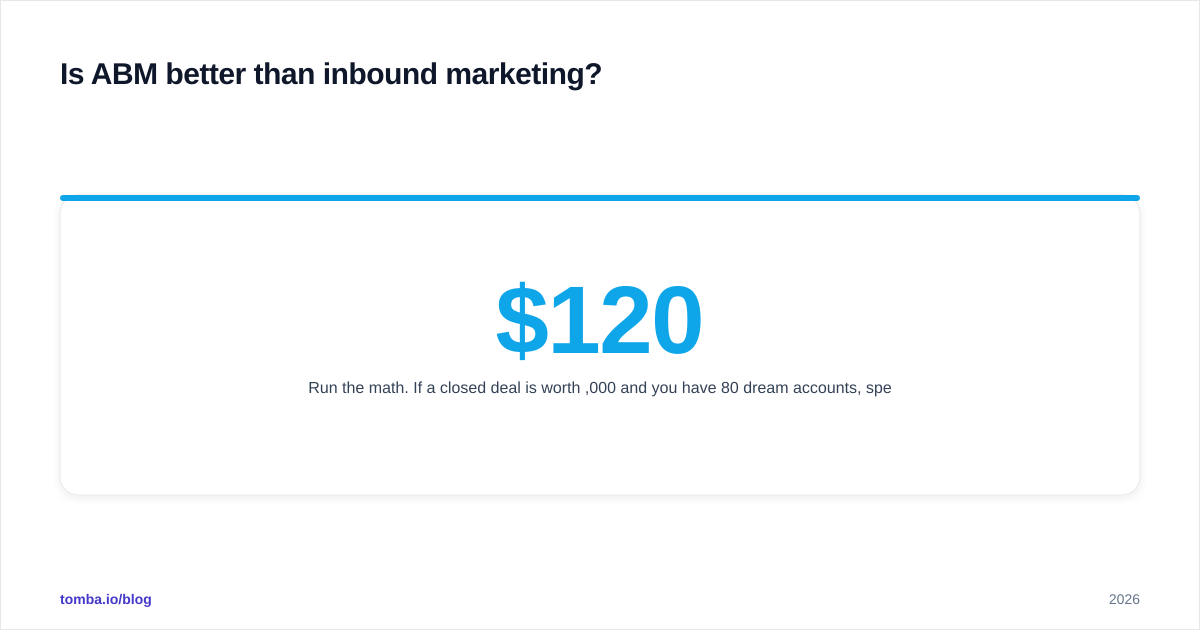
Run the math. If a closed deal is worth $120,000 and you have 80 dream accounts, spending $2,000 of orchestration per account is trivially justified — one win pays for the whole program many times over. That's ABM's home turf. But if your product is $40/month and your buyers are spread across thousands of small businesses, you can't afford 1:1 outreach to each. You need content that ranks once and converts forever. That's inbound.
The decision tree is short:
- High ACV, few named buyers, long sales cycle, committee decisions → lead with ABM.
- Low-to-mid ACV, broad market, high search volume, self-serve onboarding → lead with inbound.
- Somewhere in between, or scaling up-market → blend them (see below).
A common mistake is treating this as ideological. ABM purists dismiss inbound as "spray and pray"; inbound purists call ABM "expensive cold outreach with extra steps." Both caricatures are wrong. The teams winning in 2026 use each where it's strongest.

How do you combine ABM and inbound marketing?#
You combine them by using inbound as the top-of-funnel demand engine and ABM as the targeted conversion layer for your best-fit accounts — a model often called "ABM and inbound working as one revenue motion." Inbound surfaces intent signals at scale; ABM acts on the signals that match your ideal customer profile.
Here's the practical loop. Your content attracts a broad audience and your analytics reveal which companies are visiting high-intent pages — pricing, comparison guides, product docs. You feed those companies into your revenue operations workflow, score them against your ICP, and promote the strongest matches into an ABM track. From there, ABM takes over with personalized sequences to the specific buying committee.
This blended motion fixes the biggest weakness of each strategy. Pure inbound wastes sales time on poor-fit leads who happened to download an ebook. Pure ABM ignores in-market buyers you never put on your list. Together, inbound widens the aperture and ABM sharpens the focus.
The connective tissue is data. When a target account shows up in your inbound analytics, you need to instantly identify the right humans inside it and reach them. That means turning a company domain into a verified buying committee — which is exactly where contact intelligence tooling earns its place in the stack.
What does the tech stack look like for each?#
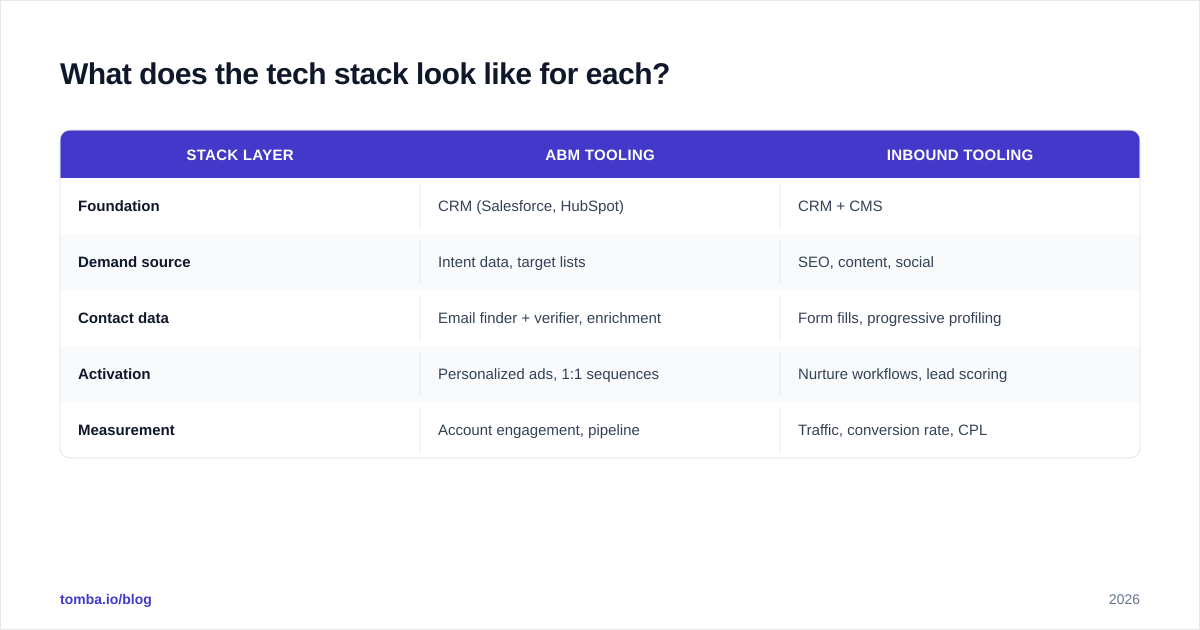
ABM and inbound share some tooling (a CRM, a marketing automation platform) but diverge sharply at the edges. ABM needs account selection, intent data, and contact enrichment; inbound needs content, SEO, and conversion optimization. Here's how the stacks compare:
| Stack layer | ABM tooling | Inbound tooling |
|---|---|---|
| Foundation | CRM (Salesforce, HubSpot) | CRM + CMS |
| Demand source | Intent data, target lists | SEO, content, social |
| Contact data | Email finder + verifier, enrichment | Form fills, progressive profiling |
| Activation | Personalized ads, 1:1 sequences | Nurture workflows, lead scoring |
| Measurement | Account engagement, pipeline | Traffic, conversion rate, CPL |
For the contact-data layer in an ABM motion, you need to convert a list of target companies into reachable people fast. A domain search pulls every known email pattern and contact at a target company, and an email verifier confirms those addresses are deliverable before your reps ever hit send. Skipping verification is how ABM campaigns quietly torch their sender reputation — too many bounces and your whole domain lands in spam folders.
If you're scaling a large account list, a bulk email finder lets you enrich hundreds of accounts in one pass rather than researching each by hand. The goal is the same regardless of volume: never run targeted outreach on unverified data. You can compare plan tiers and credit limits on the Tomba pricing page to size this against your account count.
Inbound's stack, by contrast, invests in content production and search visibility. You're less worried about finding individual emails because your forms capture them — though you'll still want verification to keep your nurture lists clean. Tools like G2 and review platforms also feed inbound by capturing buyers in active comparison mode.
How do you measure success for ABM vs inbound?#
You measure ABM by account-level outcomes — engagement, pipeline created, and win rate within your target list — and inbound by funnel-level efficiency — traffic, lead volume, and cost-per-lead. Mixing up the metrics is the fastest way to wrongly conclude a strategy "isn't working."
For ABM, vanity metrics like raw impressions are nearly meaningless. What matters is whether your named accounts are engaging: Are the right people opening emails, visiting your site, and accepting meetings? Track account penetration (how many committee members you've reached), pipeline velocity, and ultimately the win rate on targeted accounts versus non-targeted ones. If ABM accounts close at 2–3x the rate of the rest, the program is working even if "lead volume" looks small.
For inbound, efficiency rules. Cost-per-lead, organic traffic growth, response rate on nurture sequences, and the conversion rate from visitor to marketing qualified lead tell you whether the content engine is compounding. Inbound metrics trend up slowly then accelerate; judging a content program at 90 days will almost always make it look like a failure.
The shared metric that unites both is pipeline. At the end of the quarter, your CRO doesn't care whether revenue came from a spear or a magnet — only that it showed up. Report both motions against pipeline contribution and the false ABM-versus-inbound rivalry dissolves into a portfolio question: what mix of each produces the most efficient pipeline for your business?
Which should you choose in 2026?#
Choose based on your deal economics and buyer behavior, not on trends. The honest answer for most B2B teams in 2026 is "both, sequenced correctly" — but if forced to start with one, let your average contract value decide.
If you sell six-figure deals into a clearly defined set of enterprise accounts, start with ABM. The precision pays for itself, and you can layer inbound underneath later to feed the top of the funnel. If you sell a broad, lower-priced product to a market that researches via search, start with inbound. Build the content moat first, then graduate your highest-intent visitors into an ABM track once you can identify them.
Whichever you lead with, the unglamorous differentiator is the same: data accuracy. A brilliant ABM campaign aimed at the wrong email address is wasted budget, and an inbound lead with a fake email never gets nurtured. Before you scale either motion, make sure the contacts you're acting on are real and reachable. Tomba's email finder turns a name and company domain into a verified professional email, so your targeted outreach actually reaches the buying committee instead of bouncing. Pair it with bulk verification and you've removed the single biggest point of failure in both strategies. Start free with 25 searches a month, and scale up to the Starter plan at $49/mo once your account list grows — the precision of ABM and the reach of inbound both depend on getting the contact data right first.
Ready to find emails that actually work?
Join 150,000+ professionals who stopped guessing and started sending. Free credits on signup — no credit card required.
Get the Tomba newsletter
Practical outbound tactics and product updates — once every two weeks.
About the author