Account Based Marketing vs Lead Generation: 2026 Guide
ABM targets a named list of high-value accounts; lead generation fills the funnel with volume. Here's how to choose, blend, and fund each in 2026.
Account based marketing vs lead generation is not a fight you have to win — it's a budget split you have to get right. One starts with a named list of companies you've decided are worth pursuing. The other starts with a wide net and sorts the catch later. Pick the wrong one for your deal size and motion, and you either burn six months courting accounts that will never close, or you drown your reps in low-intent form fills.
This guide breaks down both models, where each wins, how the math differs, and how the best 2026 go-to-market teams run them together instead of choosing.
TL;DR#
- Lead generation is volume-first: cast wide, capture interest, qualify down. Best for low-to-mid ACV, self-serve, and high-velocity sales.
- Account based marketing (ABM) is account-first: pick a finite list of high-value companies, then orchestrate marketing and sales against each one. Best for high ACV, multi-stakeholder, considered purchases.
- They optimize for opposite metrics — leads/MQLs vs account engagement and pipeline coverage.
- Most mature teams run a hybrid: lead gen feeds the top, ABM concentrates spend on the accounts worth winning.
- Both live or die on data quality — accurate contact, firmographic, and intent data is the shared foundation.
What is lead generation?#
Lead generation is the practice of attracting individuals, capturing their contact details, and moving them through a funnel until they're sales-ready. Think of it like fishing with a wide net: you pull in a large, mixed catch, then sort for the fish you actually want.
The unit of work is the lead — a single person who raised a hand (downloaded a guide, booked a demo, started a trial). Marketing measures success by how many leads it produces and what fraction convert to a marketing qualified lead, then to pipeline.
Typical lead-gen tactics:
- Content and SEO that capture search demand
- Paid ads driving to gated assets or trials
- Webinars and events with broad registration
- Outbound sequences to large prospect lists
- Self-serve signups and product-led loops
Lead gen shines when your deal is small enough that you can't afford to hand-craft outreach per company, and when the buying decision sits with one or two people. Velocity is the whole game: more qualified leads in, more closed-won out.
What is account based marketing?#
Account based marketing flips the funnel. Instead of starting with many individuals and narrowing to a few accounts, you start with a deliberately chosen list of target accounts and expand within each one. Picture a sniper, not a net: a short list of high-value targets, each worked with precision.
The unit of work is the account — a company, not a person. Within each account you map a buying committee (champion, economic buyer, technical evaluator, blocker) and run coordinated marketing and sales plays against the whole group. Gartner notes that B2B buying groups now involve six to ten stakeholders, which is exactly why account-level orchestration exists.
ABM tiers usually look like this:
- One-to-one (Strategic): a handful of named accounts, fully bespoke plays
- One-to-few (Lite): clusters of 5–25 similar accounts sharing a playbook
- One-to-many (Programmatic): hundreds of accounts hit with personalized-at-scale campaigns
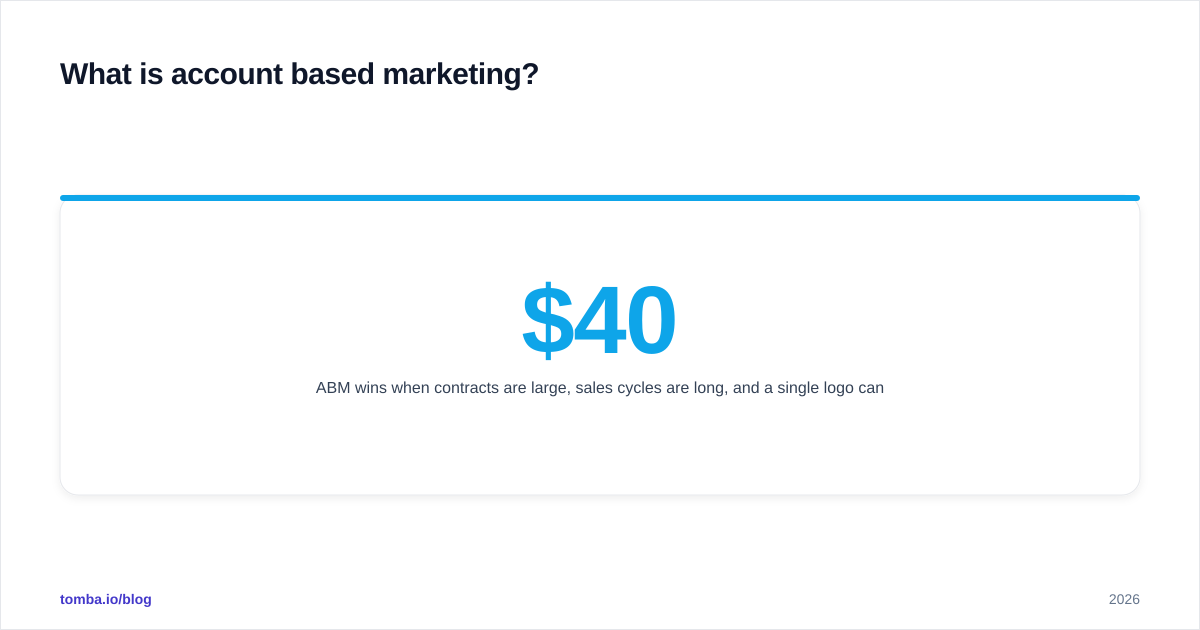
ABM wins when contracts are large, sales cycles are long, and a single logo can move your number. Spending $40,000 of campaign effort to land a $500,000 account is rational. Spending it to land a $3,000 deal is not.

Account based marketing vs lead generation: the core differences#
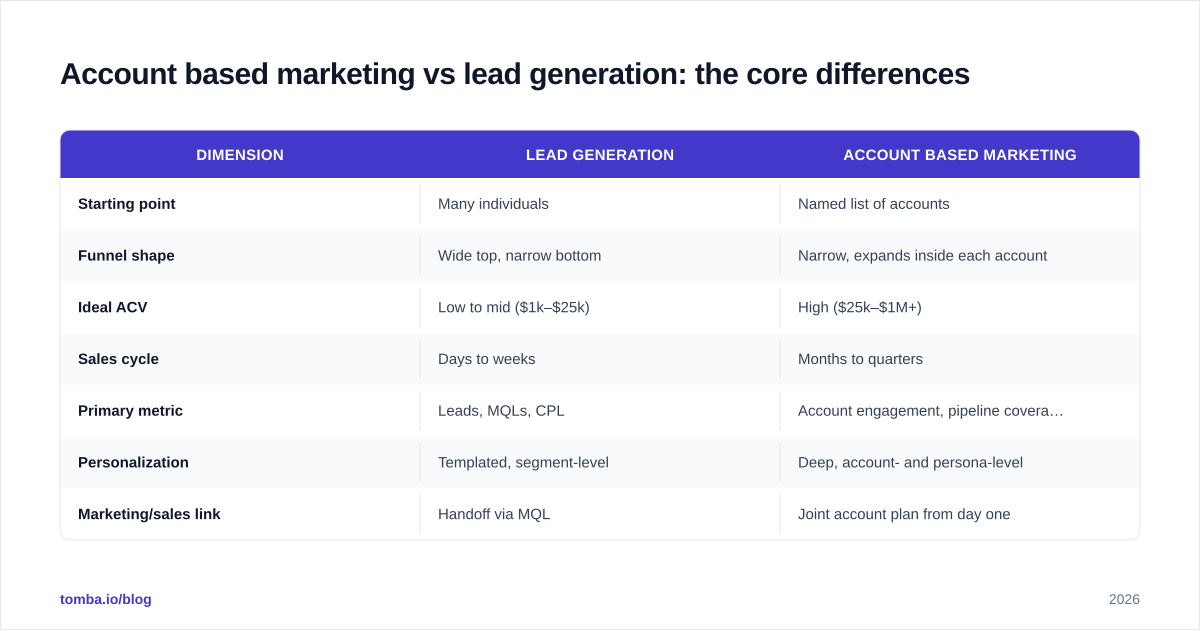
The two models diverge at almost every layer — who you target, how the funnel is shaped, which team owns the motion, and what "success" means on the dashboard.
| Dimension | Lead Generation | Account Based Marketing |
|---|---|---|
| Starting point | Many individuals | Named list of accounts |
| Funnel shape | Wide top, narrow bottom | Narrow, expands inside each account |
| Ideal ACV | Low to mid ($1k–$25k) | High ($25k–$1M+) |
| Sales cycle | Days to weeks | Months to quarters |
| Primary metric | Leads, MQLs, CPL | Account engagement, pipeline coverage |
| Personalization | Templated, segment-level | Deep, account- and persona-level |
| Marketing/sales link | Handoff via MQL | Joint account plan from day one |
| Wasted spend risk | Many low-intent leads | Effort on accounts that never buy |
| Best channels | SEO, paid, webinars, PLG | Targeted ads, 1:1 outreach, events, direct mail |
The metric difference is the one that trips teams up. A lead-gen team celebrating 3,000 MQLs and an ABM team celebrating 12 engaged accounts can both be doing excellent work — or both be failing. You cannot judge an ABM program by lead volume, and you cannot judge lead gen by account penetration. Choose the scoreboard before you choose the play.
Is ABM better than lead generation?#
No — neither is universally better; fit depends on your deal economics. The honest test is your average contract value and buying-committee size.
Run lead generation when:
- Your ACV is under ~$25k and a champion can buy without a committee
- You need pipeline velocity and volume to hit number
- You have a self-serve or product-led motion
- Your total addressable market is large and diffuse
Run account based marketing when:
- A handful of logos materially move revenue
- Five or more stakeholders touch every deal
- Sales cycles run a quarter or longer
- Your TAM is concentrated — a few hundred accounts that genuinely fit
A quick gut check: if you can name the 200 companies that would transform your year, ABM is on the table. If your best customers come from thousands of look-alikes you could never list by hand, lead gen is your engine.
How do the economics compare?#
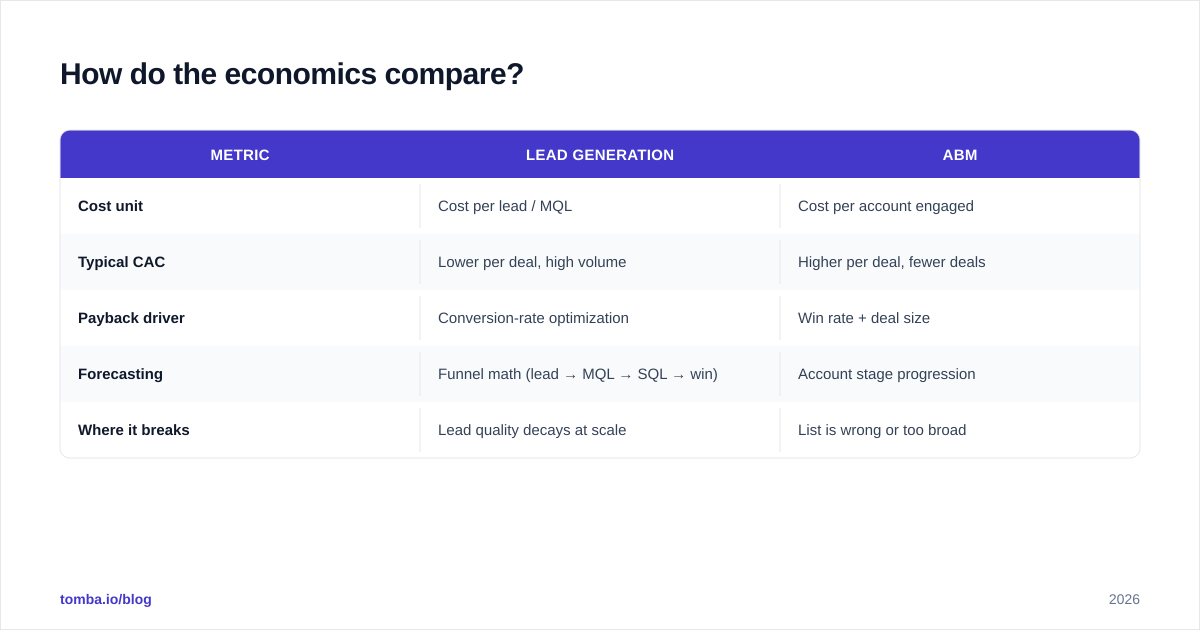
The money behaves differently, and that's the part finance cares about. Lead gen optimizes cost per lead (CPL) and conversion rate down a long funnel. ABM optimizes pipeline coverage and account ROI on a short, high-stakes list.
| Metric | Lead Generation | ABM |
|---|---|---|
| Cost unit | Cost per lead / MQL | Cost per account engaged |
| Typical CAC | Lower per deal, high volume | Higher per deal, fewer deals |
| Payback driver | Conversion-rate optimization | Win rate + deal size |
| Forecasting | Funnel math (lead → MQL → SQL → win) | Account stage progression |
| Where it breaks | Lead quality decays at scale | List is wrong or too broad |
Here's the trap. Lead gen looks cheaper per lead, so teams scale it — and quietly accumulate thousands of contacts who will never buy. ABM looks expensive per account, so teams under-resource it — and run "ABM" that's really just a renamed email blast. According to HubSpot's research on ABM, the teams that see returns are the ones that tightly align sales and marketing around the same account list, not the ones that simply spend more.
The cost both models share and underweight is data. A cheap lead is worthless if the email bounces; a perfect target account is unreachable if you can't find the buying committee's contact details. Bad data inflates CPL on the lead-gen side and stalls plays on the ABM side. That's why the smartest budget line in either model is often contact enrichment and verification, not another ad campaign.
Can you run ABM and lead generation together?#
Yes — and most high-performing 2026 teams do. They aren't rivals stacked on a shelf; they're two gears in the same machine. Lead gen creates broad awareness and surfaces in-market signals; ABM concentrates firepower on the accounts those signals point to.
A common hybrid sequence:
- Lead gen casts wide — SEO, content, and paid capture interest across the market and reveal which companies are showing intent.
- Score and cluster — group engaged contacts by account; an account lighting up with multiple visitors is a buying signal, not just a stack of leads.
- Promote to ABM — when an account crosses an engagement threshold and fits your ICP, move it onto the target list and switch to orchestrated, multi-threaded plays.
- Enrich the committee — find the other four to eight stakeholders you haven't talked to yet, using a B2B database and domain search to complete the org map.
- Measure both scoreboards — lead volume and CPL for the engine, account engagement and pipeline coverage for the concentrated plays.
This is where the "vs" dissolves. Lead generation becomes the radar; ABM becomes the strike package. The radar tells you where to point; the strike package wins the account.
What data do both models actually need?#
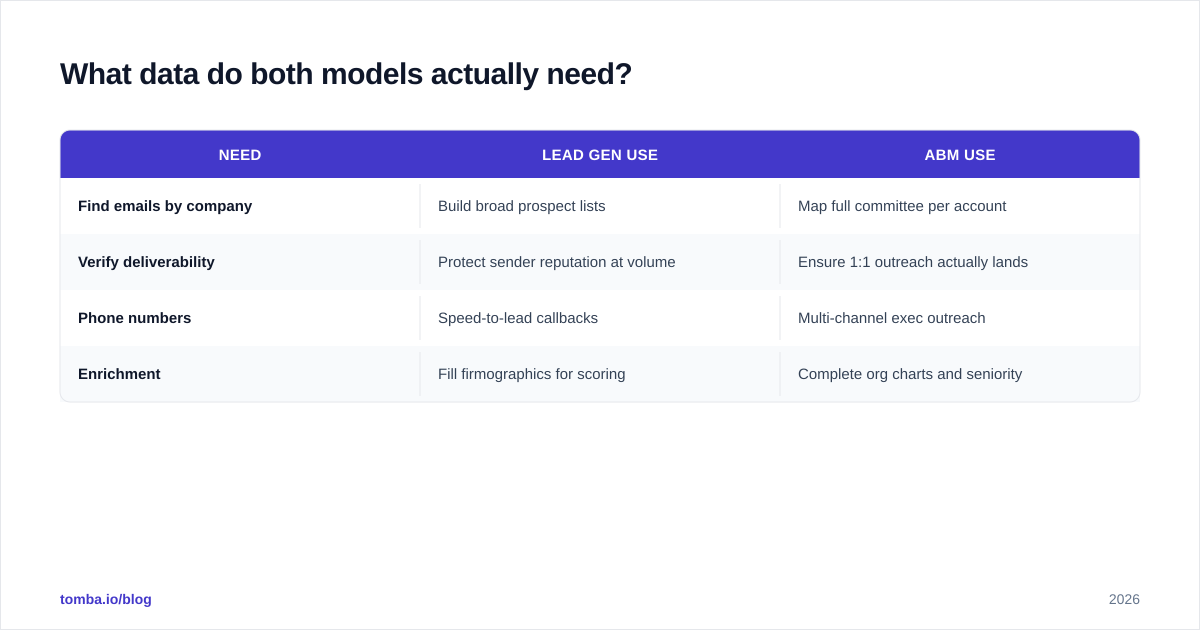
Both rest on the same foundation: knowing who to contact and being able to reach them. The difference is shape, not substance.
- Lead gen needs breadth — large volumes of verified emails so sequences don't bounce and sender reputation survives. A 30% bounce rate doesn't just waste sends; it can blacklist your domain.
- ABM needs depth — the full buying committee inside each named account, with accurate titles, emails, and phone numbers so you can multi-thread instead of betting on one champion.
In both cases, the bottleneck is rarely strategy. It's execution data. You can design a flawless ABM tier list, but if you can only reach one of the eight people who decide, the plan stalls. You can build a beautiful lead funnel, but if half your captured emails are role addresses or typos, conversion craters.
A practical stack for either motion:
| Need | Lead Gen Use | ABM Use |
|---|---|---|
| Find emails by company | Build broad prospect lists | Map full committee per account |
| Verify deliverability | Protect sender reputation at volume | Ensure 1:1 outreach actually lands |
| Phone numbers | Speed-to-lead callbacks | Multi-channel exec outreach |
| Enrichment | Fill firmographics for scoring | Complete org charts and seniority |
For breadth, a bulk email finder turns a list of domains into verified contacts fast. For depth, domain search returns the known addresses at a specific company so you can assemble the buying group. Either way, run results through an email verifier before they touch a sequence — it's the cheapest insurance in the funnel. You can compare the Tomba plans to match volume to motion: the Free tier covers 25 searches a month for testing, Starter runs $49/mo, and Growth at $99/mo fits teams running both engines at once.
How do you choose for your team in 2026?#
Start with one number: average contract value, weighted by buying-committee size. That single ratio decides more than any framework.
- Low ACV, single buyer → lead generation first. Optimize CPL and conversion; layer light ABM only on your largest accounts.
- High ACV, committee buyer → ABM first. Use lead gen as a top-of-funnel signal source, not your main pipeline driver.
- Mixed portfolio → run both, but fund them as separate programs with separate metrics. Don't let lead-volume goals quietly starve your ABM list of attention.
Then pressure-test with three questions:
- Can you name the accounts that would change your year? (Yes → ABM is viable.)
- Does a single person sign, or a committee? (Committee → ABM leans in.)
- Is your TAM a few hundred companies or tens of thousands? (Concentrated → ABM; diffuse → lead gen.)
Whatever the answer, audit your data before you scale either motion. Reputable review sites like G2's ABM category can help you compare orchestration platforms, but no platform compensates for a contact list that bounces. Fix the foundation first.
The bottom line#
Account based marketing vs lead generation isn't a verdict — it's a dial. Turn it toward volume when deals are small and fast; turn it toward concentration when a few logos decide your year. The teams that win in 2026 stop arguing about which is "better" and instead wire them together: broad capture to find the signal, focused orchestration to close it. Both run on the same fuel — accurate, verified contact data.
That's where to start. Use the Tomba Email Finder to find professional email addresses by domain, name, or company — build wide prospect lists for lead gen and map complete buying committees for ABM from the same tool. Pair it with the email verifier so every contact you load is reachable, and you've got the foundation both models depend on. Start free with 25 searches and scale into whichever motion your deal size demands.
// get started
Find, verify and enrich your first contacts today
Start on the free plan with 25 searches a month, then scale when your team is ready.
Free plan · No credit card required · GDPR & CCPA
// about the author