Account Based Sales Outreach Strategy: The 2026 Playbook
Spray-and-pray outbound is dead. Here is a concrete account based sales outreach strategy for 2026 — tiering, multi-thread messaging, channel mix, and the metrics that prove it works.
Account based sales outreach flips the traditional funnel. Instead of casting a wide net and hoping volume saves you, you pick a short list of high-fit accounts and engineer a coordinated campaign at each one. Done right, it lifts win rates and deal size at the same time. Done wrong, it is just slow spray-and-pray with a fancier spreadsheet.
This playbook shows you how to build an account based sales outreach strategy that actually books meetings in 2026 — who to target, how to message multiple stakeholders, which channels to sequence, and how to measure whether it is working.
TL;DR#
- Account based outreach beats volume outreach when deals are big, buying committees are large, and your ICP is narrow. If you sell a $99/mo self-serve tool, classic high-volume prospecting is usually cheaper.
- Tier your accounts before you write a single email. 1:1 (white-glove), 1:few (clustered by use case), and 1:many (programmatic) each get a different effort budget.
- Multi-thread or die. The average B2B deal now involves 6–10 stakeholders. Single-threaded outreach to one champion is the #1 reason ABM stalls.
- Sequence channels, don't pick one. Email, LinkedIn, phone, and ads compound when they hit the same account in the same two-week window.
- Accurate contact data is the foundation. A perfect message to a bounced address is worth zero. Verify before you send.
What is an account based sales outreach strategy?#
An account based sales outreach strategy is a coordinated plan to win specific, named companies by reaching multiple stakeholders inside each one with relevant, personalized touches across several channels.
Think of it like the difference between fishing with a net and spearfishing. Net fishing (traditional outbound) maximizes the number of casts and accepts a low hit rate. Spearfishing (account based) means you pick the fish, study how it moves, and commit your effort to landing it. You make fewer attempts, but each one is deliberate.
Technically, the strategy has four moving parts: an account list (who), a stakeholder map per account (whom inside), a message system (what and why now), and a channel sequence (how and when). The discipline is in keeping all four aligned so a CFO and a VP of Engineering at the same target hear a consistent, role-relevant story within the same campaign window.
This is the operational arm of account-based marketing — but where ABM owns awareness and air cover, account based sales outreach owns the direct, human touches that turn a target account into a booked meeting.
Is account based outreach better than high-volume prospecting?#
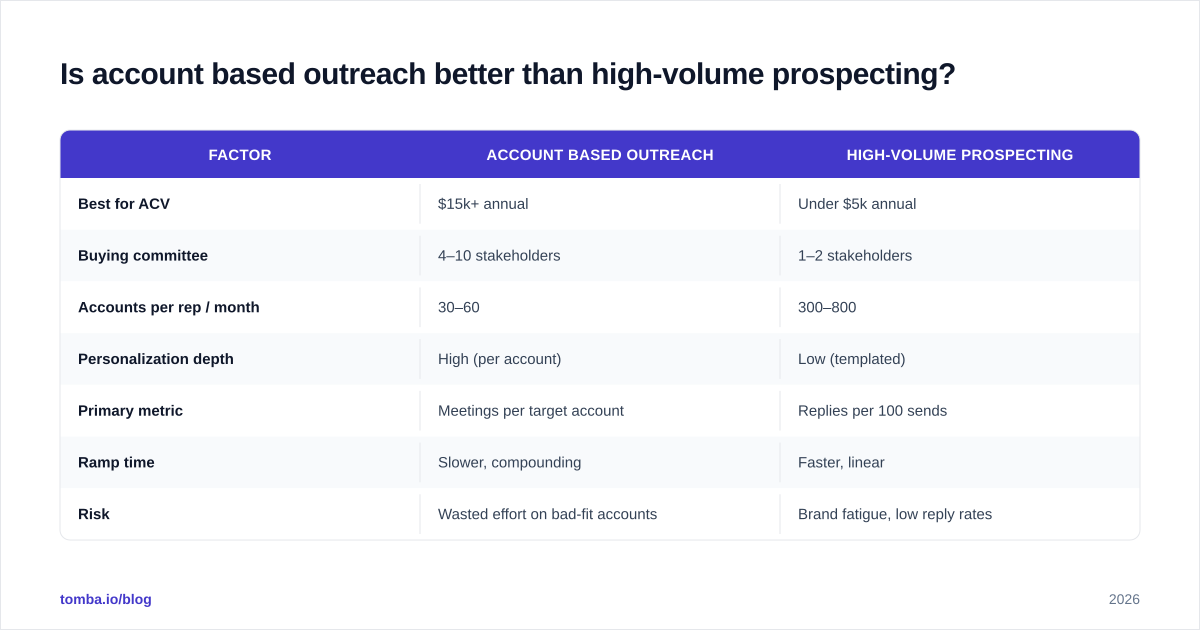
It depends on your deal economics — neither approach is universally "better."
Use this rule of thumb: the larger your average contract value and the more people sign off on a purchase, the more account based outreach wins. The smaller and more self-serve your product, the more volume prospecting wins.
| Factor | Account based outreach | High-volume prospecting |
|---|---|---|
| Best for ACV | $15k+ annual | Under $5k annual |
| Buying committee | 4–10 stakeholders | 1–2 stakeholders |
| Accounts per rep / month | 30–60 | 300–800 |
| Personalization depth | High (per account) | Low (templated) |
| Primary metric | Meetings per target account | Replies per 100 sends |
| Ramp time | Slower, compounding | Faster, linear |
| Risk | Wasted effort on bad-fit accounts | Brand fatigue, low reply rates |
Most teams selling mid-market and enterprise land somewhere in the middle: a tightly tiered account list with programmatic touches for the long tail. The mistake is pretending you are doing ABM when you are really just sending the same template to a smaller list.

How do you build and tier your target account list?#
Start with your Ideal Customer Profile, then split the list into three tiers by potential value and fit. Each tier gets a fixed effort budget so you don't burn 1:1 energy on accounts that warrant a 1:many touch.
Tier 1 — 1:1 (white-glove). Your 10–30 dream accounts. Custom research, personalized video, exec-to-exec intros, even direct mail. Expect to invest hours per account.
Tier 2 — 1:few (clustered). Accounts that share an industry, tech stack, or trigger event. You personalize the opening and the proof points by cluster, but reuse the campaign skeleton. Tens to low hundreds of accounts.
Tier 3 — 1:many (programmatic). Good-fit accounts that get a lighter, mostly-automated sequence. This tier feeds the pipeline while Tiers 1 and 2 get the craft.
To build the list you need firmographic filters (industry, headcount, revenue, geo), a technographic layer (what they already run), and trigger signals (funding, hiring, leadership changes). Pull the companies, then find the right humans. A domain search turns a target company into a list of role-relevant contacts, and a B2B database helps you fill firmographic gaps before you commit a rep's time.
A practical filter: if you can't name a credible reason this account would buy in the next two quarters, it doesn't belong in Tier 1.
Why is multi-threading the core of the strategy?#
Because modern B2B purchases are committee decisions, and single-threaded deals die when your one champion goes quiet, changes jobs, or gets overruled.
Gartner research puts the typical buying group at six to ten stakeholders. If your outreach only ever reaches one of them, you are blind to the other nine — including the economic buyer who actually controls the budget and the skeptic who can quietly kill the deal.
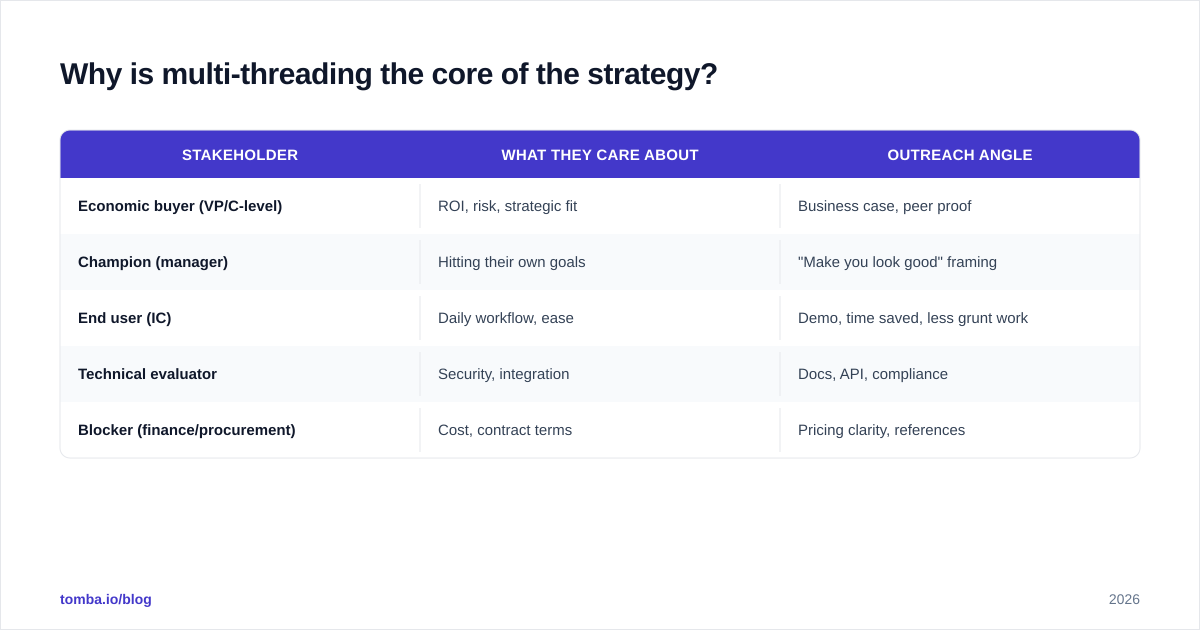
Multi-threading means mapping the buying committee and running parallel, role-specific outreach:
| Stakeholder | What they care about | Outreach angle |
|---|---|---|
| Economic buyer (VP/C-level) | ROI, risk, strategic fit | Business case, peer proof |
| Champion (manager) | Hitting their own goals | "Make you look good" framing |
| End user (IC) | Daily workflow, ease | Demo, time saved, less grunt work |
| Technical evaluator | Security, integration | Docs, API, compliance |
| Blocker (finance/procurement) | Cost, contract terms | Pricing clarity, references |
You don't hit all five on day one. You enter through the most reachable relevant contact, earn a referral inward, and widen the thread as the deal develops. The goal is that by the time you're in a proposal, three or more people inside the account already know who you are.
To do this you need contact coverage across roles, not just one email. Tools like the LinkedIn finder and a reliable email verifier let you assemble a verified, multi-role contact set per account so your threads don't bounce on the first send.
What channels should an account based sequence use?#
Use four channels in a coordinated sequence — email, LinkedIn, phone, and targeted ads — so the same account encounters your name several times in a short window. Channels compound; a cold call lands better when the prospect already saw your email and your ad.
A workable Tier 1 / Tier 2 sequence over two to three weeks looks like this:
- Day 1 — Email. Personalized opener referencing a specific trigger (funding, new hire, product launch). No pitch, just relevance.
- Day 2 — LinkedIn. View profile, engage with a recent post, send a connection request with a one-line context.
- Day 4 — Phone / voicemail. Reference the email. Keep it under 30 seconds.
- Day 6 — Email. Add a proof point — a relevant case study or a number that matters to their role.
- Day 9 — Multi-thread. Reach a second stakeholder with a role-specific angle, mentioning you've been in touch with the first.
- Day 12 — LinkedIn message or voice note. Offer something concrete: a teardown, a benchmark, an intro.
- Day 16 — Break-up email. Short, low-pressure, leaves the door open.
The mistake teams make is treating each channel as a separate campaign run by a separate tool. In an account based motion, the channels share one narrative and one timeline per account. If your SDR emails on Monday and your marketing team runs unrelated ads on Friday, you've got noise, not a sequence.

How do you personalize at scale without burning out reps?#
Personalize the layer that matters, templatize the rest. Not every sentence needs to be hand-written — the opening hook and the relevance bridge do.
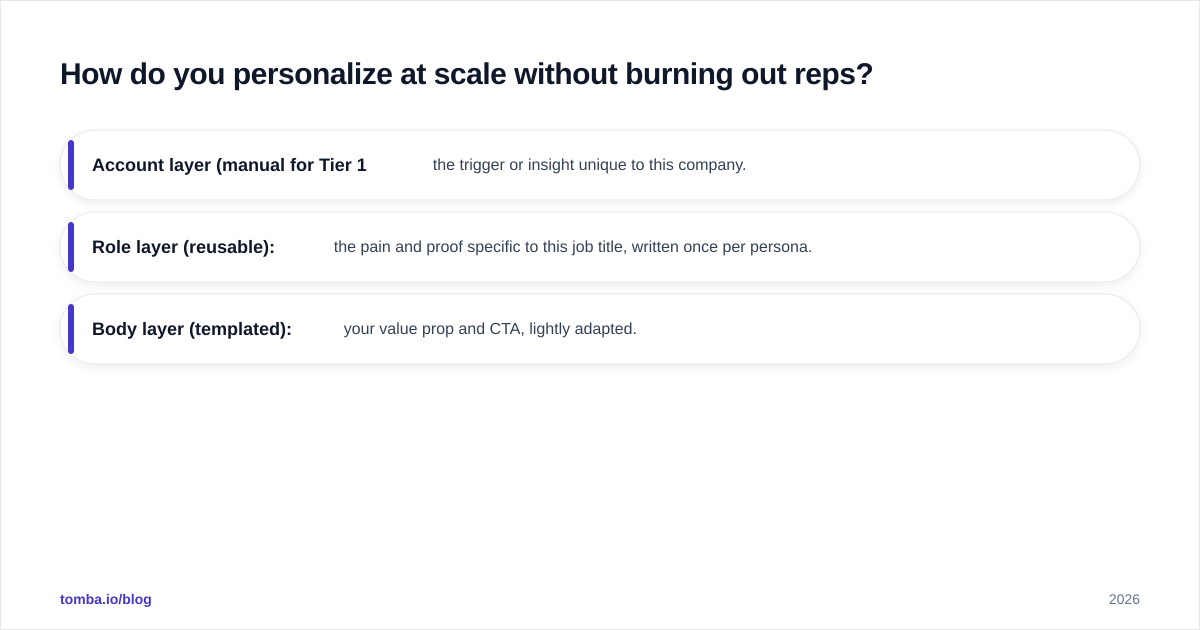
Use a three-layer model:
- Account layer (manual for Tier 1, clustered for Tier 2): the trigger or insight unique to this company.
- Role layer (reusable): the pain and proof specific to this job title, written once per persona.
- Body layer (templated): your value prop and CTA, lightly adapted.
This is where good data and good tooling pay off. When a rep can pull a verified contact, the company's tech stack, and a recent trigger in one place, they spend their time writing the one sentence that earns the reply — not hunting for an email address. Enriching your list up front with contact enrichment means the rep starts every account with role, seniority, and verified contact details already filled in.
A simple test for whether your personalization is real: could this opening line be copy-pasted to another company? If yes, it isn't personalization, it's mail-merge with extra steps.
Which metrics prove your account based outreach is working?#
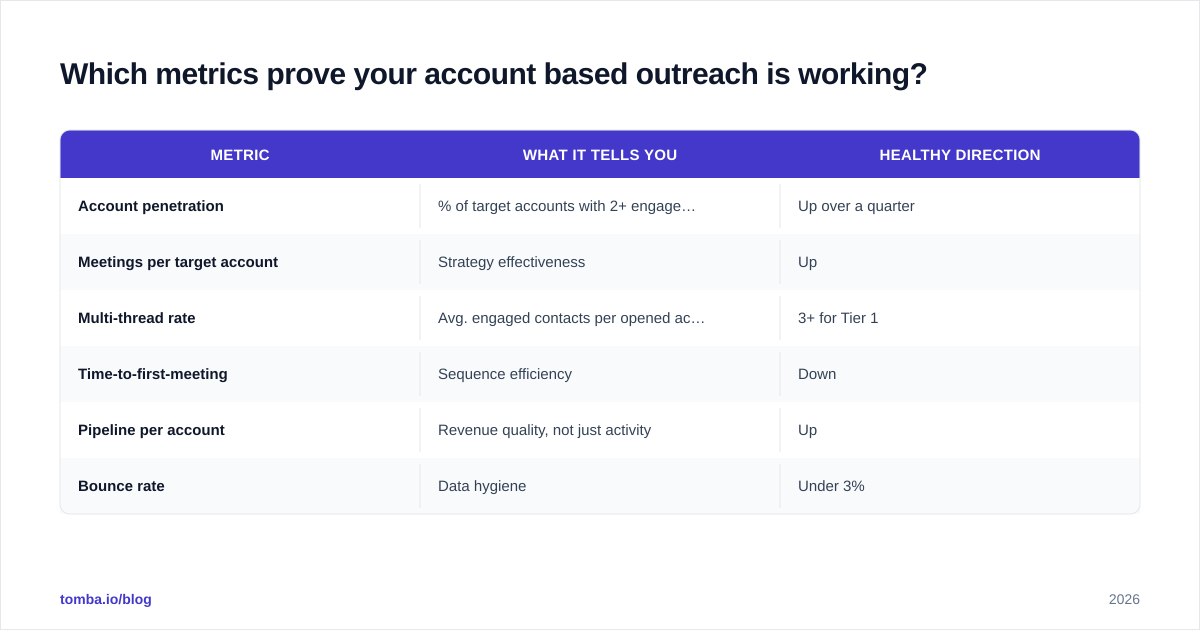
Measure at the account level, not just the contact level — that is the whole point of the strategy. Reply rate per email tells you about your copy; meetings per target account tells you about your strategy.
Track these:
| Metric | What it tells you | Healthy direction |
|---|---|---|
| Account penetration | % of target accounts with 2+ engaged stakeholders | Up over a quarter |
| Meetings per target account | Strategy effectiveness | Up |
| Multi-thread rate | Avg. engaged contacts per opened account | 3+ for Tier 1 |
| Time-to-first-meeting | Sequence efficiency | Down |
| Pipeline per account | Revenue quality, not just activity | Up |
| Bounce rate | Data hygiene | Under 3% |
Watch bounce rate especially. A high bounce rate quietly destroys an account based motion: it tanks your sender reputation, which means even your good messages to good contacts start landing in spam. Because you're investing so much per account, a deliverability problem is far more expensive here than in volume outbound. Verify contacts before the first send and re-verify Tier 1 lists every quarter.
If your account penetration is flat but your reply rate looks fine, you have a strategy problem hiding behind a copy metric — you're single-threading. Fix the thread count before you touch the templates.
What does a 90-day rollout look like?#
Don't boil the ocean. Pilot the motion on one segment, prove it, then expand.
- Days 1–30 — Foundation. Define ICP, build a 30-account Tier 1 list, map buying committees, and assemble verified multi-role contacts. Write your persona-layer messaging.
- Days 31–60 — Run the pilot. Launch coordinated sequences on Tier 1. Hold a weekly account review where reps and marketing align on each account's status. Track account penetration, not just sends.
- Days 61–90 — Measure and scale. Compare pilot metrics against your old outbound baseline. Keep what worked, cut what didn't, then layer in Tier 2 clusters and a programmatic Tier 3.
The weekly account review is the unsung hero here. It's where single-threaded deals get flagged and where reps trade the intel that makes the next touch land. Skip it and ABM degrades back into a list of individual emails.
Common mistakes that quietly kill account based outreach#
- Confusing a small list with a strategy. Sending the same template to 50 accounts isn't ABM.
- Single-threading. One champion is one resignation away from a dead deal.
- Ignoring data quality. High bounce rates wreck both deliverability and trust in your numbers.
- Misaligned sales and marketing. If ads, content, and outreach don't share a timeline per account, you create noise.
- Measuring activity, not penetration. Sends and dials feel productive; engaged accounts pay the bills.
Where Tomba fits#
Every account based sales outreach strategy rests on one unglamorous foundation: reaching the right people at the right companies without bouncing. That's exactly what the Tomba Email Finder is built for — turn a target company domain into verified, role-relevant contacts, fill out each buying committee with a domain search, and confirm every address before your first send so your sender reputation stays intact across a long, multi-touch campaign. Start free with 25 searches a month, and check the Tomba pricing plans (Starter at $49/mo) when you're ready to scale your target account list. Build the list right, verify the data, then go win the accounts that actually move your number.
// get started
Find, verify and enrich your first contacts today
Start on the free plan with 25 searches a month, then scale when your team is ready.
Free plan · No credit card required · GDPR & CCPA
// about the author