Account Based Selling in 2026: The Complete Playbook
Account based selling flips the funnel: pick the accounts worth winning, then coordinate sales and marketing around each one. Here's the 2026 framework, metrics, and tech stack.
TL;DR
- Account based selling (ABS) means choosing a small set of high-value accounts and aligning sales, marketing, and customer teams around winning each one — instead of spraying outreach across a giant list.
- It works best for B2B deals with large contract values, multiple buyers, and long cycles. For low-ticket, high-volume sales, classic lead-based selling is usually cheaper.
- The 2026 playbook is built on five moves: pick accounts with an ICP and intent data, map the buying group, build per-account messaging, run multi-threaded plays across channels, and measure at the account level.
- Your tech stack matters more than your slide deck. You need clean account data, accurate contact details, intent signals, and a CRM that reports by account — not just by lead.
- Tools like an accurate email finder and data enrichment turn a target account list into reachable, multi-threaded contacts.
What is account based selling?#
Account based selling is a B2B go-to-market approach where you treat individual accounts — not individual leads — as the unit of work. You decide which companies are worth winning, then build a coordinated plan to reach the four to ten people who actually influence the deal inside each one.
Think of the difference like fishing. Lead-based selling is a wide net dragged through the ocean: you catch a lot, most of it small, and you sort the keepers later. Account based selling is spearfishing: you pick the fish, study where it swims, and make one precise move. You catch fewer fish, but each one is a meal.
Technically, ABS reverses the traditional funnel. Instead of generating thousands of leads and narrowing down, you start with a finite list of named accounts and expand outward inside each — finding more contacts, more context, and more reasons to engage. It is the sales-side execution of the broader account-based marketing (ABM) motion, and in mature teams the two are the same program with two budgets.
According to Gartner, the typical B2B buying group now includes six to ten decision-makers, each armed with their own research. That single statistic is why ABS exists: you cannot win a complex deal by convincing one champion and hoping. You have to work the account.
How is account based selling different from lead-based selling?#
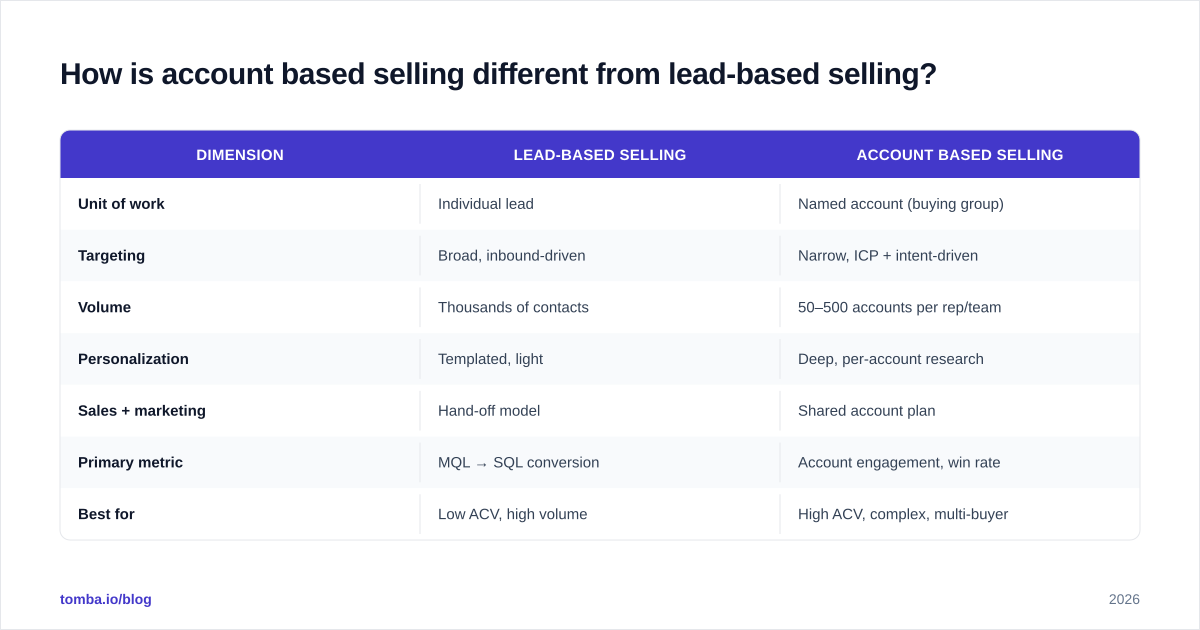
The short answer: ABS optimizes for depth, lead-based selling optimizes for volume. Everything downstream follows from that one choice.
In a lead-based model, a marketing team fills the top of the funnel, an SDR qualifies whoever raises a hand, and reps work whatever lands in their queue. Success is measured in MQLs, SQLs, and conversion rates. In an account-based model, the target list is fixed up front, every touch is personalized to the account, and success is measured in account engagement, pipeline, and win rate against the named list.
| Dimension | Lead-Based Selling | Account Based Selling |
|---|---|---|
| Unit of work | Individual lead | Named account (buying group) |
| Targeting | Broad, inbound-driven | Narrow, ICP + intent-driven |
| Volume | Thousands of contacts | 50–500 accounts per rep/team |
| Personalization | Templated, light | Deep, per-account research |
| Sales + marketing | Hand-off model | Shared account plan |
| Primary metric | MQL → SQL conversion | Account engagement, win rate |
| Best for | Low ACV, high volume | High ACV, complex, multi-buyer |
| Sales cycle fit | Short | Long (60–180+ days) |
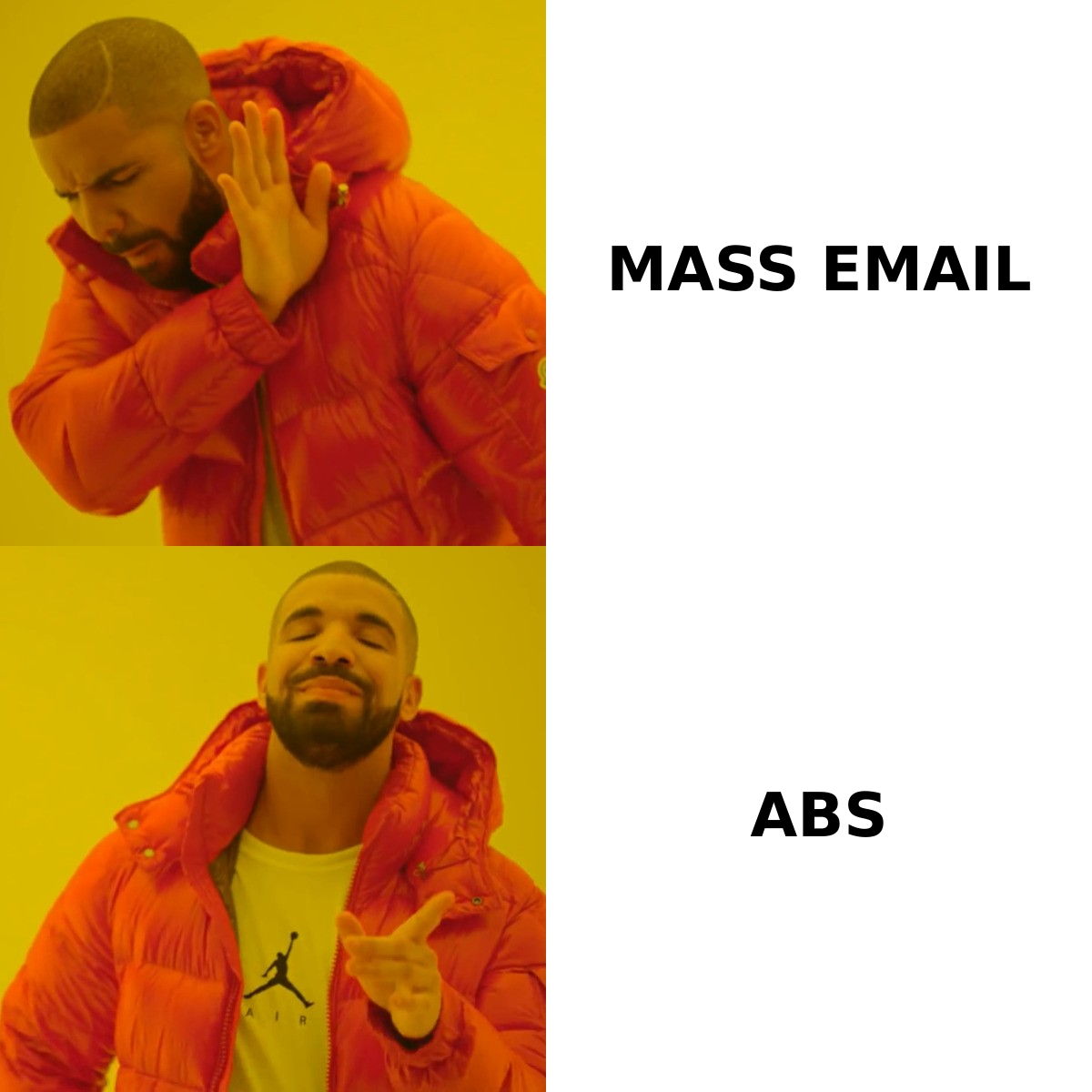
Notice this is not a moral hierarchy. A self-serve product selling $40/month seats should not run account based selling — the economics collapse. A platform selling $80k annual contracts into the enterprise should almost never run pure lead-based selling. Match the motion to the deal.
When does account based selling actually make sense?#
Use a simple test before committing: would landing one logo justify weeks of coordinated effort? If yes, ABS fits. If you need hundreds of small wins to hit quota, it does not.
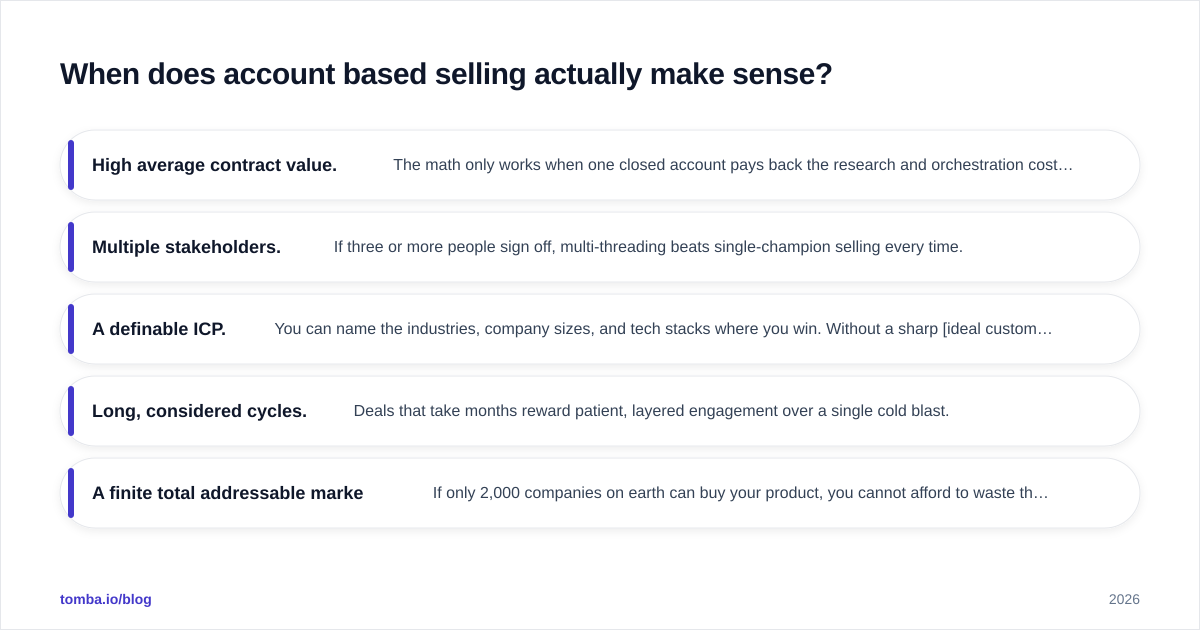
Account based selling earns its overhead when you see these signals:
- High average contract value. The math only works when one closed account pays back the research and orchestration cost — generally $15k ACV and up.
- Multiple stakeholders. If three or more people sign off, multi-threading beats single-champion selling every time.
- A definable ICP. You can name the industries, company sizes, and tech stacks where you win. Without a sharp ideal customer profile, account selection is guesswork.
- Long, considered cycles. Deals that take months reward patient, layered engagement over a single cold blast.
- A finite total addressable market. If only 2,000 companies on earth can buy your product, you cannot afford to waste them on spray-and-pray.
If you check three or more of those boxes, the rest of this playbook is for you.
What are the five steps of the account based selling playbook?#
The 2026 playbook is not complicated, but each step compounds. Skip one and the others underperform.
Step 1 — Define the ICP and score your accounts#
Start with evidence, not opinion. Pull your last 50 closed-won deals and find the shared traits: industry, headcount, revenue band, region, tech stack, and trigger events. That pattern is your ICP. Then score every account in your TAM against it — firmographic fit plus behavioral intent — and rank them into tiers. Tier 1 gets white-glove treatment; Tier 3 gets lighter, more automated plays.
Step 2 — Map the buying group#
For each Tier 1 account, identify the roles you must reach: economic buyer, champion, technical evaluator, and the blockers who can kill a deal. This is where most ABS programs stall, because finding the right humans — and their direct contact details — is tedious. A domain search gives you every reachable email at a target company in one query, so you map the org instead of guessing.
Step 3 — Build account-specific messaging#
Generic outreach is the fastest way to burn a Tier 1 account. Research each company's priorities — a recent funding round, a new VP hire, a product launch — and tie your value to that specific moment. The goal is for the prospect to feel the message could only have been written for them.
Step 4 — Run coordinated, multi-threaded plays#
This is the orchestration layer: email, LinkedIn, phone, ads, and direct mail sequenced across the buying group over weeks. Marketing warms the account with targeted ads while SDRs work the contacts and the AE engages the economic buyer. Everyone references the same account plan. Salesforce's research on account-based strategies consistently shows that this coordination — not any single channel — is what moves win rates.
Step 5 — Measure at the account level#
Throw out lead-volume vanity metrics. Track engagement per account, pipeline created from the named list, average deal size, and win rate versus a control group. If your CRM only reports by lead, you are flying blind — fix the reporting before you scale the program.
Which metrics prove account based selling is working?#
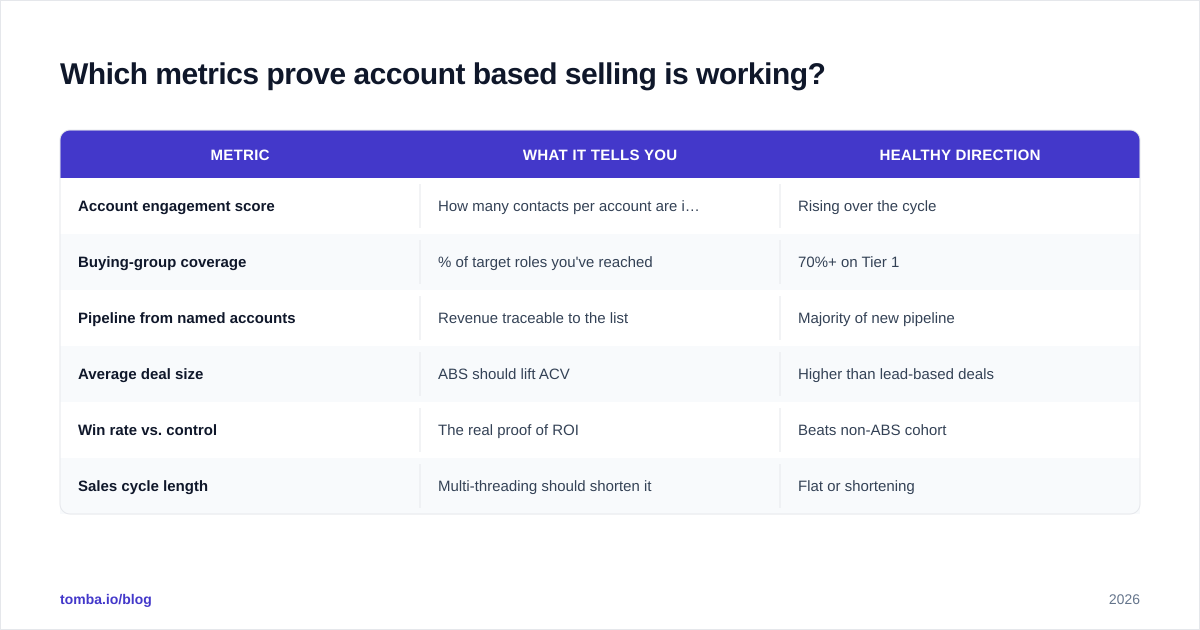
Lead metrics will lie to you in an ABS program, because volume is supposed to be low. Measure the things that reflect depth and revenue instead.
| Metric | What it tells you | Healthy direction |
|---|---|---|
| Account engagement score | How many contacts per account are interacting | Rising over the cycle |
| Buying-group coverage | % of target roles you've reached | 70%+ on Tier 1 |
| Pipeline from named accounts | Revenue traceable to the list | Majority of new pipeline |
| Average deal size | ABS should lift ACV | Higher than lead-based deals |
| Win rate vs. control | The real proof of ROI | Beats non-ABS cohort |
| Sales cycle length | Multi-threading should shorten it | Flat or shortening |
The single most persuasive number is win rate against a control group. Run ABS on half your Tier 1 list and your normal motion on the other half for a quarter, then compare. If the account based selling cohort does not win more or bigger, your execution — usually account selection or messaging — needs work before you blame the model.
What does the 2026 account based selling tech stack look like?#
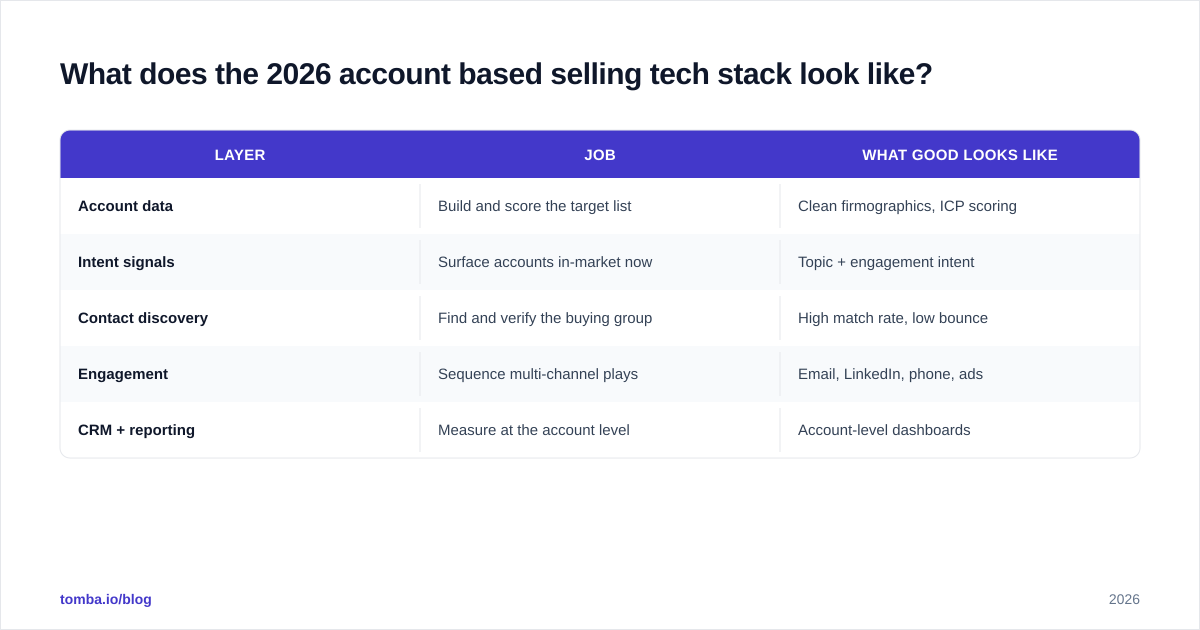
The strategy is only as good as the data underneath it. A beautiful account plan built on stale contacts and bounced emails dies on contact. Your stack needs five capabilities, and they should hand off cleanly to one another.
| Layer | Job | What good looks like |
|---|---|---|
| Account data | Build and score the target list | Clean firmographics, ICP scoring |
| Intent signals | Surface accounts in-market now | Topic + engagement intent |
| Contact discovery | Find and verify the buying group | High match rate, low bounce |
| Engagement | Sequence multi-channel plays | Email, LinkedIn, phone, ads |
| CRM + reporting | Measure at the account level | Account-level dashboards |
The contact-discovery layer is where deals are quietly won or lost. You can have a perfect target list and a brilliant message, but if half your emails bounce, your multi-threaded play collapses to a single thread. This is why accurate contact data is the unglamorous backbone of account based selling.
Tomba sits in that contact-discovery layer. Run a domain search to pull the full org at a target account, use the email verifier to protect your sender reputation before you send, and push the enriched buying group into your CRM. For teams working hundreds of accounts at once, the bulk email finder turns an entire Tier 1 list into reachable contacts in a single pass. You can compare capacity against your account volume on the Tomba pricing page — the Growth plan at $99/mo covers most single-rep ABS programs, with Pro at $249/mo for full teams.
A note on deliverability: account based selling concentrates your reputation risk. Because you are reaching the most valuable companies you will ever sell to, a spam folder is far more expensive here than in a volume motion. Verify before you send, keep your sender reputation clean, and never let a guessed address bounce against a Tier 1 economic buyer.
How do you start account based selling without a huge team?#
You do not need a 20-person revenue org to run ABS. Start with a pilot you can actually execute.
Pick 25 dream accounts — companies you would celebrate winning. Build a real ICP from your closed-won history so the list is evidence-based, not aspirational. For each account, use a domain search to map four to six contacts across the buying group, then verify every address. Write genuinely personalized opening touches — not merge tags, real research. Sequence a four-week, multi-channel play per account. Then measure engagement and pipeline against a matched set of accounts you work the old way.
Run that for one quarter. If the pilot beats your control, you have internal proof to expand — and a repeatable motion to scale. If it does not, you will know exactly which step (almost always account selection or message depth) to fix before you spend more.
The discipline that makes ABS work is the same discipline that makes it cheap to start: do less, but do it deeply. Twenty-five accounts worked properly beat 2,500 worked thinly, every quarter.
The bottom line#
Account based selling wins when your deals are large, your buyers are many, and your market is finite. It is not a tactic you bolt onto a volume motion — it is a different operating model that aligns sales and marketing around the accounts that move your number. Get the five steps right, measure at the account level, and the win-rate lift pays for the extra effort many times over.
The whole model collapses without reachable, verified contacts, though. Before you build another account plan, make sure you can actually reach the buying group. Start free with the Tomba Email Finder — 25 searches a month, no card — and turn your target account list into a multi-threaded pipeline. When your program scales, the domain search and bulk email finder keep every Tier 1 account fully mapped. You can also weigh tiers on the Tomba pricing page or read more about data accuracy before you commit.
// get started
Find, verify and enrich your first contacts today
Start on the free plan with 25 searches a month, then scale when your team is ready.
Free plan · No credit card required · GDPR & CCPA
// about the author