Account Based Selling Best Practices: The 2026 Playbook
Account based selling rewards focus over volume. Here are the best practices, frameworks, and data plays that actually move pipeline in 2026.
Account based selling (ABS) flips the classic funnel on its head. Instead of pouring thousands of half-qualified leads into the top and hoping a few survive, you pick the accounts worth winning first, then build a coordinated campaign to win them. Done right, it concentrates your scarce selling time on the revenue that actually matters.
The catch: most teams say they "do ABS" but really run spray-and-pray with a tidier spreadsheet. This guide covers the account based selling best practices that separate teams hitting 30%+ win rates on target accounts from teams quietly burning quota.
TL;DR#
- ABS is a focus discipline, not a tool. You win by choosing fewer accounts and going deeper, not by buying more software.
- Tier your accounts (1:1, 1:few, 1:many) so effort matches account value. One playbook for every account is the most common failure mode.
- Multi-thread early. The average B2B deal now involves 6–10 buyers. Single-threaded deals stall and die.
- Sales and marketing must share one account list and one definition of "engaged." Misalignment here kills more ABS programs than bad messaging.
- Clean, enriched contact data is the foundation. No accurate emails, phones, and org charts = no ABS. Tools like Tomba Email Finder supply that layer.
What is account based selling?#
Account based selling is a go-to-market strategy where sales, marketing, and customer success treat individual high-value accounts as "markets of one." Every account gets a tailored plan, coordinated outreach across multiple contacts, and success metrics measured at the account level rather than the individual-lead level.
Think of it like a wedding caterer versus a fast-food counter. Fast food optimizes for throughput — same menu, maximum volume. A wedding caterer studies one client, designs a bespoke menu, and coordinates a whole team for a single high-stakes event. ABS is the caterer model applied to revenue.
The discipline overlaps heavily with account-based marketing (ABM). The practical difference: ABM owns the air cover (ads, content, events) while ABS owns the ground game (direct outreach, discovery, multi-threading, negotiation). In healthy 2026 programs, they're two halves of one motion sharing the same target list.
Why does account based selling work better for high-ACV deals?#
ABS works when the cost of personalization is justified by the size of the prize. Gartner's research on the B2B buying journey shows buyers spend only about 17% of their time meeting with potential suppliers, and that time is split across every vendor in the deal. When your window is that narrow, relevance wins and volume loses.
ABS concentrates relevance. Instead of sending the same sequence to 5,000 contacts, you send a researched, account-specific message to the 40 people who can actually sign a six-figure contract. The math favors focus once average contract value (ACV) climbs past roughly $20K, because the labor cost of deep personalization is a rounding error against the deal size.
It also fixes the multi-threading problem. According to HubSpot and broader industry data, buying committees keep growing — often 6 to 10 stakeholders for enterprise software. A lead-based motion treats each of those people as a separate record racing through a funnel. ABS treats them as one account you win together.
What are the core account based selling best practices?#
Here's the operational core. Skip any one of these and the program leaks.
1. Define a ruthless ICP before you build the list#
Your ideal customer profile (ICP) is the filter that everything else depends on. Be specific: industry, employee count, tech stack, funding stage, geography, and a "trigger" (hiring spike, new exec, funding round, competitor switch). A vague ICP produces a bloated target list, and a bloated list is just spray-and-pray with extra steps.
A useful gut check: if your ICP would let in more than ~5% of all companies in your TAM, it's too loose.
2. Tier accounts so effort matches value#
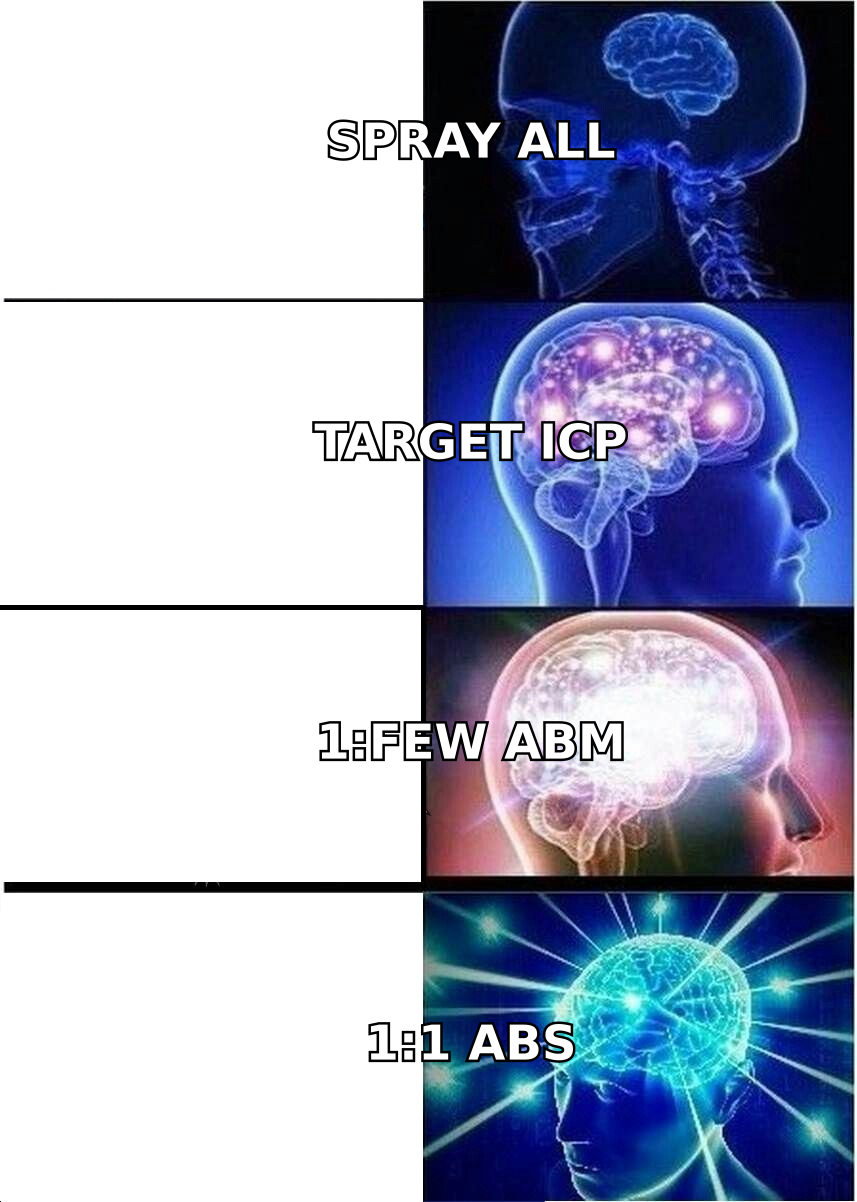
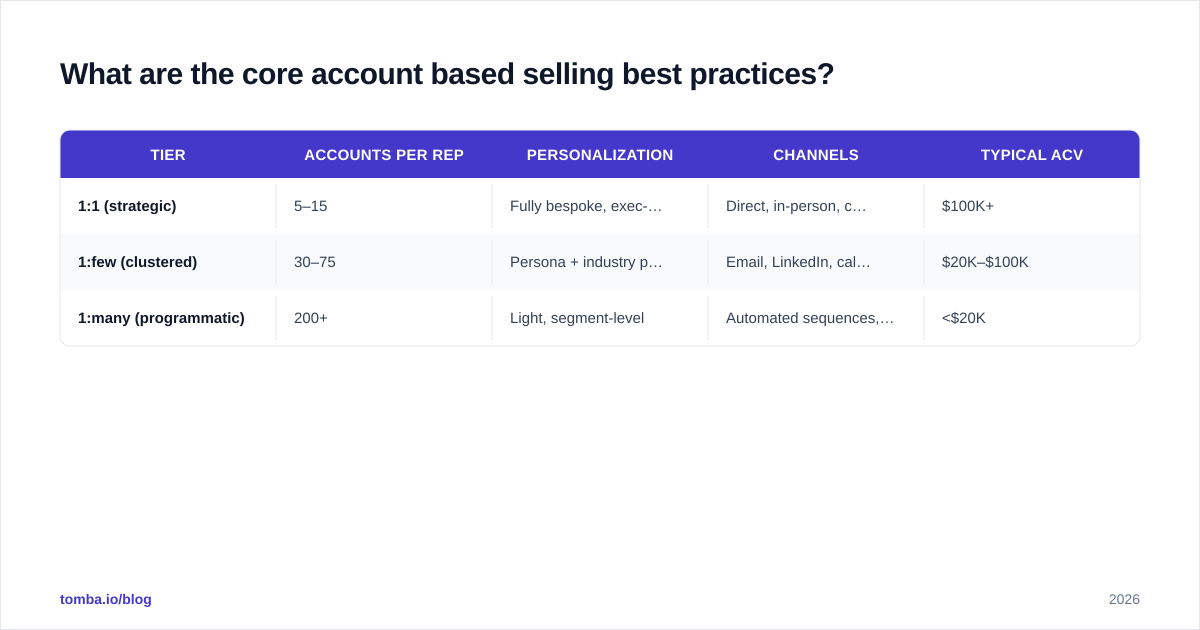
Not every target deserves a custom microsite. Split your list into three tiers:
| Tier | Accounts per rep | Personalization | Channels | Typical ACV |
|---|---|---|---|---|
| 1:1 (strategic) | 5–15 | Fully bespoke, exec-sponsored | Direct, in-person, custom content | $100K+ |
| 1:few (clustered) | 30–75 | Persona + industry plays | Email, LinkedIn, calls, ads | $20K–$100K |
| 1:many (programmatic) | 200+ | Light, segment-level | Automated sequences, intent ads | <$20K |
The mistake almost everyone makes is running 1:1 effort on 1:many accounts (burning out the team) or 1:many effort on 1:1 accounts (losing winnable whales). Match the motion to the money.
3. Build the account map before the first touch#
For tier-1 and tier-2 accounts, sketch the org chart before you reach out: economic buyer, champion, technical evaluator, blocker, and end users. You can't multi-thread a building you haven't mapped. This is where contact data quality becomes non-negotiable — you need verified names, roles, emails, and phone numbers for each seat on the committee.
4. Multi-thread from day one#
Single-threaded deals are fragile. Your champion gets laid off, reorganized, or simply goes quiet, and the deal evaporates. Aim to have active conversations with at least three contacts in every tier-1 account before you forecast it. Reference one stakeholder's priorities when you talk to another ("Your VP of Eng flagged X — here's how that affects your team").
5. Lead with account-specific research, not your feature list#
The fastest way to get ignored is a generic "I help companies like yours." The fastest way to get a reply is proof you did homework: a comment on their recent earnings call, a gap in their careers page, a integration they just announced. Personalization at the account level scales better than personalization at the individual level — one piece of research fuels outreach to the whole committee.
6. Align sales and marketing on one list and one scoreboard#
This is the practice that quietly makes or breaks ABS. Marketing and sales must agree on the target account list, what counts as "account engagement," and who owns each play. When marketing runs ads against accounts sales has abandoned — or sales cold-calls accounts marketing is nurturing — you get waste and friction. Shared definitions, like an agreed marketing qualified lead threshold, keep both teams pointed at the same revenue.
How is account based selling different from traditional selling?#
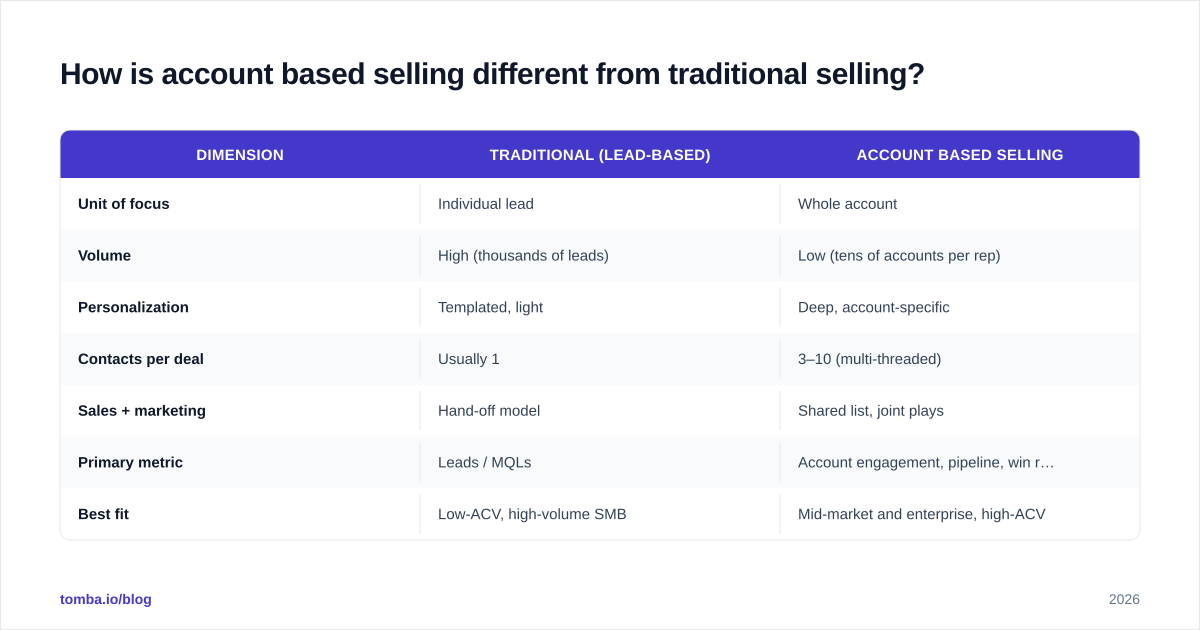
The clearest way to see ABS is side by side with the lead-based model most teams grew up on.
| Dimension | Traditional (lead-based) | Account based selling |
|---|---|---|
| Unit of focus | Individual lead | Whole account |
| Volume | High (thousands of leads) | Low (tens of accounts per rep) |
| Personalization | Templated, light | Deep, account-specific |
| Contacts per deal | Usually 1 | 3–10 (multi-threaded) |
| Sales + marketing | Hand-off model | Shared list, joint plays |
| Primary metric | Leads / MQLs | Account engagement, pipeline, win rate |
| Best fit | Low-ACV, high-volume SMB | Mid-market and enterprise, high-ACV |
Neither is universally "better." If you sell a $30/month product to a million-company TAM, lead-based volume wins. If you sell a $90K platform to 800 qualified accounts, ABS wins. Most teams above mid-market need both: programmatic 1:many for the long tail, focused ABS for the accounts that make the quarter.
What does the account based selling tech stack look like?#
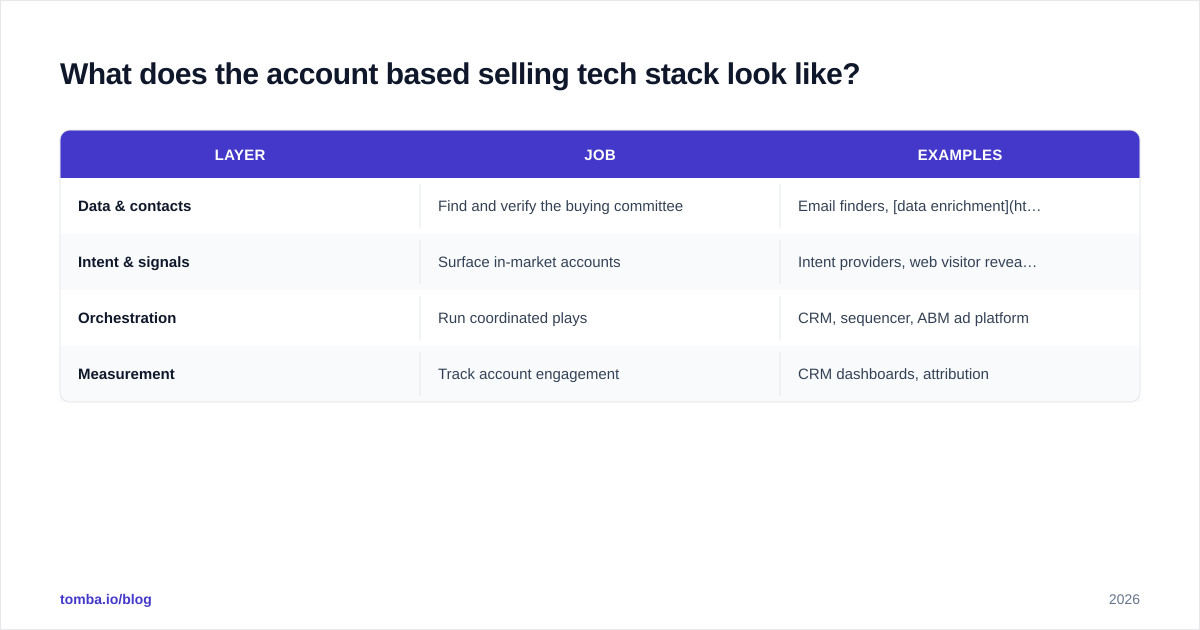
You don't need a dozen tools, but you need each layer covered. The stack falls into four jobs.
| Layer | Job | Examples |
|---|---|---|
| Data & contacts | Find and verify the buying committee | Email finders, data enrichment, org-chart data |
| Intent & signals | Surface in-market accounts | Intent providers, web visitor reveal, product signals |
| Orchestration | Run coordinated plays | CRM, sequencer, ABM ad platform |
| Measurement | Track account engagement | CRM dashboards, attribution |
The data layer is the foundation everything else stands on, and it's the one teams most often underinvest in. If your emails bounce and your phone numbers are stale, your perfectly orchestrated tier-1 play never reaches a human. Verified contact data — accurate emails, direct dials, and current roles — is what turns a target list into actual conversations. You can pull verified contacts for a whole account using domain search and confirm they're deliverable with an email verifier before a rep ever hits send.
Before you commit budget to any vendor, sanity-check it against the G2 grid for your category and compare it on real pipeline impact, not feature counts. And check Tomba pricing if you want a data layer that starts free and scales without per-seat surprises.
How do you measure account based selling success?#
Stop counting leads. ABS metrics live at the account level, and they fall into three buckets:
- Coverage — What share of your target account list has a complete buying-committee map and verified contacts? Aim for 90%+ on tier-1 before you judge the program.
- Engagement — How many target accounts have multiple engaged stakeholders? Track active contacts per account, meeting rate, and multi-threading depth, not raw email opens.
- Outcomes — Pipeline created from target accounts, target-account win rate, average deal size, and sales cycle length versus non-target deals.
A healthy ABS program should show target accounts converting at a meaningfully higher win rate and larger ACV than your inbound or non-target pipeline. If they don't after two quarters, your ICP or your tiering is wrong — fix those before you blame execution.
What are the most common account based selling mistakes?#
- Too many accounts. "Focus" on 400 accounts per rep is not focus. Cut the list until it hurts, then cut a little more.
- Single-threading. Betting a six-figure deal on one champion is gambling, not selling.
- Fake personalization. Merge-tagging
{{company}}into a generic email fools no one in 2026. Reference something only research would surface. - Ignoring data hygiene. Stale contacts mean your best plays bounce. Refresh and verify before each push.
- Sales–marketing drift. Two teams, two lists, two definitions of success. The program dies of friction, not strategy.
- Measuring like it's lead-gen. Judging ABS by MQL count rewards exactly the volume behavior ABS exists to replace.
Account based selling best practices: a 30-day starting plan#
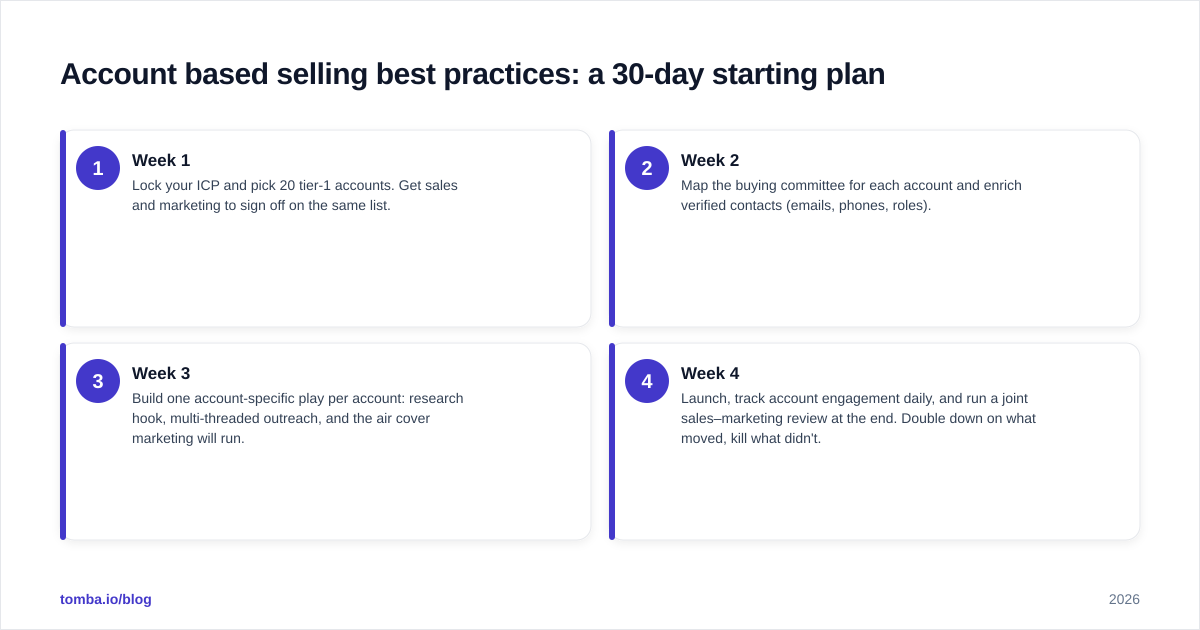
If you're standing the motion up from scratch, don't boil the ocean. A focused first month beats a sprawling six-month rollout:
- Week 1 — Lock your ICP and pick 20 tier-1 accounts. Get sales and marketing to sign off on the same list.
- Week 2 — Map the buying committee for each account and enrich verified contacts (emails, phones, roles).
- Week 3 — Build one account-specific play per account: research hook, multi-threaded outreach, and the air cover marketing will run.
- Week 4 — Launch, track account engagement daily, and run a joint sales–marketing review at the end. Double down on what moved, kill what didn't.
Repeat with the next cohort. ABS compounds: the research, contact data, and account maps you build in month one make month two faster.
Where Tomba fits#
Every best practice above depends on one thing you can't fake: knowing exactly who's on the buying committee and how to reach them. That's the data layer — and it's where deals quietly stall when a verified email turns out to be a dead address.
Tomba Email Finder gives your ABS motion that foundation: find professional emails by name, company, or domain, verify they're deliverable, and enrich each contact with role and company data so your reps multi-thread the right people from day one. Start on the free tier (25 searches/month), scale to Starter at $49/month when the program proves out, and keep your target-account data clean enough that your best tier-1 plays actually land. Pick your accounts with discipline, reach the whole committee with confidence, and let focus do what volume never could.
// get started
Find, verify and enrich your first contacts today
Start on the free plan with 25 searches a month, then scale when your team is ready.
Free plan · No credit card required · GDPR & CCPA
// about the author