Account Development Representative: The 2026 Role Guide
What does an account development representative actually do, how is the role different from an SDR or BDR, and what should you pay one in 2026? A practical breakdown.
TL;DR
- An account development representative (ADR) is a sales rep focused on developing and expanding relationships inside named, often existing or high-value target accounts — not just spraying cold leads.
- The role sits between an SDR (volume-driven net-new prospecting) and an account executive (closing), with a heavier emphasis on research, multithreading, and account strategy.
- ADRs typically own a smaller book of accounts, run deeper personalization, and are measured on qualified opportunities and account penetration rather than raw dials.
- In 2026, a realistic ADR base sits around $55K–$70K with $80K–$100K OTE, scaling with segment (SMB vs. enterprise).
- The job lives or dies on data quality: accurate contact info, clean enrichment, and good account mapping beat sheer activity every time.
What is an account development representative?#
An account development representative is a sales rep whose job is to open and grow pipeline inside a defined set of target accounts. Think of an ADR as the person who studies a neighborhood block by block instead of knocking on every door in the city. Where a classic SDR is rewarded for working a large, fast-moving lead list, an ADR is handed a curated account list — strategic logos, expansion targets, or named enterprise accounts — and told to develop each one with care.
That difference in scope changes everything downstream: how they research, how many people they contact per company, the messaging they use, and how their success gets measured. The ADR is fundamentally an account-centric role, not a lead-centric one.
The title became common as B2B teams adopted account-based marketing (ABM) and account-based selling. When the unit of work shifts from "lead" to "account," you need a rep whose whole motion is built around penetrating a single organization through multiple contacts and touchpoints. That rep is the ADR.
What does an ADR actually do day to day?#
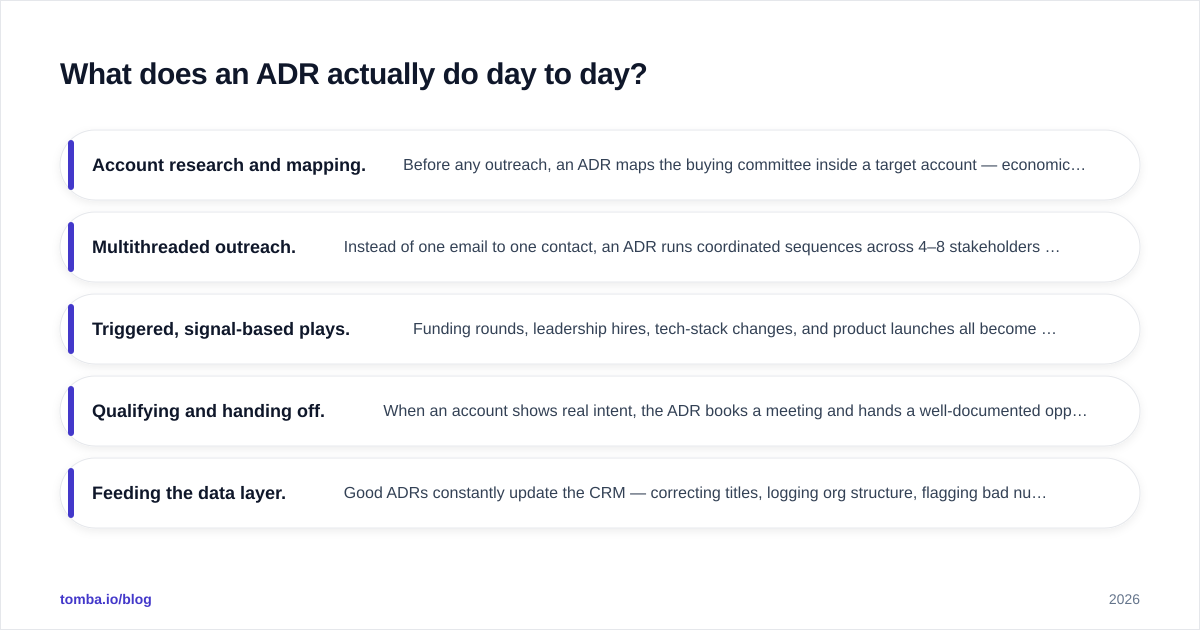
The job is part researcher, part strategist, part communicator. A typical week breaks down into a few core activities:
- Account research and mapping. Before any outreach, an ADR maps the buying committee inside a target account — economic buyer, champion, technical evaluator, blockers — and finds the contact details for each. This is where data enrichment and accurate contact discovery do the heavy lifting.
- Multithreaded outreach. Instead of one email to one contact, an ADR runs coordinated sequences across 4–8 stakeholders per account, with messaging tailored to each persona's pain.
- Triggered, signal-based plays. Funding rounds, leadership hires, tech-stack changes, and product launches all become reasons to reach out with relevance.
- Qualifying and handing off. When an account shows real intent, the ADR books a meeting and hands a well-documented opportunity to an account executive.
- Feeding the data layer. Good ADRs constantly update the CRM — correcting titles, logging org structure, flagging bad numbers — so the next play is smarter.
The throughline is depth. An ADR who sends 40 deeply personalized, account-aware touches will usually out-produce an SDR firing 400 generic ones — at least in the mid-market and enterprise segments where the role is most common.
How is an ADR different from an SDR or BDR?#
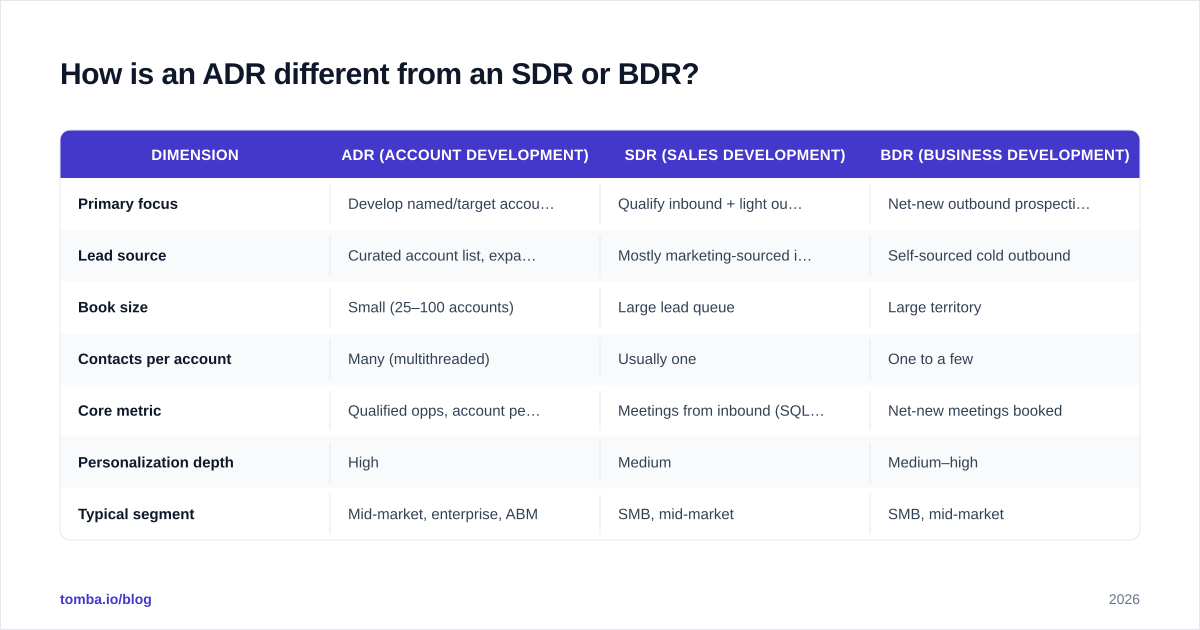
This is the question that trips up most hiring managers, so let's be precise. The titles overlap in practice and vary by company, but the canonical distinctions look like this.
| Dimension | ADR (Account Development) | SDR (Sales Development) | BDR (Business Development) |
|---|---|---|---|
| Primary focus | Develop named/target accounts | Qualify inbound + light outbound | Net-new outbound prospecting |
| Lead source | Curated account list, expansion | Mostly marketing-sourced inbound | Self-sourced cold outbound |
| Book size | Small (25–100 accounts) | Large lead queue | Large territory |
| Contacts per account | Many (multithreaded) | Usually one | One to a few |
| Core metric | Qualified opps, account penetration | Meetings from inbound (SQLs) | Net-new meetings booked |
| Personalization depth | High | Medium | Medium–high |
| Typical segment | Mid-market, enterprise, ABM | SMB, mid-market | SMB, mid-market |
A few honest caveats. First, many organizations use "SDR" and "BDR" interchangeably, and some call their account-based reps SDRs too. Second, the ADR label is sometimes used for an expansion role that works existing customers (cross-sell/upsell) rather than net-new logos. Read the job description, not just the acronym. The reliable signal is the unit of work: if the rep is handed accounts and asked to develop them with depth, it's an ADR motion — whatever the title on the org chart says.
If you want a deeper taxonomy of pipeline roles and stages, HubSpot's sales glossary and Salesforce's resources are solid neutral references. See HubSpot's breakdown of SDR vs. BDR and Salesforce's guide to sales roles.
Why do companies hire ADRs instead of more SDRs?#
Because the math changes as deal size grows. In high-velocity SMB sales, volume wins — more leads, more meetings, more closed-won. But as average contract value climbs and buying committees expand, the bottleneck shifts from quantity of conversations to quality of account penetration. You can't brute-force a seven-figure enterprise deal with 500 cold emails to one inbox.
ADRs solve three specific problems:
- Buying committees are bigger. Gartner's research has consistently shown that the typical B2B purchase involves a large group of stakeholders, not a single decision-maker. Reaching one person is no longer enough; you have to develop the whole committee. (See Gartner's B2B buying research.)
- Relevance beats volume in enterprise. When you only have a few hundred dream accounts, you can afford — and need — to go deep on each.
- Pipeline quality improves. Opportunities sourced by ADRs tend to be better qualified and multithreaded, which lifts win rate and reduces single-threaded deal risk.
The trade-off is throughput. ADRs produce fewer raw meetings, so leadership has to be comfortable measuring the role on opportunity quality and account coverage rather than activity vanity metrics.
What metrics and KPIs should you measure?#
The fastest way to ruin an ADR program is to measure it like an SDR program. If you put a 400-dials-a-week quota on someone whose job is depth, you'll get shallow work. Measure the motion you actually want.
| KPI | Why it matters for an ADR |
|---|---|
| Qualified opportunities created | The core output — real, sales-accepted pipeline |
| Account penetration rate | How many target accounts have an active conversation |
| Contacts engaged per account | Proxy for multithreading depth |
| Meeting-to-opportunity conversion | Quality of the meetings booked |
| Pipeline influenced / sourced ($) | Dollar value, not just meeting count |
| Data hygiene / CRM completeness | Healthy account records compound over time |
Activity metrics (emails sent, calls made) still matter as leading indicators — but as inputs to watch, not the scoreboard. The scoreboard should reward developed accounts and qualified pipeline.
What does the ADR tech stack look like in 2026?#
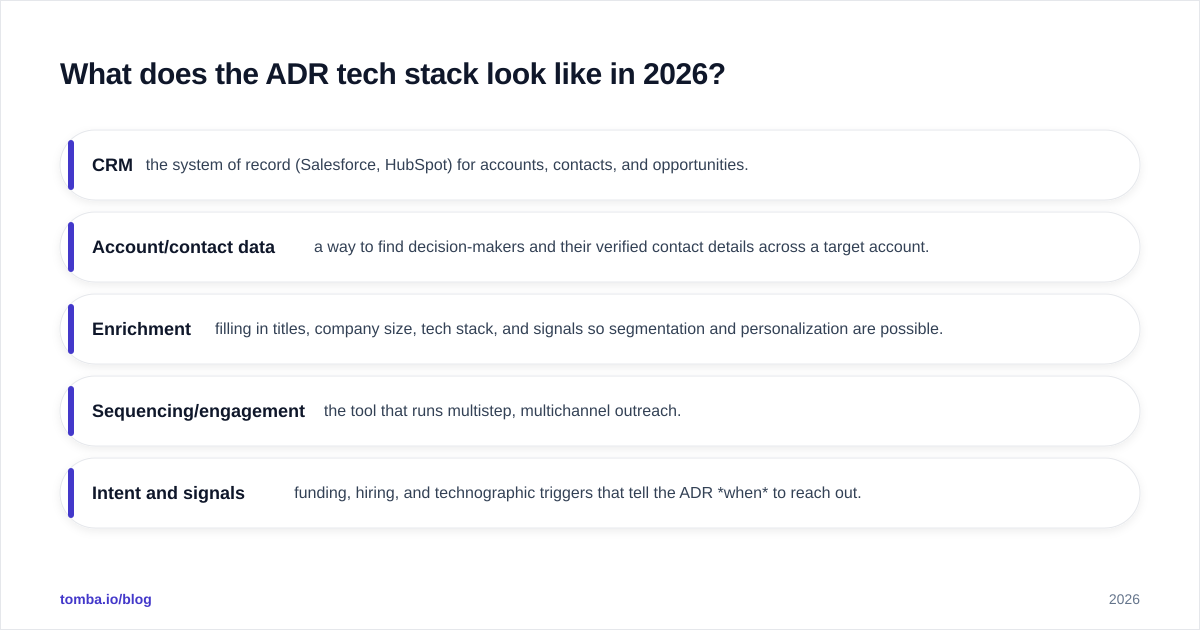
An ADR's productivity is capped by their data. You can have the best messaging in the world, but if the email bounces or the phone number is wrong, the play never lands. The modern ADR stack has five layers:
- CRM — the system of record (Salesforce, HubSpot) for accounts, contacts, and opportunities.
- Account/contact data — a way to find decision-makers and their verified contact details across a target account.
- Enrichment — filling in titles, company size, tech stack, and signals so segmentation and personalization are possible.
- Sequencing/engagement — the tool that runs multistep, multichannel outreach.
- Intent and signals — funding, hiring, and technographic triggers that tell the ADR when to reach out.
The first two layers are where many programs quietly fail. If you can't reliably find the right people inside an account and confirm their contact info, multithreading collapses into guesswork. This is exactly where a purpose-built email finder and a domain search earn their keep: an ADR can pull every relevant contact at a target company, then verify those addresses before a single email goes out.
Phone still matters in account development, too. For committee members who never answer email, a verified B2B phone number keeps the multithread alive across channels. The goal is simple: never let a developable account stall because you couldn't reach a key stakeholder.
How do you become an account development representative?#
The ADR seat is a strong entry-to-mid point in a B2B sales career, and the path in is approachable.
- Skills that transfer well: research discipline, written communication, curiosity about how businesses operate, and comfort with CRM tooling.
- Background that helps: prior SDR experience, customer-facing roles, or any job where you had to understand a buyer's world before pitching.
- What hiring managers screen for: can you write a relevant, specific message to a VP you've never met? Can you map an org chart and explain why you'd contact each person?
The typical career ladder runs ADR → senior ADR → account executive, with some reps branching into account management or RevOps. Because the role is account-strategic, ADR experience is unusually good preparation for closing roles — you've already learned to think in terms of whole accounts, not isolated leads.
What should you pay an ADR in 2026?#
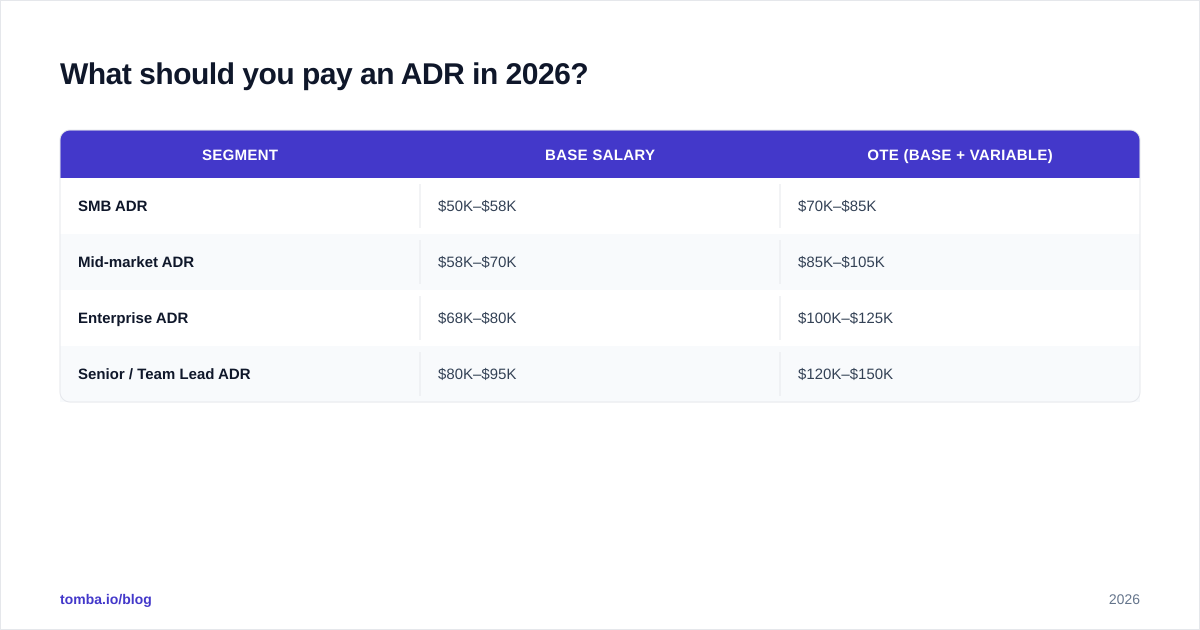
Compensation varies by region, segment, and company stage, but here's a realistic 2026 picture for U.S.-based roles. Treat these as planning ranges, not guarantees, and benchmark against live data on G2 and comp surveys for your market.
| Segment | Base salary | OTE (base + variable) |
|---|---|---|
| SMB ADR | $50K–$58K | $70K–$85K |
| Mid-market ADR | $58K–$70K | $85K–$105K |
| Enterprise ADR | $68K–$80K | $100K–$125K |
| Senior / Team Lead ADR | $80K–$95K | $120K–$150K |
The variable portion is usually tied to qualified opportunities or sourced pipeline, sometimes with accelerators for accounts that convert to closed-won. A healthy split is roughly 70/30 or 75/25 base-to-variable, which keeps the rep focused on quality without making income dangerously volatile.
Common mistakes that sink ADR programs#
A few patterns show up again and again when account development underperforms:
- Treating ADRs like SDRs. Putting a volume quota on a depth role guarantees shallow, generic outreach.
- Bad account lists. If the target accounts aren't a genuine fit, no amount of personalization saves the program. Tighten your ICP first.
- Dirty data. Outdated titles, bounced emails, and wrong numbers quietly tax every play. Verify contacts before outreach, not after the bounce.
- No marketing alignment. ADRs work best when paired with air cover — ABM ads, content, and warm signals. Solo cold outreach into named accounts is harder than it needs to be.
- Weak handoffs. A meeting booked but poorly documented frustrates the AE and wastes the account. The handoff note is part of the job.
Fix the data and the list first. Most "the ADRs aren't producing" complaints are really "the inputs were broken" complaints in disguise — better response rates almost always trace back to better targeting and cleaner contact data.
Is the ADR role worth it for your team?#
Short answer: yes, if your deals are big enough and your account list is finite enough that depth beats volume. If you sell low-ACV products into a massive, undifferentiated market, a traditional high-velocity SDR motion may serve you better. But if you run ABM, sell into the mid-market or enterprise, or need to expand within existing logos, the account development representative is one of the highest-leverage roles you can staff.
The role rewards investment in two things: a sharp ICP and a reliable data foundation. Get those right, and an ADR program compounds — every developed account makes the next one easier.
If you're standing up or scaling an ADR team, start by fixing the contact-data layer that everything else depends on. Tomba's Email Finder lets your reps find and verify decision-maker emails across any target account, so multithreaded plays land instead of bouncing. Pair it with domain search to map a whole buying committee in minutes, and check Tomba pricing — starting free with 25 searches a month, then $49/mo for Starter — to equip your ADRs without blowing up the budget. Better data in, better pipeline out.
// get started
Find, verify and enrich your first contacts today
Start on the free plan with 25 searches a month, then scale when your team is ready.
Free plan · No credit card required · GDPR & CCPA
// about the author