Account Executive Introduction Email: 2026 Templates & Tips
The account executive introduction email decides whether a handed-off deal stalls or accelerates. Here are the frameworks, templates, and metrics that make yours land in 2026.
The first email a new account executive sends to a prospect is rarely about the product. It is about not dropping the baton. A lead was qualified, a relationship was started, and now a new name is taking over the thread. Done badly, that handoff reads like a reset button — the buyer has to re-explain everything, and momentum evaporates. Done well, it feels like an upgrade.
This guide breaks down how to write an account executive introduction email that keeps deals moving, with copy frameworks, six ready templates, and the metrics that tell you whether it worked.
TL;DR#
- An account executive introduction email has one job: transfer trust from the SDR (or previous rep) to you without making the buyer restart the conversation.
- Lead with context the buyer already gave — not with your title, your tenure, or your company's funding round.
- Use a tight structure: warm reference, reason for the handoff, one specific value point, and a single clear ask.
- Keep it under 120 words, one CTA, and a calendar link or a concrete time proposal.
- Track reply rate and meeting-booked rate, not opens — opens lie, replies don't.
What is an account executive introduction email?#
An account executive introduction email is the message a closing rep sends when a deal is passed to them, usually from a sales development rep (SDR), a business development rep, or an outgoing AE. Think of it as the relay exchange in a 4x100 race: the runner handing off is still moving when the next runner grabs the baton. The buyer should never feel a dead stop.
There are three common trigger moments:
- SDR-to-AE handoff — the most frequent. A prospect booked a meeting or showed buying intent, and the AE who will run the cycle introduces themselves.
- Territory or account reassignment — an existing account changes hands because of a reorg, a promotion, or a departing rep.
- Inbound routing — a marketing-qualified lead requests a demo and gets assigned to an AE who has never spoken with them.
Each version shares the same risk: the buyer experiences the change as friction. Your email exists to absorb that friction so they don't feel it.
Why do most introduction emails fail?#
Most fail because they are written for the sender, not the reader. They open with "My name is ___ and I'm the new Account Executive for your region," which is a fact the buyer did not ask for and cannot act on. The buyer's silent question is always the same: why should I spend two minutes on this?
The other failure mode is the reset. When you ask the prospect to "tell me a bit about your goals," you are signaling that nothing carried over — that the discovery they already did with the SDR was thrown away. That single sentence can cost you the deal, because re-explaining is annoying and annoyed buyers ghost.
A strong introduction does the opposite. It proves continuity by referencing something specific the prospect said, and it earns the next step by being useful in the email itself.
What should an account executive introduction email include?#
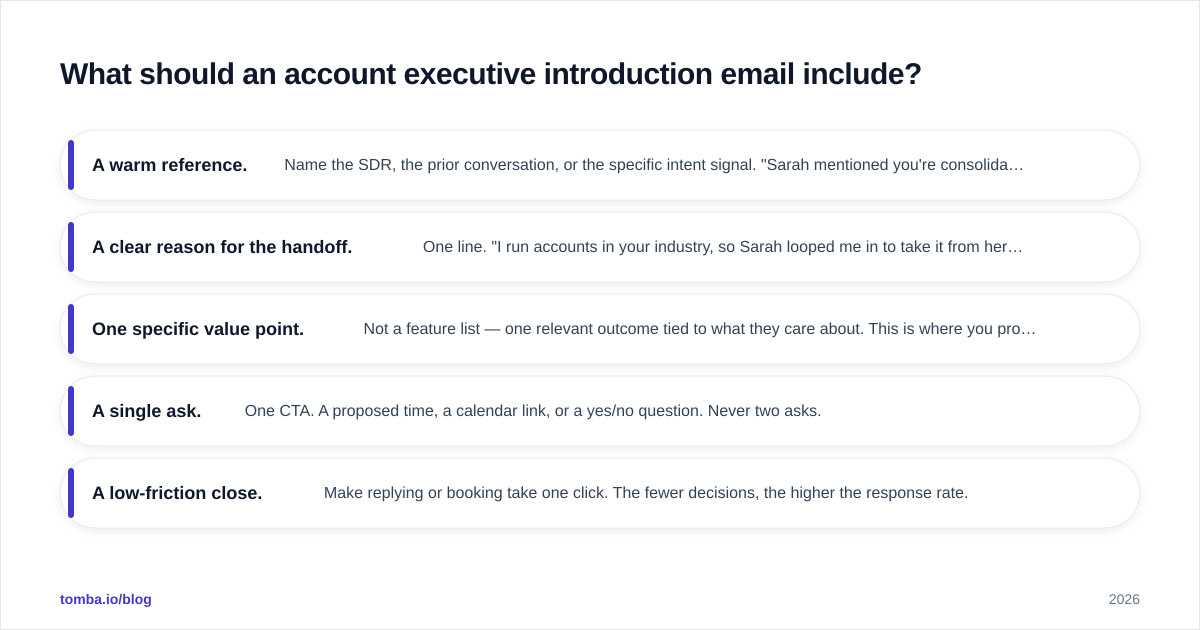
Five components, in this order. Skip any of them and the email gets weaker.
- A warm reference. Name the SDR, the prior conversation, or the specific intent signal. "Sarah mentioned you're consolidating three tools into one workflow" beats "I understand you're interested in our platform."
- A clear reason for the handoff. One line. "I run accounts in your industry, so Sarah looped me in to take it from here." This removes the awkward "why am I talking to a new person" question.
- One specific value point. Not a feature list — one relevant outcome tied to what they care about. This is where you prove you read the notes.
- A single ask. One CTA. A proposed time, a calendar link, or a yes/no question. Never two asks.
- A low-friction close. Make replying or booking take one click. The fewer decisions, the higher the response rate.
Here's the structure as a reusable skeleton:
Hi [First name],
[SDR name] shared the notes from your conversation about [specific challenge]. I run [segment] accounts here, so I'll be your point of contact from here on.
Based on what you described — [one specific detail] — the most useful next step is probably [specific value]. I put together [a quick resource / a tailored view] you can glance at before we talk.
Are you open to [specific time], or would [alternative] work better? Here's my calendar if that's easier: [link].
[Your name]
Which introduction email framework works best?#
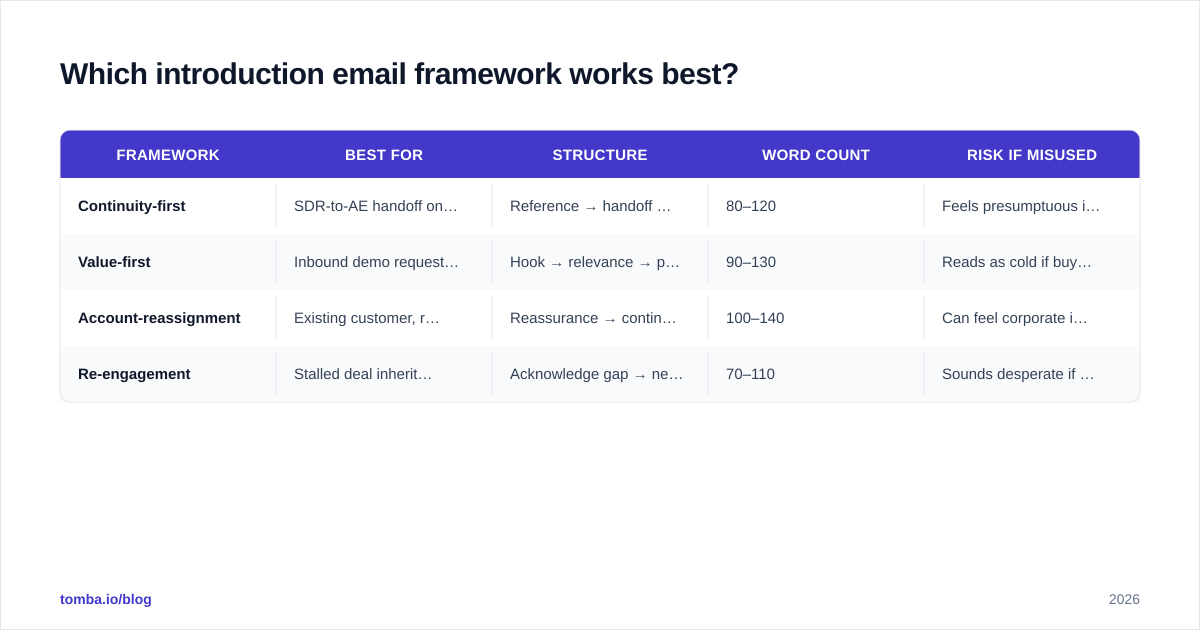
Two frameworks dominate, and they suit different handoffs. Use the table below to pick.
| Framework | Best for | Structure | Word count | Risk if misused |
|---|---|---|---|---|
| Continuity-first | SDR-to-AE handoff on a warm lead | Reference → handoff reason → value → ask | 80–120 | Feels presumptuous if no real prior contact |
| Value-first | Inbound demo request, no prior rep | Hook → relevance → proof → ask | 90–130 | Reads as cold if buyer expected continuity |
| Account-reassignment | Existing customer, rep change | Reassurance → continuity → quick win → ask | 100–140 | Can feel corporate if too formal |
| Re-engagement | Stalled deal inherited from a former rep | Acknowledge gap → new angle → ask | 70–110 | Sounds desperate if you over-apologize |
The continuity-first framework is the default for handoffs because it directly answers the buyer's friction. Value-first is your fallback when there's genuinely no relationship to inherit — for example, an inbound marketing qualified lead routed straight to you.
How long should the email be?#
Shorter than you think. The data across cold and warm outreach has been consistent for years: emails between 50 and 125 words tend to get the highest reply rates, and that holds for introductions. According to HubSpot's sales research, concise, single-CTA emails outperform long pitches, especially on the first touch.
A practical ceiling: if your introduction email is longer than what fits on a phone screen without scrolling, cut it. Most buyers read on mobile, and a wall of text signals work before they've decided you're worth the effort.
What are some account executive introduction email templates?#
Six templates you can adapt. Replace the bracketed parts with real details — the specificity is the whole point.
Template 1 — SDR handoff (continuity-first)
Subject: Picking up where [SDR] left off
Hi [Name], [SDR] passed along your notes about [challenge]. I handle [segment] accounts, so I'll take it from here. You mentioned [specific detail] — most teams in your position see the biggest lift from [outcome]. Open to 20 minutes [day]? Calendar's here: [link].
Template 2 — Inbound demo (value-first)
Subject: Your [Company] demo — a head start
Hi [Name], thanks for requesting a look at [product]. Before we meet, here's the one thing teams like yours usually want to solve first: [problem]. I'll tailor the walkthrough to that. Does [time] still work, or should we move it?
Template 3 — Account reassignment
Subject: New point of contact at [Company]
Hi [Name], I'm taking over your account from [previous rep], and nothing changes on your end — I've already read through your history with us. One thing I noticed: [quick win]. Want me to walk you through it [day]?
Template 4 — Re-engaging a stalled deal
Subject: Reviving the [project] conversation
Hi [Name], I inherited the thread you started with [former rep] a few months back. Rather than rehash it, I'd rather show you what's changed since: [new angle]. Worth 15 minutes?
Template 5 — LinkedIn-sourced lead
Subject: Following up on your post about [topic]
Hi [Name], your comment on [topic] lined up exactly with what we help [segment] teams do. [SDR] flagged you as someone worth a direct intro. Here's the specific idea: [value]. Open to a quick call?
Template 6 — Executive-level introduction
Subject: Brief intro + one relevant data point
Hi [Name], I'll be the AE supporting [Company]. I won't take your time with background — here's the single metric most [role] leaders ask me about: [stat]. If that's a priority this quarter, I'd value 15 minutes.
For more reusable copy, our library of cold email templates covers follow-ups and sequences that pair with these intros, and the cold email AI writer can draft variants when you're testing angles.

How do you personalize at scale without sounding robotic?#
Personalization fails when it's a mail-merge token in a generic sentence. "I see you work at [Company]" is not personalization; it's proof you didn't read anything. Real personalization references a decision, a signal, or a stated goal.
The trick at scale is to standardize the structure and vary only the evidence. Your framework stays fixed; the one specific detail changes per prospect. That detail can come from:
- The SDR's call notes or CRM fields
- A recent company announcement or hiring trend
- The exact pain the prospect named in a form or reply
- A trigger event — funding, a new tool in their stack, a leadership change
Getting that detail reliably depends on clean contact data. If you're enriching a list before reaching out, a data enrichment step fills in role, seniority, and company context so your "specific detail" line is accurate instead of guessed. And before any introduction email goes out, run the address through an email verifier — a bounced intro email is worse than no email, because it can quietly damage your sender reputation and drag down every message after it.
What should you avoid in an introduction email?#
A short list of reliable deal-killers:
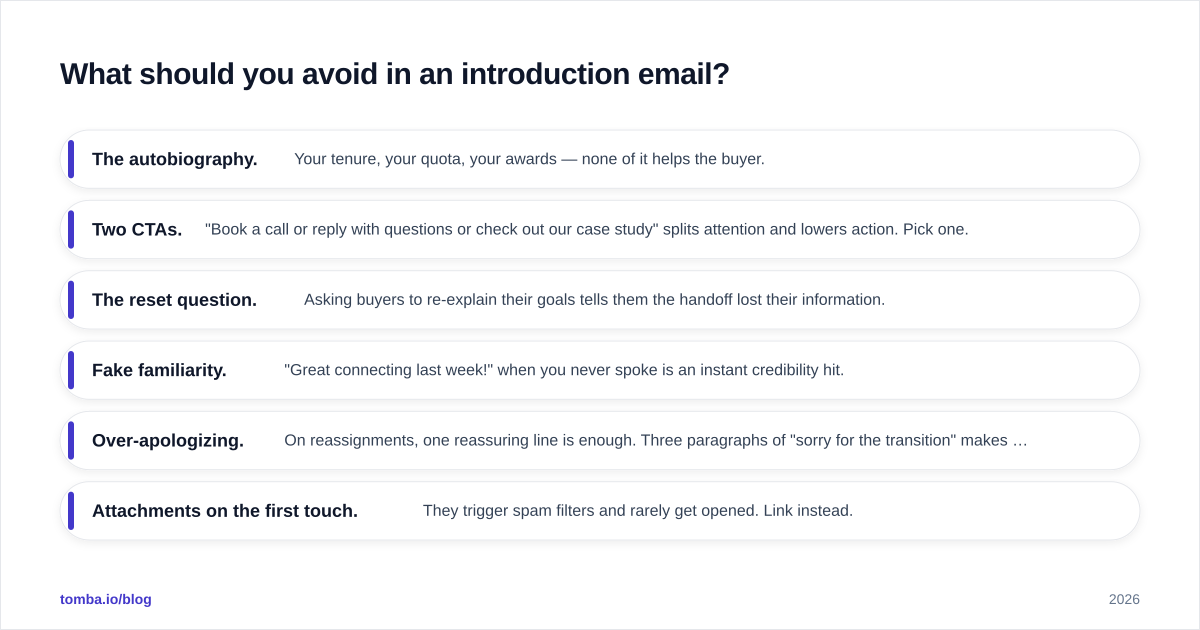
- The autobiography. Your tenure, your quota, your awards — none of it helps the buyer.
- Two CTAs. "Book a call or reply with questions or check out our case study" splits attention and lowers action. Pick one.
- The reset question. Asking buyers to re-explain their goals tells them the handoff lost their information.
- Fake familiarity. "Great connecting last week!" when you never spoke is an instant credibility hit.
- Over-apologizing. On reassignments, one reassuring line is enough. Three paragraphs of "sorry for the transition" makes the change feel bigger than it is.
- Attachments on the first touch. They trigger spam filters and rarely get opened. Link instead.
How do you measure whether it worked?#
Ignore open rates. Apple Mail Privacy Protection and bot pre-fetching have made opens unreliable since 2021 — a 60% "open rate" can include opens that no human ever made. Measure actions instead.
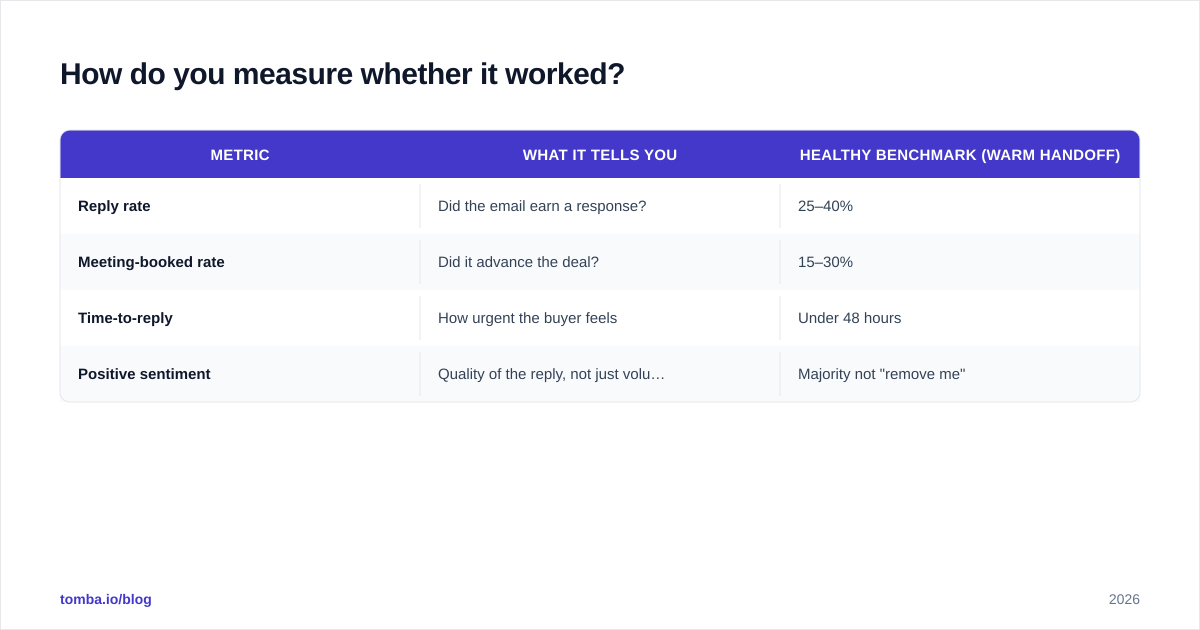
| Metric | What it tells you | Healthy benchmark (warm handoff) |
|---|---|---|
| Reply rate | Did the email earn a response? | 25–40% |
| Meeting-booked rate | Did it advance the deal? | 15–30% |
| Time-to-reply | How urgent the buyer feels | Under 48 hours |
| Positive sentiment | Quality of the reply, not just volume | Majority not "remove me" |
If your reply rate sits below 20% on warm handoffs, the problem is almost always the opening line — you're talking about yourself instead of referencing what the buyer already told you. Track response rate per template and let the winners compound. A/B testing two subject lines on the same audience will usually surface a clear winner within 40–50 sends.
How does this fit into the wider sales process?#
The introduction email is one node in a sequence, not a standalone event. It typically follows a booked meeting or an intent signal and precedes the discovery call. The cleaner the handoff, the less re-qualification you do on that call, which shortens the cycle.
The mechanics matter as much as the words. Before you can send a great introduction, you need the right person's verified address. That's where the top of the funnel meets the copy: a strong template sent to the wrong contact is wasted, and a perfect contact with a weak template is wasted too. Both have to be right.
Where do you get the contact details to send these?#
Most introduction emails are sent to a known contact — the SDR already has the address. But when you're prospecting net-new accounts or building a target list for outbound, you need a reliable way to find and confirm professional email addresses first.
That's the gap Tomba Email Finder fills. Give it a name and a company domain, and it returns the verified professional email so your carefully written introduction actually reaches a human inbox instead of bouncing. You can find one contact at a time, run a bulk email finder job across a whole account list, or pull every address on a company through domain search. Verification is built in, so the deliverability risk that quietly sinks outbound campaigns is handled before you hit send.
Start on the free tier with 25 searches a month, then scale to the $49/mo Starter plan when your list grows. Write the introduction email well, send it to a verified address, and the handoff stops being a risk and starts being an advantage.
// get started
Find, verify and enrich your first contacts today
Start on the free plan with 25 searches a month, then scale when your team is ready.
Free plan · No credit card required · GDPR & CCPA
// about the author