9 Account Growth Strategies to Expand Revenue in 2026
New logos are expensive. Your fastest revenue lives inside accounts you already won. Here are 9 account growth strategies — with a planning framework, metrics, and a comparison table — to expand existing customers in 2026.

TL;DR
- Expanding an existing account is far cheaper than acquiring a new logo — your installed base is the highest-ROI pipeline you already own.
- The nine strategies below cluster into three motions: deepen (upsell, cross-sell), widen (multithreading, new departments), and defend (QBRs, executive alignment, proactive renewals).
- Net Revenue Retention (NRR) above 120% is the single metric that separates account-growth leaders from average teams.
- Account growth is a plan, not a reaction. Build a named-account plan with whitespace mapping, stakeholder coverage, and a quarterly expansion target.
- Accurate contact data is the fuel: you cannot multithread or map whitespace if you can't reach the buyers you haven't met yet.
What are account growth strategies?#
Account growth strategies are the deliberate plays a revenue team runs to increase revenue inside accounts it has already closed — rather than only chasing brand-new customers. Think of your customer base like a city you already live in: you know the streets, you have keys to a few buildings, and growth means opening more doors in the same neighborhood instead of moving to a new city every quarter.
Technically, account growth covers upsell (more of the same product), cross-sell (adjacent products), seat expansion, new-department land, and renewal protection. It sits at the intersection of sales, customer success, and revenue operations — which is why mature teams treat it as a GTM motion with its own pipeline, not an afterthought handled at renewal time.
The shift matters in 2026 because acquisition costs keep climbing while budgets tighten. According to Gartner, B2B buying groups now involve more stakeholders than ever, which means the account you "own" is rarely fully penetrated. There is almost always more revenue sitting in whitespace you haven't sold into yet.
Why does expanding existing accounts beat chasing new logos?#
Conclusion first: it's cheaper, faster, and more predictable. A customer who already trusts you has cleared the hardest hurdle — proof of value. You are no longer selling whether your product works; you are selling more of something that already works for them.
The economics are lopsided. Industry benchmarks consistently show it costs several times more to acquire a new customer than to expand an existing one, and expansion deals close faster because the legal, security, and procurement friction is mostly behind you. HubSpot's research on customer retention reinforces the same pattern: small lifts in retention compound into large revenue gains because you stop refilling a leaky bucket.

There's also a strategic moat. Every department you expand into raises switching costs. A customer using one product from you might churn on a whim; a customer with five teams, three integrations, and an executive sponsor is structurally sticky. Expansion isn't just revenue — it's insurance against churn.
What are the 9 core account growth strategies for 2026?#
Here is the playbook. The nine strategies map to three motions — deepen, widen, defend — shown in the framework below.
Deepen (sell more of what's working):
- Usage-based upsell. Trigger expansion conversations off product signals — seat limits hit, API quota maxed, storage near cap. The best expansion reps watch usage dashboards the way day traders watch tickers.
- Cross-sell adjacent products. Map which of your products each account doesn't yet own. A customer on your core tool but missing your analytics add-on is a warm, qualified opportunity.
- Tier and plan upgrades. Customers grow into higher tiers. Proactively flag accounts whose maturity has outpaced their current plan instead of waiting for them to ask.
Widen (reach more of the org):
- Multithreading. Single-threaded accounts churn when your one champion leaves. Build relationships across at least three to five stakeholders per account. This is where you'll need fresh contact data for buyers you've never emailed — more on that below.
- New-department land. The marketing team bought you; now sell into sales, support, or product. Each department is effectively a new logo with a built-in reference next door.
- Geographic and business-unit expansion. In enterprise accounts, a win in the US subsidiary is a referral into EMEA and APAC units that have separate budgets.
Defend (protect and compound):
- Quarterly Business Reviews (QBRs). Structured reviews that prove ROI, surface new goals, and tee up the next expansion. A good QBR is half retrospective, half discovery call.
- Executive alignment. Map a senior sponsor on your side to a senior sponsor on theirs. Executive relationships survive champion turnover.
- Proactive renewal management. Start the renewal motion 90+ days out, framed around expansion, not just "keeping the lights on." A renewal handled late is a discount waiting to happen.
How do the main expansion motions compare?#
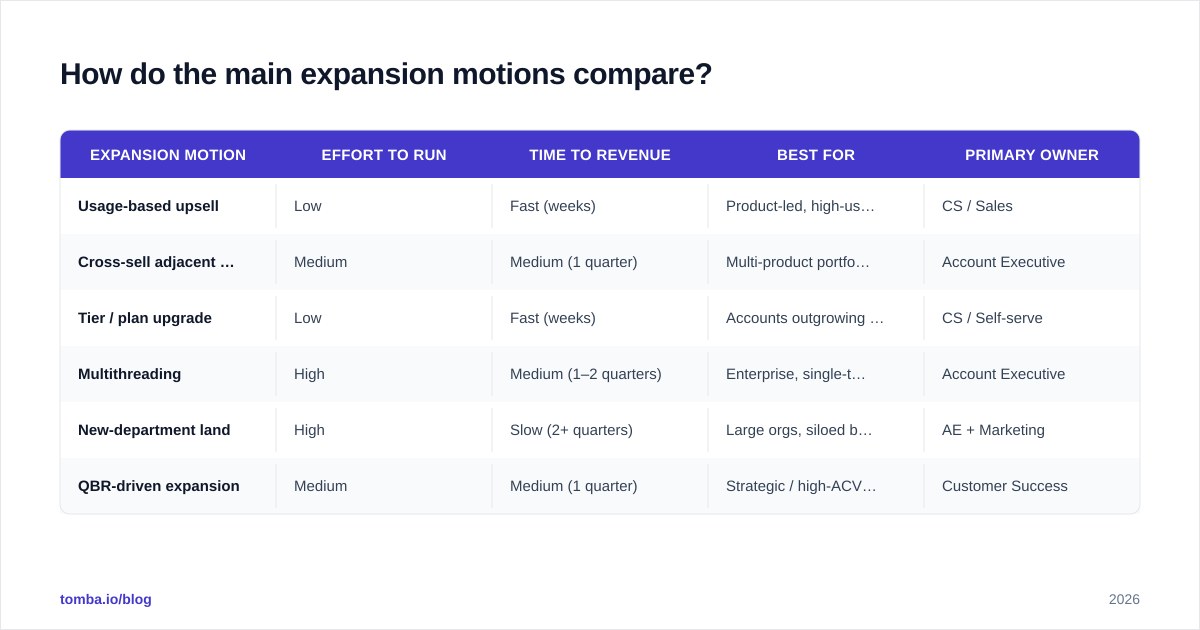
Not every strategy fits every account. Use this table to match motion to effort, time-to-value, and the type of account where it pays off.
| Expansion motion | Effort to run | Time to revenue | Best for | Primary owner |
|---|---|---|---|---|
| Usage-based upsell | Low | Fast (weeks) | Product-led, high-usage accounts | CS / Sales |
| Cross-sell adjacent product | Medium | Medium (1 quarter) | Multi-product portfolios | Account Executive |
| Tier / plan upgrade | Low | Fast (weeks) | Accounts outgrowing current plan | CS / Self-serve |
| Multithreading | High | Medium (1–2 quarters) | Enterprise, single-threaded risk | Account Executive |
| New-department land | High | Slow (2+ quarters) | Large orgs, siloed budgets | AE + Marketing |
| QBR-driven expansion | Medium | Medium (1 quarter) | Strategic / high-ACV accounts | Customer Success |
The pattern is clear: low-effort, fast-revenue motions (usage upsell, tier upgrades) should run continuously and semi-automated, while high-effort motions (multithreading, new-department land) deserve named-account planning and human attention.
How do you build an account growth plan?#
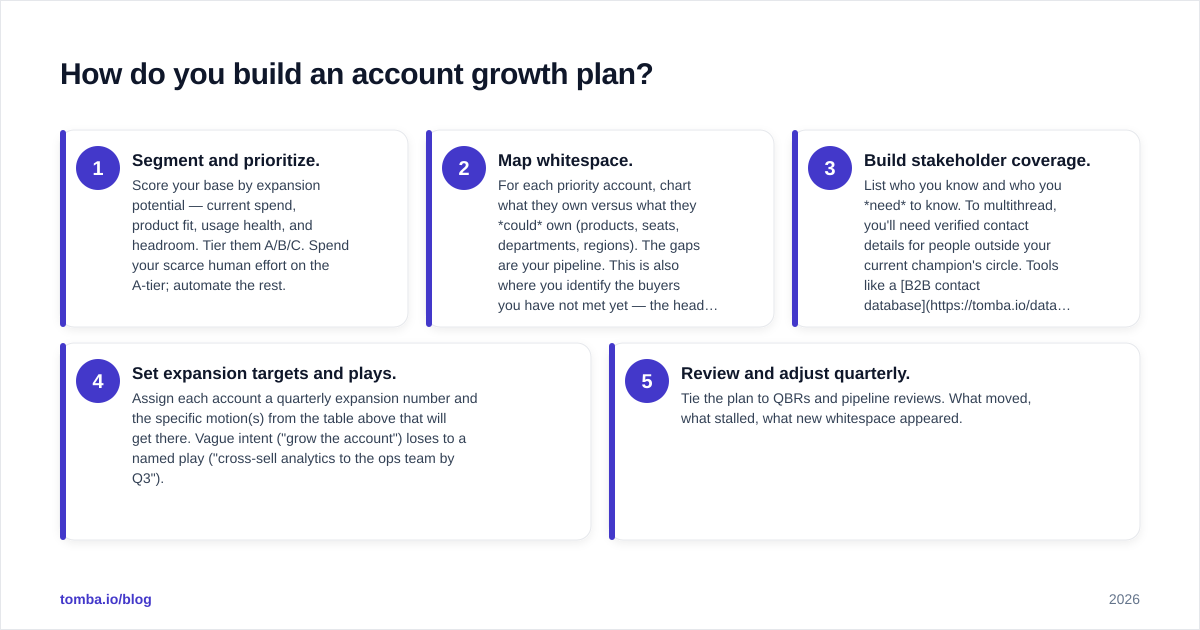
Conclusion first: pick your top accounts, map the whitespace, assign coverage, set a target, and review quarterly. A plan turns nine abstract strategies into a sequence of next steps per account.
Run it in five steps:
- Segment and prioritize. Score your base by expansion potential — current spend, product fit, usage health, and headroom. Tier them A/B/C. Spend your scarce human effort on the A-tier; automate the rest.
- Map whitespace. For each priority account, chart what they own versus what they could own (products, seats, departments, regions). The gaps are your pipeline. This is also where you identify the buyers you have not met yet — the heads of teams that haven't bought.
- Build stakeholder coverage. List who you know and who you need to know. To multithread, you'll need verified contact details for people outside your current champion's circle. Tools like a B2B contact database and data enrichment fill the gaps so your reps aren't guessing email formats or hunting on LinkedIn for hours.
- Set expansion targets and plays. Assign each account a quarterly expansion number and the specific motion(s) from the table above that will get there. Vague intent ("grow the account") loses to a named play ("cross-sell analytics to the ops team by Q3").
- Review and adjust quarterly. Tie the plan to QBRs and pipeline reviews. What moved, what stalled, what new whitespace appeared.

The meme is a joke, but the failure mode is real: reps chase shiny new leads while six-figure expansion sits untouched in their existing book. A written plan with a target is the antidote.
Which metrics actually measure account growth?#
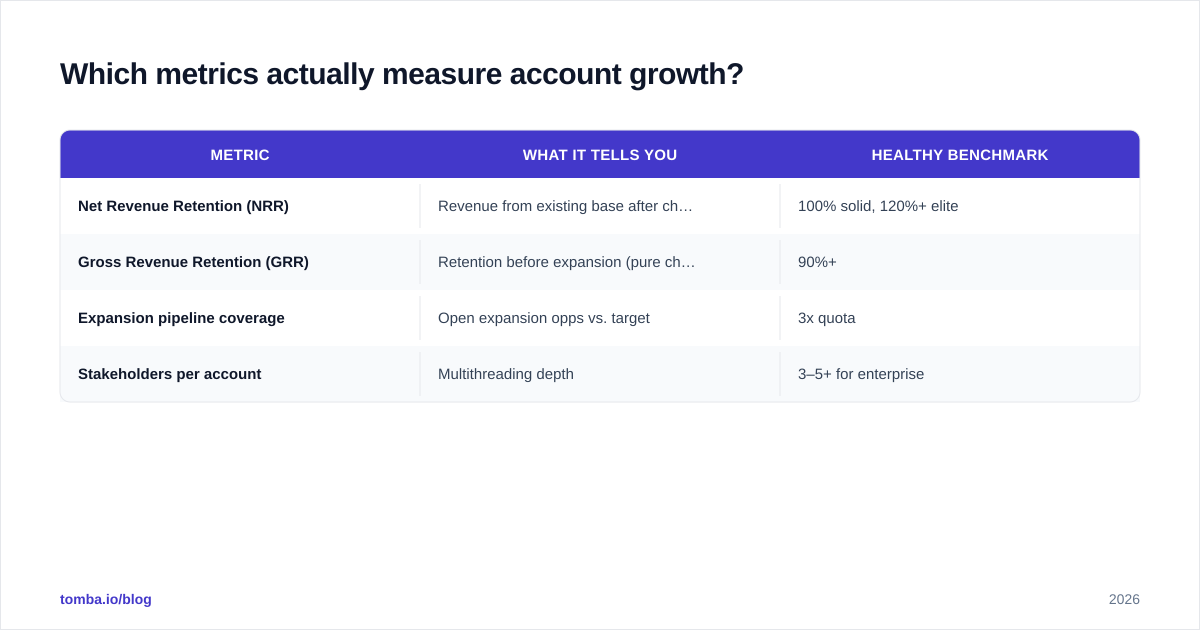
Track these four. If you only track one, track NRR.
| Metric | What it tells you | Healthy benchmark |
|---|---|---|
| Net Revenue Retention (NRR) | Revenue from existing base after churn + expansion | 100% solid, 120%+ elite |
| Gross Revenue Retention (GRR) | Retention before expansion (pure churn view) | 90%+ |
| Expansion pipeline coverage | Open expansion opps vs. target | 3x quota |
| Stakeholders per account | Multithreading depth | 3–5+ for enterprise |
NRR above 100% means your existing customers grow faster than they churn — you could add zero new logos and still grow. That's the entire promise of account growth strategies. Forrester and most SaaS investors treat NRR as a top-tier health metric for exactly this reason; you can read more in G2's grid reports where high-NRR vendors cluster at the top of their categories.
GRR is the honest counterweight: a high NRR can hide ugly churn if a few mega-expansions mask it. Watch both.
What are the most common account growth mistakes?#
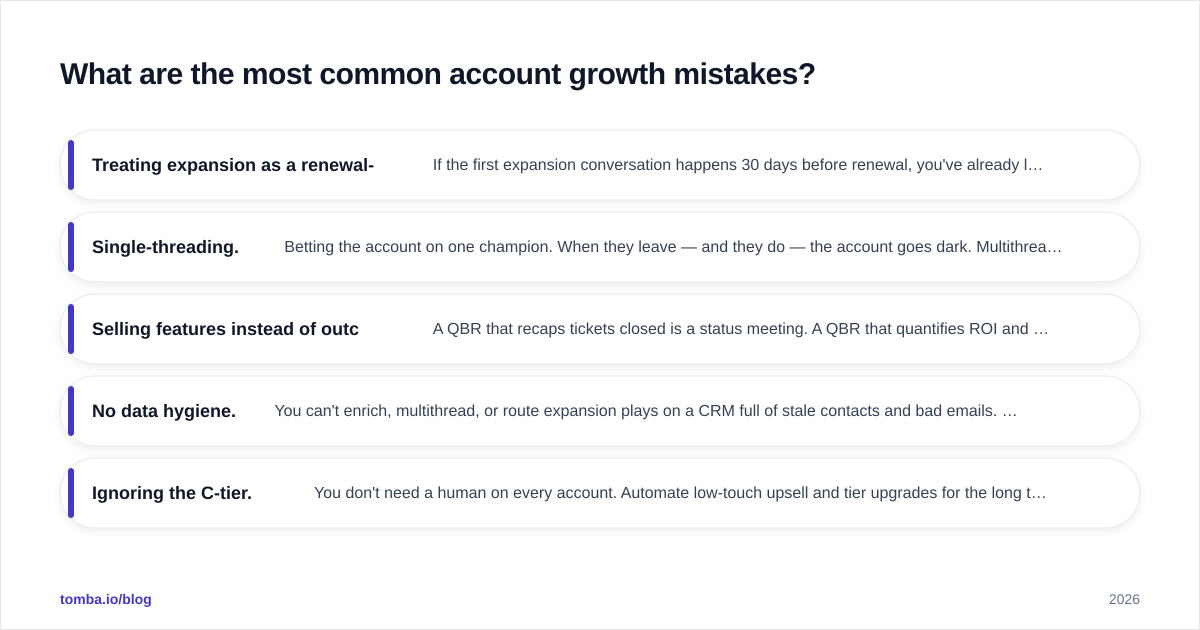
- Treating expansion as a renewal-time event. If the first expansion conversation happens 30 days before renewal, you've already lost most of the year's opportunity. Expansion is a year-round motion.
- Single-threading. Betting the account on one champion. When they leave — and they do — the account goes dark. Multithread early.
- Selling features instead of outcomes in QBRs. A QBR that recaps tickets closed is a status meeting. A QBR that quantifies ROI and surfaces the customer's next goal is a pipeline generator.
- No data hygiene. You can't enrich, multithread, or route expansion plays on a CRM full of stale contacts and bad emails. Verify your contact data before you build the plan, not after a campaign bounces. A quick pass through an email verifier protects your sender reputation when you start reaching new stakeholders.
- Ignoring the C-tier. You don't need a human on every account. Automate low-touch upsell and tier upgrades for the long tail so reps focus on strategic expansion.
How does contact data fuel account growth?#
Every "widen" strategy depends on reaching people you haven't sold to yet — a new VP in a sibling business unit, the head of a department your champion mentioned, an executive sponsor two levels up. You can't multithread blind.
That's the unglamorous engine under account growth: knowing who to reach and how to reach them. When your whitespace map says "we need the Head of RevOps in the EMEA unit," you need their email and direct line fast — not a three-day manual hunt. Pulling verified contacts by company with a domain search, enriching the records you already have, and validating them before outreach is what turns a static account plan into live expansion pipeline. Compare options on Tomba's pricing if you're scoping this into your stack — the free tier is enough to test the workflow on your top ten accounts.
Start expanding your accounts this quarter#
You already won the hard battle — these customers trust you. The fastest revenue in 2026 isn't a stranger; it's the department next door to a champion who already loves your product. Pick your ten highest-potential accounts, map the whitespace, and identify the three new stakeholders you need in each.
When you hit the "we don't have their contact info" wall — and you will — the Tomba Email Finder gets you verified professional emails by name, company, or domain in seconds, so multithreading and new-department land become a same-day task instead of a research project. Start free with 25 searches a month, prove the motion on your top accounts, and scale from there. Your installed base is the best pipeline you'll ever build — go open the doors.
// get started
Find, verify and enrich your first contacts today
Start on the free plan with 25 searches a month, then scale when your team is ready.
Free plan · No credit card required · GDPR & CCPA
// about the author