Account Intelligence in 2026: The Complete B2B Guide
Account intelligence turns scattered firmographic, technographic, and intent data into a clear picture of which accounts to chase and when. Here's how to build it in 2026.
TL;DR
- Account intelligence is the practice of collecting, unifying, and acting on everything you know about a target account — firmographics, technographics, buying-committee contacts, and real-time intent signals.
- It's the difference between a flat list of company names and a ranked, signal-driven view of which accounts are actually in-market right now.
- The stack has four layers: account data, contact data, intent/engagement signals, and an activation layer (CRM, sequencer, alerts).
- Tools range from heavyweight platforms (6sense, Demandbase, Clearbit) to focused data providers that feed your existing CRM at a fraction of the cost.
- You don't need a six-figure platform to start. Clean account data plus accurate contact discovery and a few intent signals already beats spray-and-pray outbound.
What is account intelligence?#
Account intelligence is the discipline of building a complete, continuously updated picture of the companies you sell to — and using that picture to decide who to engage, what to say, and when.
Think of it like a doctor's chart instead of a guess. A flat prospect list tells you a company exists. Account intelligence tells you the company's size and tech stack, who sits on the buying committee, that they just opened a new office, that three people there researched "data warehouse migration" last week, and that a competitor's contract is up for renewal. Technically, it's the fusion of firmographic, technographic, contact, and behavioral data into one account-level record that scoring and routing logic can act on.
This matters most in account-based motions, where a handful of high-value accounts justify deep research. But the same data discipline improves any outbound program. The companies that win in 2026 aren't the ones sending the most emails — they're the ones who know which 200 accounts are worth a personalized sequence this quarter.
Why does account intelligence matter in 2026?#
Three shifts made account intelligence non-optional.
First, buying committees got bigger. Gartner's research has long pegged the typical B2B buying group at six to ten stakeholders, each doing independent research. You can't win a deal by knowing one champion's email — you need the whole committee mapped.
Second, buyers self-educate before they ever talk to you. By the time a form gets filled out, most of the decision is made. Intent data — signals that an account is researching your category — is how you catch them earlier in that journey instead of arriving after the shortlist is set.
Third, budgets tightened and "spray and pray" stopped working. Deliverability penalties, crowded inboxes, and stricter filtering mean volume alone burns your domain reputation. Targeting fewer, better-fit accounts with relevant context is now both more effective and safer for your sender reputation.
The net effect: revenue operations teams are being measured on pipeline efficiency, not raw activity. Account intelligence is the input that makes efficient targeting possible.
What are the core layers of account intelligence?#
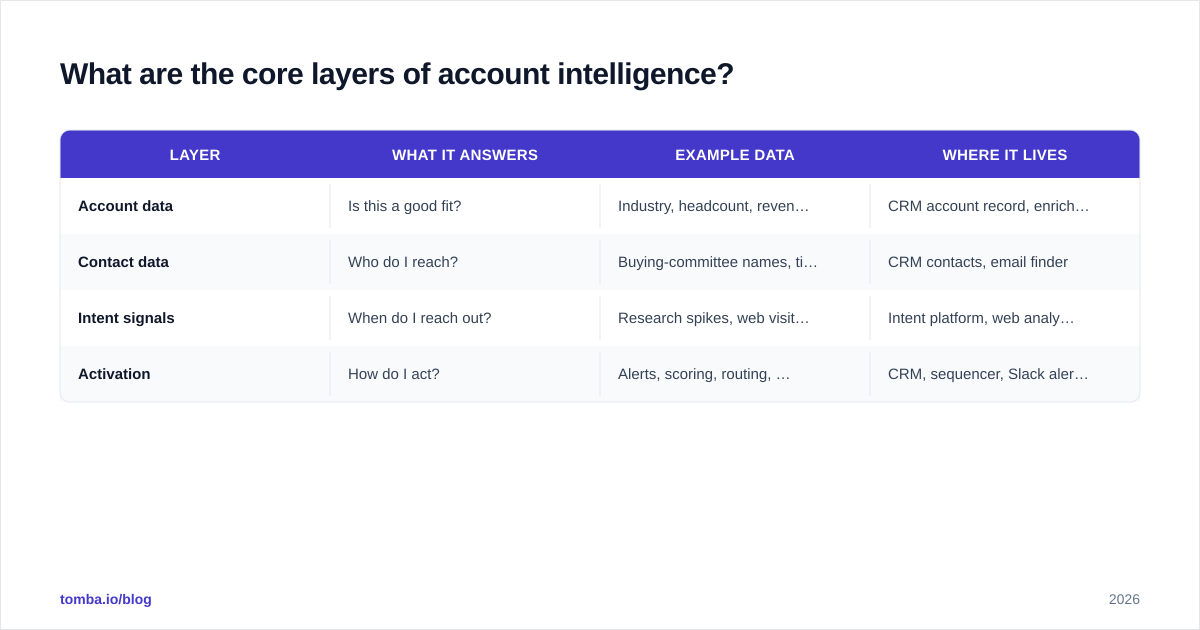
A working account-intelligence system is built from four layers stacked on top of each other. Skip a layer and the whole thing wobbles.
1. Account (firmographic + technographic) data. The foundation: industry, headcount, revenue, location, funding, and the technologies an account runs. This is what defines your ideal customer profile and lets you score fit.
2. Contact data. The people inside the account — names, titles, roles on the buying committee, and verified contact details. An account record with no reachable humans is a dead end, which is why accurate email finder and verification tooling sits right here.
3. Intent and engagement signals. Behavioral data that tells you when an account is active: third-party research intent, website visits, ad engagement, job postings, funding events, and product usage. This layer turns a static list into a prioritized queue.
4. Activation. The CRM, sequencer, and alerting that put the intelligence in front of a rep at the right moment. Data that never reaches a workflow is just an expensive spreadsheet.
| Layer | What it answers | Example data | Where it lives |
|---|---|---|---|
| Account data | Is this a good fit? | Industry, headcount, revenue, tech stack | CRM account record, enrichment tool |
| Contact data | Who do I reach? | Buying-committee names, titles, verified emails | CRM contacts, email finder |
| Intent signals | When do I reach out? | Research spikes, web visits, funding, hiring | Intent platform, web analytics |
| Activation | How do I act? | Alerts, scoring, routing, sequences | CRM, sequencer, Slack alerts |
How is account intelligence different from lead intelligence?#
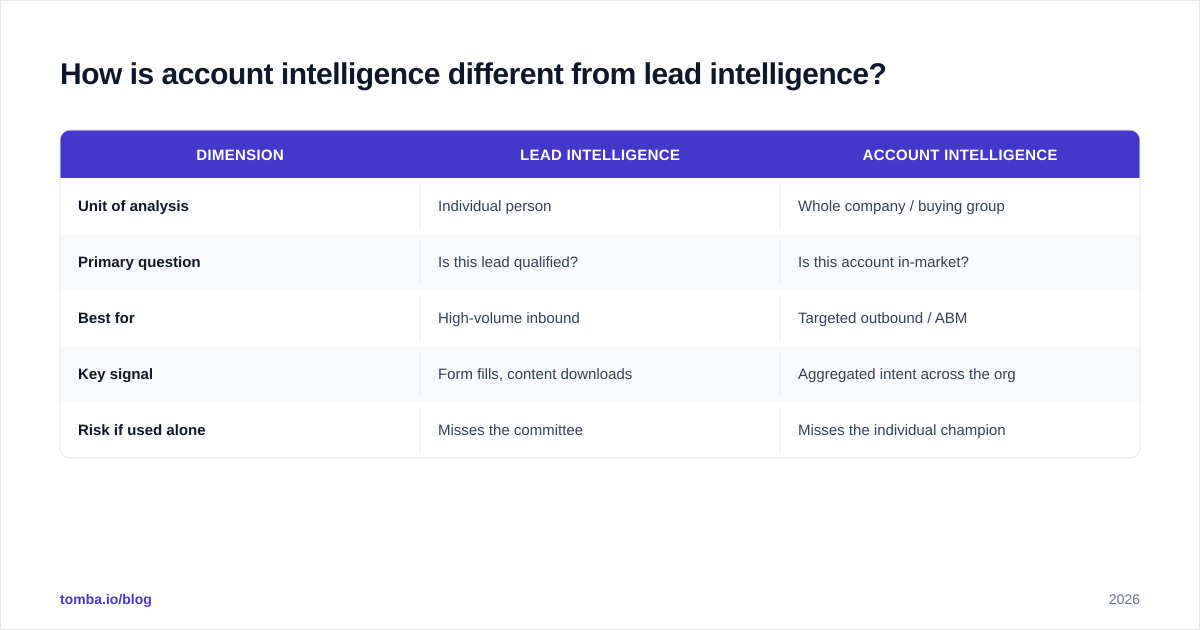
The short answer: account intelligence scores the company; lead intelligence scores the person. You need both, but you start with the account.
Lead-based thinking asks "is this individual a marketing-qualified lead?" Account-based thinking asks "is this whole company in-market, and have we engaged enough of the buying committee?" A single hand-raiser at a 12-person buying committee is weak signal in isolation. Three anonymous research spikes plus two web visits plus a relevant job posting is strong signal even before anyone fills out a form.
| Dimension | Lead intelligence | Account intelligence |
|---|---|---|
| Unit of analysis | Individual person | Whole company / buying group |
| Primary question | Is this lead qualified? | Is this account in-market? |
| Best for | High-volume inbound | Targeted outbound / ABM |
| Key signal | Form fills, content downloads | Aggregated intent across the org |
| Risk if used alone | Misses the committee | Misses the individual champion |
The mature setup blends them: account-level scoring decides which companies to pursue, then lead-level data tells you which humans to contact first.
What data signals power account intelligence?#
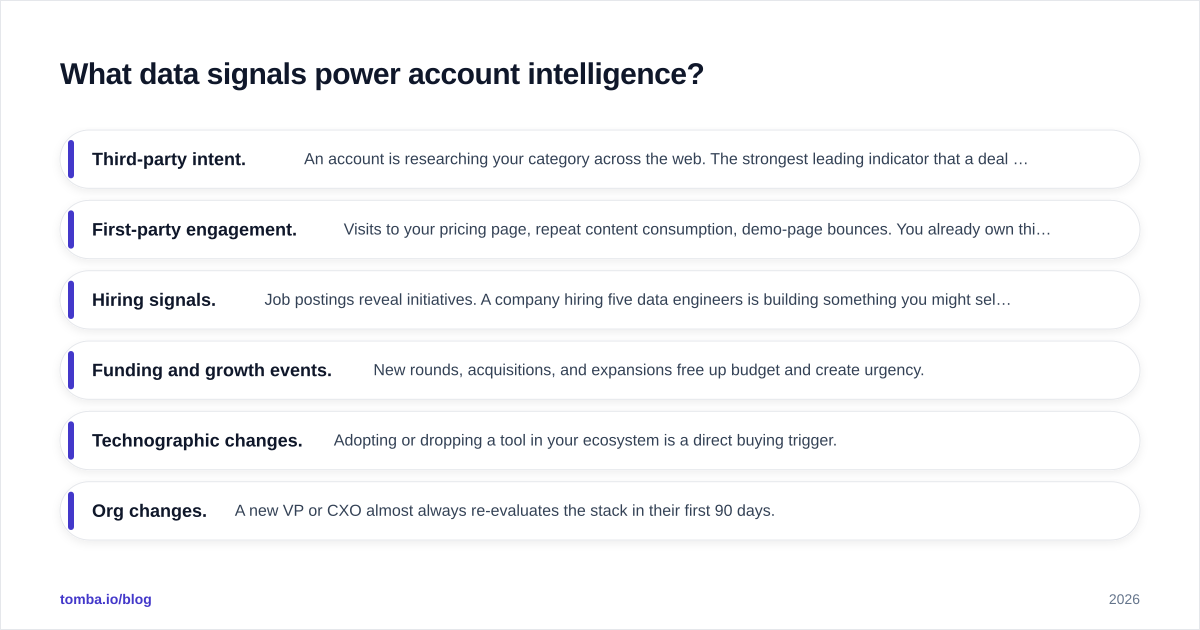
Signals are what separate a database from intelligence. Here are the ones that consistently move pipeline, roughly in order of strength:
- Third-party intent. An account is researching your category across the web. The strongest leading indicator that a deal window is opening.
- First-party engagement. Visits to your pricing page, repeat content consumption, demo-page bounces. You already own this data — most teams under-use it.
- Hiring signals. Job postings reveal initiatives. A company hiring five data engineers is building something you might sell into.
- Funding and growth events. New rounds, acquisitions, and expansions free up budget and create urgency.
- Technographic changes. Adopting or dropping a tool in your ecosystem is a direct buying trigger.
- Org changes. A new VP or CXO almost always re-evaluates the stack in their first 90 days.
The trap is treating every signal equally. Weight them. A pricing-page visit from a director at a perfect-fit account is worth more than a generic intent ping from a company half your ICP size. Good data enrichment makes that weighting possible by attaching firmographic context to every raw signal.
How do you build an account intelligence workflow?#
You don't buy account intelligence — you operate it. Here's a workflow that scales from a two-person team to a full RevOps function.
Step 1 — Define the ICP precisely. Write down the firmographic and technographic filters that define a great-fit account. Vague ICPs produce vague lists. Pull historical closed-won data and find the patterns.
Step 2 — Build the target account list. Use a B2B database and your ICP filters to assemble the universe of accounts worth tracking. This is your denominator for everything that follows.
Step 3 — Enrich and map the committee. For each priority account, identify the buying-committee roles and find verified contact details. This is where contact accuracy directly affects results — a bounced email is a wasted signal and a deliverability hit.
Step 4 — Layer in signals and score. Connect intent and engagement sources, then assign each account a composite score (fit × intent × engagement). Sort descending. The top of that list is where reps spend Monday morning.
Step 5 — Activate and alert. Push high-scoring accounts into sequences, fire Slack alerts when a tracked account spikes, and route them to the right rep automatically. Speed of follow-up on a fresh signal is a real competitive edge.
Step 6 — Close the loop. Feed won/lost outcomes back into your scoring model. Account intelligence is a living system; the model that worked last year drifts as your market shifts.
Which account intelligence tools should you consider in 2026?#
The market splits into three tiers. Match the tier to your motion and budget rather than buying the biggest name by default.
Full ABM platforms (6sense, Demandbase) bundle intent, advertising, orchestration, and analytics. Powerful for large teams running coordinated marketing-plus-sales motions — and priced accordingly, often well into five or six figures annually. You can read more on the 6sense approach to predictive intent if you want the category's origin story.
Data and enrichment providers (Clearbit/HubSpot Breeze,
ZoomInfo, and focused finders) supply the account, contact, and firmographic layers that feed your CRM. This is the layer most teams actually need first — without clean data, an orchestration platform just automates bad targeting.
Point tools handle one job extremely well: verifying emails, finding the buying committee, or revealing anonymous web visitors. They're cheap, fast to adopt, and stack neatly into an existing workflow.
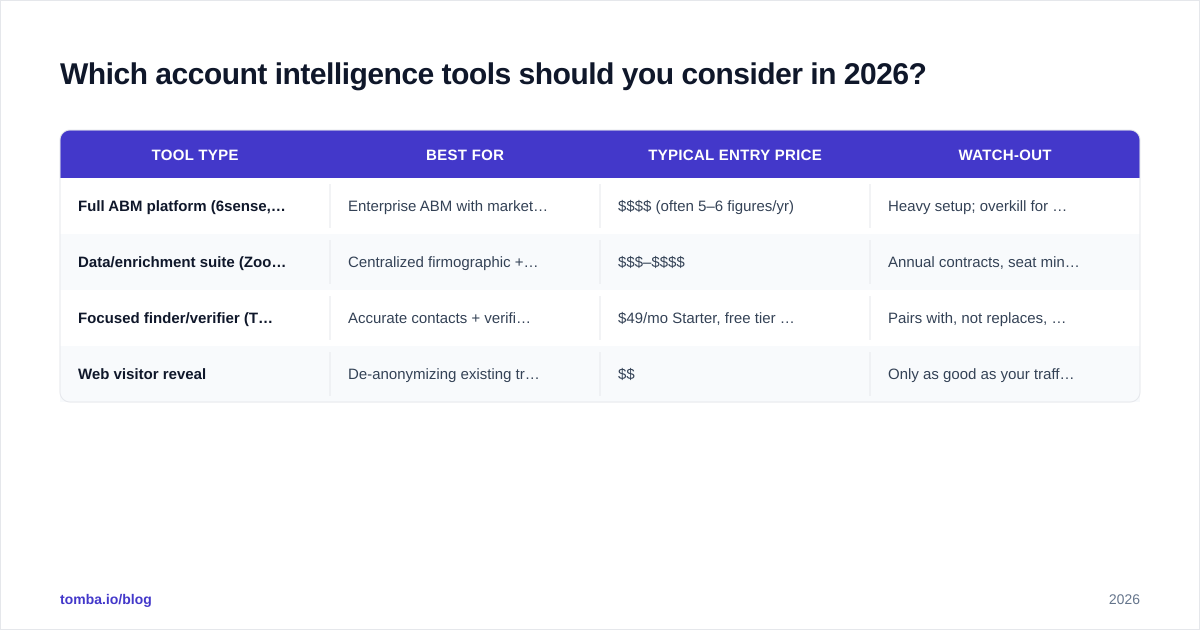
| Tool type | Best for | Typical entry price | Watch-out |
|---|---|---|---|
| Full ABM platform (6sense, Demandbase) | Enterprise ABM with marketing + sales | $$$$ (often 5–6 figures/yr) | Heavy setup; overkill for SMB teams |
| Data/enrichment suite (ZoomInfo, Clearbit) | Centralized firmographic + contact data | $$$–$$$$ | Annual contracts, seat minimums |
| Focused finder/verifier (Tomba) | Accurate contacts + verification on demand | $49/mo Starter, free tier available | Pairs with, not replaces, intent platforms |
| Web visitor reveal | De-anonymizing existing traffic | $$ | Only as good as your traffic volume |
For most teams, the smart sequence is: nail the data and contact layers first, prove the workflow, then add an intent or orchestration platform once you've outgrown the basics. Compare options honestly — G2's account data category and HubSpot's ABM resources are useful neutral starting points.
How do you measure account intelligence ROI?#
Tie it to pipeline efficiency, not activity. The metrics that prove account intelligence is working:
- Account coverage — what percentage of your ICP accounts have a complete record (firmographics, mapped committee, verified contacts).
- Signal-to-meeting rate — of accounts that fired a high-intent signal, how many converted to a meeting. This isolates the value of your signal layer.
- Win rate on prioritized accounts vs. the rest. If your scored top tier doesn't close at a meaningfully higher rate, your model is broken. Track it against your baseline win rate.
- Pipeline per rep hour. The whole point is efficiency — more qualified pipeline from less wasted outreach.
- Bounce and deliverability rates. A rising bounce rate is a leading indicator that your contact-data layer is decaying.
Set a baseline before you start, then review quarterly. The teams that treat these numbers as a feedback loop — not a vanity dashboard — are the ones that keep their scoring model sharp.
What are the common mistakes to avoid?#
- Buying a platform before fixing data. An orchestration tool sitting on stale contacts just automates misses. Data quality first.
- Treating intent as truth. Intent is a probability, not a guarantee. Always combine it with fit and engagement before a rep acts.
- Ignoring contact decay. B2B data goes stale fast as people change jobs. Re-verify regularly or your committee maps quietly rot.
- Over-personalizing on weak signals. "I saw you visited our pricing page" is creepy at scale and often wrong. Use signals to prioritize, not to script openers verbatim.
- No closed-loop feedback. A scoring model that never learns from won/lost data drifts away from reality within a year.
Where does Tomba fit in your account intelligence stack?#
Start with the layer everything else depends on: accurate, verified contacts for the accounts you've decided to pursue. Once your target account list is built, Tomba's Email Finder lets you find and verify the buying-committee contacts inside each account by domain, name, or company — feeding clean, deliverable data straight into your CRM and sequencer. Pair it with domain search to map whole companies, verification to protect your sender reputation, and enrichment to attach firmographic context to every record.
You don't need a six-figure platform to run intelligent, account-based outbound. You need clean data, a few good signals, and a workflow that acts on them. Tomba's free tier (25 searches/mo) lets you test the contact layer today, with Tomba pricing scaling from the $49/mo Starter plan as your program grows. Build the foundation right, and the rest of the stack pays off.
Ready to find emails that actually work?
Join 150,000+ professionals who stopped guessing and started sending. Free credits on signup — no credit card required.
Get the Tomba newsletter
Practical outbound tactics and product updates — once every two weeks.
About the author