Account Plan: B2B Strategic Account Planning Guide 2026
A practical guide to building an account plan that actually drives expansion revenue — the framework, a copy-ready template, and the data you need to map and grow your key accounts.
TL;DR
- An account plan is a living document that maps a strategic account's structure, goals, buying centers, and your path to grow revenue inside it — not a one-time slide for QBR theater.
- The accounts worth planning are few: your top 10–20% by current or potential revenue. Everything else runs on standard pipeline motion.
- A good plan answers four questions: who has power, what they care about, where the whitespace is, and what you'll do in the next 90 days.
- Plans fail when they're built on stale org charts and guesses. Accurate contact, hierarchy, and enrichment data is the difference between a strategy and a wish.
- Use the template and framework below, then refresh the plan quarterly against real signals.
What is an account plan?#
An account plan is a structured, regularly updated document that defines how you will retain and grow revenue within a single strategic account. Think of it like a coach's game plan for one specific opponent: you study their roster, their tendencies, their weak spots, and you write down the exact plays you'll run — instead of improvising every snap.
Technically, an account plan combines a map of the account (its org structure, business units, and decision-makers), an assessment of the relationship (where you're strong, where you're exposed), and an action plan (specific moves tied to dates and owners). It sits one level above opportunity planning. An opportunity plan wins a single deal; an account plan governs the entire multi-year relationship and all the deals inside it.
The distinction matters because the economics are different. Acquiring a new logo costs far more than expanding an existing one, and existing customers convert at much higher rates. HubSpot's sales research and most enterprise playbooks agree: your installed base is your cheapest, highest-probability pipeline. An account plan is how you stop leaving that money on the table.
Who actually needs an account plan?#
Not every account. This is the mistake that kills account planning programs — reps are told to build a plan for all 200 names in their book, the plans become copy-paste filler, and the whole exercise dies within two quarters.
Reserve real account plans for accounts where the upside justifies the effort:
- Tier 1 — Strategic: Your largest current customers and your highest-potential targets. Multi-stakeholder, multi-product, multi-year. These get a full plan, refreshed quarterly.
- Tier 2 — Growth: Solid revenue with clear expansion paths. A lightweight plan, refreshed twice a year.
- Tier 3 — Transactional: Everyone else. No formal plan — these run on your normal sales process and pipeline motion.
A practical rule: if you can't name three distinct buying centers or a realistic path to triple the account's value, it probably isn't a Tier 1 account. Be honest here. Ten well-executed plans beat fifty abandoned ones.

What goes in a strategic account plan?#
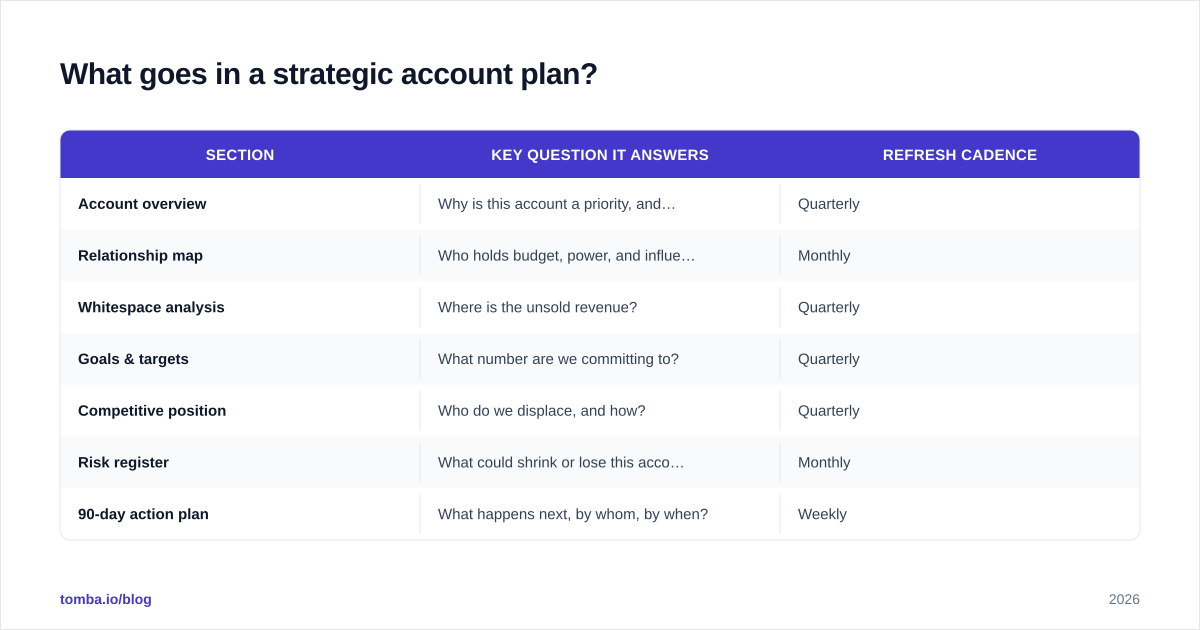
A complete account plan has seven sections. You can compress them onto one page or expand them into a deck, but skip none of them.
- Account overview — Revenue, industry, size, key business initiatives, and recent news (funding, M&A, leadership changes). This is the "why now" context.
- Relationship map — Every stakeholder who touches a buying decision: their role, their influence, their attitude toward you, and who reports to whom. This is where most plans are weakest because the data is hard to get.
- Whitespace analysis — A grid of your products against the account's business units. Filled cells are revenue you have; empty cells are revenue you could win.
- Goals and targets — Specific revenue numbers for the next 12 months, broken into named opportunities.
- Competitive position — Who else is in the account, where they're entrenched, and your displacement angle.
- Risks — Renewal exposure, champion departure, budget freezes, low product adoption.
- Action plan — The next 90 days as a list of dated, owned activities. No vague "deepen the relationship" — write "Meet new VP of Ops by March 15, owner: AE."
A copy-ready account plan template#
| Section | Key question it answers | Refresh cadence |
|---|---|---|
| Account overview | Why is this account a priority, and why now? | Quarterly |
| Relationship map | Who holds budget, power, and influence? | Monthly |
| Whitespace analysis | Where is the unsold revenue? | Quarterly |
| Goals & targets | What number are we committing to? | Quarterly |
| Competitive position | Who do we displace, and how? | Quarterly |
| Risk register | What could shrink or lose this account? | Monthly |
| 90-day action plan | What happens next, by whom, by when? | Weekly |
The cadence column is the part people ignore and the part that matters most. A relationship map built once and never touched is wrong within a quarter — people change jobs, champions leave, new VPs arrive. Treat the plan as software, not a monument.
How do you build the relationship map?#
Start with the org structure, then layer power and sentiment on top. The org structure is the skeleton; influence and attitude are the muscle.
Most reps build relationship maps from memory and LinkedIn, which produces two predictable failures: missing people (the silent influencer who kills your deal in a hallway) and stale people (the champion who left four months ago and whose email now bounces). Both are fixable with current data.
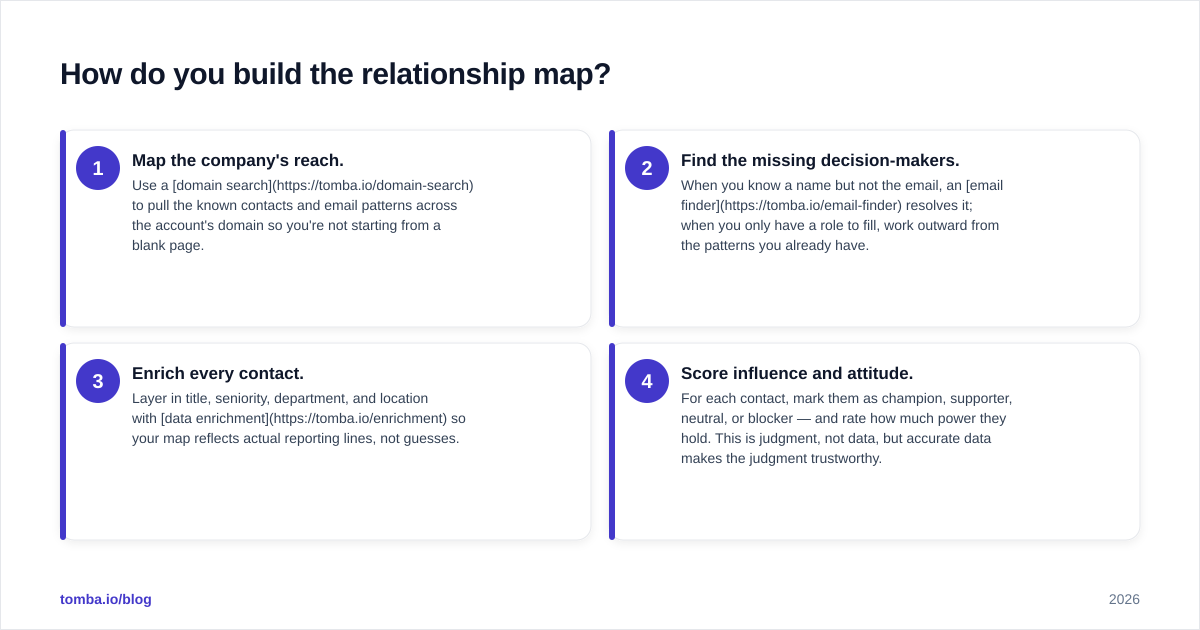
Here's the practical workflow:
- Map the company's reach. Use a domain search to pull the known contacts and email patterns across the account's domain so you're not starting from a blank page.
- Find the missing decision-makers. When you know a name but not the email, an email finder resolves it; when you only have a role to fill, work outward from the patterns you already have.
- Enrich every contact. Layer in title, seniority, department, and location with data enrichment so your map reflects actual reporting lines, not guesses.
- Score influence and attitude. For each contact, mark them as champion, supporter, neutral, or blocker — and rate how much power they hold. This is judgment, not data, but accurate data makes the judgment trustworthy.
The output is a stakeholder grid you can act on. The accounts you lose are rarely lost on price — they're lost because you were talking to the wrong people, or to people who quietly left.
How is account planning different from territory or opportunity planning?#
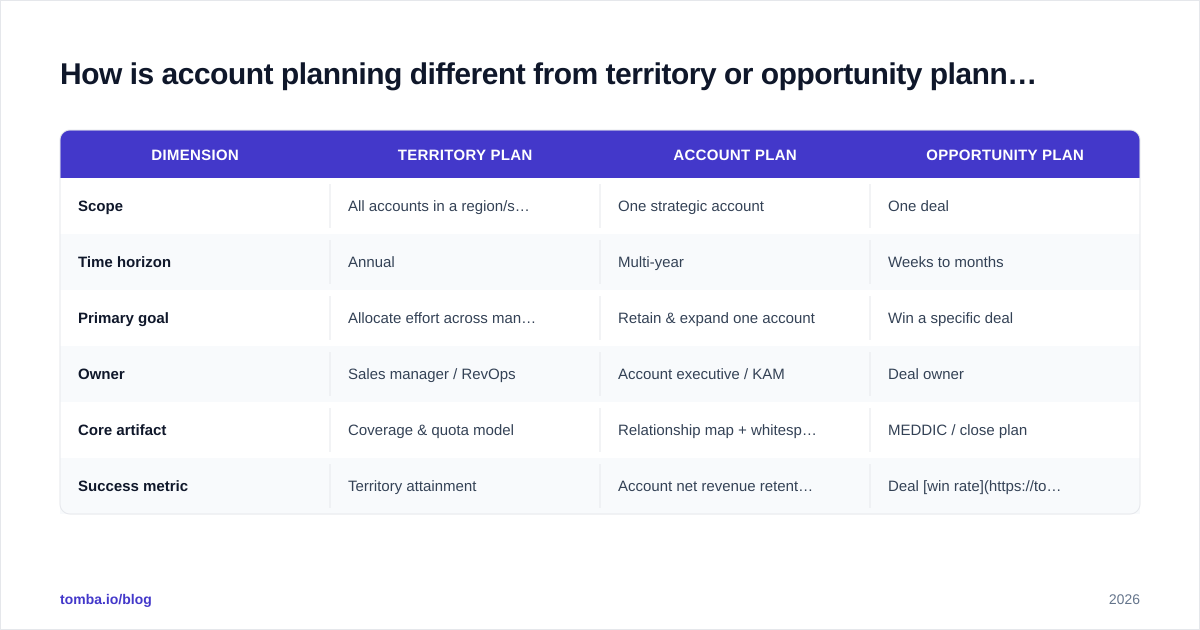
These three terms get used interchangeably and they shouldn't. They operate at different altitudes and answer different questions.
| Dimension | Territory plan | Account plan | Opportunity plan |
|---|---|---|---|
| Scope | All accounts in a region/segment | One strategic account | One deal |
| Time horizon | Annual | Multi-year | Weeks to months |
| Primary goal | Allocate effort across many accounts | Retain & expand one account | Win a specific deal |
| Owner | Sales manager / RevOps | Account executive / KAM | Deal owner |
| Core artifact | Coverage & quota model | Relationship map + whitespace | MEDDIC / close plan |
| Success metric | Territory attainment | Account net revenue retention | Deal win rate |
You need all three, and they nest. Territory planning tells you which accounts deserve a plan. Account planning tells you which opportunities to pursue inside those accounts. Opportunity planning tells you how to win each one. Skip the middle layer and your biggest accounts get treated like transactional ones — which is exactly how incumbents lose six-figure renewals to scrappier competitors.

What tools and data do you need to run account plans?#
You need three things: a place to store the plan, accurate data to fill it, and a rhythm to review it.
For storage, your CRM is the right home — keep the plan where the activity already lives rather than in a forgotten slide deck. Salesforce, HubSpot, and most enterprise CRMs now have native or app-store account planning modules. The tool matters less than the discipline of updating it.
For data, the plan is only as good as its inputs. A relationship map built on a year-old org chart is actively dangerous because it gives false confidence. This is where contact accuracy directly drives plan quality. According to Gartner's research on B2B buying, a typical enterprise purchase now involves six to ten decision-makers — if your map covers three of them, you're flying blind on the rest. Keeping emails, titles, and reporting lines current with reliable enrichment and verification is not a nice-to-have; it's the foundation.
For rhythm, run a monthly account review for Tier 1 accounts and fold the plan into your QBRs. The review has one job: compare what you said you'd do last month against what actually happened, then reset the 90-day action list.
Common account plan mistakes to avoid#
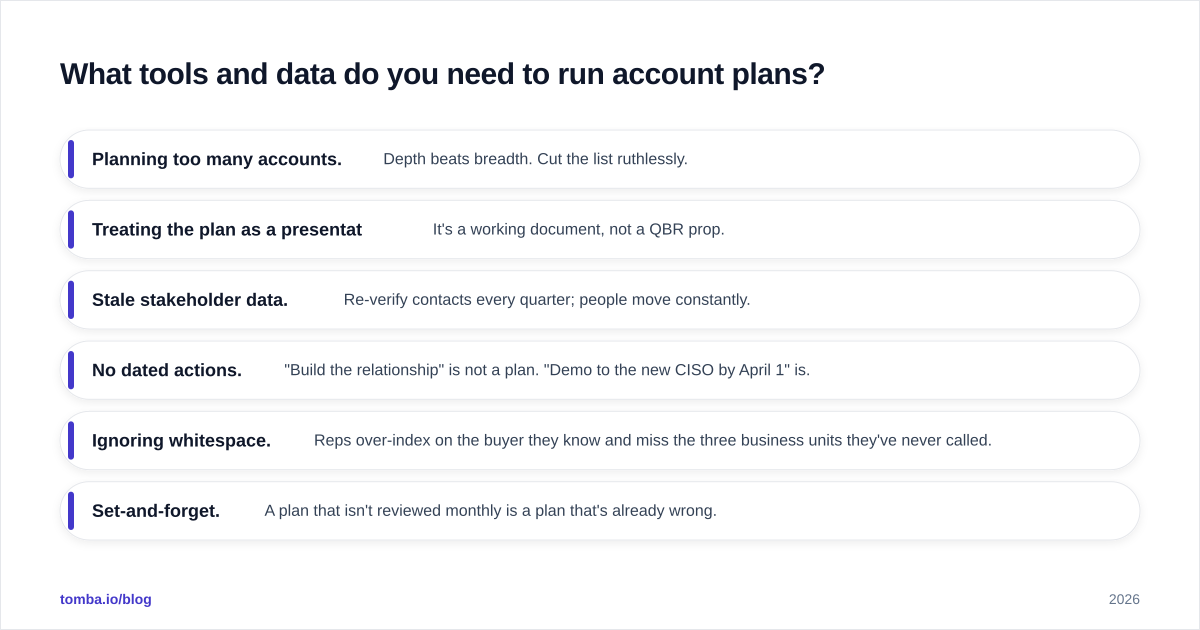
- Planning too many accounts. Depth beats breadth. Cut the list ruthlessly.
- Treating the plan as a presentation. It's a working document, not a QBR prop.
- Stale stakeholder data. Re-verify contacts every quarter; people move constantly.
- No dated actions. "Build the relationship" is not a plan. "Demo to the new CISO by April 1" is.
- Ignoring whitespace. Reps over-index on the buyer they know and miss the three business units they've never called.
- Set-and-forget. A plan that isn't reviewed monthly is a plan that's already wrong.
How do you measure if account planning is working?#
Track leading and lagging indicators together. The lagging indicator is net revenue retention in your planned accounts — are they growing year over year? The leading indicators tell you whether the program is healthy before the revenue shows up:
- Number of distinct contacts engaged per Tier 1 account (coverage)
- Whitespace cells converted from empty to active opportunity
- Percentage of action items completed on schedule
- Number of multi-threaded opportunities (3+ stakeholders engaged)
If coverage and multi-threading are rising, retention and expansion follow. If your reps are still single-threaded into one champion six months in, the plan exists on paper only.
Putting it into motion#
Start small. Pick your top five accounts this week, build a real relationship map for each, and identify one piece of whitespace per account. Don't try to roll out a 200-account program on day one — prove the motion on a handful, show the expansion revenue, then scale.
The hardest part of any account plan is keeping the people data accurate, because that's the part that decays fastest and the part your strategy rests on. When you know exactly who sits in each buying center — and you can reach them with a verified email instead of a guess — the rest of the plan becomes execution. Tomba's Email Finder helps you find and verify the decision-makers across your strategic accounts so your relationship maps reflect reality, not last year's org chart. Pair it with domain search and enrichment, start with your top accounts, and check the Tomba pricing plans — the free tier is enough to map your first few accounts before you scale the whole book.
Ready to find emails that actually work?
Join 150,000+ professionals who stopped guessing and started sending. Free credits on signup — no credit card required.
Get the Tomba newsletter
Practical outbound tactics and product updates — once every two weeks.
About the author