Account Plan Template: A 2026 Framework for Key Accounts
A practical account plan template for 2026 — the exact sections, fields, and cadence top reps use to grow and defend their largest accounts.
TL;DR
- An account plan template is a repeatable document that captures who you sell to, what they need, where the untapped revenue sits, and the next moves to win it — for a single strategic account.
- The strongest plans cover six blocks: account overview, stakeholder map, whitespace analysis, goals and metrics, action plan, and risk register.
- Templates fail when they become a one-time slide deck. Treat the plan as a living document reviewed on a fixed cadence (monthly for tier-1, quarterly for tier-2).
- Copy the section-by-section structure below, drop it into your CRM or a shared doc, and fill the stakeholder map first — that is where most plans are thin.
- Clean contact data is the fuel: a plan with stale titles and missing emails stalls before the first outreach. Enrich it before you build it.
What is an account plan template?#
An account plan template is a fixed structure you reuse to think clearly about one important customer. Think of it like a flight plan: a pilot does not improvise the route mid-air — they file a document that states the destination, the waypoints, the fuel, and the alternates before takeoff. An account plan does the same for a strategic account, so you and your team stop relying on memory and gut feel.
Concretely, it is a document (a doc, a slide, or a set of CRM fields) that answers four questions for a named account: who are the people, what do they want, where is the money we have not earned yet, and what are we going to do next. The "template" part matters because consistency lets you compare accounts, hand them off cleanly, and review them in a forecast meeting without re-learning each one.
Account plans are not for every deal. They are for accounts where the revenue, the renewal risk, or the expansion upside justifies the hours. For most teams that means tier-1 named accounts and a handful of high-potential tier-2s — rarely more than 10 to 15 per rep.

Why do most account plans fail?#
Most account plans die for one of three reasons, and knowing them up front tells you what to build against.
They are built once and never opened. A plan written for a QBR and abandoned afterward is a slide, not a plan. The fix is cadence — bake review dates into the template itself.
They are all narrative, no data. Pages of prose about "the relationship" with no named stakeholders, no contact details, no measurable goal. The fix is structured fields you must fill.
They map the people you already know. The org chart lists your three friendly contacts and ignores the economic buyer in another business unit you have never met. According to research summarized by Gartner, a typical B2B buying group for a complex solution involves six to ten decision-makers — so a plan with three contacts is missing more than half the room.
That last failure is the expensive one. You cannot action a stakeholder you cannot reach. This is where keeping the plan connected to live contact data — current titles, verified emails, direct phone numbers — separates a plan that drives pipeline from one that gathers dust.
What sections does a strong account plan template include?#
Here is the core structure. Each block is a section in your document; the bracketed items are the fields to fill.
1. Account overview
- Company name, domain, industry, employee count, revenue band
- Your current footprint: products owned, ARR, contract end dates
- Account tier (1/2/3) and why it earns that tier
2. Stakeholder map
- Every relevant contact: name, title, role in buying (champion, economic buyer, user, blocker), sentiment, last touch
- Reporting lines and influence, not just titles
- Coverage gaps — roles you know exist but have not engaged
3. Whitespace analysis
- Products/modules they own vs. products they could own
- Other business units, regions, or teams not yet sold to
- Estimated expansion value per opportunity
4. Goals and metrics
- Revenue target for the account this year (retain + expand)
- Leading indicators: meetings booked, new stakeholders engaged, pilots launched
- The customer's own business goals you are tied to
5. Action plan
- Specific next steps, each with an owner and a date
- The narrative: why these moves, in this order
6. Risk register
- Renewal risks, competitor presence, champion departure risk
- Mitigation for each
How do you build the stakeholder map?#
Start here, because it is the section that most often decides whether the plan works. A stakeholder map is only useful if every name is reachable and current.
Work in three passes:
- List who you know. Pull existing contacts from your CRM. Tag each with their buying role and your relationship strength.
- List who you are missing. For the buying group to be complete, who else must be involved? A security review means a CISO or IT lead. An expansion into a new region means a regional VP. Write the roles even when you do not have the names.
- Fill the gaps. This is the research step. Use domain search to pull the contacts at the account's domain, then use an email finder to get verified addresses for the specific people you identified in pass two. For accounts where phone outreach matters, a phone finder gets you direct lines instead of switchboards.
Before you mark the map complete, run the contacts through a data enrichment pass so titles, seniority, and email status are current. A stakeholder map built on contacts from 18 months ago is a map of people who may have changed jobs.
A quick way to score the map: for each named buying role, can you state the person, their email, and your last meaningful touch? Any role where you cannot is a gap, and gaps are your action items.

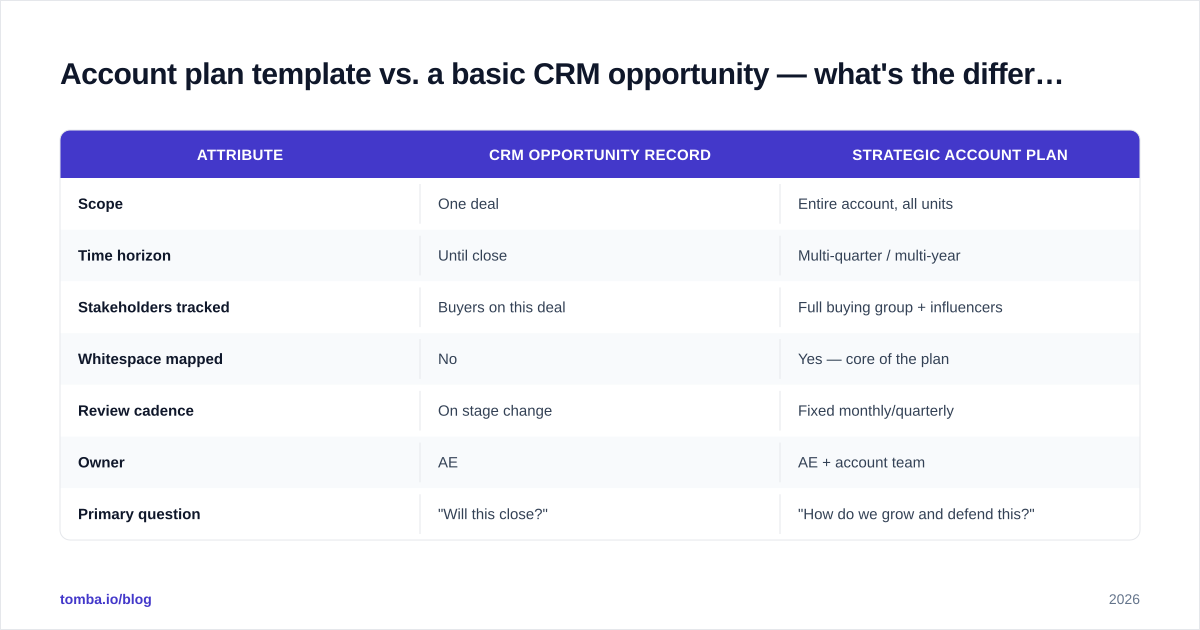
Account plan template vs. a basic CRM opportunity — what's the difference?#
People often assume their CRM opportunity record is an account plan. It is not. An opportunity tracks a single deal through stages; an account plan tracks the whole relationship and its future. The table below makes the contrast concrete.
| Attribute | CRM opportunity record | Strategic account plan |
|---|---|---|
| Scope | One deal | Entire account, all units |
| Time horizon | Until close | Multi-quarter / multi-year |
| Stakeholders tracked | Buyers on this deal | Full buying group + influencers |
| Whitespace mapped | No | Yes — core of the plan |
| Review cadence | On stage change | Fixed monthly/quarterly |
| Owner | AE | AE + account team |
| Primary question | "Will this close?" | "How do we grow and defend this?" |
The two are complements. The opportunity record feeds the account plan's revenue numbers; the account plan tells you which opportunities to create next. If you only have the opportunity record, you are managing deals, not accounts.
Which account planning approach fits your team?#
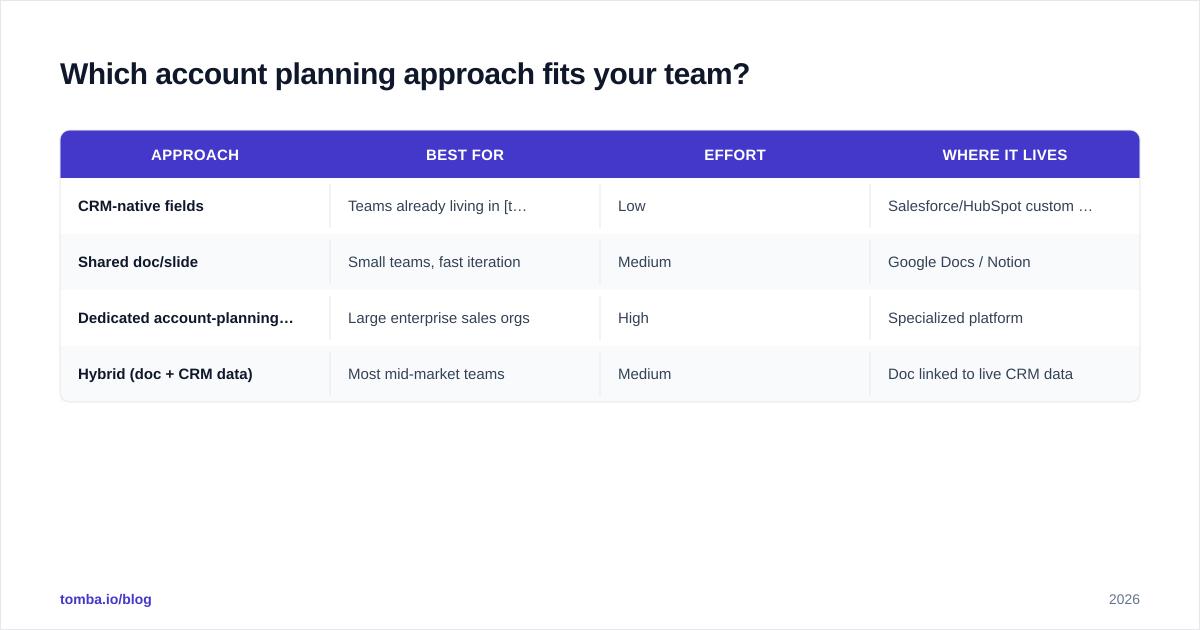
Not every team needs the same depth. Match the format to the account tier and your tooling. Here is a comparison of three common approaches.
| Approach | Best for | Effort | Where it lives |
|---|---|---|---|
| CRM-native fields | Teams already living in the CRM | Low | Salesforce/HubSpot custom objects |
| Shared doc/slide | Small teams, fast iteration | Medium | Google Docs / Notion |
| Dedicated account-planning tool | Large enterprise sales orgs | High | Specialized platform |
| Hybrid (doc + CRM data) | Most mid-market teams | Medium | Doc linked to live CRM data |
For most teams, the hybrid wins: a lightweight document for the narrative and strategy, with the stakeholder list and revenue numbers pulled from live CRM data so they never go stale. Tools like HubSpot and Salesforce both support custom objects you can shape into an account-plan structure if you prefer to keep everything in one system.
How often should you update the account plan?#
Set the cadence by tier and write the review dates into the template so they are not optional.
- Tier-1 accounts: monthly working review (30 minutes), full team review quarterly.
- Tier-2 accounts: quarterly review.
- Tier-3 accounts: twice-yearly check, or roll them up into a territory plan rather than individual plans.
Each review answers three questions: What changed in the account? Did last period's actions move a metric? What are the next three actions and who owns them? Keep the review short and action-focused — a 90-minute meeting where you read the plan aloud is the failure mode, not the goal.
A useful trigger discipline: any time a key stakeholder changes roles, a competitor wins a deal in the account, or a contract date moves inside 90 days, the plan gets an out-of-cycle update. These events change your strategy, so the document should reflect them immediately.
What metrics prove the account plan is working?#
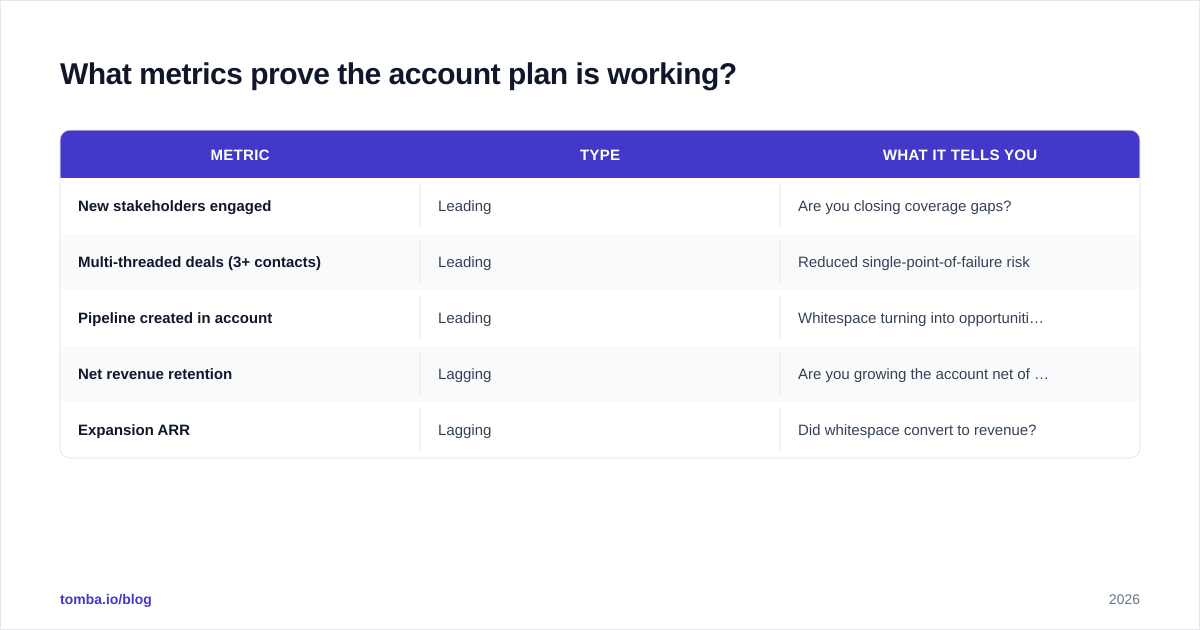
A plan you cannot measure is a story. Track a small set of leading and lagging indicators so you can tell early whether the strategy is taking hold.
| Metric | Type | What it tells you |
|---|---|---|
| New stakeholders engaged | Leading | Are you closing coverage gaps? |
| Multi-threaded deals (3+ contacts) | Leading | Reduced single-point-of-failure risk |
| Pipeline created in account | Leading | Whitespace turning into opportunities |
| Net revenue retention | Lagging | Are you growing the account net of churn? |
| Expansion ARR | Lagging | Did whitespace convert to revenue? |
The leading indicators are the ones to watch weekly, because they predict the lagging ones. If new-stakeholder engagement is flat for two months, your expansion ARR will be flat in two quarters — the plan is telling you to act now.
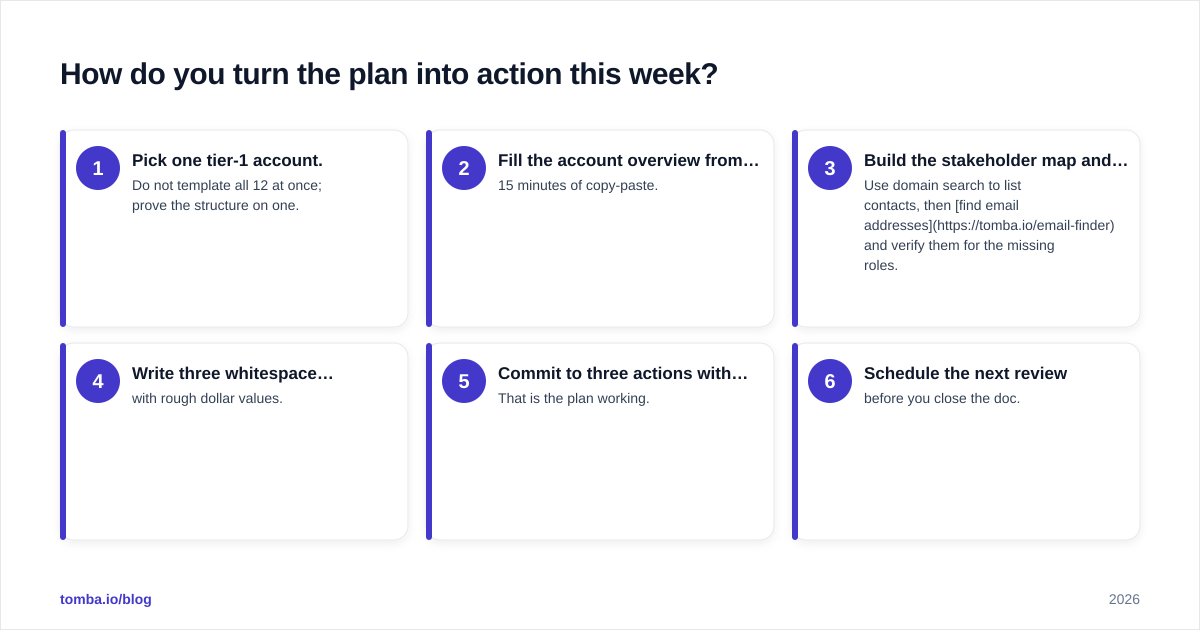
How do you turn the plan into action this week?#
A template is worthless until it produces moves. Here is the fastest path from blank document to working plan:
- Pick one tier-1 account. Do not template all 12 at once; prove the structure on one.
- Fill the account overview from your CRM — 15 minutes of copy-paste.
- Build the stakeholder map and find the gaps. Use domain search to list contacts, then find email addresses and verify them for the missing roles.
- Write three whitespace opportunities with rough dollar values.
- Commit to three actions with dates and owners. That is the plan working.
- Schedule the next review before you close the doc.
If you can do that for one account in an afternoon, you have a repeatable template. Roll it out to the rest of your book one account per week and you will have your full tier-1 list planned within a quarter — without the big-bang rollout that usually stalls.
Closing: build the plan on data you can trust#
A strategic account plan is only as good as the contacts inside it. The most carefully reasoned whitespace strategy goes nowhere if the email bounces and the phone number rings a desk nobody sits at anymore. Before you fill the stakeholder map, give yourself a clean foundation: use the Tomba Email Finder to find and verify professional email addresses for every role in your buying group, then keep the data fresh with enrichment so each quarterly review starts from current reality, not a snapshot from last year. Start on the free tier, map your most important account this week, and let the plan — not gut feel — drive your next three moves. See Tomba pricing when you are ready to scale the workflow across your whole book.
// get started
Find, verify and enrich your first contacts today
Start on the free plan with 25 searches a month, then scale when your team is ready.
Free plan · No credit card required · GDPR & CCPA
// about the author