Account Planning in 2026: A Framework for Strategic Growth
Account planning turns your biggest accounts into predictable revenue. Here's the 2026 framework, a tool comparison, and the data you need to make it work.
TL;DR
- Account planning is the disciplined process of mapping, prioritizing, and growing your highest-value accounts on purpose — not by luck or inbound timing.
- The accounts that already pay you are the cheapest revenue you will ever find: expansion closes faster and at higher margins than net-new logos.
- A usable account plan has five parts: account intelligence, white-space mapping, stakeholder mapping, a growth thesis, and a 90-day action cadence.
- Tooling matters less than the contact and firmographic data feeding it — a plan built on stale org charts and dead email addresses fails on contact, not strategy.
- Start with your top 10–20 accounts, refresh quarterly, and tie every plan to a measurable expansion number.
What is account planning?#
Account planning is the process of deciding, in advance, how you will retain and grow a specific customer account — then building a written plan that names the people, the gaps, and the moves to get there.
Think of it like a coach scouting one opponent for an entire season rather than reacting play-by-play. A rep working without an account plan responds to whatever inbound ticket or renewal date lands on the calendar. A rep with a plan already knows which department buys next, who signs the check, and what proof they will need to see in Q3.
The distinction matters because the economics are lopsided. Selling to an existing customer is dramatically cheaper than acquiring a new one, and expansion revenue carries higher win rate and shorter cycles. Account planning is simply the operating system that lets you harvest that advantage on your biggest accounts instead of leaving it to chance.
)
It is worth separating account planning from two things people confuse it with. It is not a CRM record — the CRM stores what happened; the plan declares what should happen next. And it is not territory planning — territory planning decides which accounts a rep owns; account planning decides what the rep does once they own them.
Why does account planning matter in 2026?#
Because buying committees got bigger and budgets got tighter, and both trends reward sellers who already understand the account.
Three forces make 2026 a planning year:
Committee buying is the norm. Gartner has repeatedly documented that a typical B2B purchase now involves six to ten decision-makers, each arriving with their own information. You cannot navigate that many stakeholders reactively. (Gartner B2B buying research)
Expansion is the cheapest pipeline. When new-logo acquisition costs climb, the fastest path to quota runs through accounts that already trust you. A plan turns "we should upsell them someday" into a dated, owned action.
Data decays faster than ever. Contacts change roles, companies reorganize, and the champion who sponsored you last year may already be gone. A beautiful strategy aimed at a person who left the company is worthless. This is why the contact-data layer underneath your plan is not an afterthought — it is the foundation.
The failure mode is almost always the same: teams build elegant slideware plans, then never refresh the underlying people and firmographic data. Six months later the plan describes a company that no longer exists.
What are the core components of an account plan?#
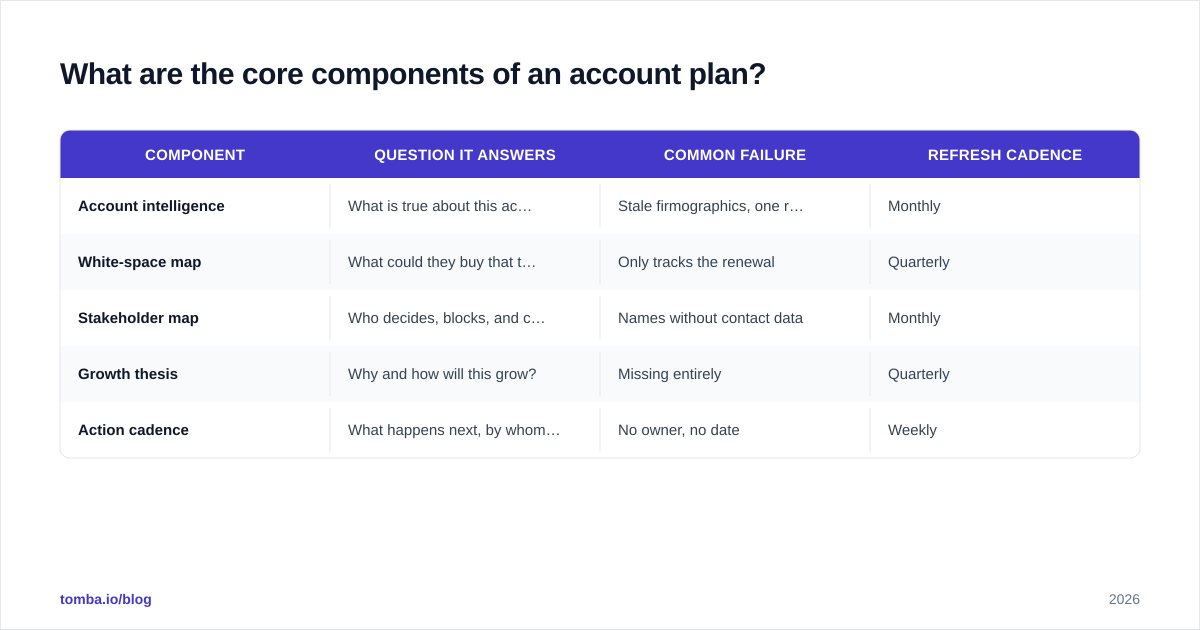
A strong account plan has five components. Skip any one and the plan tilts.
1. Account intelligence. The factual base layer: revenue, headcount, tech stack, recent funding, org structure, strategic initiatives, and current spend with you. This is where most plans are thin. You want enriched firmographic and contact data, not a single sales rep's memory. Pulling structured data enrichment into the account record keeps this section current instead of anecdotal.
2. White-space mapping. A grid of what the account could buy versus what they already own. Each empty cell is a revenue opportunity. White space is where expansion targets come from, and it forces you to think in products and departments rather than a single renewal.
3. Stakeholder mapping. Who are the economic buyer, the champion, the blockers, the influencers, and the coaches? Map them by role, by power, and by their disposition toward you. A plan that names "the CFO" but not the CFO's actual email, phone, and reporting line is a wish, not a plan.
4. Growth thesis. One or two sentences stating why this account will grow and how you will drive it. For example: "Their new EU expansion creates a compliance gap our enterprise tier solves; we land with the security team in Q2 and expand to legal in Q4." Without a thesis, the plan is a pile of facts.
5. Action cadence. Dated next steps with owners. Quarterly objectives broken into 90-day plays. This is the part that survives contact with reality — or doesn't.
| Component | Question it answers | Common failure | Refresh cadence |
|---|---|---|---|
| Account intelligence | What is true about this account? | Stale firmographics, one rep's memory | Monthly |
| White-space map | What could they buy that they don't? | Only tracks the renewal | Quarterly |
| Stakeholder map | Who decides, blocks, and champions? | Names without contact data | Monthly |
| Growth thesis | Why and how will this grow? | Missing entirely | Quarterly |
| Action cadence | What happens next, by whom, by when? | No owner, no date | Weekly |
How do you build an account plan step by step?#
Run it as a repeatable sequence, not a one-time workshop.
Step 1 — Select and tier your accounts. Don't plan all of them. Pick your top 10–20 by a blend of current revenue, expansion potential, and strategic fit. Tier them A/B/C so you spend planning energy where the return is highest.
Step 2 — Gather account intelligence. Pull firmographics, the org chart, funding history, and tech stack. Verify the people. This is the step where contact data quality decides everything downstream — a stakeholder map built on guessed email patterns will route your outreach into the void. Use a real domain search to surface the active contacts and email format for the account rather than guessing.
Step 3 — Map the white space. Build the product-by-department grid. Mark owned, in-trial, and untouched cells. Rank the untouched cells by deal size and ease.
Step 4 — Map the stakeholders. For every cell you want to attack, identify the buyer and champion. Capture verified email and phone for each, plus their relationship to you.
Step 5 — Write the growth thesis. Tie a specific account event (funding, reorg, new exec, regulatory change) to a specific offer. If you can't write the sentence, you don't yet understand the account.
Step 6 — Build the 90-day cadence. Translate the thesis into dated plays with named owners. Review weekly.
Step 7 — Review and refresh. Re-run intelligence and stakeholder steps every quarter. People move; plans rot. The refresh is not optional maintenance — it is the difference between a living plan and a slide nobody opens.
)
That meme is the whole problem in one frame. Reps chase the new logo because it feels like progress, while the key account that funds the quarter sits unattended. Account planning is the institutional discipline that keeps attention where the money is.
Which tools support account planning?#
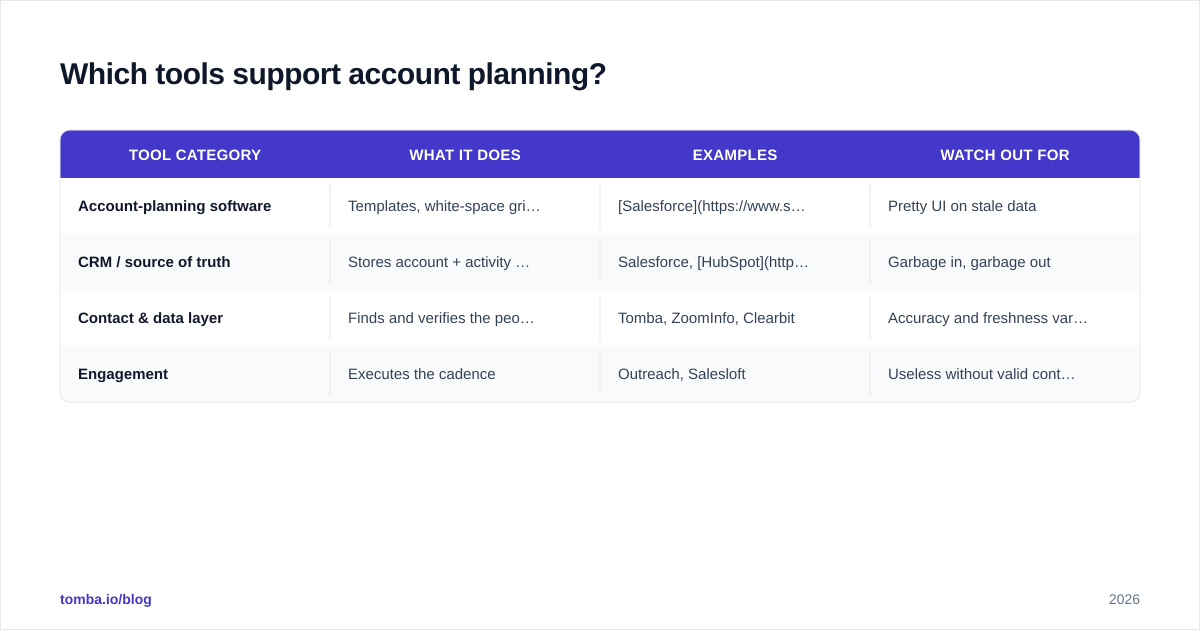
Tooling falls into three buckets: where you write the plan, where you store the data, and where you source the contacts. Most teams over-invest in the first and under-invest in the third.
| Tool category | What it does | Examples | Watch out for |
|---|---|---|---|
| Account-planning software | Templates, white-space grids, exec dashboards | Salesforce account plans, DemandFarm, Prolifiq | Pretty UI on stale data |
| CRM / source of truth | Stores account + activity history | Salesforce, HubSpot | Garbage in, garbage out |
| Contact & data layer | Finds and verifies the people in the plan | Tomba,ZoomInfo, Clearbit | Accuracy and freshness vary widely |
| Engagement | Executes the cadence | Outreach, Salesloft | Useless without valid contacts |
The uncomfortable truth: the fanciest planning platform produces nothing if the people in the stakeholder map are unreachable. A plan is only as good as the contacts inside it.
That is where the data layer earns its keep. When you need to verify that a newly mapped VP of Operations still works at the account, find their direct line, or fill a gap in the buying committee, you need an accurate finder — not a guess. Tools like the Tomba Email Finder and a phone finder keep the stakeholder map executable rather than aspirational, and a B2B database helps you discover net-new contacts inside an account you haven't reached yet.
For pricing context, Tomba runs a free tier at 25 searches per month, with paid plans starting at $49/mo (Starter), $99/mo (Growth), and $249/mo (Pro). You can compare the full Tomba pricing tiers against the volume your account list actually demands — most account-planning teams live comfortably in Starter or Growth because they're enriching a curated list, not blasting thousands.
How often should you update an account plan?#
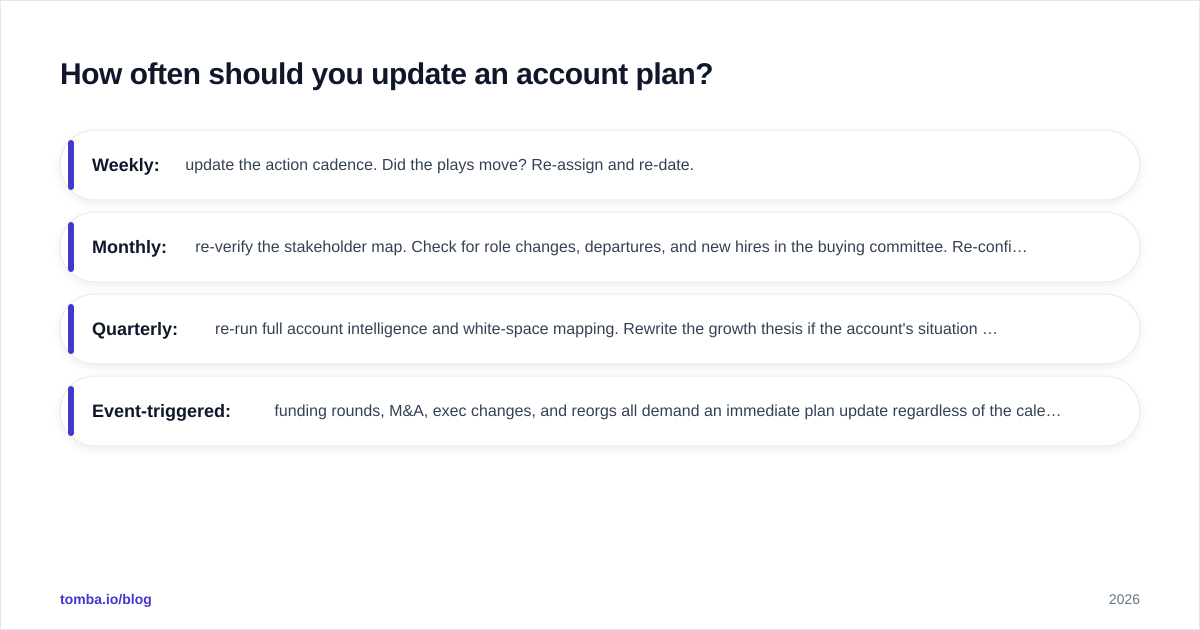
Run a light refresh monthly and a deep review quarterly — and treat any major account event as an immediate trigger.
A practical cadence:
- Weekly: update the action cadence. Did the plays move? Re-assign and re-date.
- Monthly: re-verify the stakeholder map. Check for role changes, departures, and new hires in the buying committee. Re-confirm contact details for anyone you plan to engage that month.
- Quarterly: re-run full account intelligence and white-space mapping. Rewrite the growth thesis if the account's situation shifted.
- Event-triggered: funding rounds, M&A, exec changes, and reorgs all demand an immediate plan update regardless of the calendar.
The single most common decay point is the stakeholder map. Champions leave, buyers get promoted, and your carefully built relationship map quietly becomes fiction. Wiring a data enrichment step into your monthly refresh — or pulling fresh contacts through the Tomba API on a schedule — keeps the people layer honest without manual grind.
What does a good account plan look like in practice?#
Concrete beats abstract. Here's a compressed example for a fictional account.
Account: Northwind Logistics — $80k current ARR, 1,400 employees, recently raised a Series C, expanding into the EU.
Growth thesis: EU expansion creates a data-residency and compliance gap our enterprise tier closes. Land with the security team in Q2, expand to legal and ops in Q3–Q4. Target: $80k → $210k ARR within 12 months.
White space: Currently own the core product in North America ops. Untouched: security module, legal seats, and the entire EU region.
Key stakeholders:
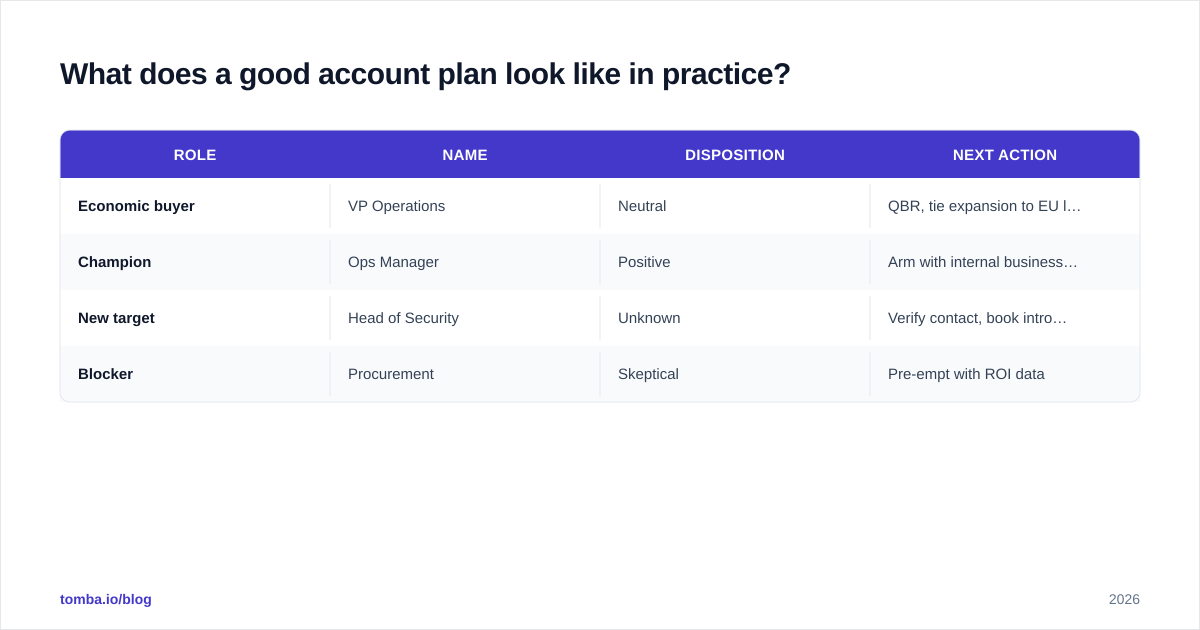
| Role | Name | Disposition | Next action |
|---|---|---|---|
| Economic buyer | VP Operations | Neutral | QBR, tie expansion to EU launch |
| Champion | Ops Manager | Positive | Arm with internal business case |
| New target | Head of Security | Unknown | Verify contact, book intro Q2 |
| Blocker | Procurement | Skeptical | Pre-empt with ROI data |
Notice the "verify contact" action on the new security target. That one line is where most plans silently break — the team knows the role they need but never confirms the person, and the play stalls. Closing that gap with a quick lookup is the difference between a plan that executes and one that decorates a QBR deck.
Account planning mistakes to avoid#
- Planning everything. If every account is strategic, none is. Tier ruthlessly.
- Confusing the CRM with the plan. History is not strategy. Write the thesis.
- Naming roles, not people. "The CFO" is not a stakeholder; a verified, reachable named human is.
- Set-and-forget. An unrefreshed plan is worse than none — it creates false confidence.
- Ignoring the data layer. The strategy fails on contact accuracy far more often than on strategic insight.
- No measurable target. Every plan needs an expansion number and a date, or it's a vibe.
Conclusion: turn your best accounts into predictable revenue#
Account planning is conclusion-first work: decide where the growth will come from, name the people who control it, and build a dated path to get there. The strategy is the easy half. The hard half — the half that quietly kills most plans — is keeping the people and contact data underneath it accurate enough to act on.
That's the layer to get right first. Before your next quarterly account review, make sure every stakeholder in your top accounts is a verified, reachable human, not a role on a slide. Start free with the Tomba Email Finder to confirm and fill the contacts in your most important account plans — find decision-makers by name or domain, verify them, and turn your strategic accounts into pipeline you can actually work. Your plan is only as good as the people you can reach.
Ready to find emails that actually work?
Join 150,000+ professionals who stopped guessing and started sending. Free credits on signup — no credit card required.
Get the Tomba newsletter
Practical outbound tactics and product updates — once every two weeks.
About the author