Account Planning in Sales: A 2026 Strategic Playbook
Account planning sales turns your biggest accounts into predictable, expandable revenue. Here's the 2026 framework, templates, and tools that make it work.
Most reps treat their top accounts the same way they treat a cold list: react to inbound, chase the next renewal, and hope expansion happens on its own. Account planning sales flips that. It is the disciplined practice of mapping, prioritizing, and growing your highest-value accounts on purpose — instead of leaving six- and seven-figure expansion to luck.
This guide breaks down what account planning actually is in 2026, the framework that works, the templates you can copy, and where most teams quietly lose deals they already had won.
TL;DR#
- Account planning sales is a structured process for retaining and expanding your most valuable accounts — not a one-time slide you build for QBR theater.
- The core artifacts are an account map (who's who and who decides), a white-space map (what you haven't sold yet), and a mutual action plan (what happens next, with dates).
- Teams that run formal account plans see materially higher net revenue retention because expansion is engineered, not accidental.
- The biggest failure mode is stale data — org charts, contacts, and buying committees change faster than your CRM does.
- Tooling matters: you need accurate contact data, clean enrichment, and a repeatable cadence. We compare the main approaches below.
What is account planning in sales?#
Account planning is the process of analyzing a key account, identifying growth opportunities inside it, and building a concrete plan to capture them. Think of it like tending an orchard instead of foraging. Foraging — classic net-new prospecting — means you grab what you can find and move on. Tending an orchard means you know every tree, you prune deliberately, and you harvest the same plot year after year, getting more from it each season.
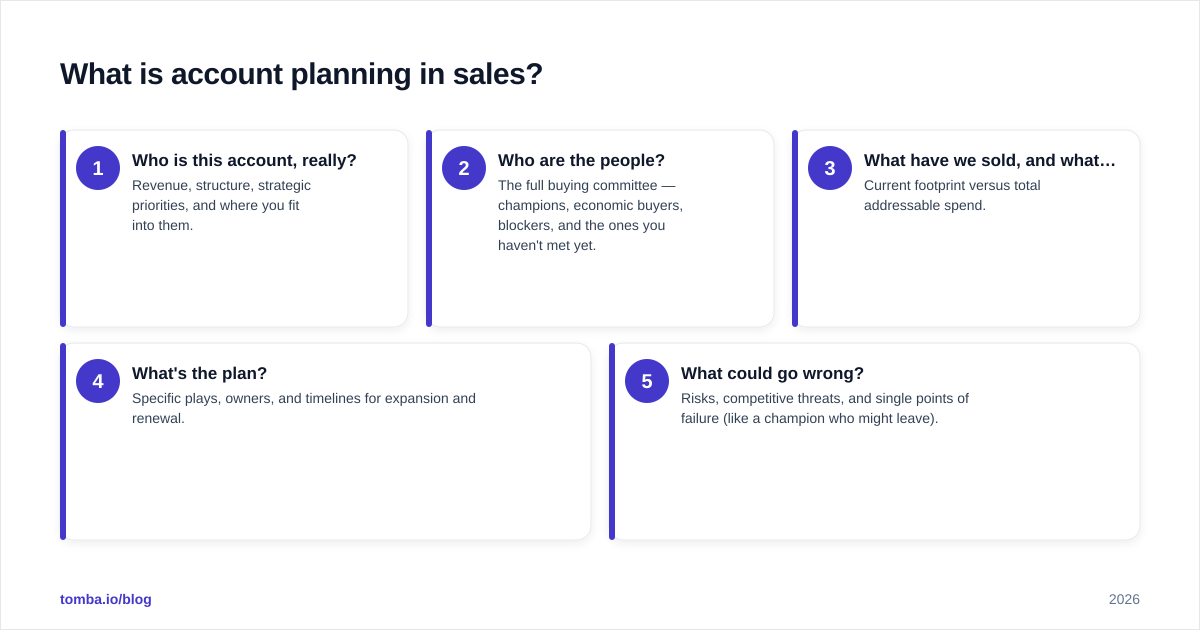
In practical terms, a sales account plan answers five questions:
- Who is this account, really? Revenue, structure, strategic priorities, and where you fit into them.
- Who are the people? The full buying committee — champions, economic buyers, blockers, and the ones you haven't met yet.
- What have we sold, and what haven't we? Current footprint versus total addressable spend.
- What's the plan? Specific plays, owners, and timelines for expansion and renewal.
- What could go wrong? Risks, competitive threats, and single points of failure (like a champion who might leave).
Account planning sales is most associated with account managers and strategic/enterprise AEs, but the discipline applies the moment an account is worth more to keep and grow than to win once. For a refresher on how this fits the broader funnel, the sales process and pipeline you already run is the container — account planning is what you do once a logo is inside it.
Why does account planning matter more in 2026?#
Because the cheapest revenue you will ever book is expansion revenue from an account that already trusts you. Acquiring a new customer costs far more than growing an existing one, and renewal-plus-expansion motions are where modern B2B margins live. Gartner's research on key account management consistently shows that the accounts receiving structured planning outperform the ones managed reactively.
Three shifts make this more urgent now:
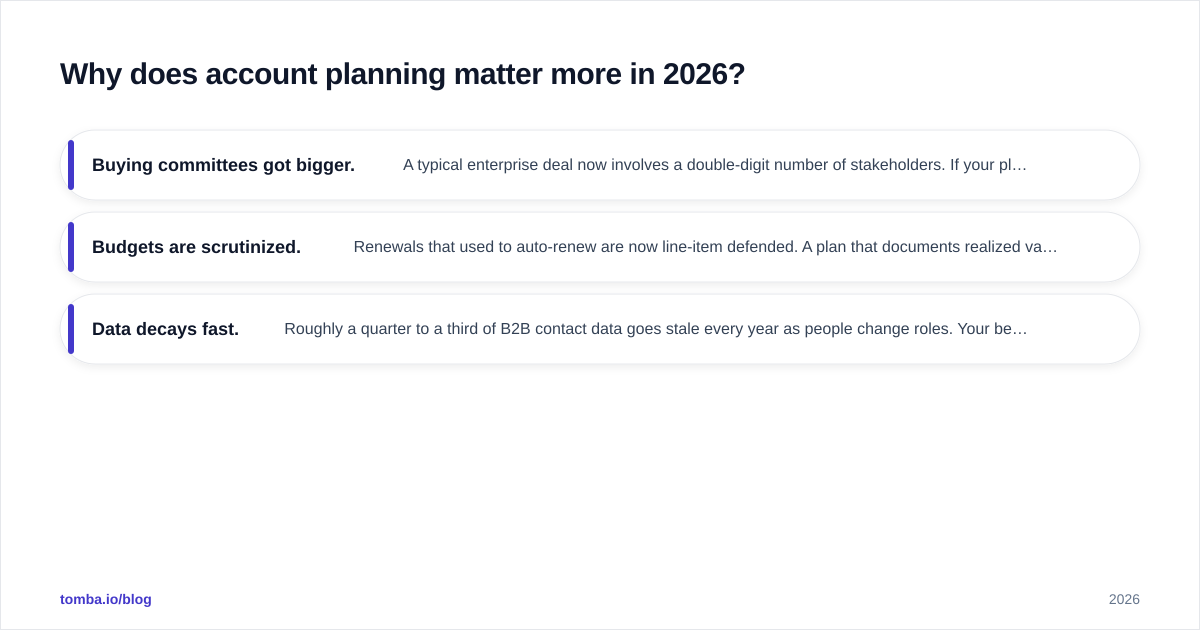
- Buying committees got bigger. A typical enterprise deal now involves a double-digit number of stakeholders. If your plan tracks two contacts, you are flying blind.
- Budgets are scrutinized. Renewals that used to auto-renew are now line-item defended. A plan that documents realized value is your renewal insurance.
- Data decays fast. Roughly a quarter to a third of B2B contact data goes stale every year as people change roles. Your beautiful account map from last January is wrong by summer.


What does an account planning framework look like?#
A good framework is simple enough that reps actually fill it out and rich enough to drive action. The diagram below shows the four layers most high-performing teams use.
Layer 1 — The account map#
This is your org chart with intelligence layered on top. For each contact you capture: role, reporting line, influence level, relationship strength, and stance (champion, supporter, neutral, blocker). The goal is to expose gaps — the VP of Finance who controls budget and whom nobody on your team has ever spoken to.
This is also where most plans rot, because contacts move. Keeping it current is a data problem before it's a sales problem. Pulling fresh titles and verified contact details with a domain search across the account's domain is faster than manually chasing LinkedIn, and it surfaces people you didn't know existed.
Layer 2 — The white-space map#
White space is everything you could sell but haven't. Build a simple grid: product lines down one axis, business units or geographies across the top. Green cells are sold. Empty cells are opportunity. Suddenly "grow this account" becomes a list of specific, nameable plays instead of a vague aspiration.
Layer 3 — The mutual action plan#
A mutual action plan (MAP) is a shared, dated list of the steps both you and the customer will take to reach a defined outcome. It is mutual on purpose — when the buyer co-owns the timeline, the deal stops stalling in their inbox. Each line has an owner and a date. No "TBD."
Layer 4 — The risk register#
Every plan needs a short list of what could derail it: champion attrition, competitor incursion, budget freeze, contract auto-terminate clauses. Naming risks lets you build mitigations before they become surprises.
How do you build an account plan step by step?#
You don't need a 40-slide deck. You need a living document you revisit on a cadence. Here is the sequence that works.
Step 1 — Select and tier your accounts. Not every account deserves a plan. Score accounts on revenue potential, strategic fit, and expansion headroom, then reserve formal planning for your top tier. Tiering is itself a form of lead and account scoring applied to existing customers.
Step 2 — Research the account. Pull recent earnings or funding news, leadership changes, hiring trends, and stated initiatives. You are looking for the account's priorities so you can attach your value to them.
Step 3 — Map the people. Build the account map in Layer 1. Verify every email and phone number before you rely on it — a bounced outreach to a senior stakeholder is an avoidable own-goal. Run new contacts through an email verifier so your sequences land.
Step 4 — Map the white space. Fill the product-by-unit grid. Circle the two or three highest-probability plays for the next two quarters.
Step 5 — Write the mutual action plan. Convert those plays into dated steps with owners. Share it with your champion and get their edits — that act alone qualifies the opportunity.
Step 6 — Review on a cadence. Monthly internal check-ins, quarterly reviews with the customer. A plan you write once and forget is worse than no plan because it gives false confidence.


That meme is the whole problem in one image. Reps get pulled toward the dopamine of net-new logos and neglect the renewal sitting right next to them — the one that's cheaper to grow and more likely to close.
Account planning vs. opportunity planning vs. territory planning: what's the difference?#
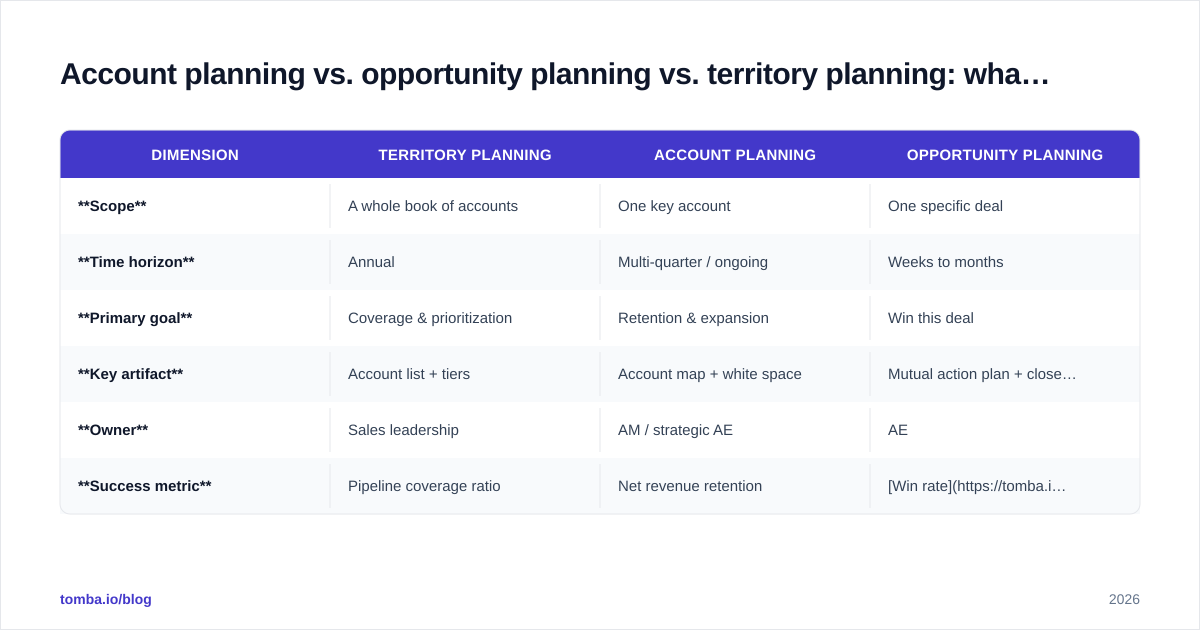
These three get used interchangeably, and they shouldn't. They operate at different altitudes.
| Dimension | Territory planning | Account planning | Opportunity planning |
|---|---|---|---|
| Scope | A whole book of accounts | One key account | One specific deal |
| Time horizon | Annual | Multi-quarter / ongoing | Weeks to months |
| Primary goal | Coverage & prioritization | Retention & expansion | Win this deal |
| Key artifact | Account list + tiers | Account map + white space | Mutual action plan + close plan |
| Owner | Sales leadership | AM / strategic AE | AE |
| Success metric | Pipeline coverage ratio | Net revenue retention | Win rate |
You need all three, but they feed each other top-down: territory planning decides which accounts get account plans, and account plans spawn the individual opportunity plans.
What tools do you need for account planning sales?#
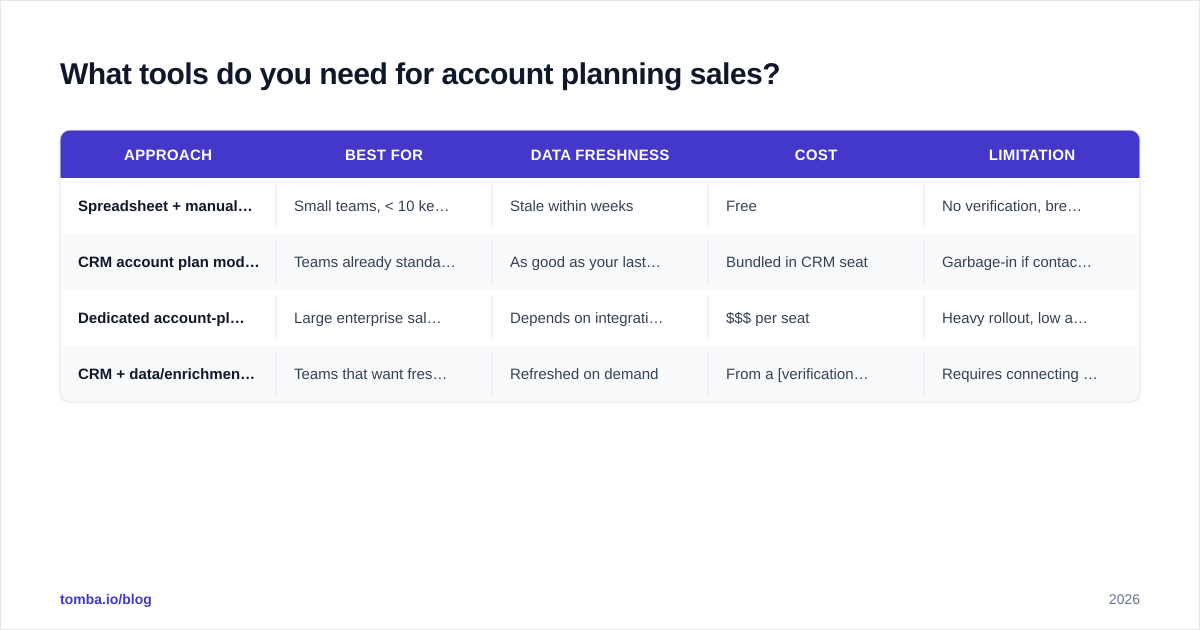
The plan is only as good as the data and the cadence behind it. Most teams cobble together three things: a place to store the plan, a source of accurate contact and account data, and a way to keep it fresh. Here's how the common approaches compare.
| Approach | Best for | Data freshness | Cost | Limitation |
|---|---|---|---|---|
| Spreadsheet + manual research | Small teams, < 10 key accounts | Stale within weeks | Free | No verification, breaks at scale |
| CRM account plan module | Teams already standardized on a CRM | As good as your last manual update | Bundled in CRM seat | Garbage-in if contact data isn't enriched |
| Dedicated account-planning software | Large enterprise sales orgs | Depends on integrations | $$$ per seat | Heavy rollout, low adoption risk |
| CRM + data/enrichment platform | Teams that want fresh maps without manual upkeep | Refreshed on demand | From a verification and enrichment plan | Requires connecting the pipes once |
The pattern that scales is the last one: keep the plan in your CRM where reps live, and wire in an accurate data source so the account map and contact details refresh themselves instead of decaying. A platform like HubSpot or Salesforce holds the plan; an enrichment and verification layer keeps the people and emails inside it correct.
For the data layer specifically, the jobs to be done are: find the stakeholders you're missing, verify their contact details before you reach out, and append phone numbers for the conversations email won't carry. Tomba covers those with domain-level discovery, verification, and a phone finder for the high-stakes contacts where a call beats an email.
How do you measure if account planning is working?#
Track leading and lagging indicators, not just bookings.
- Net revenue retention (NRR) — the headline lagging metric. Above 100% means your installed base grows even before new logos. Account planning is the lever.
- White-space conversion — what percentage of identified white-space plays turned into pipeline this quarter.
- Multithreading depth — average number of engaged contacts per account. Single-threaded accounts churn when the one person leaves.
- Plan freshness — when was each plan last updated? Stale plans correlate with surprise churn.
- Champion coverage — every tier-one account should have at least one mapped, verified champion and one backup.
If multithreading depth is low, the fix is upstream: you're not finding enough of the buying committee. That's where systematically pulling and verifying every relevant contact at the account — via Tomba's email finder and domain search — directly moves the metric.
What are the most common account planning mistakes?#
- Treating it as a one-time event. A plan built for QBR theater and never reopened is wasted effort. Cadence is the whole point.
- Single-threading. Betting the renewal on one relationship. When that person changes jobs, you lose the account and the knowledge.
- Letting data rot. An account map full of dead emails and wrong titles produces confident, wrong decisions. Re-verify quarterly.
- No customer involvement. A plan you never share with the champion is a guess. The mutual action plan exists to fix this.
- Planning everything. If every account is "strategic," none are. Tier ruthlessly and spend the planning effort where the headroom is.
How often should you update an account plan?#
Internal review monthly, customer-facing review quarterly, and full contact re-verification at least every quarter — more often for fast-moving accounts. The cheapest insurance you can buy against a surprise churn is catching that your champion changed roles in February instead of finding out at the September renewal.
The bottom line#
Account planning sales is the difference between hoping your best accounts grow and engineering it. Build the four layers — account map, white space, mutual action plan, risk register — keep them current, and review on a cadence. The framework is simple; the discipline is the hard part.
The one piece teams underinvest in is data freshness, and it's the piece that quietly kills plans. If your account maps are full of stale titles and bounced emails, start there: use Tomba's Email Finder and domain search to surface every stakeholder in your key accounts and verify their contact details before your next outreach — so your plan reflects reality, not last year's org chart. Start free with 25 searches a month, and check the Tomba pricing tiers when you're ready to scale across your whole book.
// get started
Find, verify and enrich your first contacts today
Start on the free plan with 25 searches a month, then scale when your team is ready.
Free plan · No credit card required · GDPR & CCPA
// about the author