Account Planning Template: A 2026 Framework for Sales Teams
A practical account planning template for 2026 — the exact sections, fields, and cadence top AE and strategic teams use to grow key accounts and stop losing renewals.
TL;DR
- An account planning template is a living document that captures who you're selling to, why they buy, where the white space is, and what you'll do next quarter — not a slide you build once and forget.
- The strongest templates have six core sections: account overview, stakeholder map, current-state value, white-space and growth plays, risk and competition, and a 90-day action plan.
- Strategic accounts deserve deep plans; transactional accounts need a lightweight one-pager. Match the template to the account tier or you'll drown your reps in busywork.
- Keep the plan in your CRM or a shared doc, review it on a fixed cadence, and tie every play to a contact and a date.
- Plans fail on stale data. Refresh stakeholder contacts and org changes before each review using enrichment and verification tools.
What is an account planning template?#
An account planning template is a structured format your sales team uses to document everything that matters about a target or existing account and to decide what to do next. Think of it like a flight plan: a pilot doesn't improvise altitude and fuel mid-air, and a strategic account manager shouldn't improvise a $500K renewal. The template forces you to write down the route — who the decision-makers are, what value you've delivered, where you can grow, and what could go wrong.
The difference between a real account plan and a CRM note is intent. A note records what happened. A plan commits to what will happen, names the person responsible, and sets a date. That shift — from recording to deciding — is what separates teams that grow their key accounts from teams that simply react to inbound requests and renewal deadlines.
Account planning sits inside your broader sales process and pipeline work, but it operates on a longer time horizon. Pipeline management asks "what closes this month?" Account planning asks "how do we triple this relationship over the next two years?"
Why do most account plans fail?#
Most account plans die for three predictable reasons, and naming them upfront helps you build a template that survives.
First, they're too long. A 14-tab spreadsheet feels thorough but never gets updated. If a rep needs 40 minutes to open and read the plan, they won't. Length is the enemy of adoption.
Second, they're built on stale data. A stakeholder map listing a champion who left six months ago is worse than no map — it sends reps chasing a ghost. According to Gartner research on B2B buying, the typical buying group now involves six to ten decision-makers, and those groups churn constantly. If your contact data isn't refreshed, your plan is fiction.
Third, they have no cadence. A plan reviewed once a year is a document; a plan reviewed monthly is a habit. The teams that win treat the account plan as the agenda for their recurring account review, not as a compliance artifact for the VP.
)
The fix for all three is the same: keep the template tight, wire it to live data, and put a recurring review on the calendar before you write a single field.
What sections does an account planning template need?#
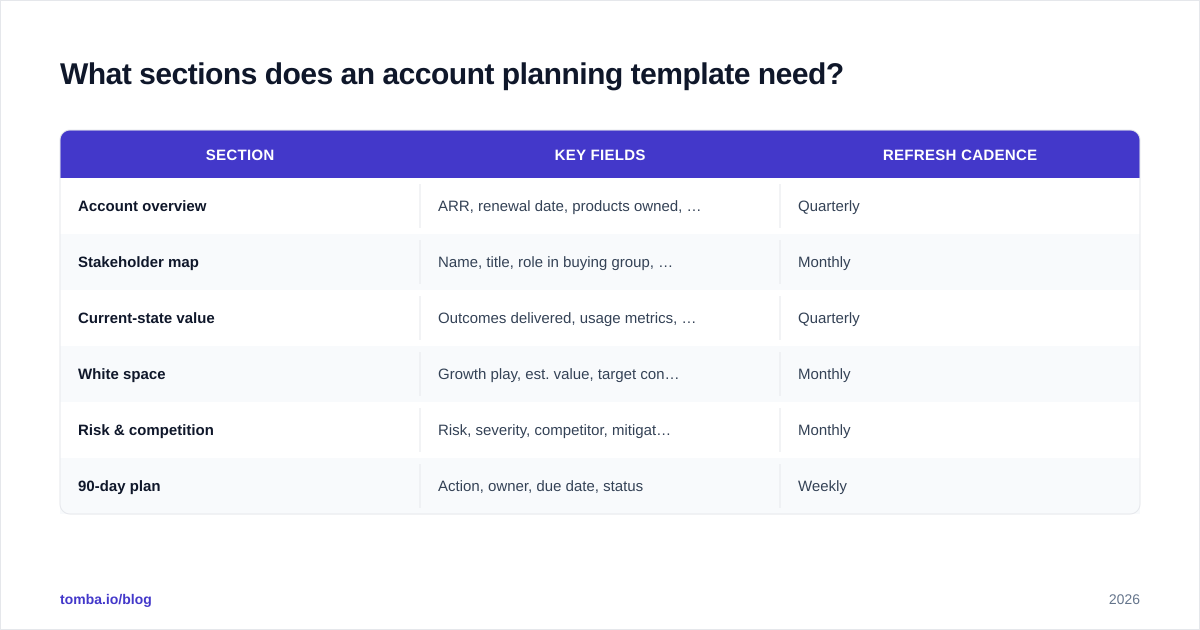
A complete account planning template has six sections. You can rename them to match your culture, but the underlying questions don't change.
1. Account overview. The basics: company size, industry, revenue, locations, current contract value, products owned, renewal date, and a one-paragraph "state of the union." Anyone should be able to read this in 30 seconds and know where the relationship stands.
2. Stakeholder map. Every person who influences the buying decision, their role in the buying group (economic buyer, champion, technical evaluator, blocker), their sentiment toward you, and your relationship strength. This is the section that goes stale fastest, so it needs the freshest data.
3. Current-state value. What outcomes have you actually delivered? Hard numbers beat adjectives. "Reduced their onboarding time 40%" is a renewal argument; "great relationship" is a feeling.
4. White space and growth plays. Where can the account grow — new departments, new products, new geographies? Each play gets an estimated value, a target contact, and a next step.
5. Risk and competition. What threatens the renewal or the relationship? Competitor presence, budget cuts, champion departure, low product usage. Each risk gets a mitigation.
6. 90-day action plan. The only section with deadlines. Three to five concrete actions, each owned by a name and dated. This is where the plan becomes real.
A starter field list#
| Section | Key fields | Refresh cadence |
|---|---|---|
| Account overview | ARR, renewal date, products owned, exec sponsor | Quarterly |
| Stakeholder map | Name, title, role in buying group, sentiment, email, phone | Monthly |
| Current-state value | Outcomes delivered, usage metrics, ROI proof points | Quarterly |
| White space | Growth play, est. value, target contact, next step | Monthly |
| Risk & competition | Risk, severity, competitor, mitigation owner | Monthly |
| 90-day plan | Action, owner, due date, status | Weekly |
How is account planning different from regular pipeline management?#
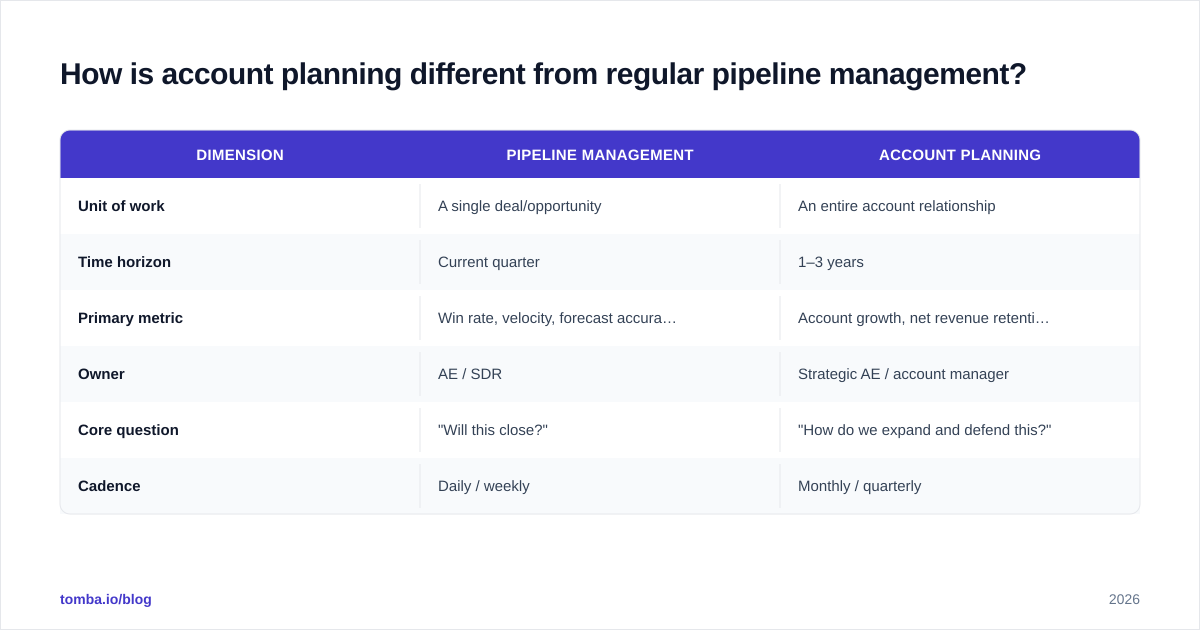
These two disciplines get conflated, and that confusion produces bad templates. The simplest way to keep them straight: pipeline management is about deals, account planning is about relationships.
| Dimension | Pipeline management | Account planning |
|---|---|---|
| Unit of work | A single deal/opportunity | An entire account relationship |
| Time horizon | Current quarter | 1–3 years |
| Primary metric | Win rate, velocity, forecast accuracy | Account growth, net revenue retention |
| Owner | AE / SDR | Strategic AE / account manager |
| Core question | "Will this close?" | "How do we expand and defend this?" |
| Cadence | Daily / weekly | Monthly / quarterly |
You need both. A team with great pipeline hygiene but no account plans will hit quarterly numbers and lose strategic accounts to better-organized competitors. A team with beautiful account plans but sloppy pipeline management will have a compelling two-year vision and miss payroll. Connect the two by letting growth plays from the account plan feed your pipeline as named opportunities with dates.
How do you fill out the template, step by step?#
Here's the working sequence. Block 90 minutes for a first pass on a strategic account; a transactional account should take 15.
Step 1 — Pull the account overview. Most of this lives in your CRM already. If fields are blank, fill them now. Confirm the renewal date against the actual contract, not memory.
Step 2 — Build the stakeholder map. List everyone you know. Then find the gaps: which buying-group roles have no name attached? An economic buyer you've never met is a flashing red risk. Use data enrichment to fill in titles, reporting lines, and verified contact details for people you've identified but can't reach.
Step 3 — Document delivered value. Pull usage data, support tickets, and QBR notes. Write three to five proof points with numbers. These become your renewal and expansion ammunition.
Step 4 — Map the white space. Compare what they own against what they could use. Each gap is a play. Be honest about estimated value — inflated white space wastes everyone's time.
Step 5 — Name the risks. For each risk, write a one-line mitigation and assign an owner. A risk without an owner is a wish.
Step 6 — Commit to a 90-day plan. Three to five actions, each with a name and a date. If an action has no contact attached, that's your cue to go find one.
Which accounts deserve a full plan?#
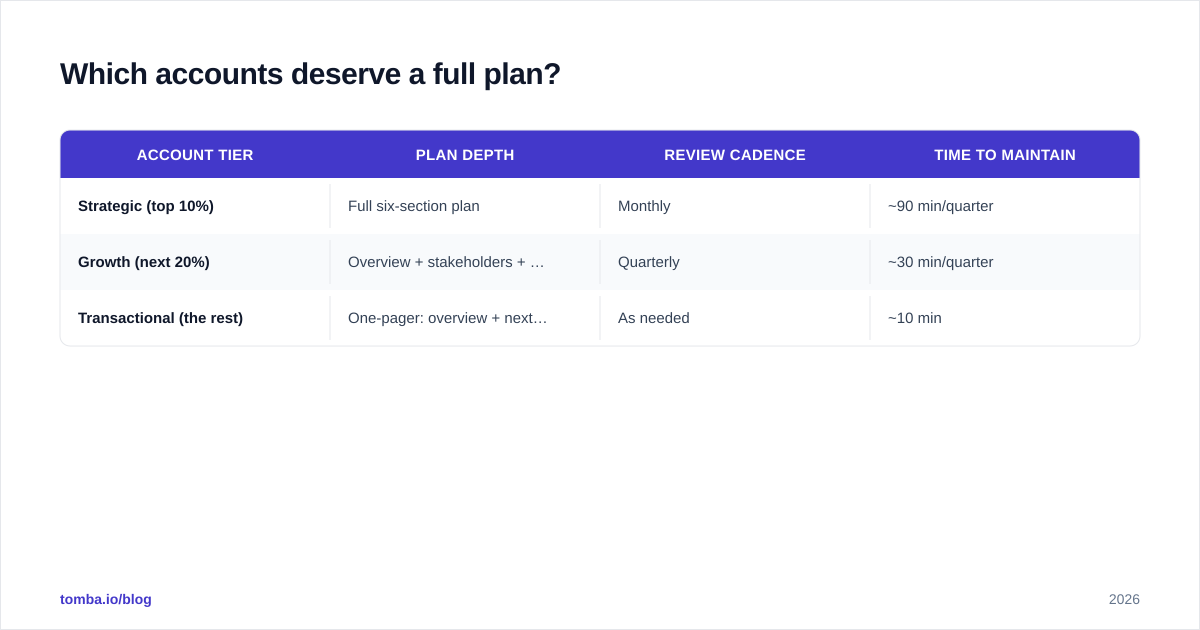
Not every account needs all six sections. Over-templating is a real failure mode — reps spend more time documenting than selling. Tier your accounts and match the plan depth to the tier.
| Account tier | Plan depth | Review cadence | Time to maintain |
|---|---|---|---|
| Strategic (top 10%) | Full six-section plan | Monthly | ~90 min/quarter |
| Growth (next 20%) | Overview + stakeholders + white space | Quarterly | ~30 min/quarter |
| Transactional (the rest) | One-pager: overview + next step | As needed | ~10 min |
The 80/20 rule applies hard here. A small fraction of accounts will drive most of your expansion revenue. Pour your planning energy there. For everything else, a lightweight one-pager keeps reps honest without burying them.
)
What tools support account planning?#
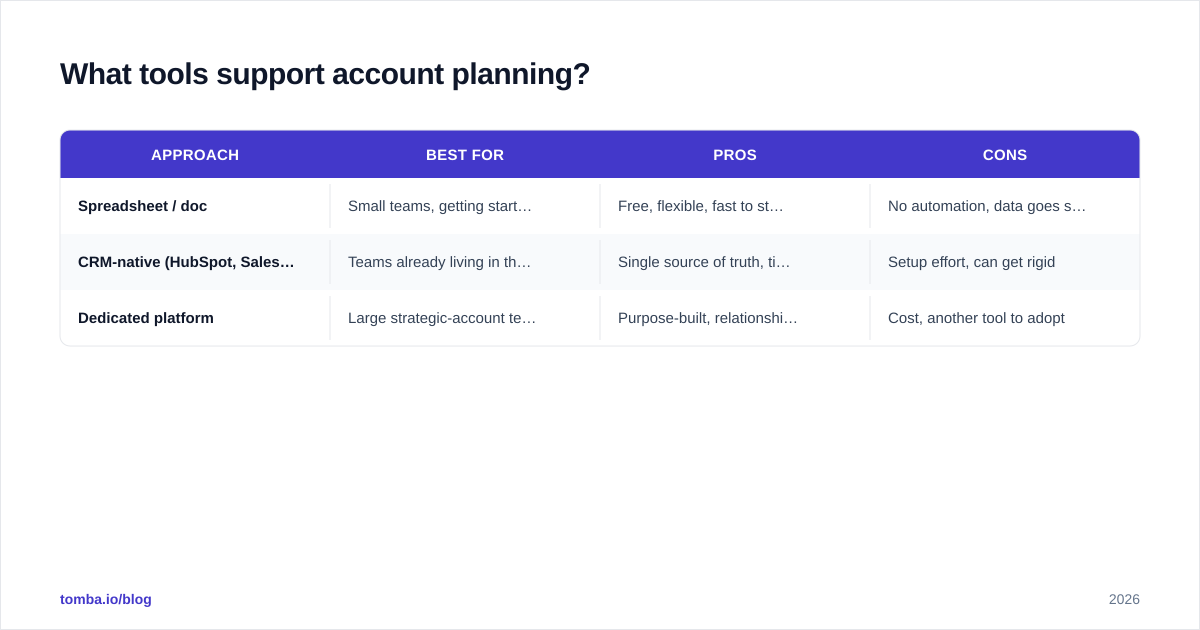
You can run account planning in a spreadsheet, a dedicated platform, or your CRM. Each has trade-offs.
| Approach | Best for | Pros | Cons |
|---|---|---|---|
| Spreadsheet / doc | Small teams, getting started | Free, flexible, fast to start | No automation, data goes stale, no reporting |
| CRM-native (HubSpot, Salesforce) | Teams already living in the CRM | Single source of truth, ties to pipeline | Setup effort, can get rigid |
| Dedicated platform | Large strategic-account teams | Purpose-built, relationship maps | Cost, another tool to adopt |
For most teams, building the template inside your existing CRM wins — it keeps the plan next to the pipeline and the activity history. HubSpot and Salesforce both support custom objects and properties you can shape into the six sections above. Whatever you choose, the tool is secondary. A disciplined cadence on a Google Doc beats a neglected plan in an expensive platform.
The one place tooling genuinely matters is keeping contact data current. Org charts shift, champions leave, and titles change. When your stakeholder map names a person you need to reach but you only have a name and company, an email finder closes that gap in seconds — and verifying the address before you send protects your sender reputation. Plans built on verified, current contacts get executed; plans built on guesses get abandoned.
How often should you update the plan?#
Tie the cadence to the section, not to the calendar quarter. The 90-day action plan needs a weekly glance — are actions moving? The stakeholder map and risk register deserve a monthly refresh, because that's how fast buying groups and threats change. The overview and value sections can ride a quarterly rhythm.
Anchor the whole thing to a recurring account review meeting. The plan is the agenda. Walk the room through changes since last time: new stakeholders, advanced plays, retired risks, completed actions. A review that just reads the plan aloud is theater; a review that updates the plan in real time and commits to new actions is the engine of account growth.
One discipline pays for itself: before every monthly review, spend ten minutes validating your stakeholder contacts. Confirm the people are still there, the emails still resolve, and no new decision-maker has appeared. This is where a quick enrichment pass keeps the entire plan trustworthy.
Account planning template: a quick checklist#
Before you call a plan "done," it should pass these checks:
- Every buying-group role has a named, reachable contact — no blanks on the economic buyer.
- Each growth play has an estimated value, a target person, and a next step.
- Every risk has an owner and a one-line mitigation.
- The 90-day plan has three to five dated actions, not a wish list of ten.
- The plan fits on two screens for a strategic account, one for everything else.
- A teammate could read it cold and know what happens next.
If any check fails, the plan isn't finished — it's a draft.
Put your account plan into motion#
A template only earns its keep when the actions in it actually happen, and most actions start with reaching the right person. The fastest way to stall a great plan is to write "contact the new VP of Operations" and then spend three days hunting for their email.
Close that gap with Tomba Email Finder. Drop in a name and company domain, get a verified professional email back, and turn the names on your stakeholder map into conversations the same day. Start on the free tier with 25 searches a month, or move to the Starter plan at $49/mo as your account list grows — see full Tomba pricing for team options. Build the plan, find the people, and work the relationships that move your number.
// get started
Find, verify and enrich your first contacts today
Start on the free plan with 25 searches a month, then scale when your team is ready.
Free plan · No credit card required · GDPR & CCPA
// about the author