Account Plans: A 2026 Guide to Strategic Account Planning
Account plans turn your biggest customers into predictable, compounding revenue. Here's the 2026 framework, template, and tooling to build them right.
TL;DR
- An account plan is a living document that maps a strategic account's goals, stakeholders, whitespace, and your play to grow revenue inside it — not a one-time slide for QBRs.
- The accounts you plan are the accounts that expand: teams with formal account plans consistently report higher net revenue retention and larger deal sizes than teams running on spray-and-pray.
- A good plan answers five questions: who buys, what they want, where the whitespace is, who you're up against, and what you'll do in the next 90 days.
- Skip the 40-field template. Start with a one-page plan you'll actually update, then layer depth onto your top 10–20 accounts.
- Plans are only as good as the contact and company data behind them — keep stakeholder maps current with reliable enrichment instead of guesswork.
What is an account plan?#
An account plan is a written strategy for growing revenue inside a single high-value customer or target account. Think of it like a flight plan: a pilot does not take off and improvise the route to Tokyo. They file where they're going, what fuel they need, which airports are alternates, and what weather might get in the way. An account plan does the same thing for a key account — it states the destination (revenue and relationship goals), the route (the plays you'll run), and the obstacles (competitors, budget cycles, detractors).
The mistake most teams make is treating the account plan as a deliverable for a quarterly business review. You build a deck, present it, and never open it again. A real account plan is a living artifact that your account executive, customer success manager, and sales engineer all touch every week. It lives in your CRM, not in a forgotten folder.
Account planning matters most for accounts where the future spend dwarfs the current spend. If a customer pays you $30,000 a year but could realistically reach $300,000 across new departments, products, and regions, that gap — the whitespace — is the entire point of the plan.
Why do account plans matter in 2026?#
Because expansion is cheaper than acquisition, and buyers are harder to reach than ever. Acquiring a new logo costs several times more than growing an existing one, and in a tighter 2026 budget environment, your installed base is the most reliable growth lever you have. Gartner's research on B2B buying has repeatedly shown that buying groups now involve 6–10 stakeholders and that most of the buying journey happens without a sales rep in the room. You cannot navigate that complexity from memory.
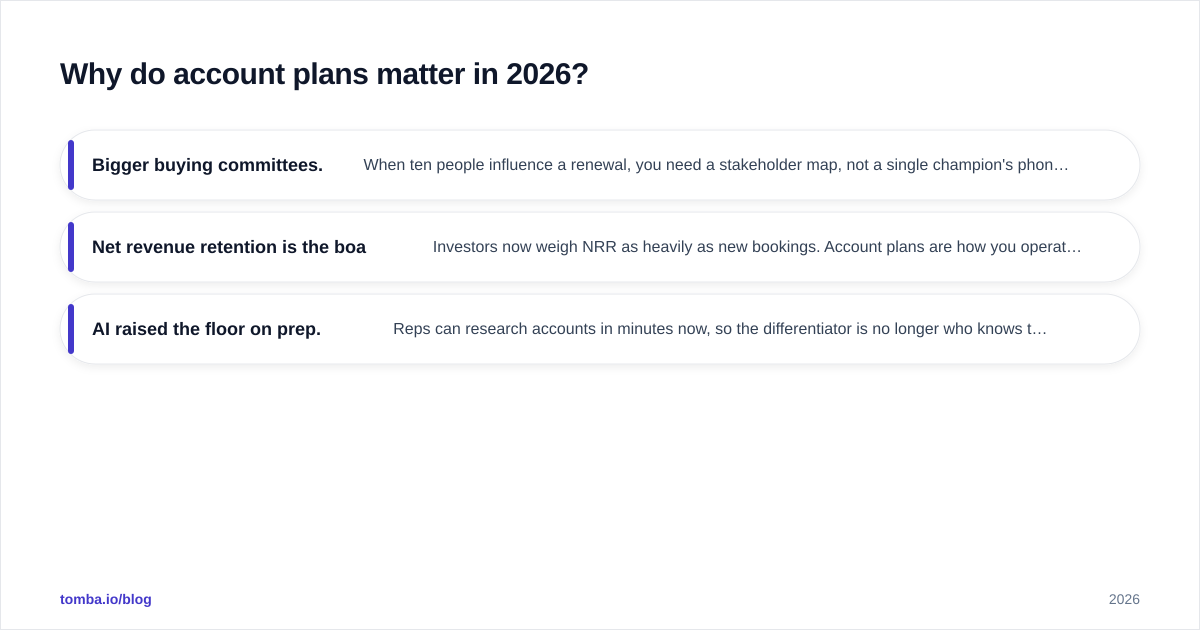
Three forces make account plans non-optional this year:
- Bigger buying committees. When ten people influence a renewal, you need a stakeholder map, not a single champion's phone number.
- Net revenue retention is the board metric. Investors now weigh NRR as heavily as new bookings. Account plans are how you operationalize retention and expansion.
- AI raised the floor on prep. Reps can research accounts in minutes now, so the differentiator is no longer who knows the most — it's who has a disciplined plan and executes it.
Teams that formalize account planning tend to see measurable lifts in win rate and average deal size, because they stop reacting to inbound requests and start steering accounts toward outcomes they defined in advance.

What goes into a strategic account plan?#
Every effective plan answers five questions. Keep the structure tight — depth comes from how well you answer them, not how many fields you fill in.
1. Account overview and goals. What does this customer sell, who do they sell to, and what are their strategic priorities this year? Your goals should ladder up to theirs. If their CEO is publicly committed to expanding into Europe, your expansion play should make that easier.
2. Stakeholder map. Name every person in the buying group: economic buyer, champions, end users, blockers, and the influencers nobody put on the org chart. Tag each with their sentiment toward you (advocate, neutral, detractor) and their level of influence. This is where most plans go stale — people change roles constantly, and a champion who left six months ago is a dangerous blind spot.
3. Whitespace analysis. Map what they already buy against everything they could buy. The empty cells are your expansion pipeline — new departments, new use cases, new geographies, and products they haven't adopted yet.
4. Competitive landscape. Who else is in the account? Which incumbent tools are you displacing, and where are you vulnerable to being displaced? Note renewal dates and switching costs.
5. Action plan. Concrete plays with owners and dates for the next 90 days. "Deepen the relationship" is not a play. "Get the VP of Operations to a reference call with Acme by March 15" is.
How do you build an account plan step by step?#
Here's a sequence you can run this week.
- Pick the accounts. Don't plan all of them. Score your book on current revenue, expansion potential, and strategic fit, then formally plan only the top 10–20. Everything else gets light-touch coverage.
- Pull the data. Gather firmographics, the org chart, current product usage, support history, and recent news. This is the foundation — and it's where bad data quietly poisons everything downstream. Refresh stakeholder titles and contact details with proper data enrichment rather than trusting whatever was in the CRM from two years ago.
- Build the stakeholder map. Identify every member of the buying committee. When you find a new decision-maker on LinkedIn but have no way to reach them, an email finder closes the gap fast so your map has working contact paths, not just names.
- Run the whitespace grid. Lay products across the top, business units down the side, and mark owned/in-progress/whitespace in each cell.
- Set 2–3 measurable goals. Tie each to a number and a date: a renewal value, an expansion target, a multi-threading milestone.
- Write the 90-day plays. Each play gets an owner, a deadline, and a defined next step. Fewer, sharper plays beat a long wishlist.
- Set a review cadence. Update the plan monthly internally and run a formal QBR with the customer quarterly. A plan reviewed once a year is a document; a plan reviewed monthly is a strategy.
What does a simple account plan template look like?#
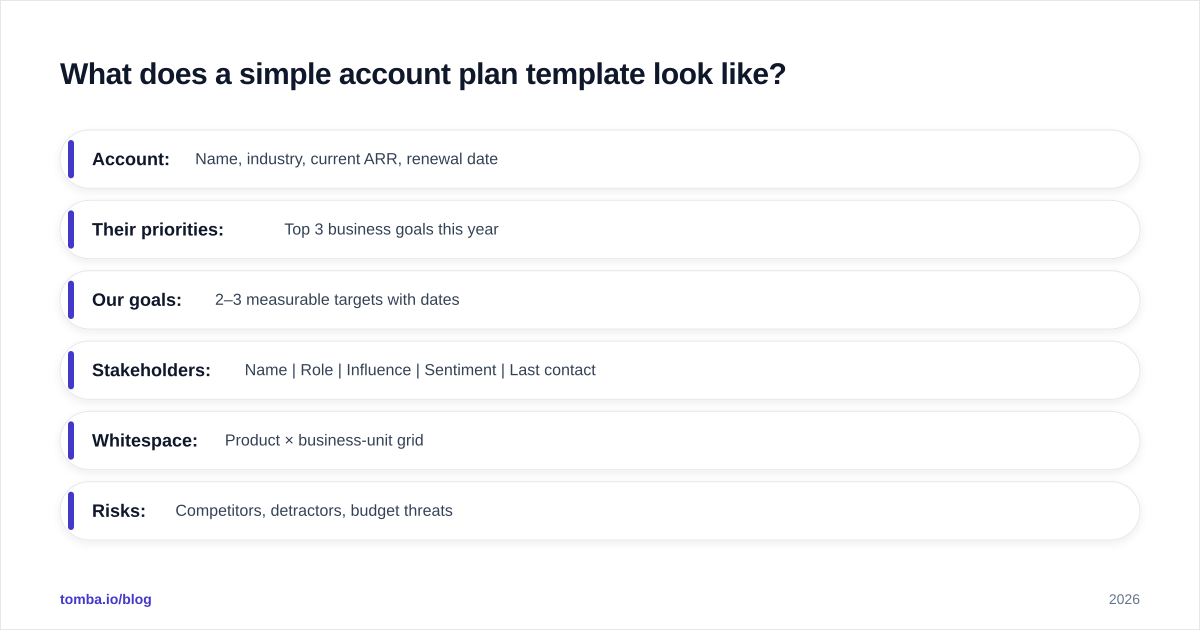
You don't need enterprise software to start. A one-page structure beats a 40-field form nobody maintains. Here's the skeleton:
- Account: Name, industry, current ARR, renewal date
- Their priorities: Top 3 business goals this year
- Our goals: 2–3 measurable targets with dates
- Stakeholders: Name | Role | Influence | Sentiment | Last contact
- Whitespace: Product × business-unit grid
- Risks: Competitors, detractors, budget threats
- Next 90 days: Play | Owner | Due date | Status
Start there. Once reps actually keep it current, you can graduate to a structured tool. Platforms like Salesforce and account-planning add-ons reviewed on G2 offer richer relationship maps and whitespace automation — but tooling without discipline just gives you a prettier place to store stale data.

How is account planning different from regular sales planning?#
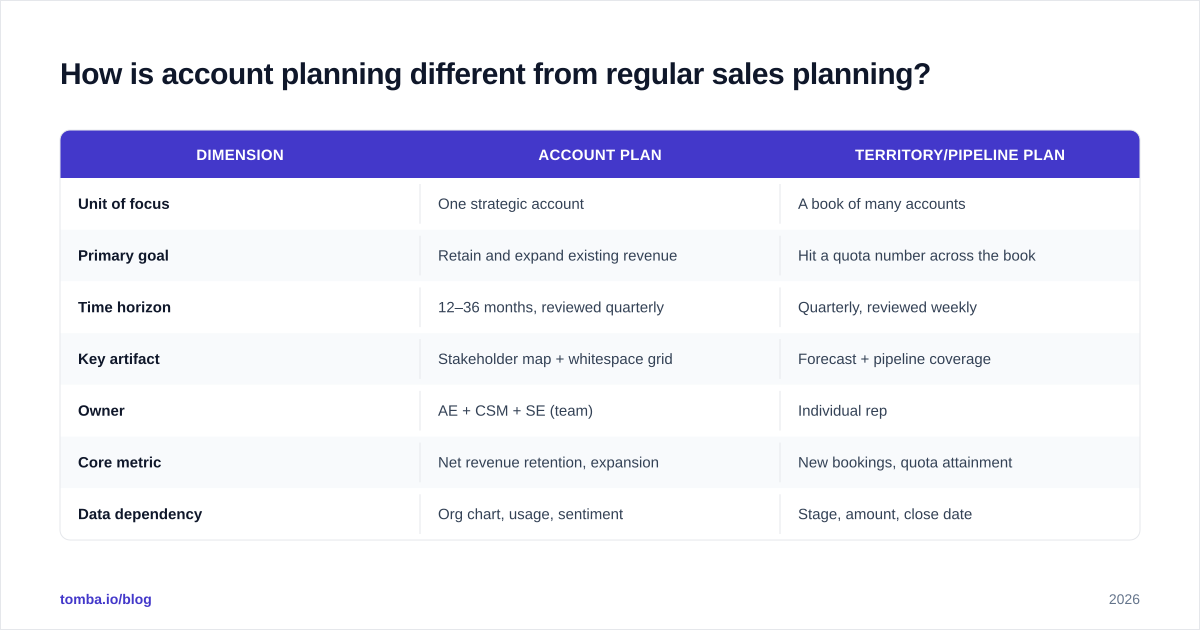
Account planning is depth; territory and pipeline planning are breadth. The table below shows where each fits.
| Dimension | Account Plan | Territory/Pipeline Plan |
|---|---|---|
| Unit of focus | One strategic account | A book of many accounts |
| Primary goal | Retain and expand existing revenue | Hit a quota number across the book |
| Time horizon | 12–36 months, reviewed quarterly | Quarterly, reviewed weekly |
| Key artifact | Stakeholder map + whitespace grid | Forecast + pipeline coverage |
| Owner | AE + CSM + SE (team) | Individual rep |
| Core metric | Net revenue retention, expansion | New bookings, quota attainment |
| Data dependency | Org chart, usage, sentiment | Stage, amount, close date |
| Failure mode | Single-threading, stale stakeholders | Sandbagging, happy-ears forecast |
Both matter. The point is that you run them differently. A pipeline review asks "will this deal close this quarter?" An account review asks "are we positioned to own this customer for the next three years?"
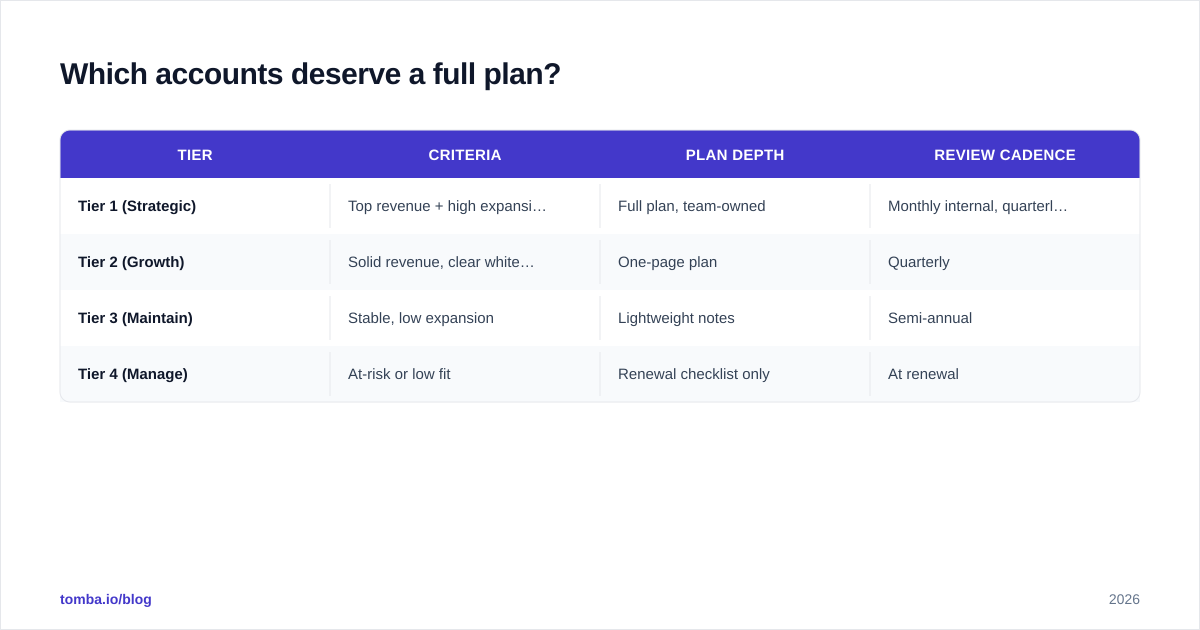
Which accounts deserve a full plan?#
Not all of them — and forcing reps to plan every account is the fastest way to kill the practice. Use a simple tiering model so effort matches opportunity.
| Tier | Criteria | Plan depth | Review cadence |
|---|---|---|---|
| Tier 1 (Strategic) | Top revenue + high expansion potential | Full plan, team-owned | Monthly internal, quarterly QBR |
| Tier 2 (Growth) | Solid revenue, clear whitespace | One-page plan | Quarterly |
| Tier 3 (Maintain) | Stable, low expansion | Lightweight notes | Semi-annual |
| Tier 4 (Manage) | At-risk or low fit | Renewal checklist only | At renewal |
Roughly speaking, your Tier 1 accounts are a small slice of your logos but a large share of your revenue and nearly all of your expansion upside. Concentrate your planning energy there. HubSpot's guidance on key account management makes the same case: depth on the few beats shallow coverage of the many.
What are the most common account planning mistakes?#
- Single-threading. Relying on one champion. When they leave — and they will — your whole relationship walks out the door. Multi-thread into at least three stakeholders per account.
- The set-it-and-forget-it plan. Built once, never updated. If the last edit was three months ago, it's fiction.
- Confusing activity with strategy. A list of meetings is not a plan. A plan states the outcome you're driving and why.
- Stale data. Wrong titles, dead email addresses, and contacts who changed jobs make your stakeholder map actively misleading. Verify contact data before it goes in the plan.
- No executive sponsorship. For Tier 1 accounts, an exec-to-exec relationship is insurance. If your leadership has never met theirs, you're exposed.
- Whitespace blindness. Selling only to the department you already serve while three other business units buy from your competitor.
How do you keep account plans current without it becoming busywork?#
Automate the data, ritualize the review. The two things that make plans rot are manual data entry and the absence of a forcing function.
For the data layer: connect your plan to live sources so firmographics, usage signals, and contact details refresh themselves. When a stakeholder gets promoted or a new VP joins the buying committee, you want to know within days, not at the next QBR. Pairing your CRM with enrichment and an email finder means new names on the org chart get working contact paths automatically — your map stays actionable instead of decorative.
For the ritual: put account reviews on the calendar as a recurring event with a fixed agenda — what changed, what's at risk, what's the next play. A 30-minute monthly review per Tier 1 account is enough to keep the plan alive. The discipline, not the document, is what compounds.
A practical loop looks like this: enrich the account data, review the stakeholder map for changes, update the whitespace grid against latest usage, confirm the next 90-day plays still make sense, and reassign owners where needed. Run that loop on a cadence and your plans become the most trusted artifact in your revenue org.
The bottom line#
Account plans are how you turn your best customers into your most predictable growth. The framework is simple — goals, stakeholders, whitespace, competition, and a 90-day action plan — but the edge comes from execution: planning the right accounts, keeping the data honest, and reviewing on a real cadence.
Your plan is only as strong as the people and contact data inside it. As buying committees grow and roles shift, you need a fast, accurate way to find and verify the stakeholders who actually sign. Use the Tomba Email Finder to map every decision-maker in your strategic accounts with verified, deliverable contact details — so your stakeholder map drives revenue instead of collecting dust. Start free with 25 searches a month, and scale into the Tomba pricing tier that matches your book when account planning becomes a habit.
// get started
Find, verify and enrich your first contacts today
Start on the free plan with 25 searches a month, then scale when your team is ready.
Free plan · No credit card required · GDPR & CCPA
// about the author