Account Prioritization in 2026: A Practical B2B Framework
Stop spraying your pipeline. This 2026 guide breaks down account prioritization scoring, tiering, and the data signals that tell reps which accounts to work first.
Account prioritization is the discipline of ranking your target accounts by how likely they are to buy, how much they're worth, and how ready they are right now — then making your reps work that ranked list top-down instead of guessing. Done well, it is the single highest-leverage change most B2B sales teams can make in a quarter.
TL;DR#
- Account prioritization = fit × intent × value. Rank accounts on how well they match your ICP, whether they're showing buying signals, and how much revenue they represent.
- Tier, don't just score. Convert raw scores into 3-4 tiers (A/B/C/D) so reps know exactly how much effort each account gets.
- Bad data kills good models. A scoring model built on stale firmographics and missing contacts ranks the wrong accounts confidently.
- Refresh on a cadence. Intent decays fast — re-score weekly or your "hot" list is last month's news.
- Start simple. A weighted spreadsheet beats no model. Add automation once the inputs are trustworthy.
What is account prioritization?#
Think of your total addressable market as a grocery store with 10,000 items and a 30-minute shopping window. You can't grab everything. Account prioritization is the shopping list that tells you which aisles to hit first so you leave with the highest-value cart before time runs out.
In B2B terms, it's the process of scoring and ranking accounts so sales and marketing concentrate effort where the return is highest. Instead of every rep building their own mental list (usually "whoever I talked to most recently" or "the biggest logo I recognize"), the team works a shared, data-backed ranking.
This matters more in 2026 than it did five years ago. Buying committees are larger, sales cycles are longer, and most teams are being asked to hit the same number with fewer reps. Spraying outreach across an undifferentiated list is how you burn a quarter. Prioritization is how you protect it.
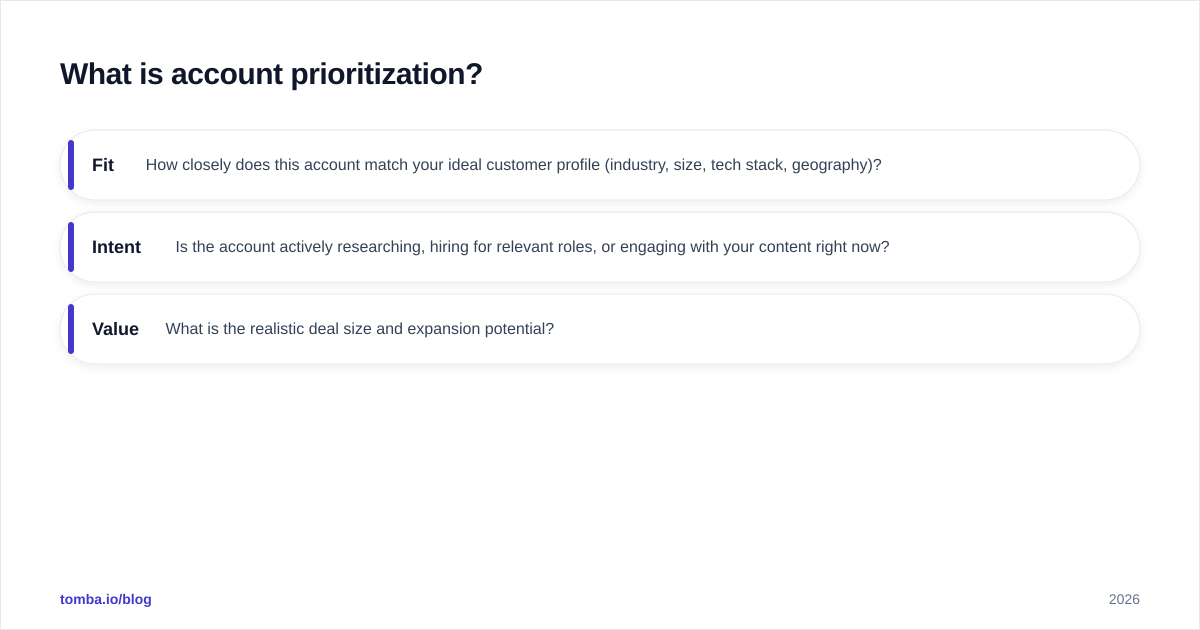
The framework above breaks prioritization into three inputs that multiply together:
- Fit — How closely does this account match your ideal customer profile (industry, size, tech stack, geography)?
- Intent — Is the account actively researching, hiring for relevant roles, or engaging with your content right now?
- Value — What is the realistic deal size and expansion potential?
An account that scores high on all three is a Tier A account. An account with great fit but zero intent is a nurture play, not a "call today" play. The multiplication matters: a perfect-fit account with no intent and no budget is not a priority, no matter how good the logo looks on a slide.

Why does account prioritization matter for revenue?#
The blunt answer: rep time is your scarcest resource, and most of it is currently spent on accounts that will never close.
Sales capacity is finite. If a rep can run 40 meaningful conversations a week, the only question that matters is which 40. When that selection is random, win rates sag, ramp times stretch, and forecasting becomes fiction. When it's prioritized, the same headcount produces more pipeline from the same number of touches.
Prioritization also fixes the marketing-sales handoff. When both teams agree on what an A-tier account looks like, marketing stops celebrating volume of leads and starts feeding sales the accounts that actually convert. That alignment is the heart of revenue operations — a shared definition of "good" that everyone is measured against.
There's a forecasting benefit too. A pipeline weighted toward high-fit, high-intent accounts is more predictable than one padded with long-shots. Your sales win rate becomes a number you can trust because the deals in the pipe were qualified by the same model, not by individual optimism.
What signals should you score accounts on?#
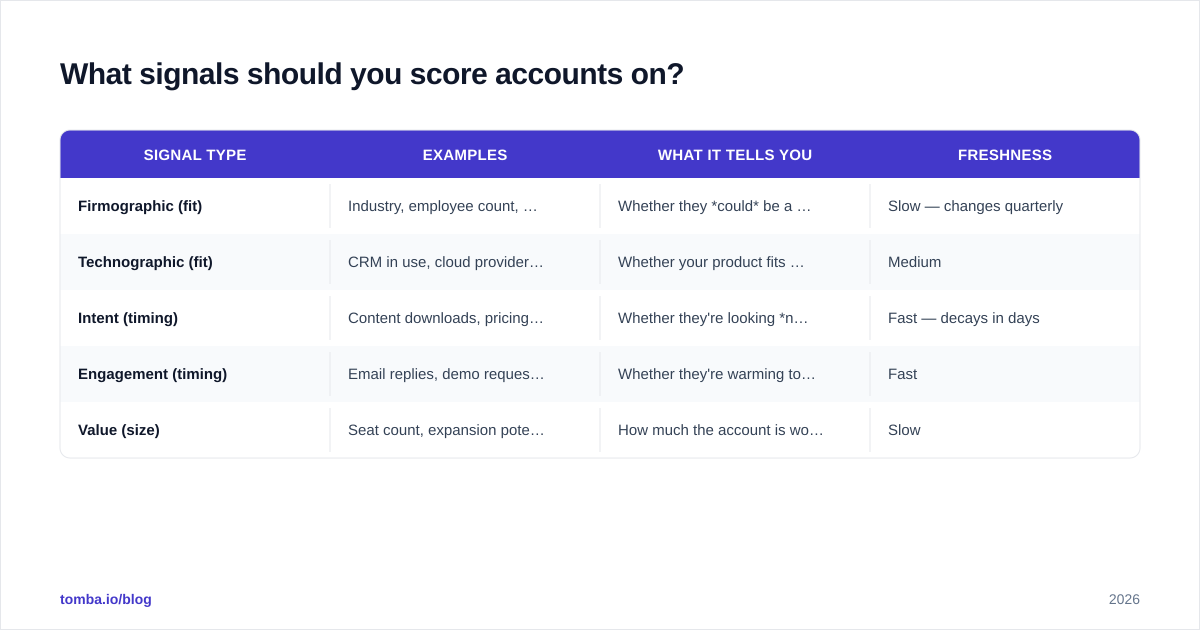
Signals fall into three buckets. The mistake most teams make is over-indexing on one (usually firmographics, because it's easy) and ignoring the others.
| Signal type | Examples | What it tells you | Freshness |
|---|---|---|---|
| Firmographic (fit) | Industry, employee count, revenue, location | Whether they could be a good customer | Slow — changes quarterly |
| Technographic (fit) | CRM in use, cloud provider, competitor tools | Whether your product fits their stack | Medium |
| Intent (timing) | Content downloads, pricing-page visits, hiring activity, review-site research | Whether they're looking now | Fast — decays in days |
| Engagement (timing) | Email replies, demo requests, event attendance | Whether they're warming to you | Fast |
| Value (size) | Seat count, expansion potential, deal-size history | How much the account is worth | Slow |
Fit signals are the foundation, but they're lagging — a company that fits your ICP today fit it last quarter too. Intent and engagement signals are what separate "good account" from "good account that's actually in-market right now." If you only score on firmographics, you'll confidently prioritize accounts that have no intention of buying for 18 months.
A practical rule: weight intent heavily for the ordering of who to contact this week, and weight fit + value heavily for who belongs in your target list at all. The two questions are different.
How do you build an account prioritization model?#
Here's a five-step process you can run with a spreadsheet before you ever buy software.
Step 1 — Define your ICP precisely. Not "mid-market SaaS." Instead: "B2B SaaS companies, 50-500 employees, US/EU, using HubSpot or Salesforce, with a VP of Sales role filled." Specificity is what makes the rest of the model work. If you can't write your ICP in one sentence with concrete thresholds, you're not ready to score.
Step 2 — Pick your signals and assign weights. Choose 6-10 signals across fit, intent, and value. Assign each a weight that sums to 100. For example: ICP match 30, intent signals 30, deal size 20, technographic fit 10, engagement 10. Don't overthink the first version — you'll calibrate it after you see results.
Step 3 — Gather the data. This is where most models quietly fail. You can't score an account on "has a VP of Sales" if you don't know who that person is or how to reach them. Enrich your account list with current firmographics and verified contacts before scoring. Tools like data enrichment fill the gaps so your model scores on facts, not blanks. A missing field shouldn't silently count as a zero — that's how good accounts get buried.
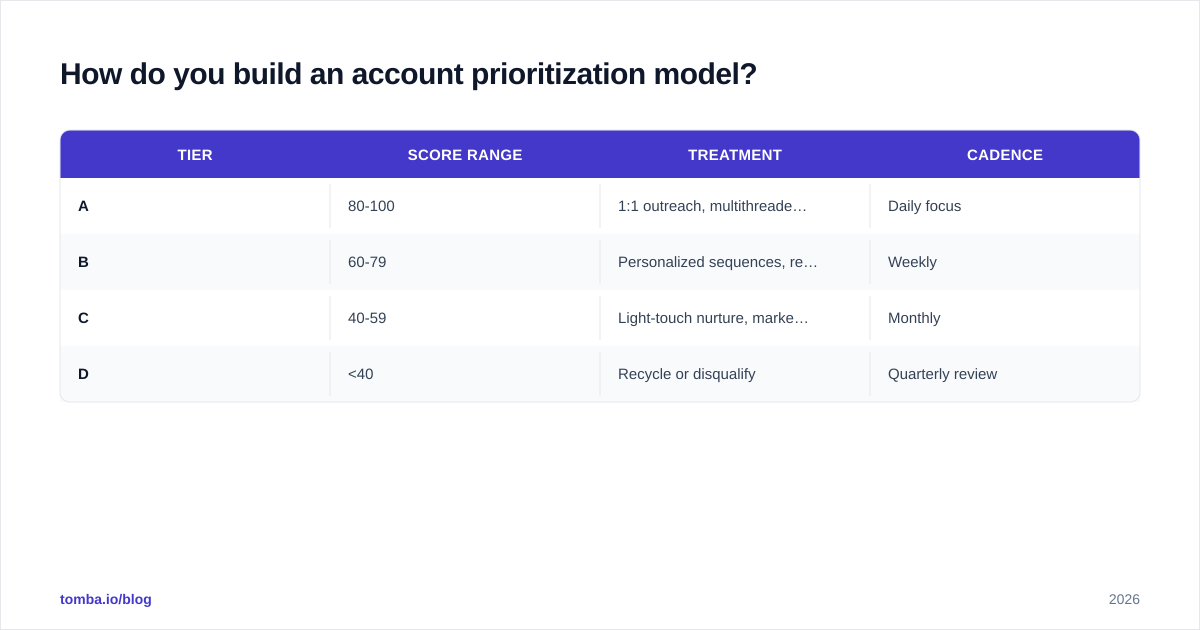
Step 4 — Score and tier. Calculate a weighted score per account, then bucket into tiers:
| Tier | Score range | Treatment | Cadence |
|---|---|---|---|
| A | 80-100 | 1:1 outreach, multithreaded, exec sponsor | Daily focus |
| B | 60-79 | Personalized sequences, rep-owned | Weekly |
| C | 40-59 | Light-touch nurture, marketing-led | Monthly |
| D | <40 | Recycle or disqualify | Quarterly review |
Tiering matters more than the raw number. A score of 73 means nothing to a rep at 8am; "this is a B account, run the B playbook" is an instruction.
Step 5 — Validate against closed deals. Pull your last 50 closed-won and closed-lost deals and run them through the model retroactively. If your won deals cluster in Tier A and B, the model works. If wins are scattered across all tiers, your weights are wrong — recalibrate.
How is account prioritization different from lead scoring?#
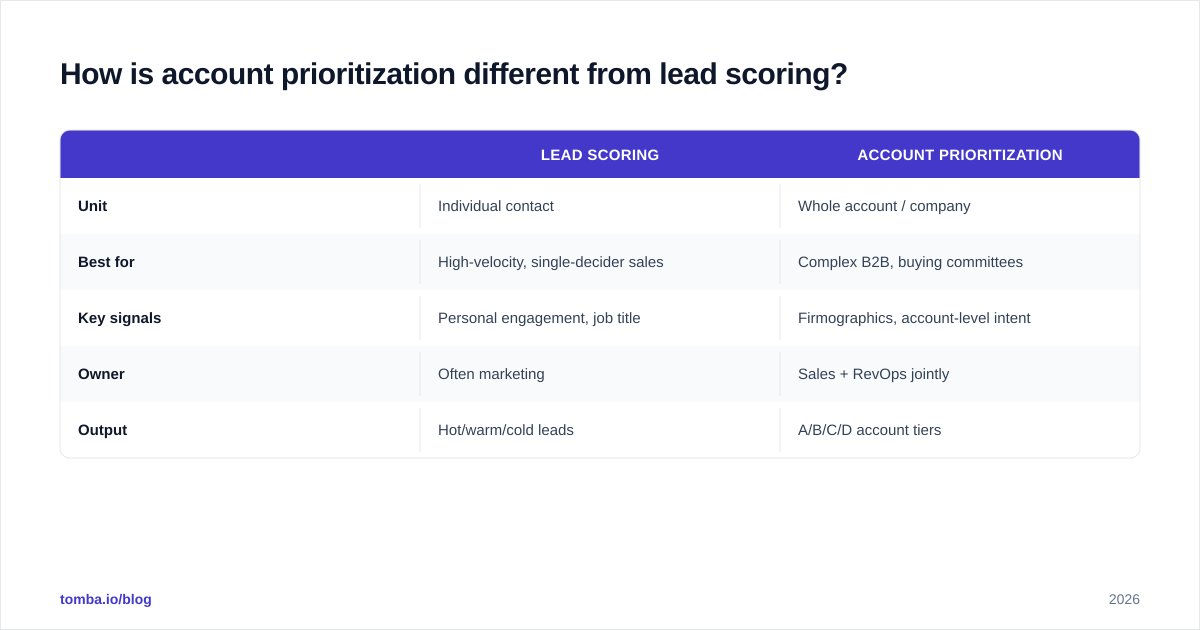
They're related but operate at different altitudes. Lead scoring ranks individual people; account prioritization ranks organizations. In a world of buying committees with 6-10 stakeholders, the account is the unit that buys, not the person.
| Lead scoring | Account prioritization | |
|---|---|---|
| Unit | Individual contact | Whole account / company |
| Best for | High-velocity, single-decider sales | Complex B2B, buying committees |
| Key signals | Personal engagement, job title | Firmographics, account-level intent |
| Owner | Often marketing | Sales + RevOps jointly |
| Output | Hot/warm/cold leads | A/B/C/D account tiers |
Most mature teams run both: prioritize accounts to decide where to play, then score leads within those accounts to decide who to engage first. If you only do one, do account prioritization — it prevents the more expensive mistake of working the wrong companies entirely. For the contact layer, a defined lead scoring model layers cleanly on top.

What tools and data do you need?#
You need three layers: a place to store and score accounts, a source of fit and intent signals, and a way to keep contact data current.
- System of record — Your CRM (Salesforce, HubSpot, Pipedrive) holds the accounts and scores. Most can store a custom "priority tier" field that drives views and reports.
- Signal sources — Intent data providers, your own product analytics, and website-visitor identification feed the timing signals.
- Enrichment and contact data — This is the layer teams underinvest in. A prioritized account is useless if you can't reach the right person at it.
That last point is where prioritization meets execution. Once your model surfaces a Tier A account, a rep needs the decision-maker's verified email to act. Pulling those contacts manually is the bottleneck that quietly kills good models. Using a domain search to find every relevant contact at a target company — then verifying them with an email verifier before outreach — turns a ranked list into actual conversations. According to HubSpot's research on sales productivity, reps spend a large share of their week on non-selling tasks like data entry and prospecting; removing the contact-finding friction is where prioritization pays off.
For teams operationalizing this at scale, third-party review platforms like G2 are a useful reference point for comparing sales intelligence and enrichment vendors before you commit.
How often should you re-prioritize?#
On a cadence matched to how fast each signal decays. Intent is perishable; firmographics are not.
- Weekly — Re-rank Tier A and B based on fresh intent and engagement. An account that hit your pricing page yesterday should jump.
- Monthly — Re-score the full list, refresh enrichment data, and move accounts between tiers.
- Quarterly — Revisit the model itself. Re-validate weights against the quarter's closed deals and prune dead accounts from Tier D.
The failure mode is treating prioritization as a one-time project. A model you built in January and never touched is, by June, ranking accounts on signals that no longer reflect reality. Build the refresh into your operating rhythm, ideally automated, so the list is always current without a manual scramble.
A quick caution on automation: automate the refresh, not the judgment. Let the system pull new data and recompute scores, but keep a human reviewing tier changes for the top accounts. Models drift, and a rep's context ("they just got acquired") will catch things your signals miss.
Common mistakes to avoid#
- Scoring on data you don't have. Empty fields treated as zeros sink good accounts. Enrich first, score second.
- Too many tiers. Five-plus tiers create decision paralysis. Three or four is plenty.
- Set-and-forget. A static model decays into noise within a quarter.
- Ignoring rep feedback. The model is a starting point, not gospel. Reps see context the data doesn't.
- Confusing big with good. The largest logo isn't automatically Tier A if fit and intent are weak.
Conclusion: prioritize the accounts, then go reach them#
Account prioritization turns a finite amount of rep time into the most pipeline it can possibly produce. Define your ICP precisely, score on fit, intent, and value, collapse those scores into clear tiers, and refresh on a cadence that respects how fast intent decays. Start with a spreadsheet if you have to — a simple weighted model beats no model every time.
But a ranked list only creates revenue when reps can actually reach the people on it. That's the gap most teams hit: the model says "go work this account," and the rep loses an hour hunting for a valid email. Tomba's Email Finder closes that gap — find and verify the decision-makers at every prioritized account by name or domain, so your reps spend their time selling instead of searching. The free tier gives you 25 searches a month to test it on your Tier A list; paid plans start at $49/mo on the Starter plan. Build the model, then let Tomba turn your priority list into conversations.
// get started
Find, verify and enrich your first contacts today
Start on the free plan with 25 searches a month, then scale when your team is ready.
Free plan · No credit card required · GDPR & CCPA
// about the author