Account Qualification in 2026: Frameworks, Steps & Tools
Account qualification is how top teams stop chasing bad-fit logos and spend time on deals they can actually win. Here are the frameworks, the process, and the data to do it in 2026.
Account qualification is the difference between a pipeline full of deals you can close and a pipeline full of polite "no"s that took three months to arrive. If your reps are busy but your win rate is flat, the problem usually isn't effort — it's that nobody decided which accounts deserve the effort in the first place.
TL;DR#
- Account qualification is the process of scoring whole companies (not just individuals) against your ideal customer profile, buying intent, and ability to buy — before you invest selling time.
- It sits upstream of lead qualification: you qualify the account, then the people inside it.
- The best-known frameworks — BANT, MEDDIC, CHAMP, and ICP-fit scoring — each answer a different question; most teams blend two of them.
- Bad-fit accounts are expensive: they inflate your pipeline, distort forecasting, and burn rep hours that should go to winnable deals.
- Accurate firmographic and contact data is the fuel for qualification. Garbage data in, garbage scores out.
What is account qualification?#
Account qualification is the act of deciding whether an entire company is worth pursuing before your team commits real selling time to it. Think of it like a restaurant host seating guests: you don't hand a four-top reservation to a party that only wants coffee. You match the table to the party. Account qualification matches your selling capacity to the accounts most likely to become revenue.
Technically, it's a scoring exercise across three dimensions:
- Fit — does this company match your ideal customer profile (industry, size, tech stack, geography, business model)?
- Intent — is there evidence they're actively looking for a solution like yours (content consumption, hiring signals, website visits, competitor churn)?
- Capacity — can they actually buy (budget, authority, no blocking constraints)?
Account qualification is deliberately broader than lead qualification. A lead is a person; an account is the company. In B2B, you rarely sell to one person — you sell to a buying committee of six to ten people. Qualifying the account first means you don't waste a week nurturing a single enthusiastic contact at a company that was never going to buy.
Why does account qualification matter in 2026?#
Because selling time is your scarcest resource, and bad-fit accounts quietly consume most of it.
According to Gartner research on B2B buying, the typical purchase now involves a buying group of six to ten decision-makers, each armed with their own stack of information. That complexity means a single unqualified account can eat dozens of rep hours across discovery calls, demos, and proposals — and still die in procurement.
Here's what poor qualification costs you in practice:
- Forecast distortion. Deals that should never have entered the pipeline make your forecast look healthier than it is, then collapse at quarter-end.
- Rep burnout. Nothing demoralizes a team faster than chasing accounts that were dead on arrival.
- Slower cycles. Bad-fit deals don't just lose — they lose slowly, clogging the pipeline behind them.
- CAC inflation. Every hour spent on an account that won't close raises your effective cost to acquire the ones that do.
Strong account qualification flips this. When you concentrate effort on accounts that fit, show intent, and can buy, win rates climb, cycles shorten, and your forecast starts telling the truth.
What are the main account qualification frameworks?#
There's no single "right" framework — there's the one that matches how you sell. Here are the four that matter most, and the question each one is built to answer.
BANT#
The oldest framework, originally from IBM. BANT scores Budget, Authority, Need, and Timing. It's fast and easy to teach, which makes it great for high-volume, transactional sales. Its weakness: in modern committee buying, "authority" is rarely one person, and "budget" is often created during the sale rather than confirmed before it.
MEDDIC (and MEDDPICC)#
Built for complex enterprise deals. MEDDIC scores Metrics, Economic buyer, Decision criteria, Decision process, Identify pain, and Champion. The expanded MEDDPICC adds Paper process and Competition. It's rigorous and forecast-friendly, but heavy — overkill for a $5k/year SaaS deal.
CHAMP#
A people-first reorder of BANT: CHallenges, Authority, Money, Prioritization. By leading with the prospect's challenges instead of your budget question, CHAMP keeps discovery consultative. Good fit for solution selling.
ICP-fit scoring#
Less a sales-call framework and more a pre-sales filter. You score every account against your ideal customer profile using firmographic and behavioral data, then route only the high scorers to reps. This is the layer that should run before a human ever picks up the phone.
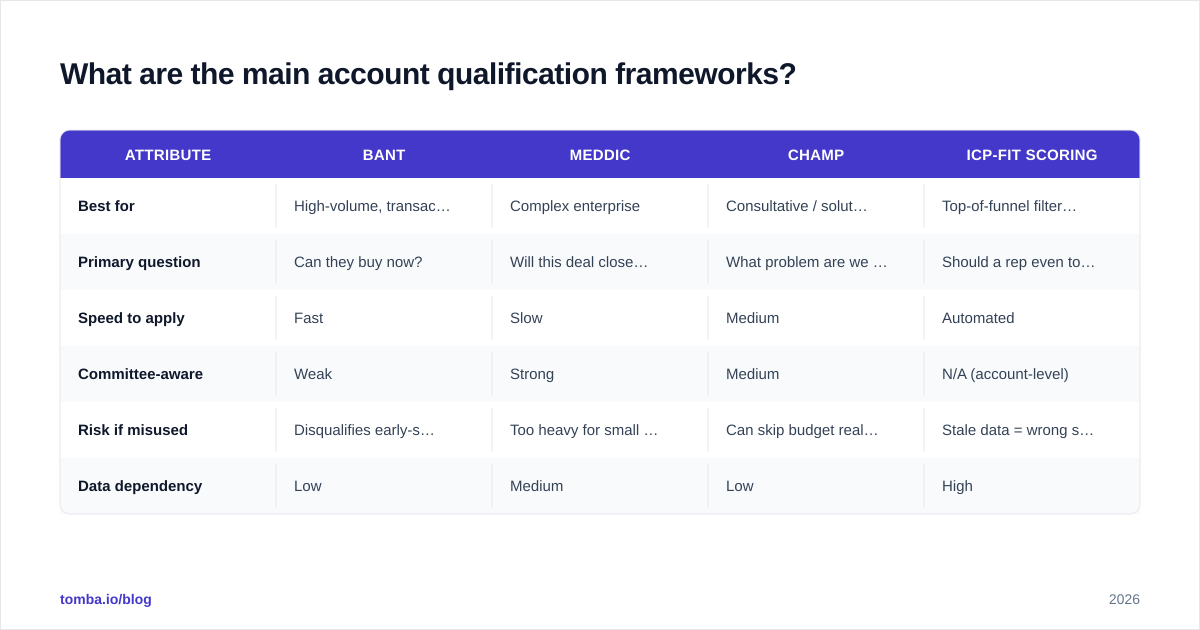
How the frameworks compare#
| Attribute | BANT | MEDDIC | CHAMP | ICP-Fit Scoring |
|---|---|---|---|---|
| Best for | High-volume, transactional | Complex enterprise | Consultative / solution sales | Top-of-funnel filtering |
| Primary question | Can they buy now? | Will this deal close cleanly? | What problem are we solving? | Should a rep even touch this? |
| Speed to apply | Fast | Slow | Medium | Automated |
| Committee-aware | Weak | Strong | Medium | N/A (account-level) |
| Risk if misused | Disqualifies early-stage budget | Too heavy for small deals | Can skip budget reality | Stale data = wrong scores |
| Data dependency | Low | Medium | Low | High |
Most teams in 2026 run a hybrid: ICP-fit scoring as an automated gate, then MEDDIC or CHAMP on the calls once a human is engaged. The automated layer protects rep time; the conversational layer protects deal quality.
How do you build an account qualification process?#
Six steps, run in order. The first three are data work; the last three are sales work.
Step 1 — Define your ideal customer profile#
Start from your best closed-won customers, not from a wishlist. Pull the accounts that closed fastest, churned least, and expanded most. Find what they share: industry, employee count, revenue band, tech stack, region, business model. That intersection is your ICP. Write it down as concrete, filterable attributes — "mid-market B2B SaaS, 50–500 employees, North America, using HubSpot" beats "growth-stage tech companies."
Step 2 — Enrich your account list with reliable data#
You can't score what you can't see. Each target account needs clean firmographic and contact data: company size, industry, technologies, key decision-makers, and verified email addresses. This is where data enrichment earns its keep — it fills the gaps between "company name" and "qualified, contactable account." If your underlying B2B database is stale, every downstream score inherits the error.
Step 3 — Score fit, intent, and capacity#
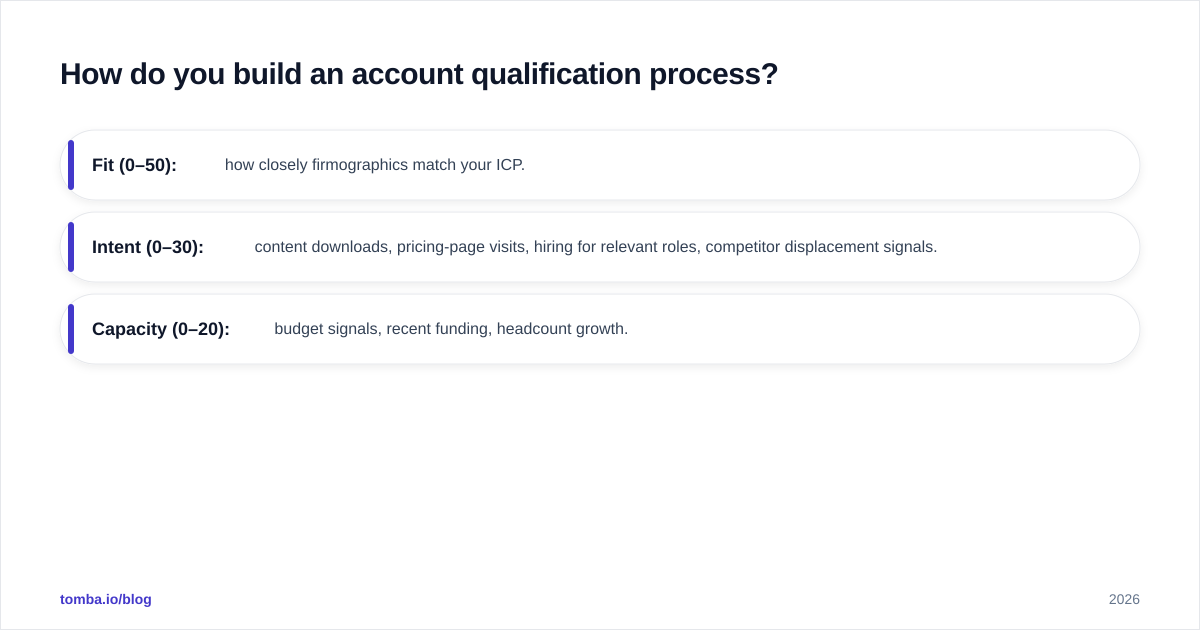
Assign weighted points across your three dimensions. A simple model:
- Fit (0–50): how closely firmographics match your ICP.
- Intent (0–30): content downloads, pricing-page visits, hiring for relevant roles, competitor displacement signals.
- Capacity (0–20): budget signals, recent funding, headcount growth.
Sum the score, set a threshold (say, 60), and route only accounts above it to sales. Everything below goes back to nurture.
Step 4 — Identify and map the buying committee#
Once an account clears the gate, find the people. You need the economic buyer, the likely champion, and the technical evaluators. Use a tool like the Tomba Email Finder to find verified contacts for each role so reps aren't guessing at who matters or burning sends on bounced addresses.
Step 5 — Apply a call framework in discovery#
Now the human layer kicks in. Run MEDDIC or CHAMP on your discovery calls to confirm what the data suggested: real pain, a real budget path, a real timeline, and a champion willing to sell internally on your behalf.
Step 6 — Disqualify ruthlessly and recycle#
Qualification includes the courage to say no. If an account fails discovery, mark it disqualified with a reason, and feed that reason back into your scoring model. Over time, your "lost-reason" data becomes the sharpest input you have. Track win rate by score band to prove the model is working.

What signals separate a qualified account from a bad-fit one?#
Not all signals are equal. Here's how to read them.
Strong positive signals
- Firmographics match your ICP on three or more attributes.
- Recent funding round or visible headcount growth in relevant departments.
- Hiring for roles that imply your problem (e.g., hiring a RevOps lead if you sell RevOps tooling).
- Repeat visits to high-intent pages (pricing, comparison, case studies).
- They're currently using a competitor you regularly displace.
Strong negative signals
- Company size far outside your ICP band (you'll either be too expensive or too small to matter).
- No identifiable budget owner for your category.
- A single contact who can't name anyone else involved — committee of one is a red flag.
- "Just researching," no timeline, no triggering event.
- Region or industry you can't legally or operationally support.
The mistake teams make is over-weighting enthusiasm. A thrilled individual contributor with no authority and no budget is not a qualified account — they're a future internal champion at best. Score the company, not the mood of the call.
How do tools and data fit into account qualification?#
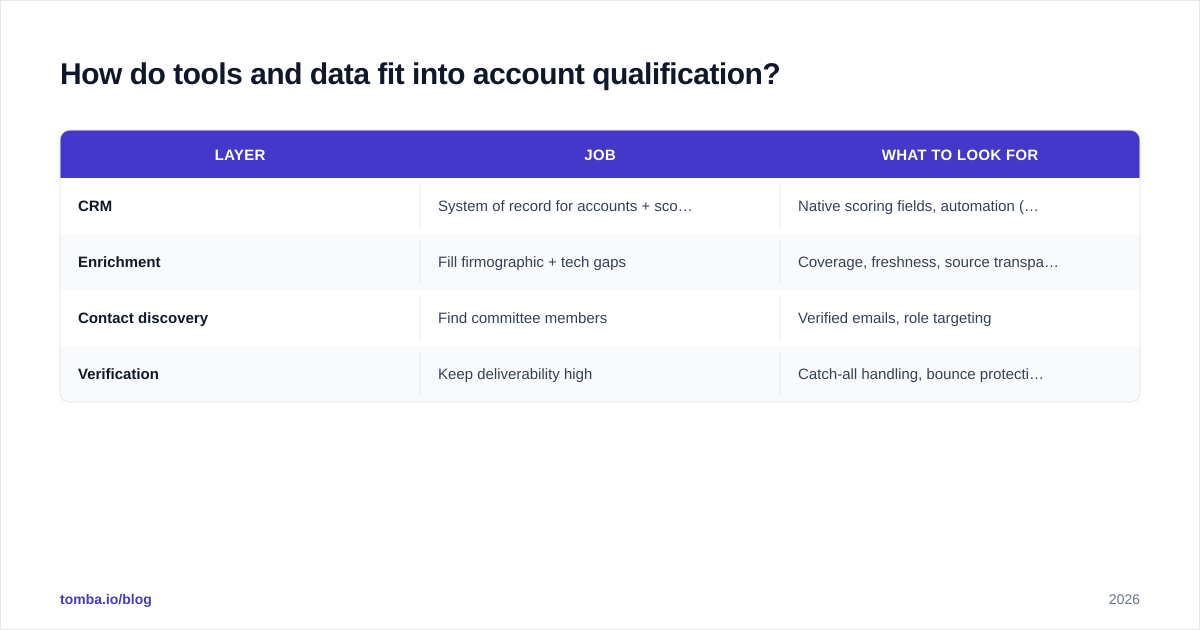
Tooling does three jobs: it enriches accounts so you can score them, it finds the right people inside qualified accounts, and it verifies contact data so your outreach actually lands.
A practical stack looks like this:
| Layer | Job | What to look for |
|---|---|---|
| CRM | System of record for accounts + scores | Native scoring fields, automation (HubSpot or Salesforce) |
| Enrichment | Fill firmographic + tech gaps | Coverage, freshness, source transparency |
| Contact discovery | Find committee members | Verified emails, role targeting |
| Verification | Keep deliverability high | Catch-all handling, bounce protection |
The unglamorous truth: most qualification failures are data failures. Reps disqualify good accounts because the data said 12 employees when it was 1,200, or they waste a week emailing an address that bounced. Verified contact data and accurate firmographics aren't a nice-to-have — they're the foundation the whole model sits on. When you connect your enrichment and finder tools directly into your CRM, scores update automatically and reps work from one source of truth.
If you want to see how scoring inputs map to real cost, the Tomba pricing page lays out search and verification credits across tiers (Free at 25 searches/mo, Starter at $49/mo, Growth at $99/mo, Pro at $249/mo) — useful for sizing how many accounts you can realistically enrich and contact each month.
How is account qualification different from lead qualification?#
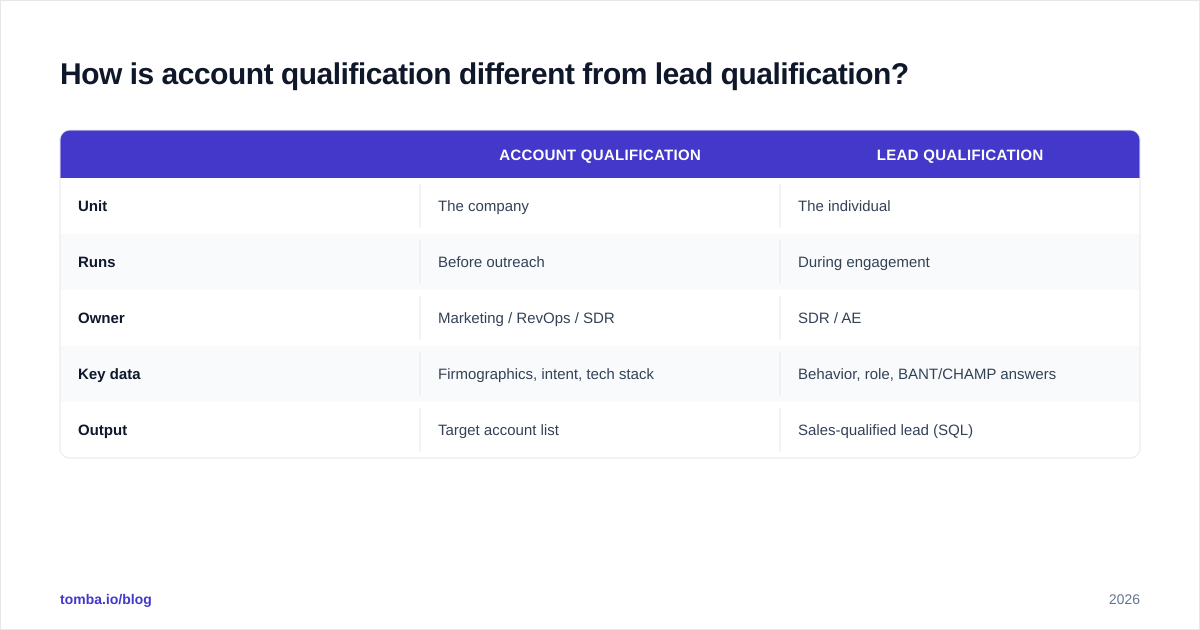
Account qualification asks "is this company worth our time?" Lead qualification asks "is this person ready to buy?" You do them in that order.
| Account qualification | Lead qualification | |
|---|---|---|
| Unit | The company | The individual |
| Runs | Before outreach | During engagement |
| Owner | Marketing / RevOps / SDR | SDR / AE |
| Key data | Firmographics, intent, tech stack | Behavior, role, BANT/CHAMP answers |
| Output | Target account list | Sales-qualified lead (SQL) |
In an account-based motion, account qualification dominates: you pick the logos first, then find and qualify the humans. In a high-volume inbound motion, lead qualification carries more weight because demand is already raising its hand. Most teams need both — a target list and a way to qualify the inbound that doesn't match it.
Common account qualification mistakes to avoid#
- Chasing logos for vanity. A famous brand that doesn't fit your ICP is still a bad-fit account. The logo on the case study won't pay your salaries.
- Qualifying once and forgetting. Accounts change — funding, layoffs, leadership swaps. Re-score on a cadence.
- Treating the framework as a checklist. BANT answered "yes/yes/yes/yes" with no evidence is theater. Demand proof.
- Ignoring disqualification data. Your lost reasons are a free, continuously improving model. Capture them.
- Letting data rot. Re-enrich and re-verify regularly. A qualification model built on six-month-old data is qualifying a company that no longer exists.
Bottom line: qualify the account before you sell to it#
The teams that win in 2026 aren't the ones with the most activity — they're the ones who pointed their activity at the right accounts. Define your ICP, enrich and score your list, map the buying committee, and apply a call framework only to the accounts that earn it. Then disqualify the rest without guilt and feed what you learned back into the model.
All of it depends on one thing: knowing who's actually inside each account and being able to reach them. The Tomba Email Finder gives you verified professional emails by name, domain, or company — so once an account clears qualification, your reps spend their time selling to the right people instead of hunting for addresses or bouncing on bad ones. Start free with 25 searches and wire it into your CRM, and your qualification model finally has clean fuel to run on.
// get started
Find, verify and enrich your first contacts today
Start on the free plan with 25 searches a month, then scale when your team is ready.
Free plan · No credit card required · GDPR & CCPA
Get the Tomba newsletter
Product and data updates
// about the author