Account Segmentation in 2026: A B2B Framework Guide
Account segmentation turns a messy TAM into a ranked target list your sales team can actually work. Here's the 2026 framework, the data you need, and the mistakes that quietly kill pipeline.
Most revenue teams do not have a lead problem. They have a focus problem. You have 40,000 companies in your addressable market, a 6-person sales team, and no honest way to decide who gets a human this quarter and who gets an automated nurture. Account segmentation is how you make that decision on purpose instead of by accident.
TL;DR#
- Account segmentation is the practice of dividing your total addressable market (TAM) into ranked groups based on fit, intent, and potential value — so reps spend time on accounts that can actually close.
- The three workhorse models are firmographic, technographic, and behavioral/intent segmentation. Most strong programs blend all three.
- A practical framework tiers accounts into A / B / C buckets, each with a different motion: ABM for A, light-touch outbound for B, automated nurture for C.
- Segmentation is only as good as the data underneath it. Stale firmographics and missing contact data are the two most common failure points.
- Start small: segment one quarter's target list, measure win rate by tier, then expand. Don't boil the ocean.
What is account segmentation?#
Account segmentation is the process of grouping the companies in your market into distinct segments so you can treat each segment differently. Think of it like a hospital triage desk. Everyone who walks in gets seen, but the nurse decides in 30 seconds who needs a trauma surgeon now and who can wait with an ice pack. Your pipeline works the same way: not every account deserves a custom demo, and pretending otherwise just burns your best reps on accounts that were never going to buy.
Formally, account segmentation sits one level above lead scoring. Lead scoring ranks individual people; account segmentation ranks whole companies. In a B2B deal where 6–10 stakeholders touch a purchase, the account is the real unit of revenue, which is why account-based teams segment at the company level first and worry about individual contacts second.
The output of segmentation is not a spreadsheet for its own sake. It's a set of motions: a documented answer to "what do we do when an account looks like this?" That linkage between segment and action is what separates segmentation that drives revenue from segmentation that drives slide decks.
Why does account segmentation matter in 2026?#
Because attention is the scarcest resource in B2B, and buyers have less of it every year. Inbox volume keeps climbing, reply rates keep sliding, and the generic "spray and pray" blast that worked in 2018 now lands you on spam lists and shared blocklists. Segmentation is the antidote: fewer, sharper touches aimed at accounts that fit.
The economics are blunt. Gartner research has repeatedly shown that B2B buyers spend only a small fraction of their journey talking to any single vendor's sales team. If you get a sliver of a buyer's time, you cannot afford to spend it on a poor-fit account. Segmentation concentrates that scarce attention where it converts.
There's also a deliverability angle. When you segment and personalize, you send less total volume to better targets, which protects your sender reputation and keeps your good accounts reachable. Untargeted blasting does the opposite — it trains mailbox providers to distrust your domain.
Finally, segmentation is what makes revenue operations measurable. When every account carries a tier, you can finally answer questions like "what's our win rate in Tier A versus Tier C?" and "are reps actually working the accounts we told them to?" Without segmentation, those questions have no clean answer.
What are the main types of account segmentation?#
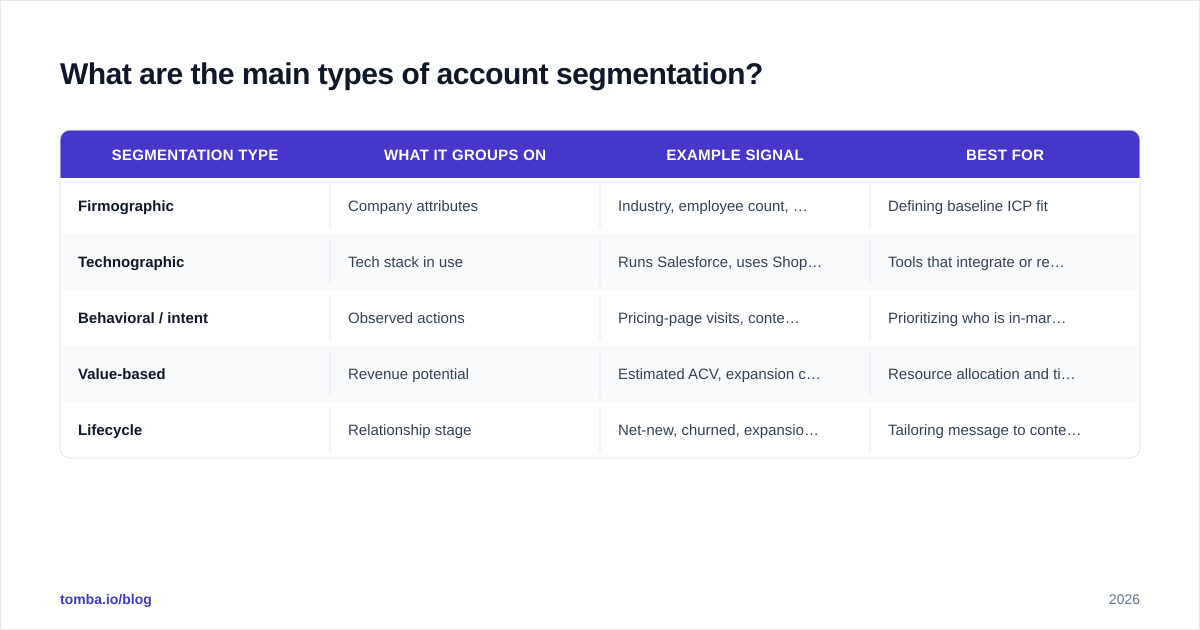
There is no single correct axis. The strongest programs layer several. Here are the models that earn their keep.
| Segmentation type | What it groups on | Example signal | Best for |
|---|---|---|---|
| Firmographic | Company attributes | Industry, employee count, revenue, region | Defining baseline ICP fit |
| Technographic | Tech stack in use | Runs Salesforce, uses Shopify, hosts on AWS | Tools that integrate or replace incumbents |
| Behavioral / intent | Observed actions | Pricing-page visits, content downloads, G2 research | Prioritizing who is in-market now |
| Value-based | Revenue potential | Estimated ACV, expansion ceiling, seat count | Resource allocation and tiering |
| Lifecycle | Relationship stage | Net-new, churned, expansion, customer | Tailoring message to context |
Firmographic segmentation is where almost everyone starts because it's the cheapest to source and the easiest to reason about. Technographic and intent layers are where the real precision comes from — they tell you not just who fits but who's ready. A 2,000-employee fintech that just started researching your category is a very different account from an identical fintech that's never heard of you, even though they're firmographically identical.
What is the difference between firmographic and behavioral segmentation?#
Firmographic segmentation describes what an account is; behavioral segmentation describes what an account is doing. Firmographics are relatively static — a company's industry and headcount don't change weekly. Behavior is dynamic and time-sensitive — a burst of pricing-page visits this week is a signal that decays fast.
Here's the trap teams fall into: they treat firmographic fit as the whole story. An account can be a perfect ICP match on paper and still be completely cold, with no budget, no trigger event, and no reason to move. Layering behavioral and intent data on top of firmographic fit is what turns a static "good fit" list into a ranked "good fit and in-market" list. The first list keeps reps busy. The second list closes deals.
In practice you want a 2x2: fit on one axis, intent on the other. High fit + high intent is your drop-everything segment. High fit + low intent is your nurture-and-wait segment. Low fit + high intent is a trap that wastes great reps on deals that won't expand. Low fit + low intent is the pile you safely ignore.
How do you build an account segmentation framework?#
Work top-down, in five steps. Each one feeds the next.
1. Define your ICP precisely. Before you can segment, you need a crisp ideal customer profile. Pull your last 50–100 closed-won deals and look for what they share: industry clusters, size bands, tech signals, the trigger events that preceded the deal. Write it down as explicit criteria, not vibes.
2. Build the universe. Source the full set of accounts that match your ICP filters. This is where a clean B2B database earns its cost — you want comprehensive, current firmographics, not a list you scraped 18 months ago. Garbage in, garbage tiers.
3. Score each account. Apply a simple weighted model: fit score (firmographic + technographic) plus intent score (behavioral signals). Keep the weights documented and the math transparent so reps trust the output. A model nobody understands is a model nobody uses.
4. Tier the results. Cut the scored list into A / B / C bands (more on this below). Resist the urge to make Tier A huge — if everything is a priority, nothing is.
5. Assign a motion per tier. This is the step teams skip, and it's the only step that produces revenue. Each tier gets a documented play: who owns it, how many touches, which channels, what content, what the SLA is.
The framework is a living document. Re-run scoring quarterly, because both your data and the market move. An account that was Tier C last quarter may have raised funding, hired a champion, or started researching your category — and your segmentation should catch that.
How do you tier accounts into A, B, and C?#
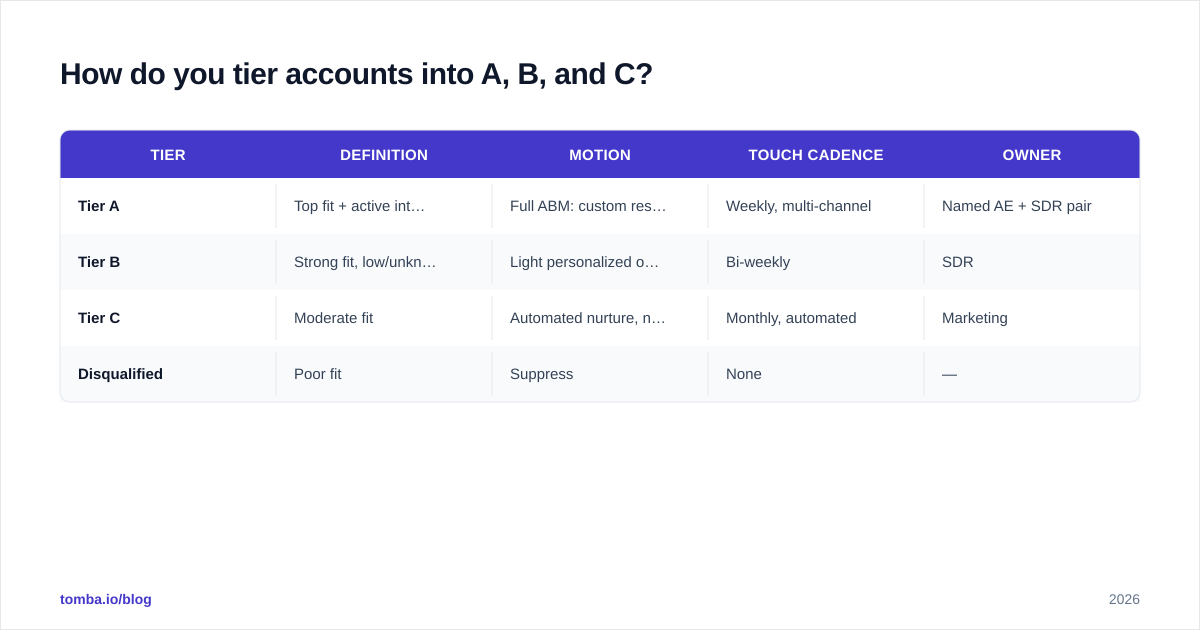
Tiering is the most operationally useful output of segmentation because it maps cleanly to how much human effort an account deserves. Here's a workable starting structure you can tune to your team size.
| Tier | Definition | Motion | Touch cadence | Owner |
|---|---|---|---|---|
| Tier A | Top fit + active intent | Full ABM: custom research, multi-threading, exec sponsor | Weekly, multi-channel | Named AE + SDR pair |
| Tier B | Strong fit, low/unknown intent | Light personalized outbound, sequences | Bi-weekly | SDR |
| Tier C | Moderate fit | Automated nurture, newsletter, retargeting | Monthly, automated | Marketing |
| Disqualified | Poor fit | Suppress | None | — |
A few rules of thumb. Tier A should be small enough that a rep can name every account and the people in them — usually 25–50 accounts per rep, not 500. Tier B is where most of your scalable outbound lives. Tier C is automation territory; you're staying top-of-mind cheaply until a signal promotes them. And the "disqualified" bucket matters more than people think — explicitly suppressing poor-fit accounts protects deliverability and rep morale.

Promotion and demotion between tiers should be automatic where possible. If a Tier C account starts hitting your pricing page and a decision-maker opens three emails, that's an intent spike — your system should bump it to Tier B and alert an SDR. Static tiers go stale; the value is in the movement.
What data and tools power account segmentation?#
Segmentation is a data problem wearing a strategy costume. You can have the cleanest framework in the world and it falls apart the moment the underlying records are wrong. Three data layers matter most.
Firmographic and technographic data to score fit. This is your foundation. It needs to be current — companies merge, grow, pivot, and get acquired constantly. Data enrichment keeps account records fresh so your tiers reflect reality, not a snapshot from two years ago.
Intent and behavioral data to score timing. First-party signals (site visits, content engagement, product usage) are the most reliable; third-party intent (review-site activity, topic surges) widens the net. Pipe these into your scoring model.
Contact data to actually execute the motion. This is the step that quietly breaks programs. You segment beautifully, tier your accounts, hand Tier A to your best AE — and then discover you have no working email addresses for the actual decision-makers. Segmentation tells you which accounts and which roles to reach; you still need to find the people. Tools like a domain search let you pull every contact at a target account, and an email verifier keeps your sends landing instead of bouncing.
Your CRM is where all of this lives. The tier field belongs on the account object, visible to every rep, and it should drive views, reports, and routing rules. Platforms like HubSpot's account-based tools and Salesforce both support custom tiering fields and account scoring — the platform matters less than the discipline of keeping the field accurate.
What are the most common account segmentation mistakes?#
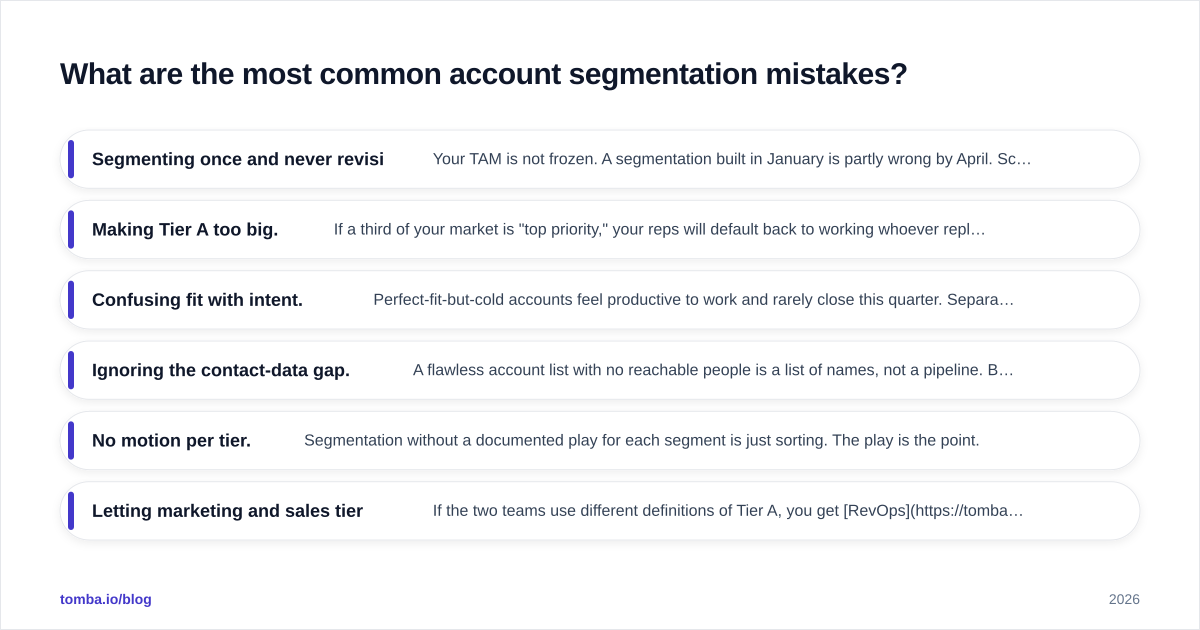
- Segmenting once and never revisiting. Your TAM is not frozen. A segmentation built in January is partly wrong by April. Schedule quarterly re-scoring.
- Making Tier A too big. If a third of your market is "top priority," your reps will default back to working whoever replies first. Keep the top tier genuinely scarce.
- Confusing fit with intent. Perfect-fit-but-cold accounts feel productive to work and rarely close this quarter. Separate the two axes explicitly.
- Ignoring the contact-data gap. A flawless account list with no reachable people is a list of names, not a pipeline. Budget for contact discovery, not just account data.
- No motion per tier. Segmentation without a documented play for each segment is just sorting. The play is the point.
- Letting marketing and sales tier differently. If the two teams use different definitions of Tier A, you get RevOps chaos. Agree on one model and one source of truth.
How is account segmentation different from ABM?#
They're related but not the same. Account-based marketing (ABM) is a strategy — concentrating marketing and sales resources on a defined set of high-value accounts. Account segmentation is the prerequisite analysis that tells you which accounts deserve that ABM treatment. You can't run ABM without first segmenting; segmentation is how you draw the line around your Tier A list. Put simply: segmentation decides the targets, ABM is one of the motions you run against the top targets. Forrester and most ABM practitioners treat tiered account lists as the entry point to any serious program.
Where do you go from here?#
Start narrow. Pick one quarter, segment a single target list, assign clear motions to A/B/C, and measure win rate and cycle time by tier. The data from that one cycle will tell you more than any framework blog post — including this one — about how your specific market responds. Then expand and automate the parts that worked.
Segmentation gives you the who. The bottleneck is almost always the how do I reach them — getting verified, deliverable contact data for the decision-makers inside your Tier A and Tier B accounts. That's exactly what Tomba's Email Finder is built for: hand it a target account, get back the professional email addresses of the people who matter, verified and ready to load into your sequences. Pair it with domain search to map every contact at an account and Tomba's data enrichment to keep tiers current. You can start free with 25 searches a month and scale up through the Tomba pricing plans as your segmented outbound grows — turn your tiers into booked meetings instead of a spreadsheet that sits in a tab nobody opens.
// get started
Find, verify and enrich your first contacts today
Start on the free plan with 25 searches a month, then scale when your team is ready.
Free plan · No credit card required · GDPR & CCPA
// about the author