Accounts In-Market Intent Data: 2026 B2B Buyer Guide
In-market intent data tells you which accounts are actively researching a solution like yours right now. Here is how to read the signals, score accounts, and turn intent into pipeline in 2026.
Most of your total addressable market is not buying anything today. The hard part of outbound is not finding companies that fit your ICP — it is finding the small slice of those companies that are actively shopping right now. That slice is what "accounts in market intent data" is built to surface.
TL;DR#
- Accounts in-market intent data identifies companies showing research behavior that signals an active buying cycle — content consumption, search spikes, competitor page visits, and review-site activity.
- It works at the account level, not the individual contact level, so it pairs naturally with account-based marketing and named-account selling.
- The two main flavors are first-party intent (your own site and product signals) and third-party intent (a data co-op or publisher network watching behavior across the web).
- Intent data is a prioritization layer, not a contact database — you still need accurate emails and phones to act on it. Pair signals with an email finder to reach the right people fast.
- Treat intent as probabilistic. Score it, combine it with fit, and trigger outreach within days — signals decay fast.
What is accounts in-market intent data?#
In-market intent data is behavioral data that shows which accounts are actively researching a product category like yours. Think of it like a store clerk noticing the same shopper circling the laptop aisle three times in one afternoon — the pattern, not any single glance, says "this person is close to buying."
Technically, intent data aggregates digital signals tied back to a company (usually by resolving IP addresses or cookies to a firmographic record): articles read, keywords searched, software-review pages visited, webinars attended, and ad engagement. When an account's activity around a topic spikes above its normal baseline, that account is flagged as "in-market" or "surging."
The key word is account. Intent platforms rarely tell you that Jane in procurement read an article. They tell you that Acme Corp shows elevated research on "data enrichment platforms" this week. Your job is to translate that account-level signal into the right human contact — which is where contact enrichment and email discovery come in.
This account focus is why intent data slots so cleanly into account-based marketing motions and named-account territories. You are not scoring leads in isolation; you are watching whole buying committees light up.
How does intent data actually work?#
There are three layers under the hood, and understanding them keeps you from over-trusting a vendor's dashboard.
1. Signal capture. Data providers collect behavioral events from across a network — a "data co-op" of publishers, B2B media sites, ad exchanges, and review platforms. Each event is a topic-tagged interaction: a page about "CRM migration," a search for "Salesforce alternative," a download of a deliverability whitepaper.
2. Account resolution. Raw events arrive as IP addresses or device identifiers. The provider maps those to a company using reverse-IP lookups and identity graphs. This step is where accuracy lives or dies — bad resolution means you chase signals attributed to the wrong company.
3. Scoring and surge detection. The platform compares an account's current topic activity to its historical baseline. A consistent low hum of activity is background noise; a sudden spike is a "surge." Most vendors output a 0–100 intent score per account per topic, refreshed weekly.
The output you act on is a ranked list: these named accounts are surging on these topics this week. Everything else — the emails, the org charts, the sequencing — is downstream work you own.
First-party vs third-party intent: what's the difference?#
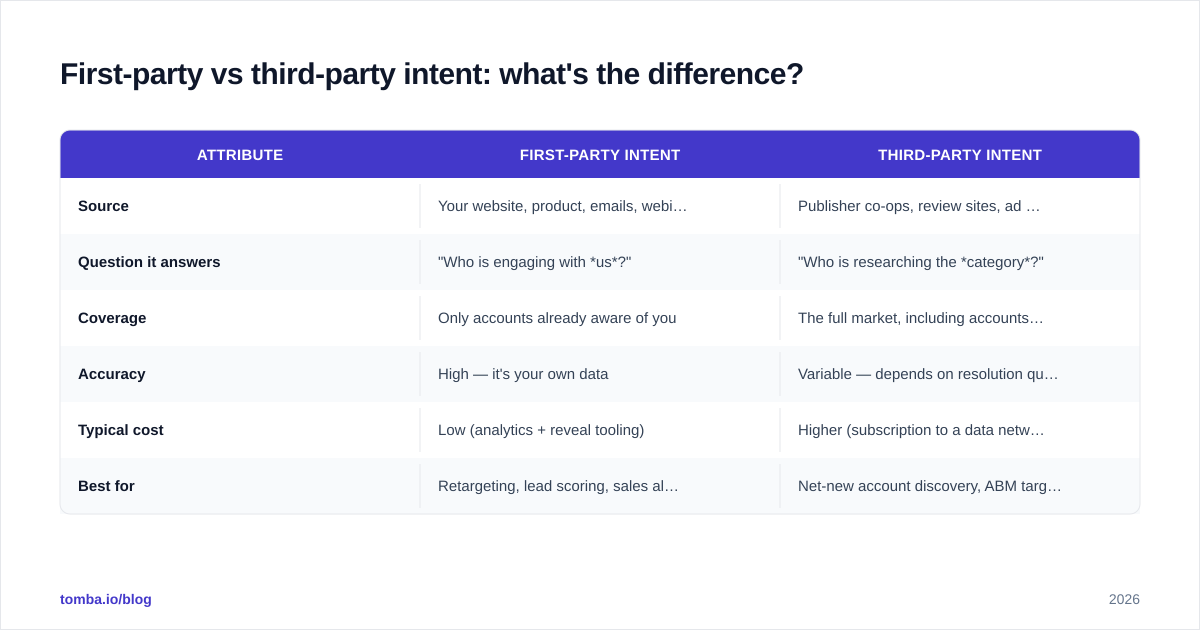
First-party intent is behavior on properties you control. Third-party intent is behavior everywhere else. You want both, but they answer different questions.
| Attribute | First-party intent | Third-party intent |
|---|---|---|
| Source | Your website, product, emails, webinars | Publisher co-ops, review sites, ad networks |
| Question it answers | "Who is engaging with us?" | "Who is researching the category?" |
| Coverage | Only accounts already aware of you | The full market, including accounts who never visited you |
| Accuracy | High — it's your own data | Variable — depends on resolution quality |
| Typical cost | Low (analytics + reveal tooling) | Higher (subscription to a data network) |
| Best for | Retargeting, lead scoring, sales alerts | Net-new account discovery, ABM target lists |
First-party signals are gold because they are unambiguous and free, but they only cover demand you have already captured. A tool like website visitor reveal turns anonymous traffic into named accounts so your first-party layer actually feeds the pipeline instead of evaporating.
Third-party intent extends your vision into accounts that have never heard of you. The tradeoff is noise: you are buying a probabilistic read on the open web, so resolution accuracy and topic relevance matter enormously.

Why does in-market intent data matter for outbound in 2026?#
Because timing now beats volume. Conversion rates on cold outbound have been compressing for years as inboxes get more crowded and buyers self-educate before they ever talk to sales. According to Gartner, B2B buyers spend only a small fraction of their journey with sales reps — most of the research happens before a rep is ever contacted. Intent data is how you crash that party earlier.
Three concrete payoffs:
- Prioritization. If you have 5,000 ICP-fit accounts and 12 SDRs, you cannot work all of them. Intent tells you which 200 to call this week.
- Relevance. Knowing an account is surging on "email deliverability" lets you lead with that pain instead of a generic pitch. Personalization stops being guesswork.
- Speed. Surges decay. An account researching your category today may sign with someone in 30–60 days. Reaching out while the iron is hot is the entire point.
The risk is treating intent as a magic "buy now" button. It is not. It is a tilt of the odds. A surging account is more likely to convert than a random ICP-fit account — not guaranteed. Teams that win treat intent as one input into a score, not a verdict.
How do you score and prioritize accounts with intent?#
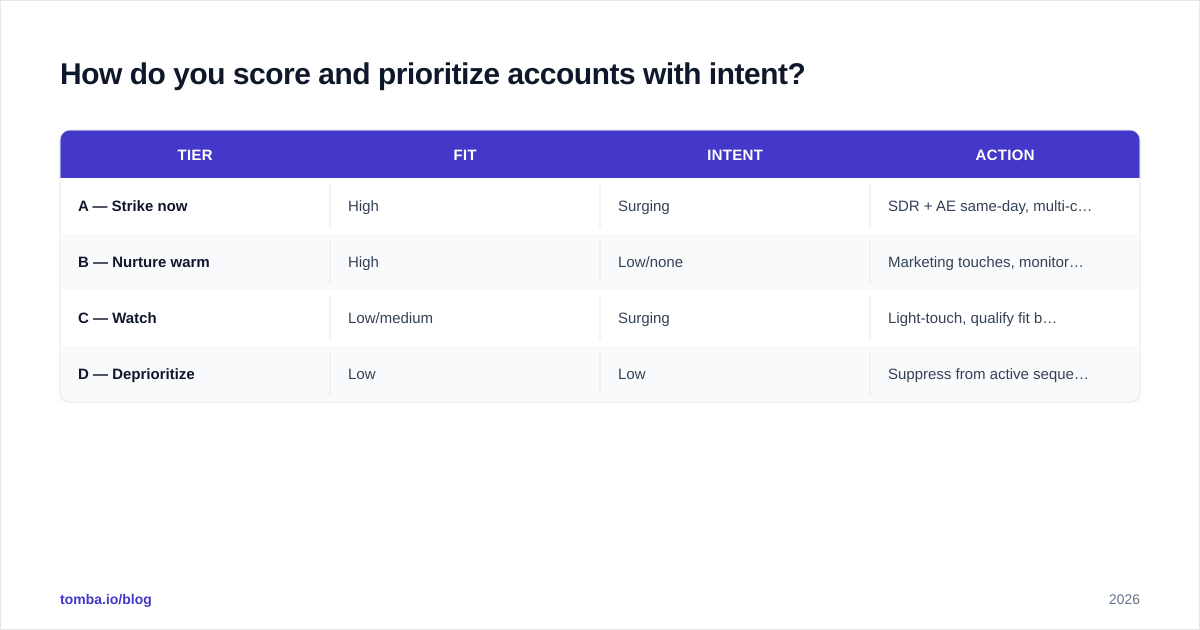
Combine fit and intent into a single priority. Fit answers "should we sell to them?" Intent answers "are they buying now?" Neither is sufficient alone.
A simple, durable model:
| Tier | Fit | Intent | Action |
|---|---|---|---|
| A — Strike now | High | Surging | SDR + AE same-day, multi-channel |
| B — Nurture warm | High | Low/none | Marketing touches, monitor for surge |
| C — Watch | Low/medium | Surging | Light-touch, qualify fit before investing |
| D — Deprioritize | Low | Low | Suppress from active sequences |
Tier A is your gold list. Tier C is the trap — a surging account that does not fit your ICP will burn rep hours and tank conversion rates, so qualify hard before committing.
Operationally, the workflow looks like this:
- Pull this week's surging accounts on your priority topics.
- Filter against your ICP firmographics (size, industry, geo, tech stack).
- For Tier A accounts, identify the buying committee — economic buyer, champion, technical evaluator.
- Enrich those people with verified contact data so sequences don't bounce.
- Trigger a coordinated, relevance-led outreach within 48 hours.
Step 4 is where most intent programs quietly fail. You have the account and the timing, but if half your emails bounce, the whole motion stalls. Run discovered contacts through an email verifier before they enter a sequence — protecting your sender reputation is non-negotiable when you are moving fast on hot accounts.
What are the limits and risks of intent data?#
Intent data is powerful and frequently oversold. Know the failure modes before you write the check.
Attribution error. Reverse-IP resolution is imperfect. Shared office buildings, VPNs, ISPs, and large enterprises with one egress IP all muddy the mapping. A surge attributed to "Account X" might be three unrelated companies behind the same gateway.
Topic noise. Broad topics ("software," "analytics") fire constantly and tell you nothing. Narrow, bottom-funnel topics ("Apollo alternative," "SOC 2 automation") are far more actionable. Audit your topic taxonomy regularly.
Latency and decay. Most third-party data refreshes weekly and reports activity that already happened. By the time you see a surge, you may be days behind a competitor's first-party alert. Speed of action is your only edge here.
No contact-level truth. Account-level intent does not tell you who to email. You still need to resolve the committee and find verified addresses. Intent without execution data is a dashboard you admire but never act on.
Privacy and compliance. Regulations like GDPR and CCPA govern how behavioral data is collected and used. Reputable providers document consent and sourcing — confirm yours does. Cross-reference vendor claims on a neutral source like G2 before committing budget.
The honest summary: intent data raises your hit rate, it does not replace judgment, data hygiene, or a real outreach motion.
How does intent data fit with the rest of your stack?#
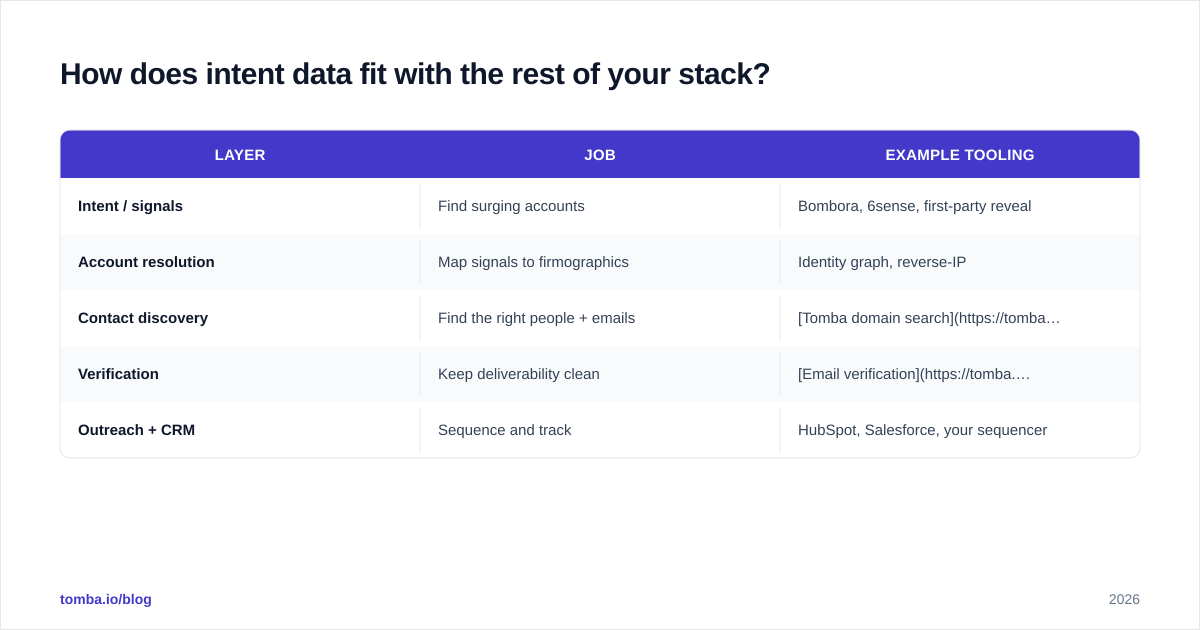
Intent is the trigger. Your data and outreach layers are what convert the trigger into a meeting. A working stack looks like this:
| Layer | Job | Example tooling |
|---|---|---|
| Intent / signals | Find surging accounts | Bombora, 6sense, first-party reveal |
| Account resolution | Map signals to firmographics | Identity graph, reverse-IP |
| Contact discovery | Find the right people + emails | Tomba domain search, email finder |
| Verification | Keep deliverability clean | Email verification |
| Outreach + CRM | Sequence and track | HubSpot, Salesforce, your sequencer |
The seam between "intent" and "contact discovery" is where revenue leaks. You have a hot account from your intent provider, but the provider gives you a company, not a person. You bridge that gap by running the domain through a finder to pull the buying committee's emails, then verifying them before they hit a sequence. Tomba's free tier (25 searches/mo) and Starter plan at $49/mo cover small teams testing this motion; the Growth and Pro tiers add the bulk lead generation and API throughput you need once intent volume scales.
For teams running ABM through a CRM, the HubSpot integration and Salesforce integration let you push enriched, verified contacts straight onto the surging accounts your intent platform flags — no CSV ping-pong.
How do you start with a small budget?#
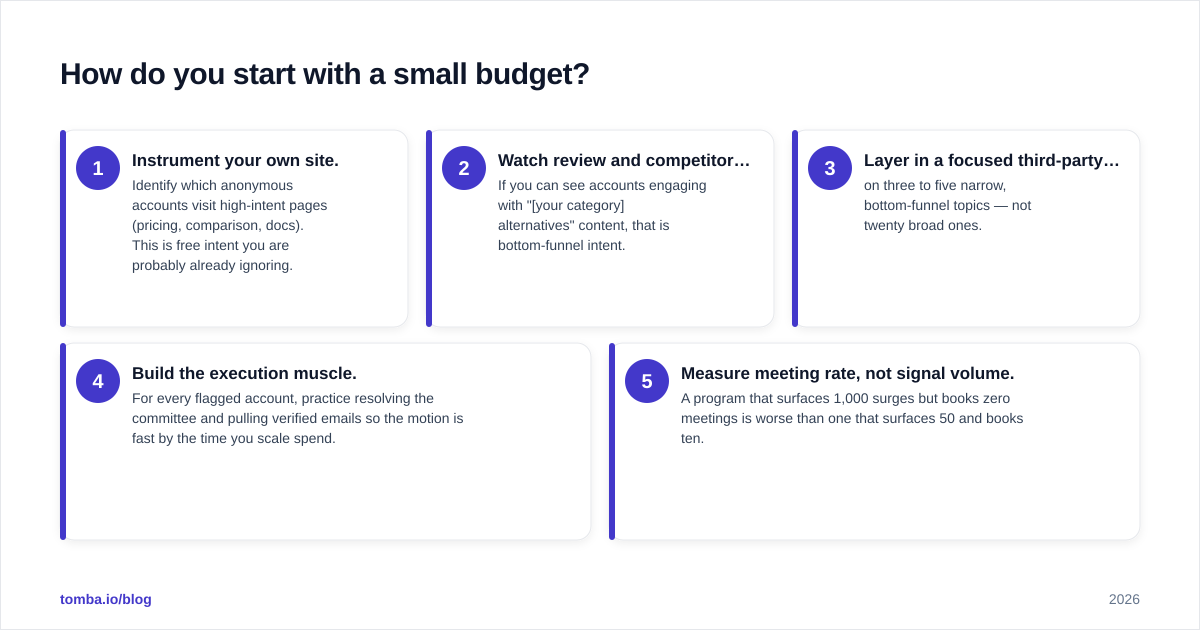
You do not need an enterprise intent contract on day one. Build the muscle with first-party signals first.
- Instrument your own site. Identify which anonymous accounts visit high-intent pages (pricing, comparison, docs). This is free intent you are probably already ignoring.
- Watch review and competitor pages. If you can see accounts engaging with "[your category] alternatives" content, that is bottom-funnel intent.
- Layer in a focused third-party feed on three to five narrow, bottom-funnel topics — not twenty broad ones.
- Build the execution muscle. For every flagged account, practice resolving the committee and pulling verified emails so the motion is fast by the time you scale spend.
- Measure meeting rate, not signal volume. A program that surfaces 1,000 surges but books zero meetings is worse than one that surfaces 50 and books ten.
The teams that get ROI from intent are the ones who close the loop fast: signal in, verified contacts out, relevant outreach within two days. Everything else is dashboard theater.
The bottom line#
Accounts in-market intent data is the difference between spraying your whole TAM and striking the 3% that are actually shopping. It is a prioritization and timing layer — genuinely valuable, frequently oversold, and useless without clean execution data underneath it. Score fit and intent together, act on surges within 48 hours, and protect your deliverability obsessively.
Intent tells you which company is ready. To turn that into a booked meeting, you still need which person and which verified email — fast, at scale, without torching your sender reputation. That is exactly what the Tomba Email Finder is built for: hand it a surging account's domain, get the buying committee's verified emails, and reach out while the signal is still hot. Start free with 25 searches and wire it into your intent workflow today.
// get started
Find, verify and enrich your first contacts today
Start on the free plan with 25 searches a month, then scale when your team is ready.
Free plan · No credit card required · GDPR & CCPA
// about the author