Accutrend vs DiscoverOrg: B2B Data Tools Compared 2026
Accutrend vs DiscoverOrg: a neutral 2026 breakdown of coverage, data freshness, pricing, and fit — plus where a leaner enrichment stack wins.
Choosing between Accutrend and DiscoverOrg comes down to one question most comparison pages dodge: do you need a bulk marketing-data file, or a living, sales-grade contact database your reps can act on this quarter? These two names get lumped together as "B2B data providers," but they solve different problems, price differently, and age differently once the data hits your CRM.
This guide breaks down both on coverage, accuracy, pricing model, and real-world fit — then shows where a lighter, pay-for-what-you-use enrichment stack beats either one for most teams in 2026.
TL;DR#
- Accutrend is a bulk business-data and marketing-list provider — strong for large compiled files, direct mail, and broad firmographic targeting, weaker on real-time contact-level freshness.
- DiscoverOrg is a sales-intelligence database (now part of ZoomInfo) — deep org charts, intent signals, and verified contacts, but enterprise pricing and annual contracts.
- Data decay is the real cost. B2B contact data degrades roughly 25–30% per year, so a cheaper file that's six months stale can cost more in wasted sends than a pricier verified source.
- Most teams overbuy. If you need targeted emails and phones on demand — not a 200,000-row file — a credit-based email finder plus data enrichment covers 80% of the use cases at a fraction of the price.
- Verdict: Accutrend for broad list compilation, DiscoverOrg for enterprise sales intelligence, Tomba for precise, verified, on-demand contact data.
What is Accutrend?#
Accutrend Data is a US-based business-data compiler. Its core product is large, structured files of company and contact records assembled from public filings, directories, surveys, and third-party sources. Think of it like a phone book printed at industrial scale: comprehensive breadth, organized by firmographics (industry, employee count, revenue, location), and sold as a list you load into your own systems.
That model is genuinely useful for a specific job. If you're running direct mail, building a total-addressable-market count, or seeding a CRM with broad firmographic coverage, a compiled file gives you volume fast. You buy a slice of the database, you own the rows, and you work them on your own schedule.
The trade-off is freshness and contact-level precision. Compiled data is a snapshot. The moment a list is delivered, it starts aging — people change jobs, companies merge, domains get retired. For email outreach specifically, that decay is brutal: a bounced send doesn't just fail, it chips away at your sender reputation and drags down every other campaign on that domain.
What is DiscoverOrg?#
DiscoverOrg was a sales-intelligence platform built around verified, human-researched contact and org-chart data. In 2019 it merged with ZoomInfo, and its capabilities now live inside the broader ZoomInfo platform. Where Accutrend sells you a file, DiscoverOrg's lineage is about a continuously maintained, sales-grade database: direct dials, reporting structures, technographics, and intent signals that tell you which accounts are in-market.
The strength is depth and verification. Reps get accurate org charts, scoops on initiatives and budget, and contacts that have been checked rather than merely compiled. For enterprise sales motions where one closed deal is worth six figures, that accuracy pays for itself.
The cost is, well, the cost — and the commitment. This is enterprise software: annual contracts, seat-based or credit-based pricing negotiated per deal, and onboarding. It's overkill if you're a two-person SDR team that just needs verified emails for 500 prospects a month.
Accutrend vs DiscoverOrg: how do they compare?#
Here's the head-to-head on the attributes that actually drive ROI. Pricing for both is quote-based and varies heavily by volume and contract, so the ranges below reflect typical market positioning rather than published rate cards.
| Attribute | Accutrend | DiscoverOrg (ZoomInfo) |
|---|---|---|
| Core model | Bulk compiled data files / lists | Live sales-intelligence database |
| Best for | Direct mail, TAM sizing, broad firmographics | Enterprise sales intel, org charts, intent |
| Contact verification | Compiled, light verification | Human-researched + verified |
| Data freshness | Snapshot at delivery | Continuously maintained |
| Intent / technographics | Limited | Yes (a core strength) |
| Pricing model | Per-list / per-record purchase | Annual contract, quote-based |
| Entry cost | Lower upfront for a file | High (enterprise commitment) |
| Self-serve / free tier | No | No |
| Time to first value | Fast (buy and load) | Slower (onboarding) |
| Ongoing data decay risk | High (static file) | Lower (refreshed) |
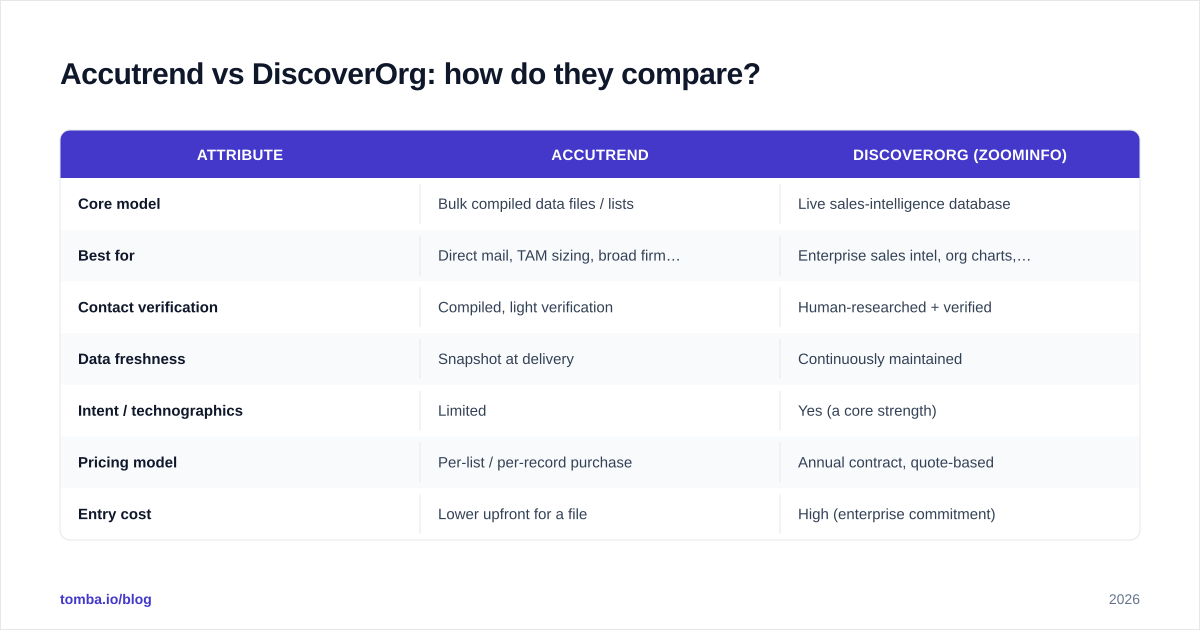
The pattern is clear: Accutrend optimizes for breadth and upfront cost, DiscoverOrg for depth and accuracy. Neither optimizes for the most common modern need — grabbing a handful of verified, deliverable contacts on demand without a contract or a 100,000-row commitment.
Why does data freshness matter more than database size?#
Conclusion first: a smaller, fresher dataset almost always outperforms a larger, staler one for outbound — because every bad record carries a hidden penalty, not just a zero.
Industry research consistently puts B2B data decay around 25–30% per year, and contact-level fields (job title, email, direct dial) decay fastest because people change roles constantly. So a one-million-record file isn't a million usable contacts. After six months it's effectively 850,000, and the dead 150,000 are landmines.
Here's the analogy: buying a giant compiled list is like buying milk in bulk because the per-gallon price is lower. It looks economical until most of it spoils before you can use it. Verified, on-demand data is buying what you'll drink this week — more per unit, less waste, and you never pour spoiled product into your morning coffee (your domain reputation).
This is why email verification and ongoing enrichment matter more than raw row count. The metric that should drive your decision isn't "how many records," it's "how many records are deliverable today." For more on how source quality affects accuracy, see Tomba's breakdown of its data sources.

Is there a better-fit alternative to both?#
For most teams in 2026, yes — and it's not a third giant database. It's a credit-based stack that finds and verifies contacts the moment you need them.
The case is simple. Accutrend and DiscoverOrg both ask you to pay for scale you may not use: a big file, or an enterprise seat. A modern email-finder approach inverts that. You search a domain, get verified emails and phones for the exact people you're targeting, and spend a credit per result instead of a five-figure contract.
Tomba covers that workflow end to end:
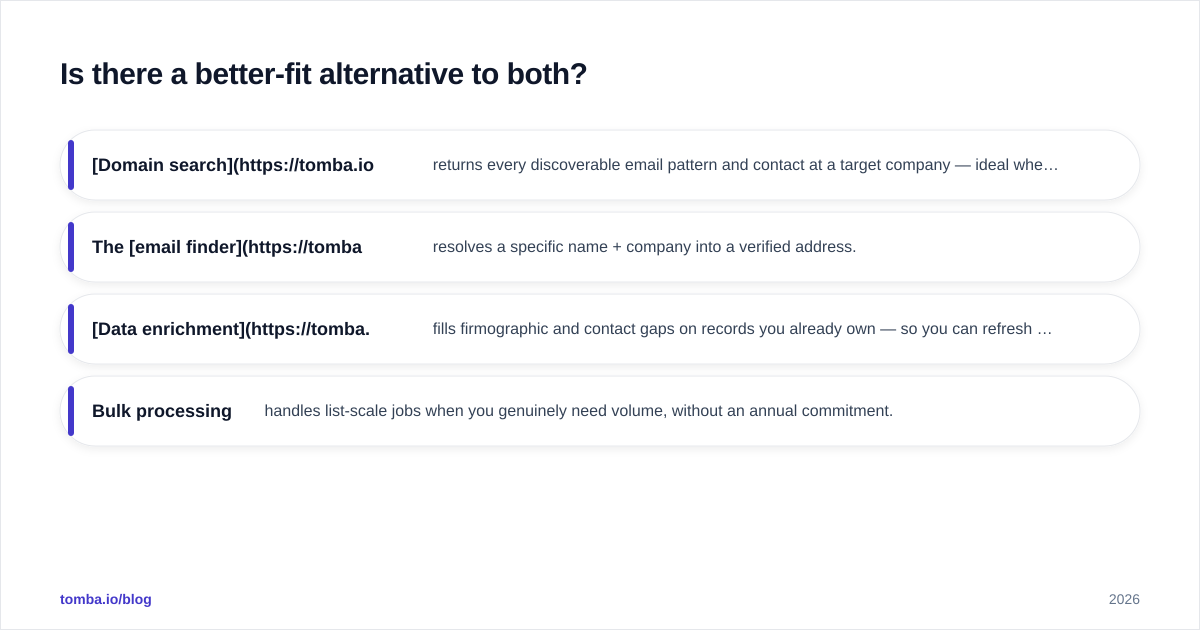
- Domain search returns every discoverable email pattern and contact at a target company — ideal when you've sized your accounts and need the people inside them.
- The email finder resolves a specific name + company into a verified address.
- Data enrichment fills firmographic and contact gaps on records you already own — so you can refresh a stale Accutrend file instead of rebuying it.
- Bulk processing handles list-scale jobs when you genuinely need volume, without an annual commitment.
It won't replace DiscoverOrg's deep intent and org-chart intelligence for a 50-rep enterprise sales floor — that's a real capability gap, and if intent data drives your motion,
ZoomInfo's platform earns its price. But for SMB and mid-market teams that mostly need accurate, deliverable contacts, the credit model is dramatically cheaper and there's nothing to spoil on a shelf.
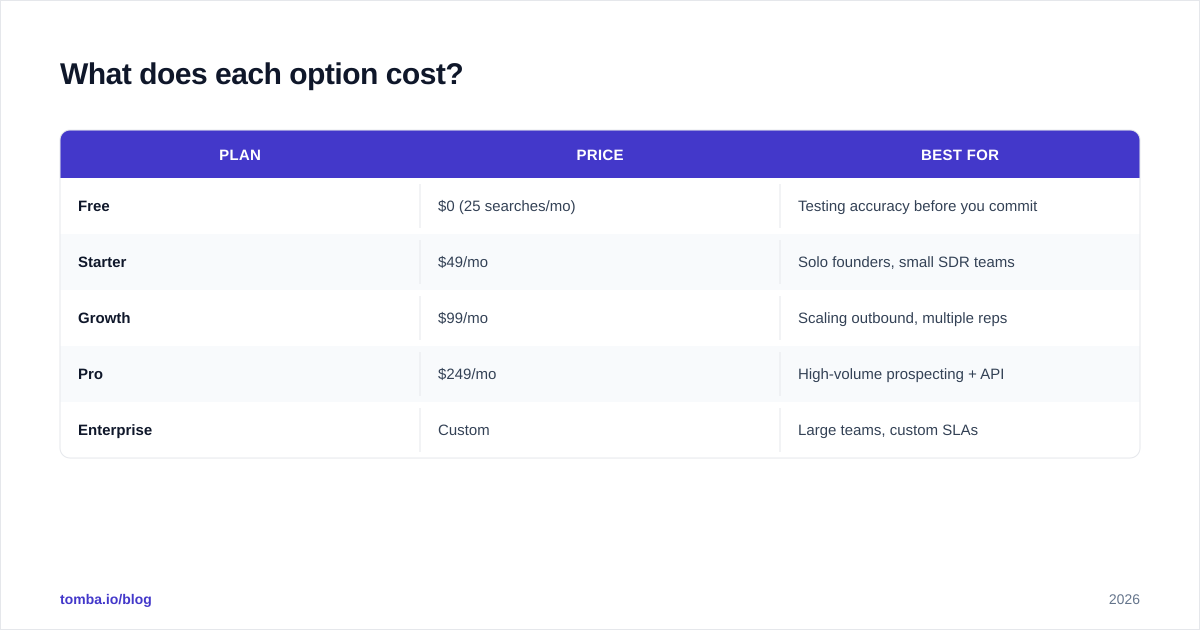
What does each option cost?#
Accutrend and DiscoverOrg both quote per deal, so you negotiate rather than pick a tier. That's friction if you want to start today. Transparent, self-serve pricing is where a tool like Tomba is structurally different — you can see the Tomba pricing before you talk to anyone.
| Plan | Price | Best for |
|---|---|---|
| Free | $0 (25 searches/mo) | Testing accuracy before you commit |
| Starter | $49/mo | Solo founders, small SDR teams |
| Growth | $99/mo | Scaling outbound, multiple reps |
| Pro | $249/mo | High-volume prospecting + API |
| Enterprise | Custom | Large teams, custom SLAs |
The difference in commitment is the headline. With Accutrend you buy a file; with DiscoverOrg you sign a year. With a credit model you can validate accuracy on the free tier, then scale spend to actual usage. For teams that hate over-buying, that alone settles the question.
Which should you choose?#
Match the tool to the job, not the brand:
- Choose Accutrend if your primary need is bulk compiled data for direct mail, broad firmographic targeting, or TAM analysis — and you have a process to verify and refresh records before outreach. Validate any list against an email verifier before you send a single campaign.
- **Choose DiscoverOrg (
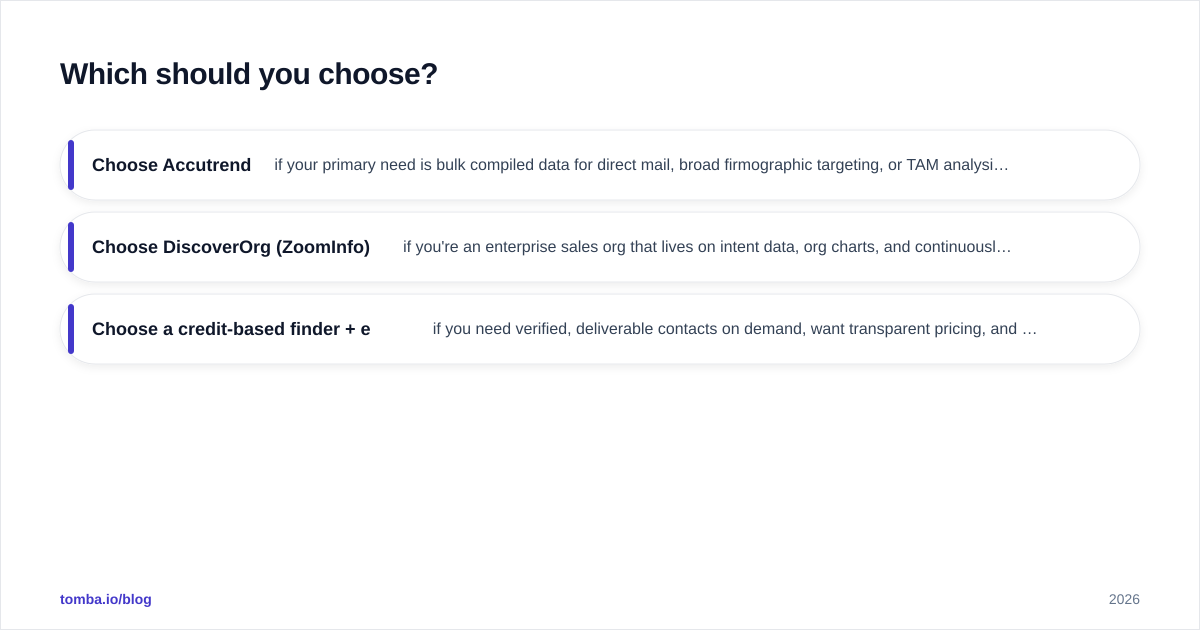
ZoomInfo)** if you're an enterprise sales org that lives on intent data, org charts, and continuously verified intelligence, and the budget supports an annual platform contract. Check current user sentiment on G2 and analyst coverage from Gartner before committing.
- Choose a credit-based finder + enrichment stack if you need verified, deliverable contacts on demand, want transparent pricing, and would rather spend per result than per file or per seat. This fits the majority of SMB and mid-market outbound teams.
The honest framing: there's no universal winner. There's the file buyer, the enterprise intelligence buyer, and the on-demand precision buyer. Pick the one that describes your next 90 days of pipeline, not your aspirational org chart.
How do you de-risk the decision?#
Run a 50-record bake-off before you spend real money. Take the same target accounts and pull contacts from each option you're considering. Then verify all of them with the same tool and compare deliverable-rate, not record count. The source with the highest percentage of valid, reachable contacts wins — even if it returned fewer rows.
This is where the free tier earns its keep. You can test contact accuracy on 25 searches at zero cost, measure the bounce rate, and only then decide whether you need an enterprise database at all. Most teams discover the gap between "rows delivered" and "people I can actually email" is wider than any vendor admits.
If you want help defining the firmographics for that test, Tomba's B2B glossary covers the terms — MQL, intent, technographics — that vendors use to justify their pricing.
The bottom line#
Accutrend and DiscoverOrg aren't really competitors — they're answers to different questions. Accutrend sells breadth in a file; DiscoverOrg sells depth in a platform. Both make you commit up front to scale you might not use, and both leave the freshness problem partly on your side of the table.
If your real need is accurate, verified, deliverable contacts — found when you need them, priced by what you use — start with the Tomba Email Finder. Run the free tier against your top accounts, verify the results, and let the deliverable-rate make the decision for you. Find the people who matter, skip the spoiled rows, and put your domain reputation first.
// get started
Find, verify and enrich your first contacts today
Start on the free plan with 25 searches a month, then scale when your team is ready.
Free plan · No credit card required · GDPR & CCPA
// about the author