Accutrend vs GrowMeOrganic: Best B2B Lead Tool in 2026?
Accutrend sells static business data lists; GrowMeOrganic runs live prospecting and outreach. Here's which one fits your 2026 pipeline — and where both leave gaps.
Choosing between Accutrend and GrowMeOrganic comes down to a single question: do you want a data list vendor or a prospecting-plus-outreach platform? They sit on opposite ends of the lead generation spectrum, and picking the wrong one wastes both budget and quarters.
TL;DR — Accutrend vs GrowMeOrganic at a glance#
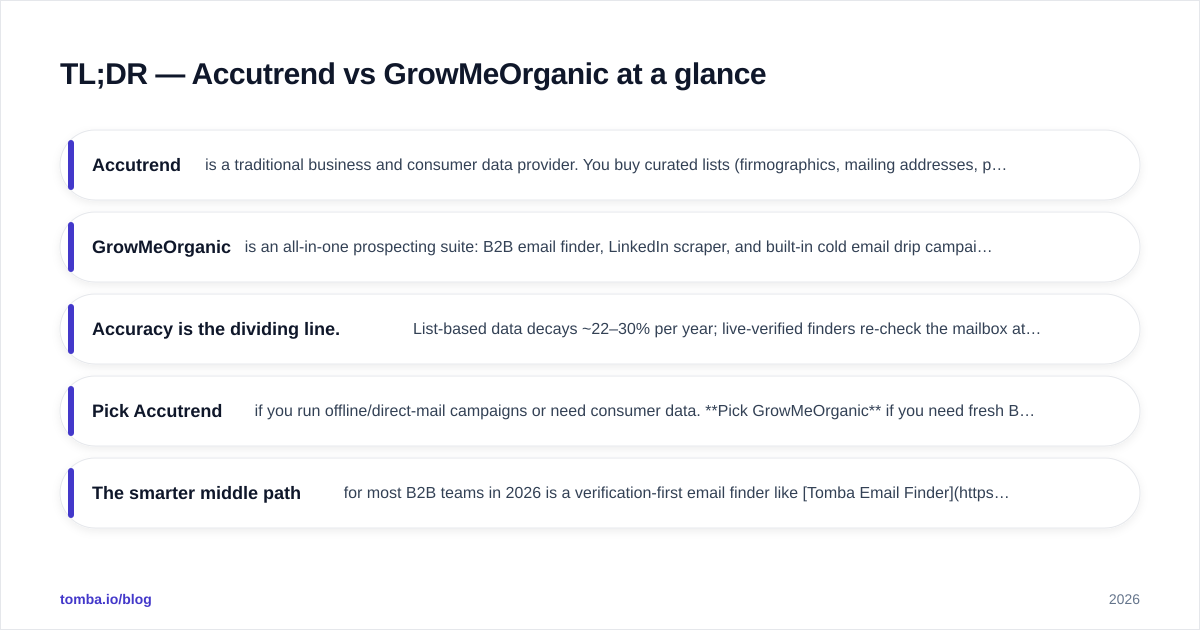
- Accutrend is a traditional business and consumer data provider. You buy curated lists (firmographics, mailing addresses, phone, some email) and load them into your CRM. Strong for direct mail and offline channels; weak for modern, real-time outbound.
- GrowMeOrganic is an all-in-one prospecting suite: B2B email finder, LinkedIn scraper, and built-in cold email drip campaigns on flat unlimited-style pricing.
- Accuracy is the dividing line. List-based data decays ~22–30% per year; live-verified finders re-check the mailbox at the moment of export.
- Pick Accutrend if you run offline/direct-mail campaigns or need consumer data. Pick GrowMeOrganic if you need fresh B2B emails plus automated sending in one tab.
- The smarter middle path for most B2B teams in 2026 is a verification-first email finder like Tomba Email Finder, which you can pair with whichever sending tool you already trust.
What is Accutrend?#
Accutrend is a data compiler. Think of it like a phone book publisher: it aggregates business and consumer records — company name, address, SIC/NAICS code, employee count, revenue band, contact names, and phone numbers — then sells you slices of that database as downloadable lists or marketing files.
The model is decades old and still useful for specific jobs. If you're mailing 10,000 postcards to dentists in three ZIP codes, a compiled list is exactly the right tool. Accutrend-style providers shine for direct mail, telemarketing, and territory planning, where you need broad coverage and physical addresses more than you need a verified, deliverable inbox.
The catch is freshness. A compiled list is a snapshot. The moment it's generated, it starts decaying — people change jobs, companies fold, area codes get reassigned. Industry research consistently puts B2B data decay at 20–30% annually, which means a list you bought in January is meaningfully wrong by summer.
What is GrowMeOrganic?#
GrowMeOrganic is a self-serve prospecting platform aimed at agencies, founders, and SMB sales teams. According to its official site, the product bundles three things most teams used to buy separately:
- An email finder / B2B database to pull contacts by company, role, or industry.
- A LinkedIn and Sales Navigator scraper to extract prospects from search results.
- A cold email sender with drip sequences, so you can prospect and send without leaving the app.
Its headline pitch is pricing: instead of per-credit metering, GrowMeOrganic leans on flat annual plans with generous extraction limits. For a small team that wants "find leads and email them" in one subscription, that's appealing.
The trade-off is depth. Bundled finders typically prioritize coverage and convenience over per-email verification rigor, and an all-in-one sender is rarely as deliverability-tuned as a dedicated outreach tool. You're buying breadth, not best-in-class on any single axis.
Accutrend vs GrowMeOrganic: the core comparison#
The two products barely overlap in philosophy, so compare them on the jobs they actually do.
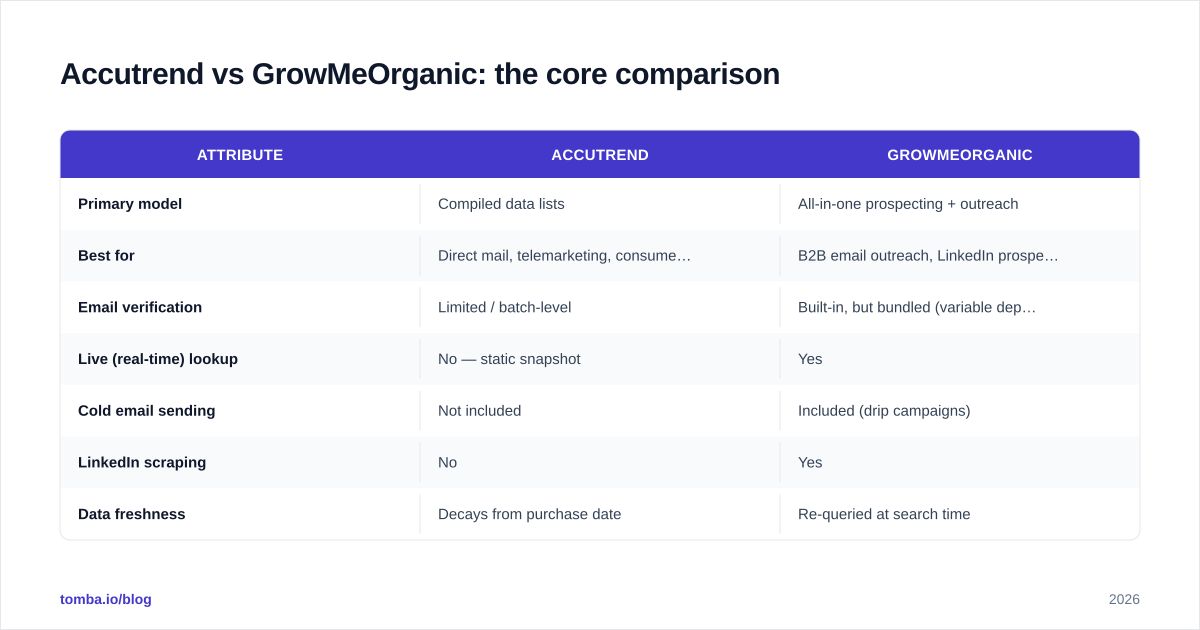
| Attribute | Accutrend | GrowMeOrganic |
|---|---|---|
| Primary model | Compiled data lists | All-in-one prospecting + outreach |
| Best for | Direct mail, telemarketing, consumer data | B2B email outreach, LinkedIn prospecting |
| Email verification | Limited / batch-level | Built-in, but bundled (variable depth) |
| Live (real-time) lookup | No — static snapshot | Yes |
| Cold email sending | Not included | Included (drip campaigns) |
| LinkedIn scraping | No | Yes |
| Data freshness | Decays from purchase date | Re-queried at search time |
| Pricing style | Per-list / per-record quote | Flat subscription tiers |
| API access | Limited | Yes |
| Ideal user | Offline marketers, list buyers | SMBs, agencies, founders |
The pattern is clear. Accutrend is an offline-era data vendor; GrowMeOrganic is an online-era outreach machine. If your motion is digital cold email and LinkedIn, Accutrend isn't really a competitor — it's a different category. If your motion is direct mail or you need consumer (B2C) records, GrowMeOrganic can't help you.
How should you choose? A 3-question framework#
Before you compare feature lists, answer three questions about your own motion. The diagram below maps each answer to the right tool class.
1. What channel will you actually use? If it's physical mail or phone, lean Accutrend. If it's email and LinkedIn, lean GrowMeOrganic — or a dedicated finder.
2. B2B or B2C? Accutrend carries consumer records; most modern finders, including GrowMeOrganic, are B2B-only. If you need both, you'll likely run two tools.
3. Do you need sending built in? GrowMeOrganic includes a sender. Accutrend does not. But "built-in" isn't automatically better — many teams get higher reply rates by pairing a precise finder with a deliverability-focused sender like Instantly or Smartlead, which is exactly why a standalone finder stays relevant.
If your honest answers are "email, B2B, and I already have a sender," then neither tool is the obvious winner — a verification-first finder is. More on that below.
Is GrowMeOrganic accurate enough for cold email?#
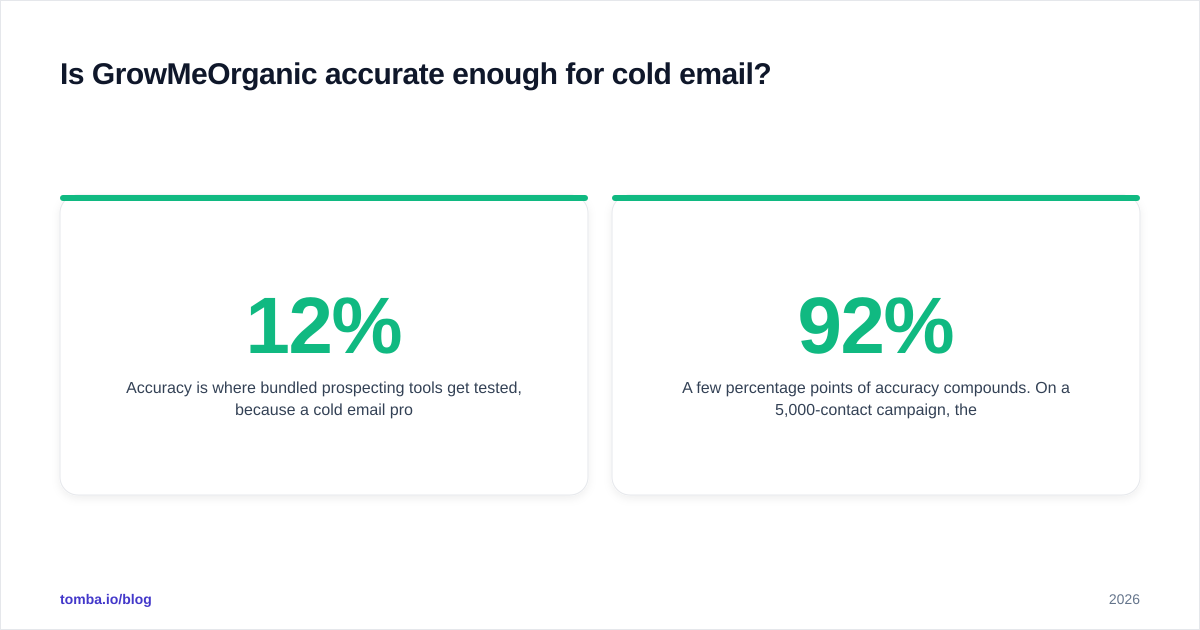
Accuracy is where bundled prospecting tools get tested, because a cold email program lives or dies on bounce rate. Send to a 12% invalid list and mailbox providers throttle your domain fast.
GrowMeOrganic verifies emails as part of its workflow, which puts it ahead of a raw compiled list. But "verification inside an all-in-one" tends to be lighter than what a specialist runs. The gold standard is a finder that performs SMTP-level checks, catch-all detection, and confidence scoring at export time — not a batch scrub done weekly.
This is the single biggest reason B2B teams split the stack: they use a dedicated email verifier to gate the list, then push clean contacts into whatever sender they like. The chart below shows how much accuracy varies across email-finding tools — the spread is wide enough to change your whole bounce profile.

A few percentage points of accuracy compounds. On a 5,000-contact campaign, the difference between 92% and 98% deliverable is 300 wasted sends — and a measurable hit to sender reputation that follows you into the next campaign.
Pricing: lists vs subscriptions vs credits#
The two vendors price on different logic, which makes apples-to-apples hard.
- Accutrend quotes by list — you pay per record or per file, often with minimums, and re-buy when the data goes stale. Costs are lumpy and recur with every refresh.
- GrowMeOrganic sells flat subscriptions with high extraction caps, so heavy users get predictable monthly cost. Light users may overpay for capacity they don't touch.
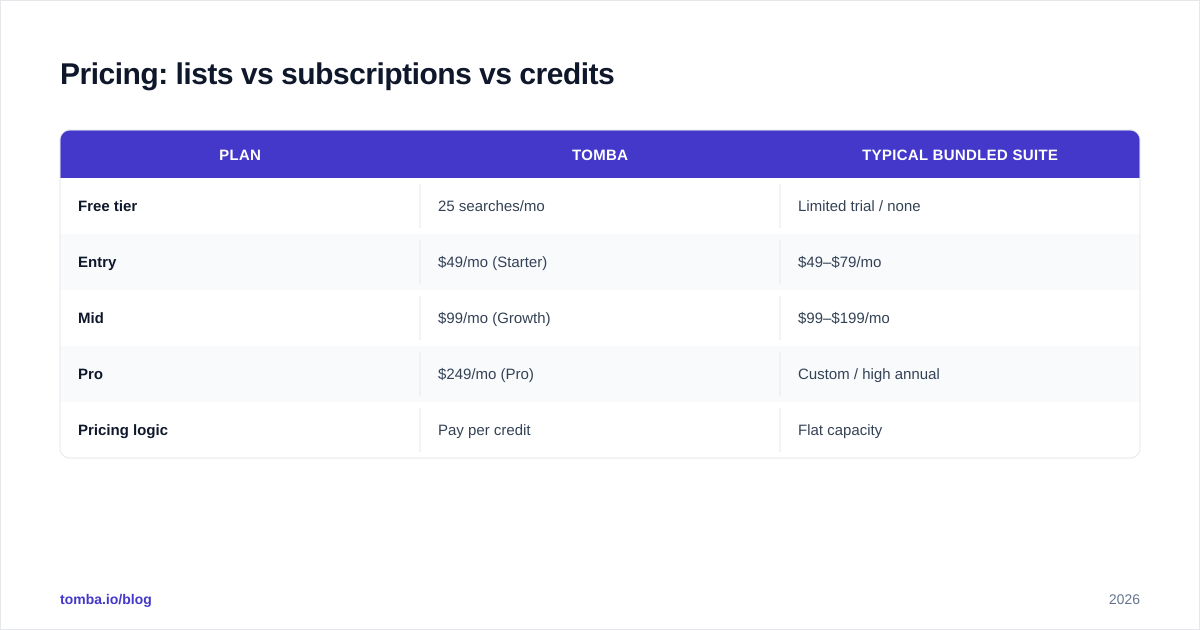
Neither model is wrong; they fit different volumes. But there's a third option worth weighing: credit-based finders that charge only for the lookups you run, with a free tier to test accuracy before you commit.
| Plan | Tomba | Typical bundled suite |
|---|---|---|
| Free tier | 25 searches/mo | Limited trial / none |
| Entry | $49/mo (Starter) | $49–$79/mo |
| Mid | $99/mo (Growth) | $99–$199/mo |
| Pro | $249/mo (Pro) | Custom / high annual |
| Pricing logic | Pay per credit | Flat capacity |
You can see full Tomba pricing for the per-tier credit counts. The point isn't that one number is lowest — it's that a credit model lets you validate accuracy on a free tier before scaling, which neither a list quote nor a flat annual contract makes easy.
Which one wins for B2B outreach in 2026?#
For modern digital outbound, GrowMeOrganic beats Accutrend — it's built for the channel, includes sending, and prices predictably. Accutrend wins only when your motion is offline (direct mail, telemarketing) or you need consumer data, which is a genuinely different use case.
But "GrowMeOrganic over Accutrend" isn't the same as "GrowMeOrganic is the best choice." The all-in-one convenience comes with two compromises that matter at scale:
- Verification depth. A specialist finder catches more invalids before they hit your sequence.
- Deliverability control. A bundled sender rarely matches a dedicated outreach tool tuned for inbox placement and warmup.
That's why many teams in 2026 run a best-of-breed stack: a precise email finder for data, a deliverability-first sender for outreach, and a B2B database or enrichment layer to fill gaps. You assemble the parts you need instead of accepting one vendor's weakest module.
Here's how the broader finder market stacks up when you compare on data quality and coverage rather than bundle convenience:

If you want third-party validation before deciding, cross-check both vendors on G2 and Capterra — pay attention to reviews mentioning bounce rates and data freshness specifically, since those are the metrics that predict campaign performance.
When Accutrend is still the right call#
Don't write off compiled data entirely. Accutrend-style lists remain the correct tool when:
- You run direct mail and need accurate physical addresses at scale.
- You're targeting consumers (B2C), where most B2B finders have no coverage.
- You need broad firmographic territory data for planning, not for sending.
- Your compliance posture favors purchased, documented data sources over scraped contacts.
In those scenarios, GrowMeOrganic isn't a substitute — it simply doesn't play in that lane. Match the tool to the channel, not to the hype.
The verification-first alternative#
If your real job is "get accurate B2B emails and reach the inbox," the cleanest 2026 stack starts with a finder built around verification rather than around a bundle.
That's where Tomba fits. Use the Tomba Email Finder to pull contacts by name, company, or domain search, with every result SMTP-checked and confidence-scored at export — so your list is clean before it ever touches a sequence. Need scale? Run a bulk email finder job. Working inside your CRM or spreadsheets? Connect via the Tomba API, Chrome extension, or native integrations. And because it starts free with 25 searches a month, you can benchmark accuracy against Accutrend's lists or GrowMeOrganic's bundled data before spending a dollar — then keep whichever sender you already trust.
Accutrend and GrowMeOrganic each solve a real problem. But if accuracy and inbox placement are what actually move your pipeline, lead with a verification-first finder and build the rest of the stack around it. Try Tomba's Email Finder free and see the bounce-rate difference on your own list.
Ready to find emails that actually work?
Join 150,000+ professionals who stopped guessing and started sending. Free credits on signup — no credit card required.
Get the Tomba newsletter
Practical outbound tactics and product updates — once every two weeks.
About the author